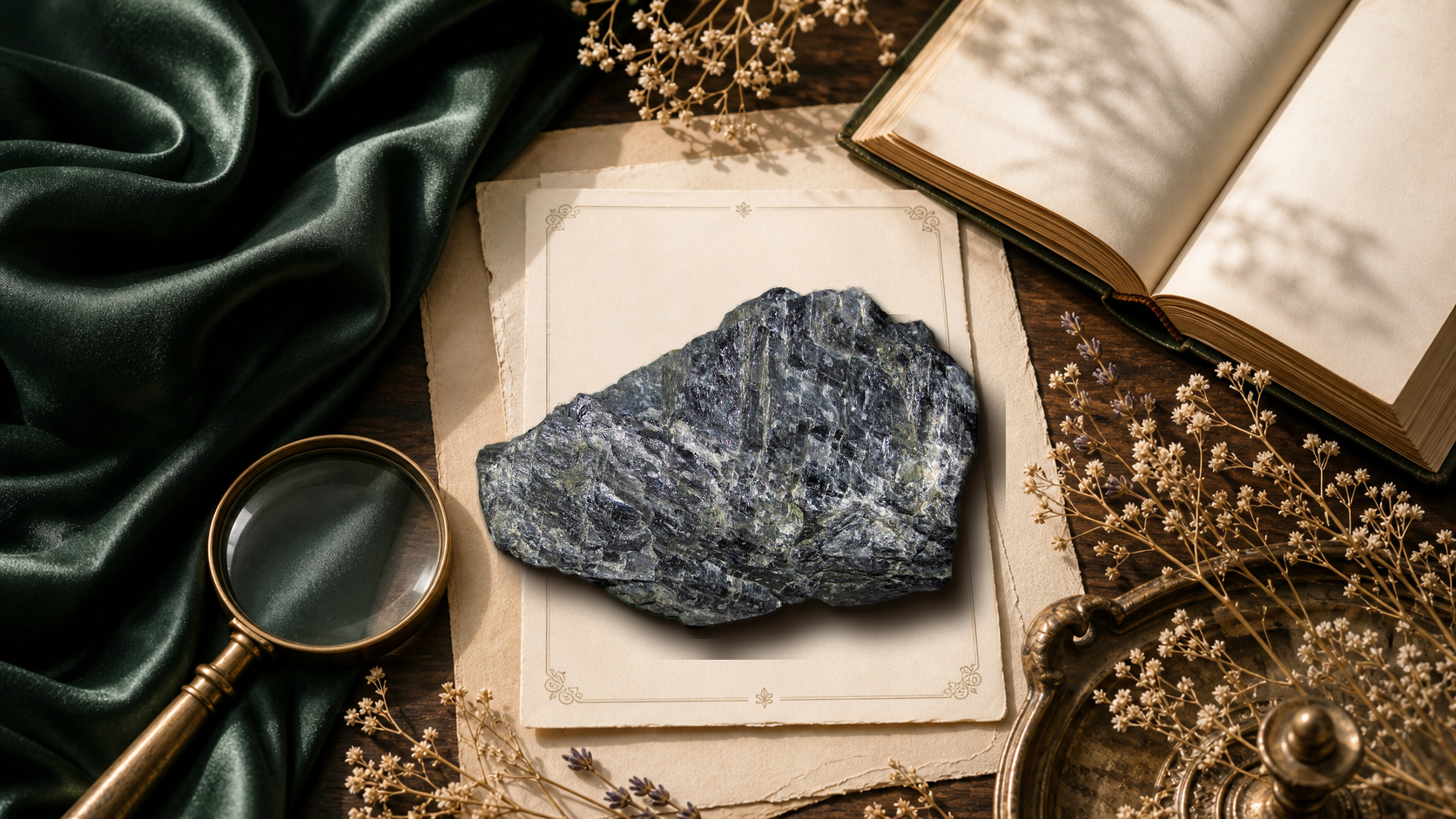
You are standing in the middle ground while everyone else demands a side. This feldspar lives between sodium and calcium, showing its quiet flash only when the angle is right. The in-between can hold its own intelligence.
Andesine labradorite addresses the lower belly and heart, the places where agency and feeling have to meet if change is going to become embodied. It is tuned to...
The Meaning
Andesine Labradorite in the Crystalis dictionary
Many important choices arrive mixed. Stay and leave at once. Love and doubt at once. Relief and grief in the same chest. Public life has very little patience for that kind of truth. It wants clarity to look harder-edged than it actually is.
This feldspar was built for the middle.
Its chemistry sits between poles. Its shimmer tends to be conditional rather than theatrical.
Grey is sometimes where the real information is.
Stone Lore
Stories carried through time
Cultural notes are presented as tradition and historical context — stories carried through time.
Unknown
Tibetan trade and modern gemology (21st century)
The appearance of large quantities of vivid red "andesine" on the international gem market, attributed to mines in Tibet, created one of the most significant gemological controversies of the 21st century. Investigations by researchers including S. F. McClure of GIA, R. W. Hughes, and independent gemologists traced material to dealers in China and found evidence of both natural and treated material in circulation.
The controversy highlighted the challenges of gem-source verification in remote regions and the commercial pressures that can compromise geological truth. Tibet's complex political status further complicated independent mine visits and verification (documented in various issues of Gems & Gemology, 2008 to 2014).
Lore review
Tradition notes are being reviewed.
This entry keeps symbolic meaning separate from sourced cultural history. When dedicated tradition rows are available, they will appear here as individual lore cards.
Andesine labradorite occupies a boundary in the plagioclase feldspar series, and boundaries are where feldspar becomes most revealing. Compositionally it sits near the transition between andesine and labradorite, where sodium and calcium share the same framework sites in varying proportion. The crystal is not wavering between identities. It is recording a continuous solid solution in which subtle changes in melt chemistry, cooling rate, and exsolution history can alter both optical behavior and classification.
What appears to be an in between stone is actually a very specific answer to mixed chemistry.
Plagioclase of this composition usually forms in intermediate to mafic igneous rocks such as andesite, diorite, basaltic andesite, and related plutonic equivalents, though metamorphic recycling can preserve it as well. Temperatures are magmatic, and growth commonly begins while the melt still contains substantial calcium and sodium available for the feldspar framework. As cooling continues, compositional zoning may develop from core to rim, especially if the surrounding melt changes faster than diffusion can fully homogenize the crystal.
In some specimens, fine scale lamellae or twinning later produce quiet flashes or aventurescent effects when light interacts with internal structures or included copper platelets in gem varieties.
The crystal system is triclinic, which matters because plagioclase is a framework silicate with lower symmetry than its external habit might suggest. Aluminum and silicon order within the tetrahedral framework, while sodium and calcium occupy larger interstitial sites. What forms is a lattice with two good cleavages and the characteristic oblique relations that gave plagioclase its name. It is a tectosilicate built from continuity, but not from perfect repetition. Its order tolerates gradient, zoning, and twinning.
That internal tolerance is the geological heart of andesine labradorite. It forms where a magma has not resolved into a single simple pole, and its beauty often lies in effects that become visible only at certain angles because internal structure has kept the mixed history intact. Sodium and calcium do not cancel each other. They produce a feldspar that makes the middle ground legible.
The final somatic note comes from that compositional poise, a crystal showing that the interval between sides can carry its own intelligence, and that a framework can remain coherent even while two end members continue speaking through it at once.
Crystal system diagram represents the general triclinic classification. Diagram created by Crystalis for educational reference.
Triclinic structure
Chemical Formula
(Ca,Na)(Al,Si)4O8 -- plagioclase feldspar solid solution series; andesine composition is An30-An50, labradorite is An50-An70; "andesine-labradorite" refers to specimens near the boundary (approximately An45-An55)
Crystal System
Triclinic
Mohs Hardness
6
Specific Gravity
2.65--2.69
Luster
Vitreous; may display weak to moderate labradorescence in some specimens; faceted stones show good brilliance
Color
Red-Orange
IMA Status
variety
IMA Number
Not IMA approved
01
Mineral conditions gather
02
Structure begins to crystallize
03
Andesine Labradorite records place and pressure
Tibet produces the most commercially available andesine-labradorite, though provenance has been debated in the gem trade. Democratic Republic of Congo yields specimens with strong red to orange coloration. Indian material from Andhra Pradesh shows distinctive aventurescent varieties.
The compositional boundary (An45-An55) that defines this material occurs in intermediate igneous rocks at each locality.
TibetDemocratic Republic of CongoIndia
Telling it apart
Andesine labradorite is one of the most abused labels in the trade, because treated red feldspar has been sold under this name for years. The confirming step is composition, not color: a proper gem lab needs to confirm where the plagioclase falls in the andesine to labradorite range, because red orange color alone proves nothing. In hand specimen, use supporting checks only, hardness 6 to 6.
5, specific gravity roughly 2. 65 to 2. 69, feldspar cleavage near 90 degrees, and occasional weak labradorescence. Genuine material is a plagioclase feldspar with a body color and internal structure consistent throughout the stone. Treated stones often show suspiciously concentrated red color along fractures or rims, with a color profile that looks baked in rather than geologically distributed.
Sellers also confuse it with sunstone, but sunstone shows aventurescent glitter from inclusions, not just orange body color. If the stone is expensive and sold as untreated, ask for a lab report. The fraud risk is real because the andesine controversy involved major treatment and disclosure failures, and buyers paid natural gem prices for altered material.
Spotting the real thing
Andesine-labradorite has been a controversial gem. Much commercial material has been treated (diffused with copper for red-orange color). Natural material shows: Mohs 6-6.
5, two cleavage planes, specific gravity 2. 65-2. 69.
If the red-orange color is exceptionally vivid and uniform, request documentation of treatment status. Unheated natural material is significantly rarer and more expensive.
The vivid red of gem andesine-labradorite operates in the longest-wavelength visible color; the color the human nervous system associates with blood, fire, and urgency. Unlike the "alarm red" of danger, andesine-labradorite's red is warm and saturated, more sunset than siren. For a sympathetic system activated by creative passion rather than threat, this stone validates the activation: not all sympathetic arousal is dangerous. Some of it is desire. Some of it is life force. State support: productive sympathetic engagement without pathologizing arousal.
Shut down & far away
The Boundary Composition
Andesine-labradorite sits at the compositional boundary between two named minerals; not quite andesine, not quite labradorite. It is both, and it is neither. For someone in dorsal collapse who has lost clear identity boundaries; merged into someone else's narrative, absorbed into a role, unable to find where they end and another begins; this stone models that boundary zones are real places, not failures of definition.
You can be between names and still be real. State shift: dorsal identity dissolution toward recognition that liminal identity has its own validity.
Charged & on alert
The Controversy Hold
The treatment controversy surrounding andesine-labradorite is unresolved; major experts disagree. This stone literally embodies unresolved conflict. For someone navigating interpersonal controversy, professional disagreement, or any situation where well-informed people hold opposing views, andesine-labradorite models the capacity to exist within the unresolved. Not everything can be settled. Some questions stay open. The stone remains beautiful regardless. State support: ventral vagal maintenance during sustained ambiguity.
Settled & connected
The Warm Feldspar
The warm red-orange tones of andesine-labradorite provide a visual warmth that the nervous system registers pre-cognitively. For someone who is regulated but lonely; safe but not connected; this stone's color frequency resonates with the warmth of human skin, firelight, and shared meals. It does not replace connection but it fills the visual channel with warmth while connection is being sought. State support: ventral vagal nourishment during periods of solitude.
Settled & connected
The Origin Question
The question "is this stone natural or treated?" often triggers an intellectual response; a desire to know, categorize, and resolve. Andesine-labradorite challenges this: what if you cannot know for certain? What if you must hold the stone, feel it, and let your body register its quality independent of its provenance documentation? This stone pushes practitioners from intellectual relationship (knowing about the stone) toward embodied relationship (knowing the stone). State shift: cerebral ventral toward somatic ventral through surrender of certainty.
These associations come from tradition and reflective practice — a way of working with the stone, not a medical prescription.
Somatic Practice
Simple ways to work with Andesine Labradorite
◇
Hold
Carry Andesine Labradorite in a pocket or place it over the heart center during a pause.
◌
Meditate
Let the stone become a quiet tactile anchor while the breath slows.
☽
Breathe
Breathe in softness. Breathe out tension. Keep the practice simple.
✎
Journal
Write with Andesine Labradorite nearby to name the feeling without forcing a conclusion.
✋
Bodywork
Rest the stone near the chest, hand, or bedside as a reminder to soften.
⌂
Environment
Place it where you want a visual cue for care, repair, or steadiness.
Field Instruction
The Boundary Stone
Neither one nor the other. Sit in the space between two names.
3 min protocol
1
Hold the andesine-labradorite in your palm. This stone exists at a boundary — literally. It sits at the compositional dividing line between two named feldspars: andesine (30-50% calcium) and labradorite (50-70% calcium). Your specimen is approximately 45-55% calcium, belonging fully to neither category. Triclinic crystal system — no right angles, no equal axes. Look at its surface. If you see a faint shimmer of color, that is weak labradorescence — light diffracting off internal lamellae. (0:00–0:45)
2
Close your eyes. Hold the stone in both hands at solar plexus height. Hardness 6 — substantial but not unyielding. This is a stone that resists easy classification, and it is perfectly stable in that resistance. Breathe in for 4, out for 6. With each exhale, consider: where in your life are you sitting at a boundary between two categories, belonging fully to neither? (0:45–1:30)
3
Move the stone to your non-dominant hand. Open that hand flat so the stone rests on your palm without gripping. The plagioclase series is a continuous solid solution — there is no sharp line where andesine ends and labradorite begins. The boundary is a gradient, not a wall. Feel the stone's weight without holding it in place. Let it sit by gravity alone. (1:30–2:15)
4
Close your hand around the stone once more. Open your eyes. The vitreous luster catches light — this stone has brilliance even without a name that fits neatly. Place it down. Press both palms flat on your thighs. One breath in, one breath out. The boundary holds without a label. (2:15–3:00)
Stone Intelligence
The fact that makes Andesine Labradorite memorable
Andesine labradorite sits at the compositional boundary between two named feldspars. Not quite andesine, not quite labradorite. The science documents how plagioclase solid solutions resist clean classification.
The practice asks what happens when your strength comes from occupying the space between definitions.
SCI
Provenance studies of basaltic tools from the Polish Lowlands in the light of geochemical and mineralogical studies
You are between two states and cannot commit to either. Andesine-labradorite sits at the boundary between two plagioclase feldspar species, An45-An55. It is literally the transition zone between andesine and labradorite.
Mohs 6, triclinic. The red-orange flash comes from copper diffusion. Hold it during decisions that feel like standing between two rooms.
The mineral exists at the boundary and does not apologize for not being fully one thing or the other. The boundary is its identity, not its limitation.
Sacred Match
Sacred Match reaches for Andesine Labradorite when what you feel sounds like:
getting tense when people demand a clear side
living in a threshold that others misread as indecision
voice wavering when you defend a nuanced position
pressure to define yourself before you are ready
feeling strongest in the middle, then shamed for it
Sacred Match listens to the body rather than to preference. It senses whether the nervous system is avoiding commitment, metabolizing complexity, or being forced to collapse a real middle state into false certainty. When that pattern resolves into sympathetic activation around identity pressure, Andesine Labradorite is the stone it offers. This is the match for threshold physiology, where the body actually knows the in-between is real but the social field punishes ambiguity.
Andesine Labradorite is matched when nuance needs stabilization, not elimination.
Tense under demands -> social threat activation -> seeking room to remain undefined a little longer
Threshold living -> prolonged transition state -> seeking coherence inside the in-between
Wavering voice -> defensive laryngeal strain -> seeking steadiness while naming nuance
Pressure to define -> identity compression -> seeking timing that respects emergence
Shamed for the middle -> misread complexity -> seeking validation for the intelligence of not choosing too soon
Stones and herbs that harmonize with Andesine Labradorite
Pairings are treated like a recipe file: clear use, method, and safety.
Crystal Companion
Andesine Labradorite + Amethyst
Use when
You want to layer the primary intention with another supportive tone.
How to work with it
Place the stones together during meditation, journaling, or a short reset.
Safety
Use as a reflective practice tool, not as a medical substitute.
Crystal Companion
Andesine Labradorite + Rhodonite
Use when
You want to layer the primary intention with another supportive tone.
How to work with it
Place the stones together during meditation, journaling, or a short reset.
Safety
Use as a reflective practice tool, not as a medical substitute.
Crystal Companion
Andesine Labradorite + Clear Quartz
Use when
You want to layer the primary intention with another supportive tone.
How to work with it
Place the stones together during meditation, journaling, or a short reset.
Safety
Use as a reflective practice tool, not as a medical substitute.
Crystal Companion
Andesine Labradorite + Black Tourmaline
Use when
You want to layer the primary intention with another supportive tone.
How to work with it
Place the stones together during meditation, journaling, or a short reset.
Safety
Use as a reflective practice tool, not as a medical substitute.
Moonstone
The Middle Path.
Andesine labradorite lives in the in-between, and moonstone helps that middle ground feel habitable rather than indecisive. Works for people caught between roles, places, or versions of self. It helps when the pressure to choose fast is making discernment harder, not easier. Place andesine labradorite at the brow and moonstone on the lower abdomen during reflection.
Carnelian
The Decision Starter.
Andesine labradorite supports nuance. Carnelian prevents nuance from becoming stall. Most helpful for anyone who sees several valid directions and needs help moving on one. Hold andesine labradorite in the left hand and carnelian in the right before taking action.
Black Tourmaline
The Transitional Guardrail.
This stone is useful when identity is not fully settled. Black tourmaline keeps that in-between state from feeling too open or unstable. Designed for moving, breakups, career shifts, and new roles. Place black tourmaline at the feet and andesine labradorite at the upper chest.
Clear Quartz
The Angle Finder.
Andesine labradorite reveals itself by angle. Clear quartz helps identify which perspective is actually productive. Useful for strategy work, reframing, and complex choices with no perfect side. Place clear quartz at the brow and andesine labradorite in the working hand.
Care & Cleansing
How to keep Andesine Labradorite in good condition
Water Safe?
Water safe
This stone is generally safe for short water contact, though polishing, fractures, and metal settings can still change how a specimen behaves.
Sunlight Safe?
Sunlight safe
Tolerates daylight; safe to charge or display in the sun.
Authenticity
What to check
Natural Andesine Labradorite should usually feel cooler than plastic or resin on first touch and warm more slowly in the hand.
Andesine labradorite is water-safe for brief rinses. Mohs 6-6. 5, plagioclase feldspar, chemically stable.
Cool running water for 30-60 seconds. Pat dry immediately. Two cleavage planes make prolonged soaking inadvisable.
Avoid salt water and ultrasonic cleaners. Some commercial andesine has been heat-treated or diffusion-treated; treated stones may be more sensitive to thermal shock. Recommended cleansing: moonlight (overnight), sound (2-3 minutes), smoke (30-60 seconds).
Temperature
Natural Andesine Labradorite should usually feel cooler than plastic or resin on first touch and warm more slowly in the hand.
Scratch logic
Use 6 on the Mohs scale as the check, not internet myths. A real specimen should behave in line with the hardness listed above.
Surface and luster
Look for a vitreous; may display weak to moderate labradorescence in some specimens; faceted stones show good brilliance surface quality rather than a painted or plastic shine.
Weight and density
The listed specific gravity is 2.65--2.69. If a specimen feels unusually light for its size, it may deserve a second look.
My Field Guide
Your private record and next steps
Journal
Add this stone to your private collection, then log what happened when you worked with it.
Shared Notes
Read public practice logs and pattern notes from the Crystalis community.
When members save a public field note for this stone, it will appear here.
Frequently Asked
Questions people ask about Andesine Labradorite
What is Andesine-Labradorite?
⌄
"Andesine-labradorite" is a compositional designation, not a species name: plagioclase feldspar, (Ca,Na)(Al,Si)4O8, triclinic (space group C-1), Mohs 6 to 6. 5. The plagioclase series is a continuous solid solution from albite (NaAlSi3O8) to anorthite (CaAl2Si2O8); andesine is the An30-An50 range, labradorite is An50-An70, and "andesine-labradorite" refers to specimens near the boundary, approximately An45-An55.
The gem-quality red material marketed under these names has been the subject of significant controversy since the early 2000s, centering on whether the red color in Tibetan/Chinese material is natural or produced through copper diffusion treatment.
What is the Mohs hardness of Andesine-Labradorite?
⌄
Andesine-Labradorite has a Mohs hardness of 6 to 6.5.
Can Andesine-Labradorite go in water?
⌄
Water Safety YES, Water safe. Plagioclase feldspar is chemically stable and does not degrade in water. Andesine-labradorite can be safely rinsed, briefly soaked, and cleaned with water. No toxic elements leach from the stone under normal conditions. Suitable for indirect gem water methods. Prolonged soaking (days) is not recommended for faceted specimens as water can deposit minerals in surface micro-fractures, but brief contact is entirely safe.
What crystal system is Andesine-Labradorite?
⌄
Andesine-Labradorite crystallizes in the Triclinic, space group C-1.
What is the chemical formula of Andesine-Labradorite?
⌄
The chemical formula of Andesine-Labradorite is (Ca,Na)(Al,Si)4O8; plagioclase feldspar solid solution series; andesine composition is An30-An50, labradorite is An50-An70; "andesine-labradorite" refers to specimens near the boundary (approximately An45-An55).
Is Andesine-Labradorite toxic?
⌄
Like all feldspars, andesine-labradorite has two perfect cleavage planes at approximately 86 to 94 degrees. Faceted stones can chip or cleave if struck sharply or set in jewelry without adequate protection. Bezel settings are more protective than prong settings.
How does Andesine-Labradorite form?
⌄
Formation Story The geological story of andesine-labradorite is inseparable from the story of how plagioclase feldspar forms in general, and then diverges dramatically based on the specific conditions that produce the rare red gem variety. Plagioclase feldspar is among the most common minerals on Earth, crystallizing in virtually every type of igneous rock from basalt to granite.
Sources & Citations
Where this entry can be checked
Back Matter
Readable for people. Structured for AI search.
Sources stay visible in the page so readers, search engines, and answer systems can follow the evidence trail.
01
SCI
Provenance studies of basaltic tools from the Polish Lowlands in the light of geochemical and mineralogical studies
Bartz, Wojciech, Chachlikowski, Piotr, Kukuła, Anna, Matusiak‐Małek, Magdalena, Mazurek, Hubert. (2023). Provenance studies of basaltic tools from the Polish Lowlands in the light of geochemical and mineralogical studies. Archaeometry. [SCI]DOI 10.1111/arcm.12876
02
SCI
Elastic wave velocities in a granitic geothermal reservoir
Sayers, Colin M. (2022). Elastic wave velocities in a granitic geothermal reservoir. Geophysical Prospecting. [SCI]DOI 10.1111/1365-2478.13267