You need a blue that behaves like ignition. Hauyne glows with an electric ultramarine rare among feldspathoids, a small stone with volcanic origin and startling color. Intensity does not ask permission from size.
At the throat and upper chest, hauyne corresponds to compressed intensity. It is useful for states where expression is not absent but condensed, waiting for a clean...
The Meaning
Hauyne in the Crystalis dictionary
There are moments when the psyche needs a jolt, not a lullaby. The system has gone dim, and what is required is not more patience but a denser shot of color, something vivid enough to wake the whole field at once.
Hauyne does that with startling efficiency. A small feldspathoid with volcanic origin, it carries an ultramarine blue so concentrated it can look almost artificial against the rock that holds it. The scale stays modest. The signal does not.
Hauyne feels like ignition rather than comfort. It proves intensity is not proportional to size. A small source can still change the atmosphere.
Stone Lore
Stories carried through time
Cultural notes are presented as tradition and historical context — stories carried through time.
Unknown
A Rare Blue Named for the Father of Crystallography
Hauyne honors the man who taught the world how crystals are built. René Just Haüy's foundational work on crystal symmetry made him known as the father of crystallography, and in 1807 the Danish scholar Tønnes Christian Bruun-Neergaard formally described the new mineral from Vesuvian lava specimens at Monte Somma, Italy, naming it in Haüy's honor. Through the 19th century hauyne remained primarily a mineralogical curiosity because of its rarity and small crystal size.
Interest as a collector's gemstone grew through the 20th and 21st centuries, and faceted hauyne has become one of the rarest blue gemstones on the market. From the 2010s to the present, gem hauyne from the Eifel region of Germany and from Morocco commands premium prices, and stones over 1 carat are exceptional rarities.
Ritual history
The Eifel: Frozen Lightning of the Laacher See
The Laacher See caldera region of Germany's Eifel has been a mineral-collecting locality since at least the Roman period. Local tradition holds that the brilliant blue crystals found in the pumice were "frozen lightning," pieces of the sky...
Unknown
Historical note
From Latialite to Haüyne
Haüyne carries the name of the father of modern crystallography. The mineral was first found near Lake Nemi in Italy's Lazio region by Carlo Giuseppe Gismondi around 1802, who tentatively called it "latialite" but never formally published...
Modern/Scientific · 1807 CE
Earth Record
Mineralogy and formation
In silica-poor alkaline volcanic systems, where feldspar cannot easily satisfy the chemistry, feldspathoids enter the scene. Hauyne is one of them, a member of the sodalite group with complex sodium, calcium, aluminum, silicon, sulfate, and sulfide chemistry. It crystallizes in the cubic system, often as dodecahedral grains or small crystals, and its intense blue belongs to sulfur species trapped in the aluminosilicate cage structure. The same family resemblance links it conceptually to lazurite and the ultramarine blue long prized in pigment history.
Formation requires silica-undersaturated magmas such as phonolites and nepheline-bearing alkaline rocks. In those settings, the melt chemistry leaves room for feldspathoids rather than ordinary feldspars. Sulfur-bearing volatiles also remain available, and cage-like tectosilicate structures can trap sulfate and sulfide anions during crystallization. Hauyne therefore records an unusual chemical regime, one far from the granitic norm.
Hardness sits around 5. 5 to 6, specific gravity around 2. 45, and the crystals are typically small, making color the first thing the eye notices.
That color is scientifically specific. Blue in hauyne is linked to sulfur radical species, not to copper or cobalt. The mineral is therefore a lesson in how nonmetal chromophores can dominate visual identity. It also reminds mineralogists that igneous rarity often comes from the chemistry of what is absent. Here, low silica is the enabling condition.
The somatic turn arrives as ignition in compact form. Hauyne is a small-body stone with disproportionate intensity, forged in magmas chemically unlike the ordinary crustal template. For the body, it reads as vivid signal emerging from uncommon conditions rather than from size or mass.
Crystal system diagram represents the general cubic classification. Diagram created by Crystalis for educational reference.
Cubic structure
Chemical Formula
(Na,Ca)4-8(Al6Si6O24)(SO4,S)1-2; sodium calcium aluminosilicate with sulfate/sulfide
Crystal System
Cubic
Mohs Hardness
5.5
Specific Gravity
2.44-2.50
Luster
Vitreous to greasy; gem-quality specimens display remarkable brilliance for a feldspathoid
Color
Blue
IMA Status
species
Type Locality
Nemi, Lazio, Italy
IMA Number
pre-IMA (Grandfathered)
01
Mineral conditions gather
02
Structure begins to crystallize
03
Hauyne records place and pressure
Eifel volcanic district, Germany . Type locality (Laacher See area); gem-quality blue crystals in phonolite
Mount Vulture (Melfi), Italy . Well-studied phenocrysts in hauynophyre; blue, white, grey, and black varieties
Alban Hills (Latium), Italy . Volcanic rocks with sodalite-group minerals
Morocco . Gem-quality transparent blue crystals
Mogok, Myanmar . Rare gem specimens
Palabora, South Africa . In alkaline intrusive complex
Cripple Creek, Colorado, USA . In phonolite
Hauyne is a feldspathoid mineral that forms exclusively in silica-undersaturated alkaline igneous rocks, it is thermodynamically incompatible with free quartz. Its occurrence is restricted to phonolites, nephelinites, leucitites, and related volcanic and plutonic lithologies where the magma's alkali content exceeds that required to form feldspar, and silica activity is too low for feldspar alone to crystallize.
The mineral characteristically occurs as phenocrysts in phonolitic lavas, where it crystallizes at relatively high temperatures (approximately 800-1000 degrees C) from sulfate-bearing, alkali-rich melts. The sodalite-group structure consists of a framework of alternating SiO4 and AlO4 tetrahedra forming a cage-like arrangement (beta-cages or sodalite cages) that enclose anion groups, in hauyne's case, sulfate (SO4)2- groups and associated sodium/calcium cations (Caggiani et al.
, 2022, doi:10. 1002/jrs. 6310; Della Ventura et al. , 2019, doi:10. 1002/jrs. 5665). Hauyne's host rocks, phonolites and related volcanics, are associated with continental rift systems, oceanic island volcanism, and other tectonic settings where mantle-derived, alkaline magmatism occurs. The Eifel volcanic field in Germany, Mount Vulture in southern Italy, and the Laacher See volcanic complex are classic localities.
These volcanic systems tap deep mantle sources enriched in incompatible elements and volatiles, producing the specific melt compositions necessary for feldspathoid crystallization (Della Ventura et al. , 2019, doi:10. 1002/jrs. 5665).
Germany (Eifel)ItalyMorocco
Telling it apart
Hauyne is a deep blue feldspathoid mineral in the sodalite group, and the market confusion involves lazurite, sodalite, and occasionally blue glass or synthetic material. At Mohs 5. 5 to 6 with specific gravity 2. 44 to 2. 50, hauyne is lighter than most blue gem materials and forms isometric crystals, typically dodecahedral, rather than the massive habit more common in sodalite and lazurite.
The blue color comes from sulfur related S3 minus radical color centers, the same chromophore as lazurite. Genuine hauyne is relatively rare as faceted gems and typically shows a vivid electric blue that can rival fine sapphire at a fraction of the hardness. Sodalite is usually more opaque and massive. Lazurite is the blue component of lapis lazuli, not normally seen as individual crystals.
If a small vivid blue gem is offered as hauyne without a gem lab report, confirm the isometric crystal system and specific gravity before paying collector prices.
Spotting the real thing
Hauyne: vivid blue sodalite-group mineral from volcanic rocks. Mohs 5. 5-6.
Specific gravity 2. 44-2. 50.
Vitreous to greasy luster. Cubic system. Gem-quality hauyne is extremely rare and expensive.
Distinguished from lazurite (lower SG, different host rock) and sodalite (slightly different blue, often paler). If offered cheaply as gem-quality, verify.
Hauyne's brilliant, almost electric blue has a quality distinct from lazurite's deep, contemplative blue. Hauyne's blue is bright, alert, present
Shut down & far away
Overwhelm states (dorsal vagal tendencies toward shutdown under information overload):
Hauyne's vivid blue from the S3- radical; a single, precise chromophore producing a clear signal; offers a somatic metaphor for finding the one clear note in cacophony. Useful for those who freeze when facing too many choices. - Throat/voice activation: Blue stones have traditional associations with communication. Hauyne's connection to the framework silicate structure (where every atom has a defined place in the cage) maps to structured expression; saying what you mean, precisely.
- Transition states: Hauyne forms in volcanic environments during eruption; the moment of transformation from deep earth to surface. Useful during life transitions where the old framework is dissolving and new structures have not yet solidified.
Sympathetic depletion with social mask (performing fine while exhausted):
When already socially regulated but creatively energized, hauyne amplifies the bright, expressive quality of this optimal state. Its rarity and brilliance mirror the preciousness of moments when we are both safe and on fire
Settled & connected
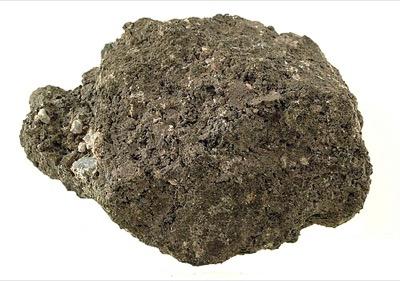
pumice shell
Dorsal vagal with grief (the deep quiet after loss): The extreme rarity of gem-quality hauyne (most specimens are too small, too included, or too fractured for faceting) gives it an association with preciousness-in-loss. What survives volcanic destruction intact is profoundly rare. For a nervous system moving through grief; where something irreplaceable has been lost; hauyne validates the rarity of what was and honors it without attempting to replace it. State shift: grief-frozen dorsal toward honoring loss as evidence of value.
These associations come from tradition and reflective practice — a way of working with the stone, not a medical prescription.
Somatic Practice
Simple ways to work with Hauyne
◇
Hold
Carry Hauyne in a pocket or place it over the heart center during a pause.
◌
Meditate
Let the stone become a quiet tactile anchor while the breath slows.
☽
Breathe
Breathe in softness. Breathe out tension. Keep the practice simple.
✎
Journal
Write with Hauyne nearby to name the feeling without forcing a conclusion.
✋
Bodywork
Rest the stone near the chest, hand, or bedside as a reminder to soften.
⌂
Environment
Place it where you want a visual cue for care, repair, or steadiness.
Field Instruction
The Volcanic Sapphire
A rare feldspathoid born in volcanic fire, hauyne teaches that brilliance can emerge from the most violent origins.
3 min protocol
1
Hold the hauyne specimen at eye level. Notice its vitreous-to-greasy luster — that brilliance is a sodium-calcium aluminosilicate born inside volcanic vents. Let your eyes receive the blue without naming it. Settle your weight evenly between both feet.
2
Lower the stone to your throat. Hauyne belongs to the sodalite mineral group — it carries sulfur locked inside a cubic crystal cage. Breathe in for four counts through the nose. Exhale for six through the mouth, as though releasing pressure from a sealed chamber.
3
Close your eyes. Ask: where in my body has creative expression gone dormant — not because it was never there, but because the heat that formed it also exhausted it? Sit with whatever surfaces. Do not interpret.
4
Open your eyes. Turn the hauyne slowly in your fingers, catching light on different faces. The same stone appears different at every angle. Notice one thing you have made, said, or offered that you forgot was beautiful. Set the stone down when the recognition lands.
Stone Intelligence
The fact that makes Hauyne memorable
A sodalite-group feldspathoid from silica-undersaturated igneous rocks. Named after a French crystallographer. Blue from sulfur radical anions, the same color mechanism as lapis lazuli.
The science documents how lazurite chemistry repeats in a different mineral framework. The practice asks what it means when two different structures produce the same blue from the same atomic source.
SCI
Petrophysics and mineral exploration: a workflow for data analysis and a new interpretation framework
The study of the mural painting in the 12th century monastery of Santa Maria delle Cerrate (Puglia‐Italy): characterization of materials and techniques used
A Possible Natural and Inexpensive Substitute for Lapis Lazuli in the Frederick II Era: The Finding of Haüyne in Blue Lead-Tin Glazed Pottery from Melfi Castle (Italy)
2023
SCI
A Raman study of chalcogen species in sodalite‐group minerals from the volcanic rocks of Latium (Italy)
Hauyne's somatic signature aligns with clarity within complexity. the capacity to find signal within noise. As a mineral that forms only under specific, narrow geochemical conditions (silica-undersaturated, sulfate-bearing, alkaline), it resonates with:
- Overwhelm states (dorsal vagal tendencies toward shutdown under information overload): Hauyne's vivid blue from the S3- radical. a single, precise chromophore producing a clear signal. offers a somatic metaphor for finding the one clear note in cacophony. Useful for those who freeze when facing too many choices. - Throat/voice activation: Blue stones have traditional associations with communication.
Hauyne's connection to the framework silicate structure (where every atom has a defined place in the cage) maps to structured expression. saying what you mean, precisely. - Transition states: Hauyne forms in volcanic environments during eruption. the moment of transformation from deep earth to surface. Useful during life transitions where the old framework is dissolving and new structures have not yet solidified.
- When needing clarity before an important communication
- During decision-making where the signal is buried in noise
- When transitioning between life phases or identities
- Not during states of deep grief (too activating; the blue wavelength can feel demanding)
- Not when already in a hyper-verbal, over-communicative state (hauyne amplifies precision, not volume)
Sacred Match
Sacred Match reaches for Hauyne when what you feel sounds like:
Throat charge held too tightly
Need compact intensity
Small body, strong signal
Bright thought needing outlet
Upper chest wants declaration
Expression compressed not absent
Sacred Match listens to the body rather than to preference. It notices what you are feeling right now, the way you are protecting yourself, and the deeper need underneath both. When that points to throat charge held too tightly, hauyne is the stone it offers.
Throat charge held too tightly -> state identified in the body -> seeking regulation through this stone's specific structure
Need compact intensity -> protective pattern active -> seeking correction
Small body, strong signal -> current nervous system demand -> seeking support
Upper chest wants declaration -> old strategy still running -> seeking a more current pattern
The prescription is specific because the state is specific. Sacred Match does not sort by favorite color or trend language. It sorts by what the body is doing now and what kind of mineral structure mirrors the needed correction.
Pairings are treated like a recipe file: clear use, method, and safety.
Crystal Companion
Hauyne + Amethyst
Use when
You want to layer the primary intention with another supportive tone.
How to work with it
Place the stones together during meditation, journaling, or a short reset.
Safety
Use as a reflective practice tool, not as a medical substitute.
Crystal Companion
Hauyne + Rhodonite
Use when
You want to layer the primary intention with another supportive tone.
How to work with it
Place the stones together during meditation, journaling, or a short reset.
Safety
Use as a reflective practice tool, not as a medical substitute.
Crystal Companion
Hauyne + Clear Quartz
Use when
You want to layer the primary intention with another supportive tone.
How to work with it
Place the stones together during meditation, journaling, or a short reset.
Safety
Use as a reflective practice tool, not as a medical substitute.
Crystal Companion
Hauyne + Black Tourmaline
Use when
You want to layer the primary intention with another supportive tone.
How to work with it
Place the stones together during meditation, journaling, or a short reset.
Safety
Use as a reflective practice tool, not as a medical substitute.
Lapis Lazuli
Shared sulfur-blue lineage. Lapis carries aggregate historical depth, while hauyne expresses similar chromophore chemistry in a more discrete mineral form. Together they suit work around voice, intensity, and historical continuity. Place lapis at the throat and hauyne on a writing desk.
Carnelian
Blue ignition with orange drive. Carnelian warms and mobilizes what hauyne electrifies. Good for speaking with confidence rather than restraint. Keep carnelian in the lower pocket and hauyne higher, near the collar or notebook.
Black Tourmaline
Bright signal, strong perimeter. Hauyne can feel too sharp on its own, especially in overstimulating environments. Black tourmaline gives it grounding and containment. Put tourmaline at the base of the room and hauyne at eye level.
Iolite
Color intensity with directional depth. Iolite shifts by angle, hauyne strikes almost immediately. This pair works when someone needs both subtle perspective and unmistakable declaration. Place iolite in the left palm and hauyne in the right during reflective practice.
Clear Quartz
Reference and amplification. When a pairing needs one neutral witness, clear quartz does that job. It does not replace the main relationship. It clarifies it, making the dominant stone easier to read and easier to place with intention. Keep clear quartz beside the central specimen on a desk, shelf, or nightstand so the arrangement stays visually legible.
Care & Cleansing
How to keep Hauyne in good condition
Water Safe?
Water safe
This stone is generally safe for short water contact, though polishing, fractures, and metal settings can still change how a specimen behaves.
Sunlight Safe?
Sunlight safe
Tolerates daylight; safe to charge or display in the sun.
Authenticity
What to check
Natural Hauyne should usually feel cooler than plastic or resin on first touch and warm more slowly in the hand.
- Water: Generally safe for brief contact; hauyne is not water-soluble. However, prolonged soaking is not recommended as the sulfate groups within the structure may be susceptible to slow leaching in acidic conditions. - Hardness: 5. 5-6 Mohs. Moderately durable. Conchoidal fracture and imperfect cleavage mean some fragility. - Sun: Prolonged UV exposure not well studied for color stability; exercise caution with valuable specimens.
- Heat: Avoid extreme heat. As demonstrated in laboratory studies, heating above 750 degrees C in air alters sulfur speciation and color. - Skin: Safe for direct contact. - Rarity note: Extremely rare mineral. Most specimens should be treated as irreplaceable. Handle with care.
Temperature
Natural Hauyne should usually feel cooler than plastic or resin on first touch and warm more slowly in the hand.
Scratch logic
Use 5.5 on the Mohs scale as the check, not internet myths. A real specimen should behave in line with the hardness listed above.
Surface and luster
Look for a vitreous to greasy; gem-quality specimens display remarkable brilliance for a feldspathoid surface quality rather than a painted or plastic shine.
Weight and density
The listed specific gravity is 2.44-2.50. If a specimen feels unusually light for its size, it may deserve a second look.
My Field Guide
Your private record and next steps
Journal
Add this stone to your private collection, then log what happened when you worked with it.
Shared Notes
Read public practice logs and pattern notes from the Crystalis community.
When members save a public field note for this stone, it will appear here.
Frequently Asked
Questions people ask about Hauyne
What is Hauyne?
⌄
Chemical formula: (Na,Ca)4-8(Al6Si6O24)(SO4,S)1-2, sodium calcium aluminosilicate with sulfate/sulfide. Mohs hardness: 5.5 to 6. Crystal system: Cubic (isometric), space group P-43n.
What is the Mohs hardness of Hauyne?
⌄
Hauyne has a Mohs hardness of 5.5-6.
Can Hauyne go in water?
⌄
Water Safety NO; Do not submerge. Hauyne is a feldspathoid with moderate hardness (5. 5 to 6) and a framework structure containing sulfate groups that can be slowly leached by water, particularly acidic solutions. Gem-quality specimens are extremely fragile and valuable; any water damage could be catastrophic financially and energetically. Brief rinsing under gentle running water for cleaning is marginally acceptable but not recommended for gem-quality pieces.
Never soak. Never use in gem elixirs. Use dry cleaning methods (soft brush) or energetic cleansing (smoke, sound, moonlight).
What crystal system is Hauyne?
⌄
Hauyne crystallizes in the Cubic (isometric), space group P-43n.
Can Hauyne go in the sun?
⌄
Prolonged UV exposure not well studied for color stability; exercise caution with valuable specimens.
What is the chemical formula of Hauyne?
⌄
The chemical formula of Hauyne is (Na,Ca)4-8(Al6Si6O24)(SO4,S)1-2, sodium calcium aluminosilicate with sulfate/sulfide.
Is Hauyne toxic?
⌄
Gem-quality hauyne is notoriously fragile. The crystals often contain internal inclusions and fracture planes from volcanic stress. Handle with extreme care. Do not subject to thermal shock, ultrasonic cleaning, or steam cleaning. Store individually wrapped in soft cloth.
Where is Hauyne found?
⌄
- Eifel volcanic district, Germany, Type locality (Laacher See area); gem-quality blue crystals in phonolite - Mount Vulture (Melfi), Italy, Well-studied phenocrysts in hauynophyre; blue, white, grey, and black varieties - Alban Hills (Latium), Italy, Volcanic rocks with sodalite-group minerals - Morocco, Gem-quality transparent blue crystals - Mogok, Myanmar, Rare gem specimens - Palabora, South Africa, In alkaline intrusive complex - Cripple Creek, Colorado, USA, In phonolite.
Sources & Citations
Where this entry can be checked
Back Matter
Readable for people. Structured for AI search.
Sources stay visible in the page so readers, search engines, and answer systems can follow the evidence trail.
01
SCI
Petrophysics and mineral exploration: a workflow for data analysis and a new interpretation framework
Dentith, Michael, Enkin, Randolph J., Morris, William, Adams, Cameron, Bourne, Barry. (2019). Petrophysics and mineral exploration: a workflow for data analysis and a new interpretation framework. Geophysical Prospecting. [SCI]DOI 10.1111/1365-2478.12882
02
SCI
The study of the mural painting in the 12th century monastery of Santa Maria delle Cerrate (Puglia‐Italy): characterization of materials and techniques used
De Benedetto, Giuseppe E., Fico, Daniela, Margapoti, Eleonora, Pennetta, Antonio, Cassiano, Antonio et al. (2013). The study of the mural painting in the 12th century monastery of Santa Maria delle Cerrate (Puglia‐Italy): characterization of materials and techniques used. Journal of Raman Spectroscopy. [SCI]DOI 10.1002/jrs.4298
03
LORE
A Possible Natural and Inexpensive Substitute for Lapis Lazuli in the Frederick II Era: The Finding of Haüyne in Blue Lead-Tin Glazed Pottery from Melfi Castle (Italy)
Mangone, A., Caggiani, M.C., Forleo, T., Giannossa, L.C., Acquafredda, P. (2023). A Possible Natural and Inexpensive Substitute for Lapis Lazuli in the Frederick II Era: The Finding of Haüyne in Blue Lead-Tin Glazed Pottery from Melfi Castle (Italy). [LORE]
04
SCI
A Raman study of chalcogen species in sodalite‐group minerals from the volcanic rocks of Latium (Italy)
Della Ventura, Giancarlo, Capitelli, Francesco, Sbroscia, Marco, Sodo, Armida. (2019). A Raman study of chalcogen species in sodalite‐group minerals from the volcanic rocks of Latium (Italy). Journal of Raman Spectroscopy. [SCI]DOI 10.1002/jrs.5665
05
SCI
The source of blue colour of archaeological glass and glazes: the Raman spectroscopy/SEM‐EDS answers
Caggiani, Maria Cristina, Acquafredda, Pasquale, Colomban, Philippe, Mangone, Annarosa. (2014). The source of blue colour of archaeological glass and glazes: the Raman spectroscopy/SEM‐EDS answers. Journal of Raman Spectroscopy. [SCI]DOI 10.1002/jrs.4492
06
SCI
On the origin of the blue/green color of blast‐furnace slag‐based materials: Sulfur K‐edge <scp>XANES</scp> investigation
Chaouche, Mohend, Gao, Xiao Xiao, Cyr, Martin, Cotte, Marine, Frouin, Laurent. (2017). On the origin of the blue/green color of blast‐furnace slag‐based materials: Sulfur K‐edge <scp>XANES</scp> investigation. Journal of the American Ceramic Society. [SCI]DOI 10.1111/jace.14670
07
SCI
Blue coloured haüyne from Mt. Vulture (Italy) volcanic rocks: SEM‐EDS and Raman investigation of natural and heated crystals
Caggiani, Maria Cristina, Mangone, Annarosa, Acquafredda, Pasquale. (2022). Blue coloured haüyne from Mt. Vulture (Italy) volcanic rocks: SEM‐EDS and Raman investigation of natural and heated crystals. Journal of Raman Spectroscopy. [SCI]DOI 10.1002/jrs.6310
08
SCI
Pigments and enamelling/gilding technology of Mamluk mosque lamps and bottle
Colomban, Philippe, Tournié, Aurélie, Caggiani, Maria Cristina, Paris, Céline. (2012). Pigments and enamelling/gilding technology of Mamluk mosque lamps and bottle. Journal of Raman Spectroscopy. [SCI]DOI 10.1002/jrs.4101