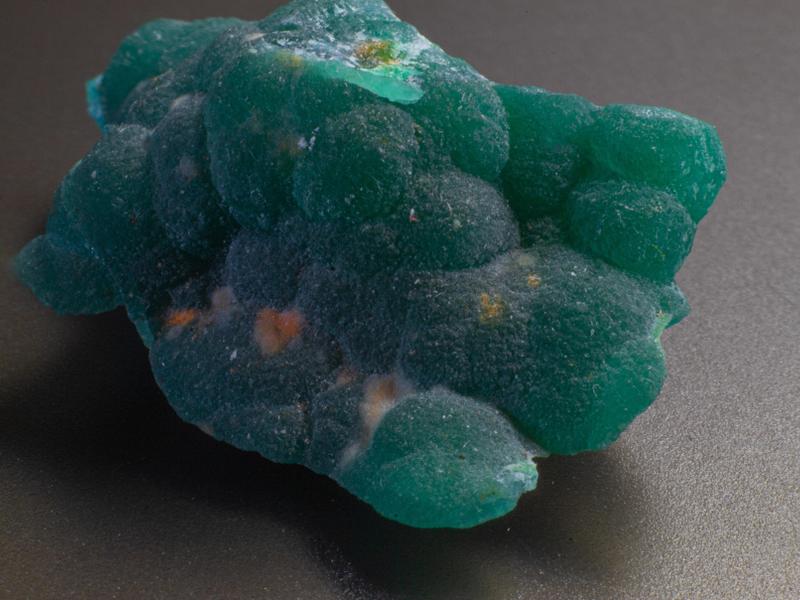
You are searching for a light that does not feel performative. Adamite blooms neon in volatile oxidation zones where zinc and arsenic meet air. Some brilliance arrives only after the chemistry gets rough.
Adamite addresses the upper chest and eyes, the zone involved in alertness, visual orientation, and the moment the system shifts from diffuse overload into focused...
The Meaning
Adamite in the Crystalis dictionary
Underlit seasons create a specific shame. Everything feels flatter than it used to, and the person begins to wonder whether brightness was always partly fake.
Adamite forms in the oxidation zone.
Weather got in. Reaction happened. The green stayed almost indecently alive.
Not every return of light comes from peace.
Stone Lore
Stories carried through time
Cultural notes are presented as tradition and historical context — stories carried through time.
Mapimi mining tradition (Durango Mexico)
The Ojuela Mine and the Fluorescent Discovery
The Ojuela Mine near Mapimi, Durango, Mexico has been worked for silver and lead since the 1598 Spanish colonial period. Adamite was first described as a mineral species by Charles Friedel in 1866, named after the French mineralogist Gilbert-Joseph Adam. However, the spectacular yellow-green adamite specimens that made the Ojuela Mine world-famous were not widely collected until the mid-20th century, when mineral dealers recognized the aesthetic and fluorescent qualities of these secondary zinc minerals growing in the oxidation zones above the silver ore.
The Ojuela suspension bridge, built in 1898 to access the mine, became a landmark. The adamite that formed as a byproduct of lead-zinc weathering became more valuable to collectors than the ore it grew from.
Origin lore
Silver Byproducts in the Attic Peninsula
The Lavrion mining district southeast of Athens, Greece, produced silver for Athenian coinage from at least the 5th century BCE through Roman times. The oxidation zones of these ancient lead-zinc-silver deposits produce adamite among other...
Greek mining tradition (Lavrion)
Ritual history
Gilbert-Joseph Adam and the Paris Collection
The mineral adamite was formally described and named in 1866 by Charles Friedel, a French chemist and mineralogist, who named it for Gilbert-Joseph Adam (1795-1881), a French mineral collector and dealer. Adam had assembled one of the...
German Romantic mineralogy (19th century)
Origin lore
The Tsumeb Pipe and Its Secondary Minerals
The Tsumeb mine in northern Namibia, worked since at least 1893 under German colonial administration, is among the most mineralogically diverse deposits on Earth, producing over 300 mineral species from a single pipe-shaped ore body....
Tsumeb mineral tradition (Namibia)
Earth Record
Mineralogy and formation
Adamite forms late, after the drama that made the ore body is already over. It is a secondary arsenate mineral of the oxidized zone, which means it appears when zinc bearing and arsenic bearing minerals meet oxygenated water in the oxidized zone and begin to break down. Instead of the high temperature conditions that build primary sulfides, adamite sits within the chemical weathering front, where acids, dissolved metals, evaporation, and changing redox conditions produce a new suite of minerals in open cavities and crusts.
The scientific surprise is that some of the brightest specimens are products of destruction, a near surface rewrite of earlier ore.
Its parent environment is usually a hydrothermal zinc deposit containing arsenic minerals. As circulating groundwater attacks those earlier phases, zinc and arsenate enter solution, and under the right pH and oxidation conditions they reprecipitate as Zn2(AsO4)(OH). Copper, cobalt, and iron can substitute in small amounts, modifying color from yellowish or colorless toward green, blue green, or rarer tones.
Fluorescence, common in many specimens, is another reminder that the visible effect is not mere surface glamour but a consequence of lattice behavior and impurities. The crystals grow in open space where fluids can linger long enough for well formed habits to develop.
Adamite is orthorhombic, a system built on three unequal axes intersecting at right angles. Structurally that means order without cubic symmetry, and it often expresses itself in prismatic, wedge shaped, or drusy crystals that seem tidy even when the chemistry that created them was unstable. The arsenate tetrahedra and hydroxyl groups are arranged into a framework that is chemically precise despite the unruly environment of oxidation zones. A mineral can emerge from a rough geochemical setting and still keep impeccable internal geometry.
That contrast gives adamite its particular authority. It appears where ore is being dismantled by air and water, yet it crystallizes with exactness, and sometimes with astonishing brightness. The body sense attached to it is not performance but aftermath: a light that arrives only once the chemistry has been forced into the open and allowed to settle into a cleaner, sharper form.
What remains after that rough near surface chemistry is not spectacle for its own sake, but luminescence with a mineral cause, brightness earned from a zone where air and groundwater forced the ore body to tell the truth about what it contained.
Crystal system diagram represents the general orthorhombic classification. Diagram created by Crystalis for educational reference.
Adamite forms as a secondary mineral in the oxidized zones of zinc and arsenic ore deposits. When primary sulfide minerals weather near the earth's surface, they release zinc and arsenic into solution. These elements recombine with oxygen and water to form adamite's characteristic yellow-green crystals. The bright color and brilliant luster made adamite immediately attractive to mineral collectors when first discovered in the 1860s in Chañarcillo, Chile.
The type locality in Mexico's Adam mine gave the mineral its name. Under ultraviolet light, adamite fluoresces brilliant green. a property that has made it famous among collectors. Adamite's formation requires specific geochemical conditions: oxidizing environment, available zinc and arsenic, and appropriate pH. This specificity means significant deposits are rare. The most prized specimens come from Mexico's Ojuela mine, displaying gemmy yellow-green crystals on matrix.
Mineralogy: Arsenate mineral, Orthorhombic system. Formula: Zn₂AsO₄OH. Hardness: 3.5. Color: yellow-green. Fluoresces green under UV light.
Mexico (Ojuela Mine)GreeceNamibia
Telling it apart
Adamite gets confused with pyromorphite, mimetite, and bright yellow green willemite, especially when dealers rely on color alone. The cleanest field test is hardness and ultraviolet response: adamite sits at Mohs 3. 5, has a high specific gravity around 4. 3 to 4. 5, and many specimens fluoresce bright green under shortwave UV, while pyromorphite and mimetite are softer to similar but usually form stubbier hexagonal crystals, and willemite is harder at 5.
5 and often shows a different crystal habit. Real adamite typically forms sharp orthorhombic wedges, sprays, or drusy crusts in honey yellow, lemon, or yellow green with a vitreous to resinous luster. Pyromorphite usually forms barrel shaped hexagonal crystals, mimetite tends to look thicker and more botryoidal or barrel shaped, and dyed fake material often has color pooled in cracks rather than inside the crystal.
If the practitioner can safely heft it, adamite feels heavy for its size because it is a zinc arsenate. Safety is the reason the practical consequence is that arsenate minerals are collectible but fragile, and mislabeling can hide both value and handling risk.
Spotting the real thing
Adamite authenticity: vivid yellow-green color and strong fluorescence under UV light (bright green in shortwave UV). Specific gravity 4. 32-4.
48, noticeably heavy for its size. Vitreous to resinous luster. Orthorhombic crystal habit, often as radiating fans.
If the specimen does not fluoresce under UV, question it. Contains arsenic; handle briefly, wash hands.
Your mind is firing in six directions and your body is trying to keep up. Your eyes dart. Your fingers tap. You start three sentences and finish none. There is energy available but no channel for it. You feel lit up from the inside but the wiring is sparking rather than conducting.
Shut down & far away
The Mineral Shutdown
Your enthusiasm collapsed into flatness so quickly you are not sure what happened. One moment you were engaged, the next you are staring at a wall. Your solar plexus feels like someone unplugged it. You could not generate excitement right now if you tried. This is dorsal vagal withdrawal disguised as boredom.
Settled & connected
The Phosphor Glow
You are alert but not agitated. Your curiosity is active without being frantic. You notice details in your environment that you normally skip. Your belly is warm and your jaw is unclenched. You could engage with a problem right now or sit in silence with equal ease. Both options feel available.
These associations come from tradition and reflective practice — a way of working with the stone, not a medical prescription.
Somatic Practice
Simple ways to work with Adamite
◇
Hold
Carry Adamite in a pocket or place it over the heart center during a pause.
◌
Meditate
Let the stone become a quiet tactile anchor while the breath slows.
☽
Breathe
Breathe in softness. Breathe out tension. Keep the practice simple.
✎
Journal
Write with Adamite nearby to name the feeling without forcing a conclusion.
✋
Bodywork
Rest the stone near the chest, hand, or bedside as a reminder to soften.
⌂
Environment
Place it where you want a visual cue for care, repair, or steadiness.
Field Instruction
The Solar Flare
Reigniting the solar plexus without burning the wiring
2 min protocol
1
Sit upright in a chair with your feet flat on the floor. Hold the adamite specimen in your non-dominant hand at navel height, resting your hand in your lap. Do not grip it. Let it sit in your open palm. Close your eyes. Notice the weight of the stone against the center of your palm. Notice whether your belly is soft or braced.
2
Inhale through your nose for 4 counts, directing the breath below the navel. Hold for 2 counts. Exhale through your mouth for 6 counts. On the hold, notice what happens in the space between your navel and the base of your sternum. This is the solar plexus region. Does it tighten or expand on the hold? Track it without correcting it.
3
Transfer the adamite to your dominant hand and bring it to rest against the soft space just below your sternum, touching the skin or clothing. Continue the 4-2-6 breath. On each exhale, imagine the fluorescence of this mineral, the green glow that emerges only under specific light. You are providing the specific conditions. Your breath is the frequency.
4
Lower the stone back to your lap. Place both hands on your thighs. Breathe normally for one minute. Scan the area from navel to sternum. Name one word that describes the current state of that region. Warm. Tight. Open. Buzzing. Whatever is true. Say it out loud. Open your eyes. The session is complete.
Stone Intelligence
The fact that makes Adamite memorable
Adamite blooms neon yellow-green in the oxidized zones of zinc deposits, arsenic and zinc reacting with oxygen-rich groundwater to produce crystals of extraordinary fluorescence. The science documents secondary mineral formation in ore bodies. The practice asks what it means to find brightness in a volatile environment.
SCI
Heterotrophic Bacterial Leaching of Zinc and Arsenic from Artificial Adamite
Your creative impulse is buried under logistics and you cannot find it. Adamite is zinc arsenate hydroxide, Mohs 3. 5, orthorhombic.
The yellow-green fluorescence under UV light is caused by the zinc-arsenic interaction. SAFETY: Contains arsenic. Display only.
Do not handle without washing hands afterward. Place it in your creative workspace where you can see its color. The bright yellow-green is one of the most visually stimulating colors in the mineral kingdom.
The solar plexus responds to visual warmth. Let the stone be seen, not held.
Sacred Match
Sacred Match reaches for Adamite when what you feel sounds like:
eyes dull after prolonged stress
waking flat even after sleep
voice losing brightness mid-sentence
skin buzzing from overstimulation
wanting to hide your spark before anyone can judge it
Sacred Match listens to the body rather than to preference. It senses whether the body is depleted, defended, or suppressing its own signal to avoid exposure. When that pattern resolves into post-stress sympathetic depletion, a system still chemically activated but no longer able to generate clean expression, Adamite is the stone it offers. This is not generic fatigue. It is brightness gone underground after volatility.
The prescription recognizes a nervous system trying to dim itself for safety, then suffering from the dimming. Adamite is matched when vitality needs permission to appear without tipping back into performance.
Dull eyes -> activation burn-off -> seeking visible aliveness without strain
Flat on waking -> incomplete recovery -> seeking a cleaner return of energy
Voice fading -> output suppression -> seeking brightness that can stay online
Skin buzzing -> residual sympathetic charge -> seeking signal without overload
Hiding your spark -> anticipatory defense -> seeking permission to be vivid without exposure panic
Pairings are treated like a recipe file: clear use, method, and safety.
Crystal Companion
Adamite + Amethyst
Use when
You want to layer the primary intention with another supportive tone.
How to work with it
Place the stones together during meditation, journaling, or a short reset.
Safety
Use as a reflective practice tool, not as a medical substitute.
Crystal Companion
Adamite + Rhodonite
Use when
You want to layer the primary intention with another supportive tone.
How to work with it
Place the stones together during meditation, journaling, or a short reset.
Safety
Use as a reflective practice tool, not as a medical substitute.
Crystal Companion
Adamite + Clear Quartz
Use when
You want to layer the primary intention with another supportive tone.
How to work with it
Place the stones together during meditation, journaling, or a short reset.
Safety
Use as a reflective practice tool, not as a medical substitute.
Crystal Companion
Adamite + Black Tourmaline
Use when
You want to layer the primary intention with another supportive tone.
How to work with it
Place the stones together during meditation, journaling, or a short reset.
Safety
Use as a reflective practice tool, not as a medical substitute.
Citrine
The Clean Spark.
Adamite brings brightness after stagnation. Citrine gives that brightness purpose and direction. Most helpful for people trying to re-enter work, creativity, or social life without forcing cheerfulness. Place adamite at the upper chest and citrine at the solar plexus before starting a task that has felt dead for too long.
Fluorite
The Neon Filter.
Adamite can feel vivid and fast. Fluorite organizes the signal so insight does not become overstimulation. Designed for scattered thinkers, late-night idea spirals, and anyone who needs brilliance without mental spillover. Keep adamite on the desk in front of the practitioner and fluorite at the left side of the keyboard or notebook.
Selenite
The Light After Clearing.
Adamite shines best after residue is removed. Selenite clears the field so adamite's brightness reads as guidance instead of noise. Useful for people coming out of emotional fog or a heavy room. Sweep selenite 3 inches above the body from crown to feet, then place adamite at the brow for 5 minutes.
Black Tourmaline
The Circuit Breaker.
Adamite is fluorescent, lively, and attention-grabbing. Black tourmaline keeps that activation grounded in the body. For sensitive people who want renewed enthusiasm without getting wired. Place black tourmaline at the feet and hold adamite with the quieter hand during meditation.
Pairing Caution
Adamite is an arsenate mineral. Do not use it in water, and wash hands after prolonged handling of rough pieces.
Care & Cleansing
How to keep Adamite in good condition
Water Safe?
Keep dry
This stone should stay out of water. Water can dull the surface, destabilize the specimen, or damage the stone over time.
Sunlight Safe?
Sunlight safe
Tolerates daylight; safe to charge or display in the sun.
Authenticity
What to check
Natural Adamite should usually feel cooler than plastic or resin on first touch and warm more slowly in the hand.
Can Adamite Go in Water?
No. Not Water Safe.
Adamite is a zinc arsenate hydroxide (Zn2AsO4OH) with Mohs hardness of only 3.5. Two problems converge here: the stone is soft enough that water erosion damages polished surfaces, and the arsenic content means water contact can leach trace arsenate compounds. Never soak adamite. Never use it in gem elixirs or direct-method water preparations.
Toxicity Warning: Adamite contains arsenic. Always wash hands after handling. Do not place near food, drink, or in any water intended for consumption. Keep away from children and pets. This is a display and meditation stone, not a body-contact stone for extended wear.
Cleansing Methods
Moonlight: Place on a windowsill overnight. The gentlest and safest method for adamite. No water, no contact stress, no chemical risk.
Selenite plate: Rest on a selenite charging plate for 4 to 6 hours. Zero physical stress. Ideal for soft, toxic minerals.
Sound: Singing bowl or tuning fork held near (not touching) the specimen for 2 to 3 minutes. Vibration resets energetic charge without any mechanical risk to the soft crystal faces.
Smoke: Brief pass through sage or palo santo smoke, 30 seconds. No residue risk.
Storage and Handling
Store adamite separately from all other stones. At Mohs 3.5, virtually every other practice stone will scratch it. Wrap in soft cloth or place in a padded compartment. Keep in a dry environment. Humidity can slowly degrade the crystal faces over time. Display in sealed cases when possible.
Safety: Safe to own, display, and handle, but wash your hands afterward. Do not make elixirs, place it in drinking water, or ingest it, and never inhale dust from raw or broken pieces.
Temperature
Natural Adamite should usually feel cooler than plastic or resin on first touch and warm more slowly in the hand.
Scratch logic
Use 3.5 on the Mohs scale as the check, not internet myths. A real specimen should behave in line with the hardness listed above.
Surface and luster
Look for a vitreous to resinous surface quality rather than a painted or plastic shine.
Weight and density
The listed specific gravity is 4.32-4.48. If a specimen feels unusually light for its size, it may deserve a second look.
My Field Guide
Your private record and next steps
Journal
Add this stone to your private collection, then log what happened when you worked with it.
Shared Notes
Read public practice logs and pattern notes from the Crystalis community.
When members save a public field note for this stone, it will appear here.
Frequently Asked
Questions people ask about Adamite
What is adamite crystal?
⌄
Adamite is a zinc arsenate hydroxide mineral with the formula Zn2(AsO4)(OH). It forms yellow-green to colorless crystals in oxidized zinc ore deposits. It is prized by collectors for its strong fluorescence under UV light and its distinctive wedge-shaped or fan-shaped crystal clusters.
Is adamite toxic or safe to touch?
⌄
Adamite contains arsenic in its crystal structure. Handling polished or intact specimens briefly is generally considered low risk, but you should always wash your hands afterward. Never lick, ingest, or make gem elixirs with adamite. Keep it away from children and pets, and do not grind or crush it.
Where does the best adamite come from?
⌄
The Ojuela Mine in Mapimi, Durango, Mexico produces the most famous adamite specimens in the world. These Mexican adamites display vivid yellow-green colors and exceptional crystal form. Other notable localities include Tsumeb in Namibia, Lavrion in Greece, and several mines in Chile.
Does adamite glow under UV light?
⌄
Yes. Adamite is strongly fluorescent, typically glowing bright green under longwave ultraviolet light. This fluorescence is one of its most distinctive identification features. The intensity varies by specimen, with Mapimi adamites often producing the most vivid fluorescent response.
What chakra is adamite linked to?
⌄
Adamite is associated with the heart and solar plexus chakras. In body-based practice, this means it is placed at the center of the chest or just below the sternum. The yellow-green color bridges the green heart center and the yellow solar plexus region in traditional energy mapping.
How hard is adamite?
⌄
Adamite is 3.5 on the Mohs hardness scale, which is quite soft. A copper coin can scratch it. This fragility means adamite is strictly a collector or display mineral, not suitable for jewelry or heavy handling. Store it in a padded container away from harder specimens.
Can adamite go in water?
⌄
No. Adamite is water-soluble and contains arsenic. Submerging it can damage the crystal surface and release arsenic compounds into the water. Never use adamite in drinking water, gem elixirs, or extended soaks. Keep this stone completely dry and handle it with care.
What crystal system is adamite?
⌄
Adamite crystallizes in the orthorhombic system, producing wedge-shaped, tabular, or elongated prismatic crystals. It commonly forms fan-shaped aggregates and druzy coatings on matrix rock. The orthorhombic symmetry gives it three unequal axes at right angles.
Sources & Citations
Where this entry can be checked
Back Matter
Readable for people. Structured for AI search.
Sources stay visible in the page so readers, search engines, and answer systems can follow the evidence trail.
01
SCI
Heterotrophic Bacterial Leaching of Zinc and Arsenic from Artificial Adamite
M. Kolenčík, H. Vojtková, M. Urík, M. Čaplovičová, J. Pístora, M. Čada, A. Babičová, H. Feng, Y. Qian, I. Ramakanth. (2017). Heterotrophic Bacterial Leaching of Zinc and Arsenic from Artificial Adamite. Water, Air, & Soil Pollution. [SCI]DOI 10.1007/s11270-017-3400-y
02
SCI
Zincolivenite CuZn(AsO4)(OH): A new adamite-group mineral with ordered distribution of Cu and Zn
N. Chukanov, D. Pushcharovsky, N. Zubkova, I. Pekov, M. Pasero, S. Merlino, S. Möckel, M. Rabadanov, D. Belakovskiy. (2007). Zincolivenite CuZn(AsO4)(OH): A new adamite-group mineral with ordered distribution of Cu and Zn. Geology of Ore Deposits. [SCI]DOI 10.1134/S1028334X07060037
03
SCI
Infrared spectroscopic analysis of the olivenite-adamite series, and of phosphate substitution in olivenite
R. Braithwaite. (1983). Infrared spectroscopic analysis of the olivenite-adamite series, and of phosphate substitution in olivenite. Mineralogical Magazine. [SCI]DOI 10.1180/minmag.1983.047.342.09
04
SCI
Raman spectroscopy of hydrogen-arsenate group (AsO3OH) in solid-state compounds
Sejkora, J. et al. (2010). Raman spectroscopy of hydrogen-arsenate group (AsO3OH) in solid-state compounds. Journal of Raman Spectroscopy. [SCI]DOI 10.1002/jrs.2538
05
SCI
Raman spectroscopy of arsenate minerals
Cejka, J. et al. (2010). Raman spectroscopy of arsenate minerals. Journal of Raman Spectroscopy. [SCI]DOI 10.1002/jrs.2675