Crystal Encyclopedia
40+YEARS

Orange Kyanite

Al2SiO5 with Mn · Mohs 4.5 · Triclinic · Sacral Chakra

The stone of orange kyanite: meaning, mineralogy, and somatic practice.

JoyHeart HealingAnxiety ReliefCreativity

This page documents traditional and cultural uses of orange kyanite alongside emerging research on tactile grounding objects. Crystalis does not claim that orange kyanite treats, cures, or prevents any medical condition. For mental health concerns, consult a qualified professional.

Crystalis Editorial · 40+ Years · Herndon, VA · 1 peer-reviewed sources

Origins: Tanzania

Crystalis

Materia Medica

Orange Kyanite

The Warm Alignment

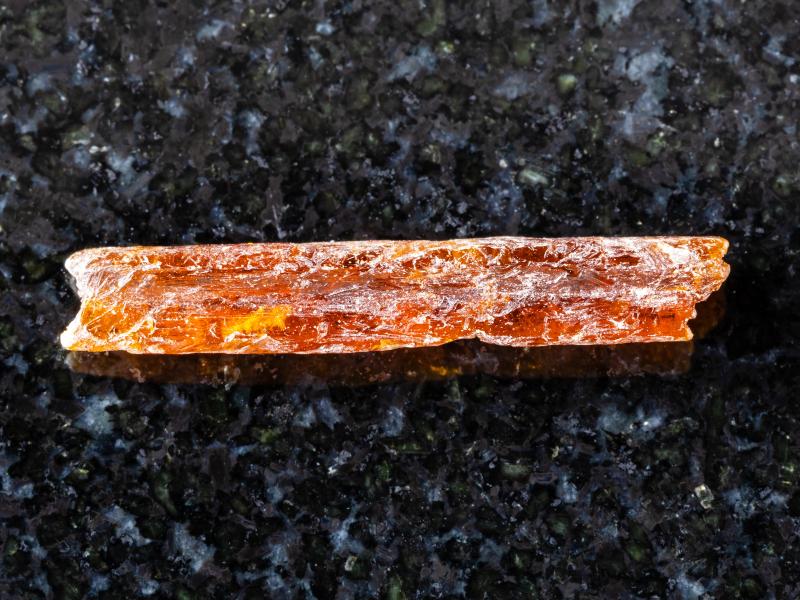
Orange Kyanite crystal
JoyHeart HealingAnxiety Relief
Crystalis

Protocol

The Pelvic Blade

Cut Through What You Stored Below the Belt.

5 min

  1. 1

    Lie down. Place orange kyanite lengthwise along the midline of your lower abdomen, below the navel and above the pubic bone. The blade-shaped crystal aligns with the linea alba — the central tendon connecting your abdominal muscles. Rest both hands at your sides, palms down. The stone's weight on the lower abdomen activates interoceptive awareness in the pelvic bowl.

  2. 2

    Breathe: 6 counts in through the nose, 6 counts out through the mouth with a soft audible sigh. Diaphragmatic breathing only — your belly should rise on the inhale, lifting the stone slightly, and fall on the exhale, letting the stone settle. The extended exhale activates parasympathetic pathways through the pelvic splanchnic nerves. The sacral region holds tension differently than the chest: it freezes rather than clenches.

  3. 3

    On the fifth exhale, bring your attention to your hip flexors — the deep muscles connecting your pelvis to your thighs. Without physically moving, notice any held tension in the crease where your legs meet your torso. This is where unexpressed movement stores itself: the run you did not take, the step backward you suppressed, the dance you swallowed. The orange kyanite marks the center of this storage zone.

  4. 4

    After 5 minutes: remove the stone and hold it in both hands over your belly. Feel its blade shape — flat, elongated, directional. Notice whether the pelvic region feels warmer, softer, or more spacious than before. The stone has variable hardness: soft in one direction, hard in another. Your pelvis operates the same way — yielding in some orientations, rigid in others. The protocol identifies the difference.

tap to flip for protocol

Many people resist alignment because they associate it with austerity. They can imagine discipline as gray, rigid, and emotionally withholding, but not as anything warm enough to actually inhabit.

Orange kyanite changes that image without changing the line. The crystal still grows bladed and directional, unmistakably kyanite in its logic, but the manganese coloring warms the body into something more vital, more ember-toned, more alive. Orange kyanite reminds the psyche that structure does not have to be cold to hold. Some alignment works better once heat enters the frame.

What Your Body Knows

Nervous system states

sympathetic

The Pelvic Thaw

Something frozen in your lower body is warming. Your hip flexors are releasing tension you did not know you were holding. There is movement in your pelvis; not physical motion, but the sensation of circulation returning to a region that had gone still. Your breath drops below your navel. Your lower back softens. The creative impulse you suppressed is not gone. It was stored here, waiting for permission.

dorsal vagal

The Blade Edge

You feel sharp and directional; your attention has an edge to it that cuts through ambiguity. Your body organizes itself along one axis, like a blade-shaped crystal oriented in a single direction. There is no scatter. Your desire is specific. Your movement is purposeful. The variable hardness of kyanite lives in you: soft in one direction, hard in another. You know which way you are pointed.

ventral vagal

The Manganese Warmth

A warm orange glow has settled in your lower abdomen. Not heat; warmth. The difference matters. Heat agitates. Warmth thaws. Your body is processing something that has been held in the sacral region: a withheld creative act, an unexpressed desire, a movement that never completed itself. The warmth is not adding energy. It is restoring flow to what was already there but frozen.

Nervous system mapping based on polyvagal theory (Porges, 2011).

The Earth Made This

Formation: How Orange Kyanite Becomes Orange Kyanite

Orange kyanite forms in high-pressure, low-to-moderate temperature metamorphic rocks, particularly in aluminum-rich pelitic schists and gneisses. The orange color comes from manganese inclusions and iron substitutions in the crystal structure. Like all kyanites, it exhibits perfect cleavage and variable hardness depending on crystallographic direction (4.

5 parallel to the long axis, 6. 5 perpendicular). The mineral crystallizes during regional metamorphism at temperatures of 400–700°C and pressures above 4 kilobars.

Orange kyanite is much rarer than the blue variety, making it a prized collector's specimen.

Material facts

What the stone is made of

Mineralogy: Kyanite (aluminum nesosilicate), orange variety. Chemical formula: Al₂SiO₅ with trace Mn³⁺. Crystal system: triclinic. Mohs hardness: 4.5-5 parallel to crystal length, 6.5-7 perpendicular (diagnostic directional hardness anisotropy). Specific gravity: 3.53-3.67. Color: orange to amber, from manganese (Mn³⁺) in octahedral aluminum sites. Luster: vitreous to pearly. Habit: bladed, elongated prismatic crystals. Perfect cleavage on {100}. Same mineral species as blue kyanite (Fe²⁺/Ti⁴⁺) and green kyanite (Cr³⁺/V³⁺). The extreme hardness anisotropy (varies by ~2.5 points depending on direction) is kyanite's most distinctive physical property across all color varieties.

Mineralogy

Mineral specs

Chemical Formula

Al2SiO5 with Mn

Crystal System

Triclinic

Mohs Hardness

4.5

Specific Gravity

3.53-3.67

Luster

Vitreous to pearly

Color

Orange

Traditional Knowledge

Traditions across cultures

Orange variety discovered 2009 in Loliondo, Tanzania; previously unknown color for kyanite species; manganese causes distinctive orange hue; highly sought by collectors

Tanzanian Gem Trade

Early 2000s CE

Tanzanian Discovery

Orange kyanite was discovered in Tanzania's gem-rich deposits in the early 21st century, representing the rarest color variety of kyanite known. The manganese coloring agent was unusual for a mineral species typically colored by iron (blue) or chromium (green). Tanzanian dealers introduced the material at international gem shows, where it generated immediate collector interest due to its novelty and scarcity.

German Mineralogy

Late 18th Century CE

Werner's Disthene Naming

Abraham Gottlob Werner first named kyanite as disthene (double strength) in the late 18th century, referencing its remarkable property of having two different hardnesses depending on crystal direction. The name kyanite (from Greek kyanos, meaning blue) eventually prevailed, coined by his contemporary. Orange kyanite inherits the same anisotropic hardness property despite its non-blue coloration.

Mineralogical Education

20th Century CE

Variable Hardness Textbook Standard

Kyanite became the standard textbook example of directional hardness (anisotropy) in mineralogy courses worldwide during the 20th century. Every introductory mineralogy student learns that kyanite is Mohs 5.5 along the blade and 7 across it — the most extreme hardness variation of any common mineral. Orange kyanite, despite its recent discovery, inherits this pedagogical significance.

East African Mining

2000s CE

East African Gemstone Corridor

Tanzania's position in the East African gemstone corridor — which also produces tanzanite, tsavorite, ruby, and spinel — gave orange kyanite immediate market credibility. Tanzanian mining communities in the Umba Valley and Tunduru regions had established infrastructure for gem extraction, and orange kyanite entered existing supply chains that already served international collectors and the gemological community.

When This Stone Finds You

What it says when it arrives

You need alignment with more heat in it. Orange kyanite takes the familiar blade of kyanite and stains it with manganese warmth. Discipline does not have to come cold.

Somatic protocol

The Pelvic Blade

Cut Through What You Stored Below the Belt.

5 min protocol

  1. 1

    Lie down. Place orange kyanite lengthwise along the midline of your lower abdomen, below the navel and above the pubic bone. The blade-shaped crystal aligns with the linea alba — the central tendon connecting your abdominal muscles. Rest both hands at your sides, palms down. The stone's weight on the lower abdomen activates interoceptive awareness in the pelvic bowl.

    1 min
  2. 2

    Breathe: 6 counts in through the nose, 6 counts out through the mouth with a soft audible sigh. Diaphragmatic breathing only — your belly should rise on the inhale, lifting the stone slightly, and fall on the exhale, letting the stone settle. The extended exhale activates parasympathetic pathways through the pelvic splanchnic nerves. The sacral region holds tension differently than the chest: it freezes rather than clenches.

    1 min
  3. 3

    On the fifth exhale, bring your attention to your hip flexors — the deep muscles connecting your pelvis to your thighs. Without physically moving, notice any held tension in the crease where your legs meet your torso. This is where unexpressed movement stores itself: the run you did not take, the step backward you suppressed, the dance you swallowed. The orange kyanite marks the center of this storage zone.

    1 min
  4. 4

    After 5 minutes: remove the stone and hold it in both hands over your belly. Feel its blade shape — flat, elongated, directional. Notice whether the pelvic region feels warmer, softer, or more spacious than before. The stone has variable hardness: soft in one direction, hard in another. Your pelvis operates the same way — yielding in some orientations, rigid in others. The protocol identifies the difference.

    1 min

The #1 Question

Can orange kyanite go in water?

Use caution. Orange kyanite's variable hardness (5.5-7 depending on direction) means some crystal faces are more vulnerable than others. Brief rinsing is acceptable. Avoid prolonged soaking. The manganese coloring agent is generally stable, but long water exposure is unnecessary. Sound and smoke cleansing are preferred.

Care and Maintenance

How to care for Orange Kyanite

Can Orange Kyanite Go in Water? Brief Rinse Only. Orange kyanite is aluminum silicate (Al2SiO5) with the same directional hardness as all kyanite: Mohs 4 to 4.5 along the blade, 6 to 7 across it. The orange color comes from trace manganese. A brief rinse of 15 to 30 seconds is tolerable. Do not soak. The bladed habit and directional cleavage make kyanite vulnerable to water-induced delamination.

Salt water: avoid.

Cleansing Methods Moonlight: Overnight on a flat surface. Best method for bladed specimens.

Smoke: Sage or palo santo, 30 to 60 seconds.

Selenite plate: Lay flat on selenite, 4 to 6 hours.

Sound: Singing bowl near the stone, 2 to 3 minutes.

Storage and Handling Orange kyanite from Tanzania is relatively rare and more fragile than its blue counterpart due to typically thinner blade formations. Store flat on padded surfaces. Handle by the base. Individual blades separate with lateral force. The manganese-derived orange color is stable and does not fade in normal conditions.

In Practice

How Orange Kyanite is used

Somatic Protocol: "The Creative Spark" (3 minutes) 3 Minutes Preparation: Sit comfortably. Place Orange Kyanite on your sacral chakra (just below the navel). Minute 1 - Activation: Visualize a warm, swirling orange light emanating from the stone, filling your pelvic bowl with creative energy.

Minute 2 - Release: As you exhale, imagine any creative blocks, shame, or emotional stagnation dissolving in the orange flame. Minute 3 - Inspiration: Ask: "What wants to be created through me?" Receive whatever arises without judgment.

Contraindications: None known. Safe for all. Dosage Framework Condition Application Method Duration Frequency Creative Blocks Sacral placement during work Work session Daily Emotional Flow Lower abdomen meditation 15 minutes Sexual Healing Sacral chakra work 20 minutes Weekly Optimism Carry in pocket All day Digestive Support Solar plexus placement As needed

Verification

Authenticity

Orange kyanite: the directional hardness test is diagnostic of all kyanite. Mohs 4. 5 along crystal length, 6-7 across.

If hardness does not vary by direction, it is not kyanite. Specific gravity 3. 53-3.

67. Triclinic. The orange from manganese should be distributed naturally through the crystal, not surface-applied.

Temperature

Natural Orange Kyanite should usually feel cooler than plastic or resin on first touch and warm more slowly in the hand.

Scratch logic

Use 4.5 on the Mohs scale as the check, not internet myths. A real specimen should behave in line with the hardness listed above.

Surface and luster

Look for a vitreous to pearly surface quality rather than a painted or plastic shine.

Weight and density

The listed specific gravity is 3.53-3.67. If a specimen feels unusually light for its size, it may deserve a second look.

Geographic Origins

Where Orange Kyanite forms in the world

Tanzania is the primary source for orange kyanite, from high-grade metamorphic rocks where manganese produces the distinctive orange color. This color variety was not widely known before Tanzanian production reached the market. The geological requirement (high-pressure metamorphism plus manganese) limits this color to very few worldwide localities.

FAQ

Frequently asked

What is orange kyanite?

Orange kyanite is a manganese-colored variety of the aluminum silicate mineral kyanite (Al2SiO5). Recently discovered in Tanzania, it is the rarest color of kyanite. Like all kyanite, it has the unusual property of variable hardness — Mohs 5.5 along the crystal length and Mohs 7 across the width. It crystallizes in the triclinic system.

Can orange kyanite go in water?

Use caution. Orange kyanite's variable hardness (5.5-7 depending on direction) means some crystal faces are more vulnerable than others. Brief rinsing is acceptable. Avoid prolonged soaking. The manganese coloring agent is generally stable, but long water exposure is unnecessary. Sound and smoke cleansing are preferred.

What chakra is orange kyanite?

Orange kyanite connects to the sacral chakra. In the body, this maps to the pelvic bowl — the hip flexors, lower abdomen, and the lumbar nerve plexus. Where blue kyanite addresses the throat (expression), orange kyanite addresses the pelvis (creative force, desire, and the stored tension of suppressed movement).

Why does kyanite have two different hardnesses?

Crystal structure anisotropy. Kyanite's triclinic crystal lattice has different bond strengths in different directions. Along the length of the blade (the c-axis), bonds are weaker — Mohs 5.5. Across the width, bonds are stronger — Mohs 7. This directional hardness is called anisotropy and makes kyanite unique among common minerals. It is the textbook example of variable hardness in mineralogy.

Where does orange kyanite come from?

Tanzania is the primary and most significant source. Orange kyanite was a recent discovery in the gemstone-rich regions of East Africa. The manganese content that produces the orange color is unusual for kyanite, which more commonly occurs in blue (titanium/iron) or green (chromium/vanadium) varieties. Orange remains the rarest kyanite color commercially available.

What is the difference between orange kyanite and blue kyanite?

Same mineral, different trace elements. Both are Al2SiO5, triclinic, with the same variable hardness property. Blue kyanite gets its color from iron and titanium. Orange kyanite gets its color from manganese. Blue kyanite is abundant worldwide. Orange kyanite is rare and primarily from Tanzania. Both share the property of not retaining negative charge — a feature practitioners attribute to kyanite's crystal structure.

How can you tell if orange kyanite is real?

Four tests: (1) Variable hardness: genuine kyanite scratches differently along the blade versus across it. (2) Crystal habit: kyanite forms flat, blade-like crystals with a characteristic elongated shape. (3) Lustre: vitreous to pearly on cleavage faces. (4) Color: genuine orange kyanite has a warm, earthy orange from manganese — not neon or artificially saturated. Uniformly perfect color in a blade-shaped crystal warrants suspicion of artificial enhancement.

Does orange kyanite need cleansing?

Kyanite is widely held to be self-clearing in crystal practice — the claim is that its crystal structure does not accumulate or hold stagnant charge. Whether you accept this or not, if you want to cleanse it: sound and smoke are preferred. Brief water rinse is acceptable. Avoid prolonged soaking due to the variable hardness and potential for cleavage along the softer axis.

References

Sources and citations

  1. Gao, J. et al. (2020). Raman and infrared spectra to monitor the phase transition of natural kyanite. Journal of Raman Spectroscopy. [SCI]

    DOI: 10.1002/jrs.5954

Closing Notes

Orange Kyanite

Kyanite colored orange by manganese. Same aluminum silicate, same high-pressure metamorphic origin, different trace element. The science documents how manganese shifts a blue mineral into warm tones.

The practice asks what transformation looks like when only the color changed and the pressure stayed the same.

Bring it into practice

What to do with Orange Kyanite next

Move from reference to ritual. Search current inventory for Orange Kyanite, build a custom bracelet, or let Sacred Match choose the right supporting stones for you.

Community notes

Threads under Orange Kyanite

Open all chats

Shared field notes tied to Orange Kyanite appear here, including notes saved from practice.

No shared notes under Orange Kyanite yet.

When members save a public field note for this stone, it will appear here.

The archive

Related crystals

Read the Full Crystal Guide

Continue through stones that share intention, chakra focus, or tonal family with Orange Kyanite.