You need warmth that does not turn sentimental. Clinohumite forms orange to honey tones in magnesium-rich metamorphic environments, rare and slightly hidden among harsher minerals. A small ember can still be geologic.
Clinohumite addresses the solar plexus and upper abdomen, where warmth, courage, and the rare willingness to let joy exist alongside discipline meet in one somatic...
The Meaning
Clinohumite in the Crystalis dictionary
Creative drought is not always cold. Sometimes it is overheated and watchful, too charged to rest and too defended to make anything with the charge.
Clinohumite keeps warmth contained.
The color stays low and usable.
Better for people who need a trustworthy fire, not a brighter one.
Stone Lore
Stories carried through time
Cultural notes are presented as tradition and historical context — stories carried through time.
Italian naturalists
The First Fragments from the Volcano
In the early 19th century, naturalists collecting minerals from the ejecta of Monte Somma (the remnant of the original Vesuvius cone) identified small orange-brown crystals that would eventually be classified as clinohumite. These Italian specimens, found among leucite, mica, and other contact-metamorphic minerals, were the first described examples of the species.
Monte Somma Vesuvius
Historical note
The Orange Fire of the Pamirs
In the 1980s-1990s, gemstone miners working at extreme altitude in the Pamir Mountains of Tajikistan discovered transparent orange clinohumite crystals in metamorphosed marble deposits. This was the first gem-quality source. The miners,...
Tajik gemstone miners · Pamir Mountains
Historical note
The East African Surprise
In the early 2000s, artisanal miners in the Mahenge region of Tanzania, already known for spinel production, began finding small clinohumite crystals in similar metamorphic environments. These East African specimens expanded the known...
Tanzanian artisanal miners · Mahenge region
Lore & history
The Neapolitan Classifier
In 1876, Italian mineralogist Arcangelo Scacchi formally described clinohumite from Monte Somma specimens, establishing it as a distinct member of the humite mineral group. His systematic work distinguished clinohumite from the closely...
Arcangelo Scacchi · University of Naples
Earth Record
Mineralogy and formation
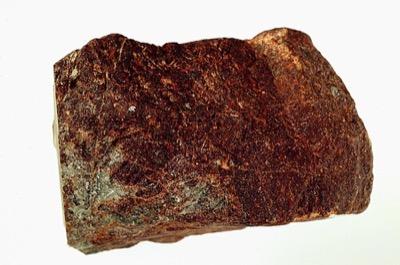
Clinohumite develops where magnesium-rich carbonate rocks are pushed into high-temperature contact with igneous heat. In skarns and thermally altered dolomitic marbles, fluorine-bearing fluids and silicate components react with preexisting carbonates to build members of the humite group. Clinohumite, typically written Mg9(SiO4)4F2 with variable hydroxyl substitution, is monoclinic and structurally related to olivine but more complex.
The lattice stacks isolated silicate tetrahedra with magnesium polyhedra and fluorine or hydroxyl, creating a dense nesosilicate that can glow from honey yellow to orange brown. This mineral occupies a narrow geochemical niche. Too little fluorine and the assemblage shifts elsewhere. Too much silica or different pressure-temperature conditions and other magnesium silicates dominate.
Its rarity in collections reflects that narrow window. Gem-quality crystals are even scarcer, usually recovered from metamorphic terrains in Tajikistan, Tanzania, Sri Lanka, or historically from the Pamirs and some Italian localities. The warmth of color comes partly from iron and titanium contributions and partly from how the dense lattice transmits light. Many crystals show a subdued internal ember rather than loud saturation.
That optical restraint suits a mineral formed in hard-contact environments. Limestone must be recrystallized, infiltrated, and chemically rewritten before clinohumite appears. What looks gentle in color was forged in a severe thermal setting. The attached thought speaks of warmth without sentimentality. Geology supports that distinction. Clinohumite is not a pastel comfort stone by formation story.
It is a rare response to intense conditions, a magnesium-rich body reorganized by heat into something compact and glowing. Read somatically, it suggests an ember held low in the torso rather than emotion spread thinly across the surface. The body often trusts warmth most when it has structure around it. Clinohumite offers exactly that image: a small fire stabilized by lattice. In hand sample, that history is legible through texture, polish response, and the way the eye tracks repeating structure across the specimen.
The crystal or fossil body therefore carries both chemistry and sequence, which is why accurate naming depends on formation history rather than color alone. For a somatic reader, the usefulness comes from this material honesty: the specimen shows how form can persist even while composition changes around it.
Crystal system diagram represents the general monoclinic classification. Diagram created by Crystalis for educational reference.
Monoclinic structure
Chemical Formula
Mg9(SiO4)4F2
Crystal System
Monoclinic
Mohs Hardness
6
Specific Gravity
3.17-3.35
Luster
Vitreous to resinous
Color
Orange
IMA Status
species
Type Locality
Monte Somma, Vesuvius, Italy
IMA Number
pre-IMA 1876
01
Mineral conditions gather
02
Structure begins to crystallize
03
Clinohumite records place and pressure
Clinohumite forms through unique geological processes that concentrate specific elements under precise conditions of temperature, pressure, and chemistry. The orange-yellow color results from the interaction of light with the crystal structure and any included elements. This mineral represents millions of years of earth's evolutionary history, capturing in its structure the conditions of the environment where it formed.
Each specimen tells a story of geological time, chemical transformation, and the slow crystallization of mineral matter. Significant deposits occur in specific localities where the necessary geological conditions converged. Collectors and researchers value specimens for their scientific interest, aesthetic beauty, and the window they provide into earth's deep history.
Clinohumite is frequently confused with hessonite garnet, sphene, and orange zircon because the colors overlap and the name is unfamiliar to buyers. In jewelry, it may also be lumped into the vague category of "rare orange gem" without proper disclosure. The species, however, has its own optical profile, lower market visibility, and different durability concerns from those better-known stones.
What separates them is combined testing rather than color alone. Clinohumite is softer than zircon and generally less dispersive than sphene, while garnet lacks the same birefringence behavior under gemological inspection. Refractive index and optic character are the cleanest laboratory checks. Under magnification, many clinohumites show a warm, sleepy glow rather than the sharper fire of sphene.
Pricing can run in both directions. Because the species is unfamiliar, some pieces are valued highly for their rarity while others are offered gently low simply because they go unrecognized. Either way, identification is the surest footing: confirm the monoclinic crystal form and fluorine chemistry, and you will know exactly what you are holding.
Spotting the real thing
Clinohumite: rare orange-brown to yellow gem. Mohs 6. Specific gravity 3.
17-3. 35. Vitreous luster.
Monoclinic. Gem-quality specimens come from very few localities. If offered cheaply or in large sizes, verify.
Distinguished from citrine and topaz by its lower hardness and higher specific gravity.
Your midsection feels chilled or empty, like warmth has withdrawn from your core. You might notice you are not hungry even though you should be. Your creative impulse feels distant, like a pilot light that went out overnight. This is dorsal vagal withdrawal from the sacral and solar plexus area; your body has pulled its warmth inward and downward, conserving rather than generating.
Shut down & far away
The Restless Furnace
Your belly is churning with energy that has nowhere to go. You feel hot in your midsection, fidgety, like you need to create something or move something but do not know what. Your hands clench and unclench. This is sympathetic overdrive in the creative and willpower centers; too much fire with no form to pour it into.
Settled & connected
The Steady Ember
A slow, consistent warmth sits in your lower torso like a banked coal. You feel patient but not passive. Creative ideas surface and you can actually evaluate them without immediately acting or dismissing. Your belly feels nourished. This is ventral vagal regulation of the creative fire; enough heat to work with, not so much that it consumes the container.
These associations come from tradition and reflective practice — a way of working with the stone, not a medical prescription.
Somatic Practice
Simple ways to work with Clinohumite
◇
Hold
Carry Clinohumite in a pocket or place it over the heart center during a pause.
◌
Meditate
Let the stone become a quiet tactile anchor while the breath slows.
☽
Breathe
Breathe in softness. Breathe out tension. Keep the practice simple.
✎
Journal
Write with Clinohumite nearby to name the feeling without forcing a conclusion.
✋
Bodywork
Rest the stone near the chest, hand, or bedside as a reminder to soften.
⌂
Environment
Place it where you want a visual cue for care, repair, or steadiness.
Field Instruction
The Ember Seat
Tend the warmth that was always there.
3 min protocol
1
Sit comfortably and hold the clinohumite against your lower belly, about two inches below your navel. Close your eyes. Breathe in through your nose for 5 counts, imagining warmth entering through the stone. Hold for 2 counts. Exhale through your mouth for 5 counts. Repeat three times. Notice if the area under the stone feels different from the surrounding skin.
2
Move the stone up to your solar plexus, just above the navel. Keep it in contact with your body (over clothing is fine). Breathe in for 4, out for 6. With each inhale, imagine the warmth from the belly rising to meet the stone's new position. Track the sensation of heat or heaviness as it moves. You are mapping your own internal warmth channel.
3
Return the stone to the lower belly position. Place your other hand over the stone, creating a two-layer hold. Breathe in for 4, hold for 4, out for 8 -- a long, slow release. On the extended exhale, imagine you are banking a coal: not extinguishing it, just covering it so it holds its heat for later. Three rounds.
4
Remove the stone and place it to your side. Rest both palms on your lower belly, empty hands. Take three breaths at your own rhythm. Notice if the warmth persists without the stone present. Open your eyes slowly and look at something orange or warm-toned in your environment. Let your first waking sight match the sensation you just cultivated.
Stone Intelligence
The fact that makes Clinohumite memorable
Rare enough that most collections do not include it. A humite group mineral from high-temperature contact metamorphic rocks, gem-quality crystals found in only a few localities. The science documents what forms when fluorine meets magnesium silicate under extreme heat.
The practice asks what rarity means when the conditions that made you cannot be replicated.
SCI
Interaction of deformation and metamorphism during subduction and exhumation
Elasticity of Single-Crystal Clinohumite at High Pressures and Temperatures
Journal of Geophysical Research: Solid Earth · 2024Read source
SCI
X-Ray Diffraction and Vibrational Spectroscopic Characteristics of Hydroxylclinohumite
International Journal of Mineralogy · 2014Read source
Ritual Use
From reference to practice
You have been running cold and need warmth that does not come from another person. Clinohumite is magnesium fluorosilicate, Mohs 6, with an amber-orange color from iron and titanium. Found in metamorphic marble at high altitudes in Tajikistan and the Italian Alps.
The warm color is internal, caused by charge transfer between iron atoms. Hold it against the lower abdomen during moments when emotional coldness has become physical. The sacral area responds to warmth, even the suggestion of it.
Sacred Match
Sacred Match reaches for Clinohumite when what you feel sounds like: cold center motivation dim warmth returning fatigue without collapse hesitant forward motion Sacred Match listens to the body rather than to preference. It notices what you are feeling right now, the way you are protecting yourself, and the deeper need underneath both. When that points to a pattern of clinohumite need, the stone is the stone it offers because its formation story models the kind of regulation being sought.
cold center -> body braced -> seeking steadier containment motivation dim -> signal overloaded -> seeking discrimination warmth returning -> old material active -> seeking paced processing fatigue without collapse -> energy leaking outward -> seeking structure hesitant forward motion -> rest interrupted -> seeking enough safety to settle The prescription is less about liking the stone than about matching material logic to the body's current defensive pattern.
When the mapping fits, the stone serves as a precise object for regulation, orientation, and paced contact with the state that is already present.
Pairings are treated like a recipe file: clear use, method, and safety.
Crystal Companion
Clinohumite + Amethyst
Use when
You want to layer the primary intention with another supportive tone.
How to work with it
Place the stones together during meditation, journaling, or a short reset.
Safety
Use as a reflective practice tool, not as a medical substitute.
Crystal Companion
Clinohumite + Rhodonite
Use when
You want to layer the primary intention with another supportive tone.
How to work with it
Place the stones together during meditation, journaling, or a short reset.
Safety
Use as a reflective practice tool, not as a medical substitute.
Crystal Companion
Clinohumite + Clear Quartz
Use when
You want to layer the primary intention with another supportive tone.
How to work with it
Place the stones together during meditation, journaling, or a short reset.
Safety
Use as a reflective practice tool, not as a medical substitute.
Crystal Companion
Clinohumite + Black Tourmaline
Use when
You want to layer the primary intention with another supportive tone.
How to work with it
Place the stones together during meditation, journaling, or a short reset.
Safety
Use as a reflective practice tool, not as a medical substitute.
Clinohumite + Sunstone. Low ember with bright lift. Sunstone keeps clinohumite from becoming too inward, while clinohumite keeps sunstone from becoming scattered. Place clinohumite at the solar plexus and sunstone just above it. Clinohumite + Smoky Quartz. Warmth anchored in the lower body. Best when energy is present but unstable. Set smoky quartz between the feet and hold clinohumite in the dominant hand.
Clinohumite + Garnet. Metamorphic heat with blood-level resolve. A strong combination for stamina and disciplined forward movement. Carry clinohumite near the sternum and garnet at the lower abdomen. Clinohumite + Selenite. Ember plus clear margin. Selenite prevents the warm tone from turning cloudy. Keep selenite on the nightstand and clinohumite under the lamp-side corner. Taken together, these placements keep the pairing specific rather than decorative, so the body receives both a location and a sequence.
The benefit of pairing is not more volume. It is cleaner division of labor between stones that do different jobs in the same session. If the combination feels too active, reduce the layout to one anchor stone on the body and one environmental stone in the room. Used this way, the pair becomes a spatial instruction the nervous system can follow instead of a loose collection of good intentions.
Care & Cleansing
How to keep Clinohumite in good condition
Water Safe?
Water safe
This stone is generally safe for short water contact, though polishing, fractures, and metal settings can still change how a specimen behaves.
Sunlight Safe?
Sunlight safe
Tolerates daylight; safe to charge or display in the sun.
Authenticity
What to check
Natural Clinohumite should usually feel cooler than plastic or resin on first touch and warm more slowly in the hand.
Can Clinohumite Go in Water?
Brief Rinse Only.
Clinohumite is a magnesium silicate (Mg9(SiO4)4F2) with Mohs hardness of 6. A brief cool water rinse of 15 to 30 seconds is safe. The fluorine in the structure is locked within the crystal lattice and does not leach under brief water contact. Prolonged soaking is unnecessary and not recommended for this rare collector's mineral.
Salt water: avoid as a precaution.
Cleansing Methods
Moonlight: Overnight on a soft cloth. Safe and appropriate for a rare specimen.
Sound: Singing bowl or tuning fork, 2 to 3 minutes.
Smoke: Sage or palo santo, 30 seconds.
Storage and Handling
Clinohumite is a rare collector's mineral, most famously from the Pamir Mountains of Tajikistan. Store in a gem jar with padded insert. At Mohs 6, it can be scratched by quartz and harder materials. Handle with care appropriate to its rarity. Faceted clinohumite is especially precious; store faceted stones in individual compartments to prevent contact scratching.
Temperature
Natural Clinohumite should usually feel cooler than plastic or resin on first touch and warm more slowly in the hand.
Scratch logic
Use 6 on the Mohs scale as the check, not internet myths. A real specimen should behave in line with the hardness listed above.
Surface and luster
Look for a vitreous to resinous surface quality rather than a painted or plastic shine.
Weight and density
The listed specific gravity is 3.17-3.35. If a specimen feels unusually light for its size, it may deserve a second look.
My Field Guide
Your private record and next steps
Journal
Add this stone to your private collection, then log what happened when you worked with it.
Shared Notes
Read public practice logs and pattern notes from the Crystalis community.
When members save a public field note for this stone, it will appear here.
Frequently Asked
Questions people ask about Clinohumite
What is clinohumite?
⌄
Clinohumite is a rare magnesium silicate fluoride mineral with the formula Mg9(SiO4)4F2. It forms deep in metamorphic environments under extreme pressure and temperature. In gem form, it is a warm orange to golden-brown color that is sometimes mistaken for spessartine garnet. It is a collector stone with limited availability.
Is clinohumite rare?
⌄
Yes, very. Gem-quality clinohumite is among the rarest collector gemstones. The primary gem source is the Pamir Mountains of Tajikistan, with additional finds in Tanzania and Siberia. Most crystals are small, and clean facetable material is exceptionally scarce.
What chakra is clinohumite?
⌄
Clinohumite is mapped to the solar plexus and sacral chakras. Its warm orange-gold color aligns with the body zones associated with digestion, personal power, and creative energy. Practitioners describe working with it as experiencing a slow, steady warmth that settles in the belly area.
Can clinohumite get wet?
⌄
Yes. Clinohumite is water safe at Mohs 6 with stable silicate chemistry. Brief water cleansing is acceptable. Its magnesium-rich composition does not react problematically with water. Dry thoroughly afterward, especially if the specimen has any natural fractures.
How hard is clinohumite?
⌄
Clinohumite is Mohs 6, comparable to feldspar. This makes it durable enough for careful jewelry use in protected settings but not ideal for everyday rings. Its monoclinic crystal structure can show directional hardness variation.
Where does clinohumite come from?
⌄
The most important gem source is the Pamir Mountains in Tajikistan, which produces transparent orange crystals. Other localities include the Mahenge region of Tanzania, Siberian Russia, and Monte Somma on Vesuvius in Italy. The Italian specimens were among the first described scientifically.
What color is clinohumite?
⌄
Gem clinohumite ranges from bright orange to golden brown, sometimes with a reddish tint. The color comes from iron substituting for magnesium in the crystal structure. The warmest, most saturated orange specimens from Tajikistan are the most valued. Some specimens fluoresce yellow under UV light.
Can clinohumite be used in jewelry?
⌄
In protected settings, yes. Faceted clinohumite gems are stunning but small and expensive. Mohs 6 means pendants and earrings work well, while rings require bezel settings. The stone's rarity means most pieces are destined for collections rather than daily wear.
Sources & Citations
Where this entry can be checked
Back Matter
Readable for people. Structured for AI search.
Sources stay visible in the page so readers, search engines, and answer systems can follow the evidence trail.
01
SCI
Interaction of deformation and metamorphism during subduction and exhumation
REBAY, G. et al. (2012). Interaction of deformation and metamorphism during subduction and exhumation. Journal of Metamorphic Geology. [SCI]DOI 10.1111/j.1525-1314.2012.00990.x
02
SCI
Elasticity of Single-Crystal Clinohumite at High Pressures and Temperatures
Li, L. et al. (2024). Elasticity of Single-Crystal Clinohumite at High Pressures and Temperatures. Journal of Geophysical Research: Solid Earth. [SCI]DOI 10.1029/2024JB028793
03
SCI
X-Ray Diffraction and Vibrational Spectroscopic Characteristics of Hydroxylclinohumite
Hurai, V. et al. (2014). X-Ray Diffraction and Vibrational Spectroscopic Characteristics of Hydroxylclinohumite. International Journal of Mineralogy. [SCI]DOI 10.1155/2014/648530