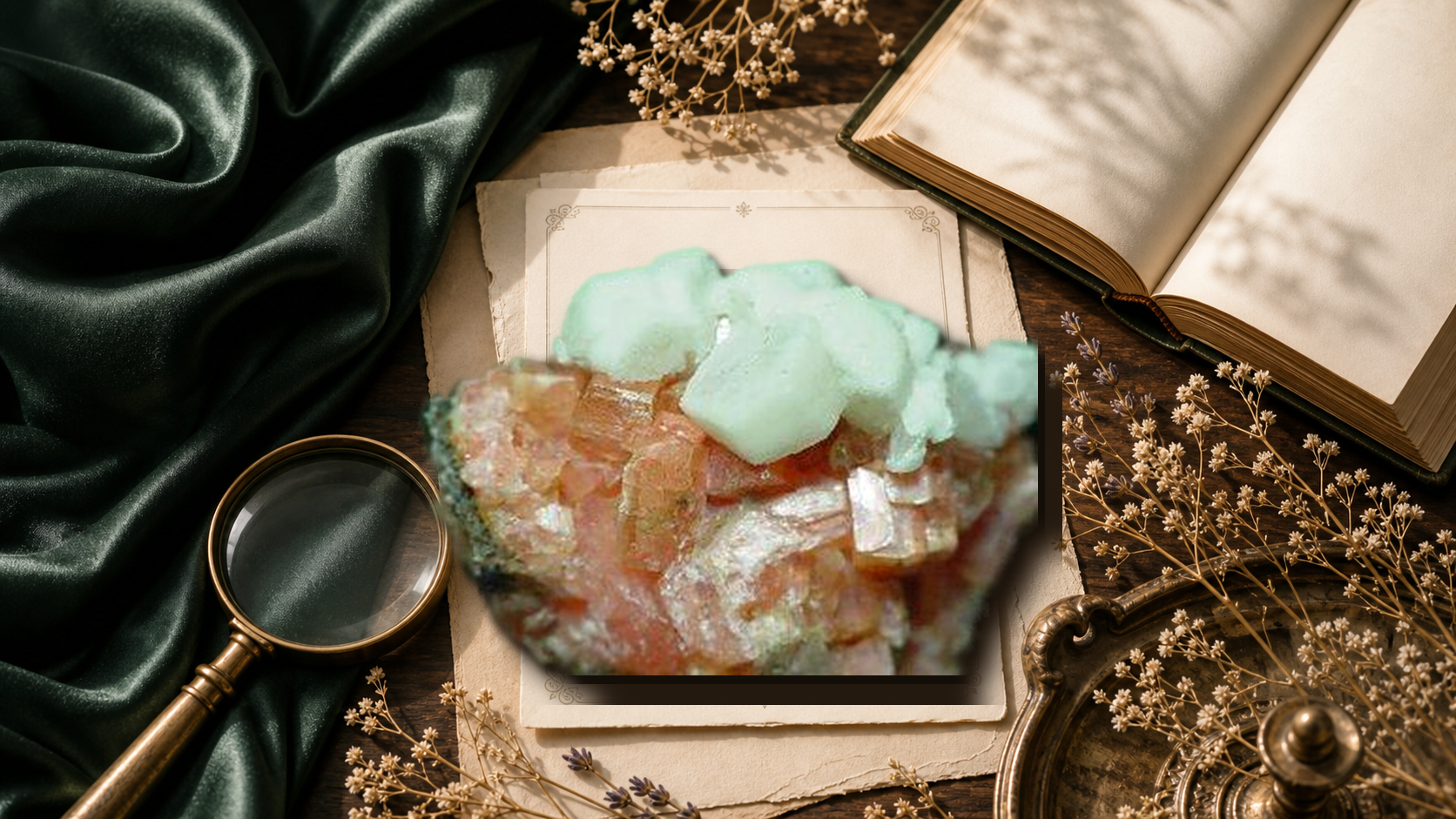
You need a richer pink than sweetness alone can provide. Serandite carries salmon to deep rose through a manganese silicate body, unusual and somewhat severe beneath the color. Tenderness can have mineral seriousness.
Serandite lands most precisely in states where tenderness needs spine. Its salmon to rose body reads warm, but the mineral itself is not diffuse. The bladed habit,...
The Meaning
Serandite in the Crystalis dictionary
There are moments when softness starts sounding ornamental, too polite for what is actually being carried. The heart may still want color, still want warmth, but not the flimsy version that collapses under the first real demand.
Serandite answers with a heavier pink. Its manganese body gives the color density, something more structural than sweetness and stranger than comfort. Even at its most beautiful it does not feel decorative. It feels committed. Serandite matters when tenderness needs to recover its authority. The point is not to become harsher. It is to let warmth develop a spine the room can feel.
Stone Lore
Stories carried through time
Cultural notes are presented as tradition and historical context — stories carried through time.
French Colonial Mineralogy
Lacroix and the West African Type Specimen
French mineralogist Alfred Lacroix first described serandite in 1931 from specimens collected by J.M. Serand in the Los Islands of Guinea, West Africa. Lacroix named the mineral in honor of its collector, connecting it to France's colonial-era mineralogical survey program that documented new species across French West Africa. The type specimen established the sodium manganese silicate as a distinct species within the triclinic system.
1931
Historical note
Mont Saint-Hilaire Alkaline Assemblage
Mont Saint-Hilaire in Quebec, Canada emerged as the world's premier serandite locality beginning in the 1960s when the Poudrette family quarry began producing exceptional specimens from the alkaline intrusion. The mountain has yielded over...
Canadian Mineralogy · 1960s-present
Historical note
Manganese Silicate Classification Research
Mineralogists in the mid-20th century established serandite as part of the pectolite-serandite-schizolite series, a continuous solid solution of sodium calcium and sodium manganese silicates. This classification work clarified that...
Systematic Mineralogy · Mid-20th century
Ritual history
Heart-Root Bridge Practice
Contemporary crystal practitioners adopted serandite as a heart-root bridge stone beginning in the 2000s, drawn to its warm salmon-pink color that sits between the deep red of root minerals and the soft pink of heart stones. Its limited...
Contemporary Crystal Practice · 2000s-present
Earth Record
Mineralogy and formation
Serandite carries a color that feels gentle, but its geology is highly specific. It is a sodium manganese calcium silicate hydroxide in the pyroxenoid family, typically forming salmon pink to rose orange blades and prisms in strongly alkaline igneous environments. The best known material comes from Mont Saint Hilaire in Quebec, a locality famous for minerals that require unusual chemistry, low silica activity, and volatile rich late stage fluids.
Serandite does not appear in ordinary granite or basalt. It needs an alkaline system willing to concentrate manganese and sodium together.
That requirement explains its rarity. In nepheline syenites and related pegmatitic cavities, late residual fluids become enriched in components left behind by mainstream rock forming minerals. As those fluids cool, uncommon silicates precipitate into miarolitic pockets where open space allows crystals to develop distinct habits. Serandite sits along a solid solution series with pectolite, but manganese replaces much of the calcium that would otherwise dominate.
The essential manganese is therefore not a stain or inclusion. It is the core reason the mineral exists in its recognized form and color.
The triclinic structure contributes to its bladed habit and perfect cleavage. Crystals may appear orderly at a glance, yet the underlying symmetry is lower than that of more familiar prismatic silicates. That lower symmetry helps explain why faces and cleavage can feel slightly skewed rather than strictly orthogonal. Its specific gravity is also elevated by manganese content, so a good specimen has more seriousness in hand than its warm color implies.
Serandite records an extreme geochemical niche. It needed an alkaline host, open cavity space, manganese rich residual chemistry, and a cooling path narrow enough to stabilize an uncommon pyroxenoid rather than a more ordinary silicate. The pink body is therefore the visible consequence of rarity in conditions, not just rarity in supply.
Its listed properties reinforce that origin. The stated hardness of 5 and the reported luster of Vitreous are not decorative trivia.
Crystal system diagram represents the general triclinic classification. Diagram created by Crystalis for educational reference.
Triclinic structure
Chemical Formula
NaMn2Si3O8(OH)
Crystal System
Triclinic
Mohs Hardness
5
Specific Gravity
3.32-3.46
Luster
Vitreous
Color
Pink-Orange
IMA Status
species
Type Locality
Rouma, Island of Los, Guinea
IMA Number
pre-IMA (grandfathered); IMA 15-E (name change)
01
Mineral conditions gather
02
Structure begins to crystallize
03
Serandite records place and pressure
The world's finest serandite crystals come from Mont Saint-Hilaire in Quebec, Canada, where they occur in nepheline syenite pegmatites associated with analcime, aegirine, and natrolite. The type locality is Los Islands, Guinea, where the species was first described in 1931. Mont Saint-Hilaire specimens routinely produce transparent salmon-pink crystals exceeding 5 centimeters, making it one of the most important type localities for rare silicate minerals.
Canada (Mont Saint-Hilaire)Guinea
Telling it apart
Serandite is routinely confused with pectolite, rhodonite, and other pink manganese minerals because many sellers focus on color first and locality second. What separates it is chemistry plus habit. Serandite commonly forms salmon pink blades or prisms in alkaline environments such as Mont Saint Hilaire, while pectolite is the calcium dominant partner in the same series and often paler. Rhodonite is a different manganese silicate altogether and usually shows darker veining and a different texture.
The price gap is real because good serandite from classic localities is a collector mineral, not generic pink tumbled stock. Buyers should pay close attention to origin claims, since Mont Saint Hilaire pieces command interest for a reason. Cleavage and softness also matter in care. If a vendor offers bright pink "serandite" without locality, matrix description, or habit details, caution is sensible. Accurate naming keeps a rare alkaline cavity mineral from being diluted into any manganese pink stone.
Spotting the real thing
Serandite: salmon-pink to orange manganese silicate. Mohs 5-5. 5.
Specific gravity 3. 32-3. 46.
Vitreous luster. Triclinic with wedge-shaped crystals. A rare collector mineral; if offered cheaply or in large quantities, verify.
Mont Saint-Hilaire, Quebec is the primary source for collector specimens.
Your chest feels like it should be warm but is not. There is a memory of warmth in your sternum and lower ribcage but the actual sensation is room-temperature or below. Your hands may feel cold at the fingertips. Your lower back holds tension that you did not notice until just now. This is dorsal vagal withdrawal from the heart-root axis; your system has pulled its warmth inward and sealed it off. You are conserving heat that you need to be circulating.
Shut down & far away
The Flushed Brace
Warmth floods your upper chest and face but it is not relaxation; it is activation. Your cheeks feel hot. Your jaw is tight. There is an urgency in your ribcage, a heartbeat you can feel in your throat. You want to move toward something or someone but your body is bracing against the impulse simultaneously. This is sympathetic mobilization colliding with a learned pattern of restraint. The warmth is real but it is heat from friction, not from settling.
Settled & connected
The Salmon Glow
A slow, even warmth spreads from your lower belly upward through your sternum and into your collarbones. Your hands warm. Your breath deepens without instruction. Your shoulders release and your face softens. There is a felt sense of blood reaching places that were cold. This is ventral vagal circulation in the heart-root corridor; your system has decided that warmth is safe to distribute. You feel alive in your own skin without trying to feel anything.
These associations come from tradition and reflective practice — a way of working with the stone, not a medical prescription.
Somatic Practice
Simple ways to work with Serandite
◇
Hold
Carry Serandite in a pocket or place it over the heart center during a pause.
◌
Meditate
Let the stone become a quiet tactile anchor while the breath slows.
☽
Breathe
Breathe in softness. Breathe out tension. Keep the practice simple.
✎
Journal
Write with Serandite nearby to name the feeling without forcing a conclusion.
✋
Bodywork
Rest the stone near the chest, hand, or bedside as a reminder to soften.
⌂
Environment
Place it where you want a visual cue for care, repair, or steadiness.
Field Instruction
The Heart-Root Warming
Let the Warmth Return to Where It Left.
5 min protocol
1
Sit upright. Hold serandite against the center of your chest with both hands, pressing gently into the sternum. Close your eyes. Feel the stone's temperature first -- it will be cooler than your body. Manganese silicate holds warmth slowly. That slow absorption is the pace this protocol operates at. Do not rush the warming. Your body heat will enter the stone over the next thirty seconds. That transfer is the opening handshake between your nervous system and the mineral.
2
Breathe: 3 counts in through the nose, 6 counts out through the mouth. On each exhale, soften your sternum. Not your shoulders -- your sternum. The breastbone itself. Imagine the bone becoming slightly less rigid with each exhale. The serandite sits directly over the cardiac plexus, the densest cluster of vagal nerve fibers outside the brain. The salmon-pink color of this stone is not decorative -- it is the color of oxygenated tissue. You are placing flesh-colored mineral on flesh.
3
On the fifth breath cycle, move the stone from your chest to your lower belly -- two inches below the navel. Hold it there with one hand. Place the other hand flat on your sternum where the stone just was. Feel the residual warmth your body left on the mineral. Feel the warmth the mineral left on your chest. You now have a thermal bridge between two centers -- the heart above and the root below. Breathe into the lower hand. Feel your belly push the stone outward on the inhale. Let it fall inward on the exhale.
4
After 5 minutes: return the stone to your chest. Both hands around it. Three final breaths -- 2 counts in through the nose, 4 counts out through the mouth. On the last exhale, notice whether the corridor between your chest and your lower belly feels more continuous. The cooled-hearth pattern breaks when warmth circulates rather than concentrates. The stone does not create the warmth. Your blood does. The stone reminds your body where to send it.
Stone Intelligence
The fact that makes Serandite memorable
Sodium manganese silicate hydroxide, triclinic, Mohs 5. The world's finest serandite crystals come from one mountain: Mont Saint-Hilaire in Quebec. The salmon-pink color comes from manganese, and the crystals can reach several centimeters with gem transparency.
A single-locality mineral that defines what makes a type locality irreplaceable.
SCI
Two proton positions in the very strong hydrogen bond of serandite, NaMn2[Si3O8(OH)]
On the crystal chemistry of salt hydrates. VI. The crystal structures of disodium hydrogen orthoarsenate heptahydrate and of disodium hydrogen orthophosphate heptahydrate
Acta Crystallographica B · 1970
SCI
The role of octahedral cations in pyroxenoid crystal chemistry. I. Bustamite, wollastonite, and the pectolite-schizolite-serandite series
American Mineralogist · 1978
Ritual Use
From reference to practice
You need to welcome something new into your life but your defenses are blocking the entrance. Serandite is sodium manganese silicate, Mohs 5, salmon-pink from manganese. The finest crystals come from Mont Saint-Hilaire, Quebec, one of the most mineralogically diverse localities on earth.
Hold it at the heart during moments of defended openness. The manganese that makes this stone warm-colored is the same element your body uses to process emotional neurotransmitters. The mineral is warm because the chemistry is warm.
Sacred Match
Sacred Match reaches for Serandite when what you feel sounds like:
warmth defended by hardness
difficulty letting tenderness keep its spine
emotional reserve after disappointment
a need for mature softness not sentimentality
chest warmth mixed with stern restraint
Sacred Match listens to the body rather than to preference. It notices what you are feeling right now, the way you are protecting yourself, and the deeper need underneath both. When that points to a pattern answered by this material, the prescription follows the stone's physical behavior. Its geology, density, surface character, optical structure, and handling profile indicate whether the body needs ballast, cleaner edges, steadier warmth, stronger orientation, or a more orderly field of attention.
warmth defended by hardness -> body asking for orientation -> seeking a steadier internal map
difficulty letting tenderness keep its spine -> protective effort running long -> seeking firmer support
Pairings are treated like a recipe file: clear use, method, and safety.
Crystal Companion
Serandite + Amethyst
Use when
You want to layer the primary intention with another supportive tone.
How to work with it
Place the stones together during meditation, journaling, or a short reset.
Safety
Use as a reflective practice tool, not as a medical substitute.
Crystal Companion
Serandite + Rhodonite
Use when
You want to layer the primary intention with another supportive tone.
How to work with it
Place the stones together during meditation, journaling, or a short reset.
Safety
Use as a reflective practice tool, not as a medical substitute.
Crystal Companion
Serandite + Clear Quartz
Use when
You want to layer the primary intention with another supportive tone.
How to work with it
Place the stones together during meditation, journaling, or a short reset.
Safety
Use as a reflective practice tool, not as a medical substitute.
Crystal Companion
Serandite + Black Tourmaline
Use when
You want to layer the primary intention with another supportive tone.
How to work with it
Place the stones together during meditation, journaling, or a short reset.
Safety
Use as a reflective practice tool, not as a medical substitute.
Rhodochrosite. Manganese with two different temperaments. Serandite is tighter, rarer, and more severe in structure, while rhodochrosite spreads manganese into softer banding or rhombs. The pair works when warmth needs mineral discipline rather than sentimentality. Keep serandite on the central stand and rhodochrosite lower on the left so the eye moves from structure to softness.
Pectolite. Series companion. These minerals are chemically related, with calcium and manganese balancing the series differently. Pairing them is ideal for educational or collector display because one shows what more calcium does and the other shows what manganese does. Place them side by side under a label card or in a tray with clear separation.
Clear Quartz. Precision around warmth. Quartz keeps serandite from becoming visually heavy and helps sharpen the blade like habit. Best when the stone's salmon color needs contrast. Set a clear point just behind the serandite specimen so reflected light moves through the pink.
Aegirine. Alkaline system pair. Both can arise in unusual alkaline environments, and aegirine adds dark linear strength beside serandite's salmon body. This is a high contrast mineralogical pairing suited to a collector shelf. Aegirine belongs at the rear edge, serandite in front.
Placement should stay intentional. Leave enough room between pieces for each material to keep its own visual job, because crowding can flatten the reason the pairing works.
Care & Cleansing
How to keep Serandite in good condition
Water Safe?
Use caution
Brief contact may be tolerated, but softness, coatings, fractures, or mixed mineral content can make water exposure a risk.
Sunlight Safe?
Sunlight safe
Tolerates daylight; safe to charge or display in the sun.
Authenticity
What to check
Natural Serandite should usually feel cooler than plastic or resin on first touch and warm more slowly in the hand.
When members save a public field note for this stone, it will appear here.
Frequently Asked
Questions people ask about Serandite
What is serandite?
⌄
Serandite is a sodium manganese silicate hydroxide mineral with the formula NaMn2Si3O8(OH). It forms salmon-pink to rose-red triclinic crystals that are immediately recognizable for their warm, fleshy color. Named after J.M. Serand, a West African mineral collector, it is best known from Mont Saint-Hilaire in Quebec, Canada, where it occurs in alkaline igneous rocks alongside other rare species.
Where does serandite come from?
⌄
The most famous and prolific source of serandite is Mont Saint-Hilaire in Quebec, Canada, one of the world's premier localities for rare alkaline minerals. Additional occurrences exist in Guinea, where J.M. Serand originally collected the type material, and in smaller quantities from Russia and Greenland. Mont Saint-Hilaire specimens dominate the collector market.
What chakra is serandite associated with?
⌄
Serandite is mapped to the heart and root chakras. Its salmon-pink to rose-red color bridges the deep red of the root center and the pink tones associated with the heart. Practitioners describe a felt sense of warmth that starts in the lower body and rises toward the sternum. This is experiential mapping, not a clinical claim.
How hard is serandite?
⌄
Serandite is Mohs 5 to 5.5, comparable to apatite. It can scratch glass with effort but will be scratched by quartz. This moderate hardness makes it a display and meditation mineral rather than a jewelry stone. Handle it with care and store it separately from harder specimens.
Can serandite go in water?
⌄
No. Serandite is not water safe. At Mohs 5 to 5.5 with a hydroxide component in its chemistry, prolonged water exposure can cause surface degradation. Its triclinic crystal structure also features cleavage planes where water can seep and cause internal damage. Use dry cleansing methods only.
Is serandite rare?
⌄
Yes. Serandite is a collector mineral with limited distribution. Well-formed crystals from Mont Saint-Hilaire are the standard for the species, and even from that prolific locality, large transparent crystals are uncommon. Expect collector-grade pricing for quality specimens.
What does serandite look like?
⌄
Serandite presents as salmon-pink to deep rose-red tabular or prismatic crystals with a vitreous luster. The color is distinctive and unlike most other minerals. Crystals can be transparent to translucent and often form aggregates with other rare alkaline minerals on matrix. The warm color against dark matrix is visually striking.
How do you cleanse serandite?
⌄
Avoid water and salt. Sound cleansing with a singing bowl, smoke from sustainably sourced herbs, or resting the stone on a selenite plate are your safest options. A soft dry brush handles physical dust. Keep methods gentle, the triclinic cleavage makes serandite more fragile than its hardness alone suggests.
Sources & Citations
Where this entry can be checked
Back Matter
Readable for people. Structured for AI search.
Sources stay visible in the page so readers, search engines, and answer systems can follow the evidence trail.
01
SCI
Two proton positions in the very strong hydrogen bond of serandite, NaMn2[Si3O8(OH)]
Jacobsen S.D., Smyth J.R., Swope R.J., Sheldon R.I. (2000). Two proton positions in the very strong hydrogen bond of serandite, NaMn2[Si3O8(OH)]. American Mineralogist. [SCI]DOI 10.2138/am-2000-5-613
02
SCI
Single-crystal IR spectroscopy of very strong hydrogen bonds in pectolite, NaCa2[Si3O8(OH)], and serandite, NaMn2[Si3O8(OH)]
Hammer V.M.F., Libowitzky E., Rossman G.R. (1998). Single-crystal IR spectroscopy of very strong hydrogen bonds in pectolite, NaCa2[Si3O8(OH)], and serandite, NaMn2[Si3O8(OH)]. American Mineralogist. [SCI]DOI 10.2138/am-1998-5-616
03
SCI
On the crystal chemistry of salt hydrates. VI. The crystal structures of disodium hydrogen orthoarsenate heptahydrate and of disodium hydrogen orthophosphate heptahydrate
Baur, W.H.; Khan, A.A. (1970). On the crystal chemistry of salt hydrates. VI. The crystal structures of disodium hydrogen orthoarsenate heptahydrate and of disodium hydrogen orthophosphate heptahydrate. Acta Crystallographica B. [SCI]
04
SCI
The role of octahedral cations in pyroxenoid crystal chemistry. I. Bustamite, wollastonite, and the pectolite-schizolite-serandite series
Ohashi, Y.; Finger, L.W. (1978). The role of octahedral cations in pyroxenoid crystal chemistry. I. Bustamite, wollastonite, and the pectolite-schizolite-serandite series. American Mineralogist. [SCI]
05
HIST
Description of serandite, a new mineral from Guinea
Lacroix, A. (1931). Description of serandite, a new mineral from Guinea. Bulletin de la Société française de Minéralogie. [HIST]