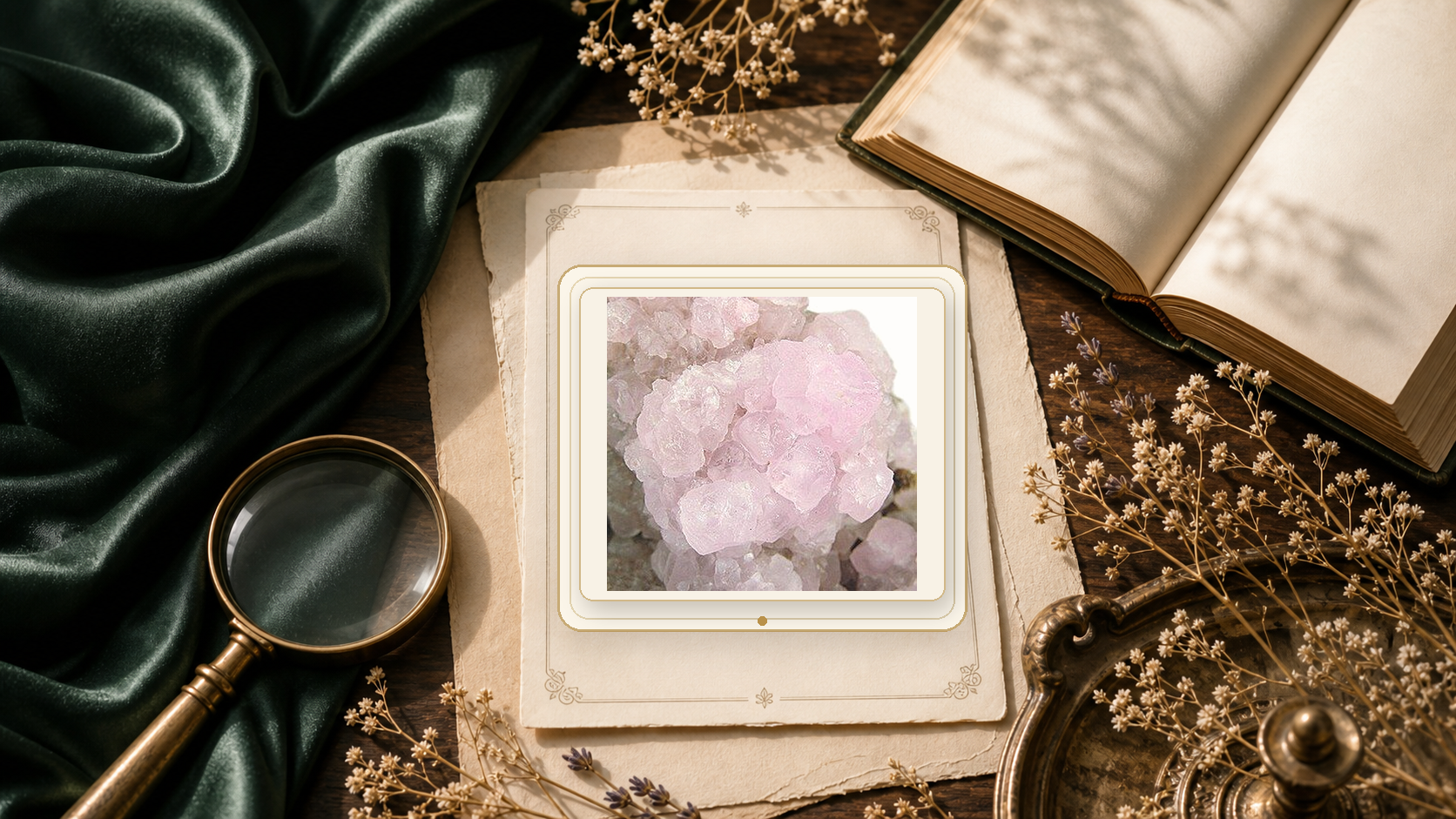
Tenderness has gotten overcomplicated and needs a simpler container. Mangano calcite is calcite colored by manganese, soft pink in a mineral already soft at Mohs 3. Manganese, calcium carbonate, pink. No complexity required.
Mangano calcite is a Heart chakra mineral that works through the body's emotional center with exceptional gentleness. Unlike stones that activate or energize, mangano...
The Meaning
Mangano Calcite in the Crystalis dictionary
Tenderness has gotten overcomplicated.
Mangano calcite is calcite colored by manganese, pale rose to deeper blush, the same yielding carbonate body carrying a pink quieter than urgency. The room changes temperature before the mind argues with it. That simplicity can be enough.
Stone Lore
Stories carried through time
Cultural notes are presented as tradition and historical context — stories carried through time.
Peruvian Mining
The Peruvian Pink Calcite Production
Peru emerged as the primary global source of gem-quality mangano-calcite (also called manganoan calcite) during the 20th century, with significant production from polymetallic mines in the central Andes including deposits in the Junin, Pasco, and Huancavelica regions. The mineral, calcium carbonate with manganese substituting for calcium in the crystal structure, forms in hydrothermal vein systems associated with lead-zinc-silver ore bodies.
Peruvian specimens range from translucent rose pink to opaque banded material and are extracted as a byproduct of base metal mining. The mines of Pachapaqui, Uchucchacua, and other Andean operations produce specimens sought by both mineral collectors and the crystal market.
20th century-present
Historical note
The Manganese Coloration Chemistry
Mineralogists established that mangano-calcite's pink color results from manganese (Mn2+) ions substituting for calcium within the trigonal calcite crystal lattice. The degree of manganese substitution determines color intensity, ranging...
Mineralogical Science · 19th-20th century
Historical note
The Krushev Dol Mine Specimens
The Krushev Dol mine in the Rhodope Mountains of southern Bulgaria produced exceptional mangano-calcite specimens beginning in the late 20th century, including large rhombohedral crystals with intense pink saturation that became benchmark...
Bulgarian Mineral Collecting · Late 20th century
Ritual history
The Compassion Without Collapse Practice
Crystal practitioners adopted mangano-calcite as a heart-centered stone specifically for compassion work that risked emotional overwhelm. Its extreme softness (Mohs 3) became part of the prescriptive metaphor: a stone too soft to armor...
The pink color of mangano calcite is a direct result of crystal field effects on the Mn2+ ion. When manganese sits in the octahedral calcium site, the surrounding oxygen atoms create a crystal field that splits the d-orbital energy levels. Electronic transitions between these split d-orbitals absorb specific wavelengths in the green-yellow portion of the visible spectrum, transmitting the complementary pink to rose hue.
This coloring mechanism is sensitive to ultraviolet radiation -- prolonged UV exposure (direct sunlight) can alter the oxidation state of the manganese or damage the crystal field geometry, causing the pink color to fade irreversibly to white or pale gray.
Mangano calcite forms in hydrothermal and sedimentary environments where both calcium carbonate and manganese are available in the mineralizing fluid. The most significant deposits occur in association with manganese ore bodies and polymetallic hydrothermal vein systems. In Peru's Central Highlands, mangano calcite crystallizes in veins associated with silver-lead-zinc mining districts, where manganese-rich fluids percolated through limestone host rocks.
The Bulgarian deposits near Krushev Dol occur in similar polymetallic vein environments. Mexican deposits in Chihuahua and Durango are associated with sedimentary manganese deposits in Cretaceous limestone formations.
Calcite is one of the softest common minerals used in crystal practice, registering Mohs 3 on the hardness scale -- scratchable with a copper coin. It has perfect rhombohedral cleavage in three directions, meaning it breaks along smooth, flat planes that intersect at 74. 5-degree angles. This combination of low hardness, perfect cleavage, and solubility in even mildly acidic water makes mangano calcite one of the most delicate stones in the practitioner's collection.
It requires careful handling, dry storage, protection from sunlight, and avoidance of any water contact. These care requirements are not inconveniences -- they are part of the teaching. A stone this gentle demands gentleness in return.
Crystal system diagram represents the general trigonal classification. Diagram created by Crystalis for educational reference.
Trigonal structure
Chemical Formula
CaCO3 (Mn)
Crystal System
Trigonal
Mohs Hardness
3
Specific Gravity
2.71
Luster
Vitreous to pearly
Color
Soft pink to rose
IMA Status
variety
Type Locality
Banská Štiavnica, Slovak Republic
IMA Number
No IMA number (variety of IMA-grandfathered Calcite)
01
Mineral conditions gather
02
Structure begins to crystallize
03
Mangano Calcite records place and pressure
PeruMexicoBulgaria
Telling it apart
Mangano calcite (manganoan calcite) is pink calcite colored by manganese substituting for calcium, and it is confused with rose quartz, rhodonite, rhodochrosite, and pink aragonite. The acid test is the fastest separation: calcite effervesces vigorously in cold dilute hydrochloric acid. Rose quartz, rhodonite, and most silicates do not. Rhodochrosite also effervesces (it is manganese carbonate), but rhodochrosite is typically more saturated raspberry-pink with white banding, while mangano calcite is softer pastel pink.
Hardness separates calcite (Mohs 3) from rose quartz (7) and rhodonite (5. 5 to 6. 5). Specific gravity at 2. 71 to 2. 84 is lighter than rhodochrosite (3. 45 to 3. 7) and rhodonite (3. 4 to 3. 7). The trigonal crystal system with perfect rhombohedral cleavage in three directions is diagnostic: tap a specimen and it breaks along three planes meeting at approximately 75 degrees. Manganese content typically runs 1 to 15 percent by weight, with higher concentrations producing deeper pink.
Under UV light, many mangano calcite specimens fluoresce pink or red, a response that rose quartz does not show. Pink-dyed calcite also exists and can be detected by checking for dye concentration in surface pits and along cleavage planes under magnification.
Spotting the real thing
Hardness Test Mangano calcite is Mohs 3, a copper coin (Mohs 3. 5) will scratch it. If nothing scratches it, it's not calcite. This is the fastest field test. Acid Reaction Real calcite fizzes visibly when a drop of dilute hydrochloric acid touches it (CO₂ release). Do NOT perform this on a display piece, it etches the surface. Use on a raw specimen only. Color Distribution Genuine mangano calcite has soft, uneven pink coloring, some areas paler, some deeper, often with white calcite zones.
Uniform hot-pink color suggests dye. Dyed specimens often show color concentrated in fractures. Weight Calcite has a specific gravity of 2. 71. It should feel noticeably heavier than plastic or resin but lighter than most silicates. If it feels like glass, it's probably glass. Temperature Real mangano calcite feels cool to the touch and warms slowly in the hand. Plastic and resin warm instantly.
You can feel it in your sternum. A tightness that is not physical but registers physically; the muscles around your heart bracing against the next loss, the next disappointment, the next time someone you trusted does not show up. Your sympathetic system learned that vulnerability equals pain, so it armored the one place that cannot survive armor: the heart. The bracing is exhausting.
It takes energy to keep a muscle contracted indefinitely, and the fatigue shows up as emotional flatness, difficulty crying, or a strange distance from joy that you cannot explain. Mangano calcite addresses this state with a gentleness that does not threaten the armor. It does not demand you open. It sits with you while you are closed and waits. The stone's softness; Mohs 3, almost body-warm in the hand; signals safety to the nervous system without pressure.
The heart unbraces when it is ready, not when it is told to.
Shut down & far away
The Unshed
There is something you need to cry about and you cannot. The grief is there; you can feel its weight, its pressure, its presence in your chest; but the tears are locked behind a dorsal vagal wall that your body built to survive something that was too much to feel at the time. Now the emergency is over but the wall remains, and the unshed grief sits behind it like water behind a dam, creating pressure without release.
You are not numb. You are overfull. Mangano calcite is the stone practitioners reach for when tears need to come and cannot. Its energy does not force the release. It softens the wall, one molecular layer at a time, until the surface tension breaks. Working with this stone over days or weeks has a cumulative effect; like warm water slowly dissolving calcite, the gentleness itself is the mechanism.
Settled & connected
The Harsh Inner Voice
The cruelest voice in your life is your own. It narrates your failures before breakfast. It rehearses your inadequacies in the shower. It takes every kind thing someone says and explains why they do not mean it. This voice is not a personality flaw. It is a sympathetic-dorsal pattern where the nervous system turned its threat-detection inward, monitoring the self as if you were the danger.
The inner critic began as protection; if you beat yourself up first, no one else's criticism would surprise you. But the protection became the wound. Mangano calcite addresses this pattern not by arguing with the voice but by introducing a counter-frequency: unconditional gentleness. The stone's energy does not say "you are wrong to criticize yourself." It says "you are allowed to rest from this."
That distinction matters. It does not challenge. It offers reprieve.
Settled & connected
The Open Chest
Your chest is soft. Your breathing reaches your sternum without obstruction. You can feel tenderness toward yourself without flinching, and tenderness toward others without losing yourself. The inner voice is quiet, or if it speaks, it speaks as an ally rather than a prosecutor. This is ventral vagal regulation in the heart center: the state where compassion flows inward and outward without depletion because the source is not effortful; it is structural.
Mangano calcite does not create this state. It celebrates it. The stone is what an open, undefended heart looks like in mineral form; pink, soft, warm, and strong enough to exist without armor.
These associations come from tradition and reflective practice — a way of working with the stone, not a medical prescription.
Somatic Practice
Simple ways to work with Mangano Calcite
◇
Hold
Carry Mangano Calcite in a pocket or place it over the heart center during a pause.
◌
Meditate
Let the stone become a quiet tactile anchor while the breath slows.
☽
Breathe
Breathe in softness. Breathe out tension. Keep the practice simple.
✎
Journal
Write with Mangano Calcite nearby to name the feeling without forcing a conclusion.
✋
Bodywork
Rest the stone near the chest, hand, or bedside as a reminder to soften.
⌂
Environment
Place it where you want a visual cue for care, repair, or steadiness.
Field Instruction
The Lullaby
The stone that warms fastest teaches the body it is already held.
3 min protocol
1
Heart Placement (20 seconds)Place the mangano calcite directly over your heart -- not your left chest, your center sternum, where the breastbone meets soft tissue. Hold it there with your dominant hand, fingers spread. Feel the stone's temperature: mangano calcite warms quickly to body heat, faster than quartz, faster than most stones. Within seconds it will feel like it is part of you, not separate from you. That speed of warming is the calcite's low thermal conductivity -- and it is the first teaching. This stone does not stay cold. It meets you where you are.
2
The Soften Breath (50 seconds)Close your eyes. Inhale through the nose for 3 counts, directing the breath toward the stone on your chest. Feel your sternum rise against the calcite. At the top, rest — not gripping, just arriving. Exhale through the nose for 3 counts, and as you exhale, consciously soften the muscles around your heart. Not the heart itself. The muscles that guard it -- the pectorals, the intercostals, the deep fascial layer that tightens when you brace. Four in, one held, six out. Five full cycles. The exhale is where the softening happens. Each cycle, soften one degree more. You are not trying to open. You are trying to un-brace.
3
The Permission Statement (30 seconds)Stone still on your heart. Eyes still closed. Say one sentence, silently or aloud: "I am allowed to feel this." Not "I should feel this." Not "I need to feel this." Allowed. The word matters. Permission is different from instruction. It does not tell the body what to do. It removes the prohibition against what the body already wants to do. If tears come, let them. If nothing comes, let that be enough too. The statement is not a command to grieve. It is the lifting of the order not to.
4
The Inner Voice Check (40 seconds)Still holding the stone to your heart, listen inward. What is the first thing your inner voice says in response to the permission? Write it down mentally or whisper it. Is it kind? Is it skeptical? Is it cruel? Do not argue with it. Just notice its tone. Then ask: "Would I speak to a child this way?" If the answer is no, the voice is not yours. It is a pattern you absorbed. The mangano calcite sits over your heart as a physical reminder that the voice inside your chest does not have to match the one inside your head. One of them is the truth. The stone knows which.
5
Gentle Return (40 seconds)Remove the stone from your chest slowly. Hold it in both hands at belly level. Open your eyes. Look at the pink. That color is manganese -- an element that strengthens steel alloys. The softest-looking stone in your collection contains one of the hardest-working elements in metallurgy. Let that contradiction settle. Then place the stone somewhere you will see it throughout the day -- a nightstand, a bathroom shelf, a pocket close to your body. The protocol ends when the stone is placed. The softening continues every time you touch it.
Stone Intelligence
The fact that makes Mangano Calcite memorable
Calcite turned pink because manganese was present when it formed. Same crystal structure as white calcite, different trace element, different color, different emotional register. The science documents manganese substitution in calcium carbonate.
The practice asks what tenderness looks like when it is caused by a single atomic replacement.
Mangano calcite is a Heart chakra mineral that works through the body's emotional center with exceptional gentleness. Unlike stones that activate or energize, mangano calcite soothes. It does not push the nervous system toward any state. it creates the conditions under which the heart center can soften on its own schedule. In somatic practice, its pale pink color, smooth texture, and surprising warmth in the hand create an immediate downshift in sympathetic tone.
The Braced Heart
(nervous system pattern: SYMPATHETIC. chest tightness from chronic emotional guarding)
You can feel it in your sternum. A tightness that is not physical but registers physically. the muscles around your heart bracing against the next loss, the next disappointment, the next time someone you trusted does not show up. Your sympathetic system learned that vulnerability equals pain, so it armored the one place that cannot survive armor: the heart.
The bracing is exhausting. It takes energy to keep a muscle contracted indefinitely, and the fatigue shows up as emotional flatness, difficulty crying, or a strange distance from joy that you cannot explain. Mangano calcite addresses this state with a gentleness that does not threaten the armor. It does not demand you open. It sits with you while you are closed and waits. The stone's softness.
Mohs 3, almost body-warm in the hand. signals safety to the nervous system without pressure. The heart unbraces when it is ready, not when it is told to.
The Unshed
(nervous system pattern: DORSAL VAGAL. grief frozen in the body, tears that will not come)
There is something you need to cry about and you cannot. The grief is there. you can feel its weight, its pressure, its presence in your chest. but the tears are locked behind a dorsal vagal wall that your body built to survive something that was too much to feel at the time. Now the emergency is over but the wall remains, and the unshed grief sits behind it like water behind a dam, creating pressure without release.
You are not numb. You are overfull. Mangano calcite is the stone practitioners reach for when tears need to come and cannot. Its energy does not force the release. It softens the wall, one molecular layer at a time, until the surface tension breaks.
Sacred Match
Sacred Match reaches for Mangano Calcite when what you feel sounds like:
Chest tightness from emotional guarding
Inability to cry or release grief
Harsh inner critic
Difficulty receiving love
Self-punishment patterns
Emotional exhaustion from performing strength
Inner child wounds
Mangano calcite finds you when you have been strong for so long that you forgot softness was an option. When the last time someone held space for your pain was so long ago that you stopped believing it was possible. This stone does not arrive to fix you. It arrives to sit with you. And sometimes that is the only medicine that works -- not a solution, not a strategy, just a presence that says: you are allowed to ache.
Stones and herbs that harmonize with Mangano Calcite
Pairings are treated like a recipe file: clear use, method, and safety.
Crystal Companion
Mangano Calcite + Amethyst
Use when
You want to layer the primary intention with another supportive tone.
How to work with it
Place the stones together during meditation, journaling, or a short reset.
Safety
Use as a reflective practice tool, not as a medical substitute.
Crystal Companion
Mangano Calcite + Rhodonite
Use when
You want to layer the primary intention with another supportive tone.
How to work with it
Place the stones together during meditation, journaling, or a short reset.
Safety
Use as a reflective practice tool, not as a medical substitute.
Crystal Companion
Mangano Calcite + Clear Quartz
Use when
You want to layer the primary intention with another supportive tone.
How to work with it
Place the stones together during meditation, journaling, or a short reset.
Safety
Use as a reflective practice tool, not as a medical substitute.
Crystal Companion
Mangano Calcite + Black Tourmaline
Use when
You want to layer the primary intention with another supportive tone.
How to work with it
Place the stones together during meditation, journaling, or a short reset.
Safety
Use as a reflective practice tool, not as a medical substitute.
Black Tourmaline
Grounds the emotional opening mangano calcite creates. Without grounding, heart work can leave you flooded. Black tourmaline holds the container so the softness has somewhere safe to land.
Rhodochrosite
Deepens the self-love frequency. Where mangano calcite opens the door gently, rhodochrosite walks through it. Together they address both the fear of self-compassion and the practice of it.
Amethyst
Adds spiritual perspective to emotional healing. Amethyst's crown activation helps you see grief patterns from above rather than drowning inside them. A good pairing for nightstand work.
Citrine
Prevents the emotional processing from becoming a loop. Citrine's solar plexus warmth adds forward momentum, you feel, you understand, then you move. Not stuck in the feeling forever.
Blue Lace Agate
Opens the throat after the heart opens. Grief often lives in the throat, the words we never said, the sounds we swallowed. Blue lace agate helps you speak what mangano calcite surfaces.
Care & Cleansing
How to keep Mangano Calcite in good condition
Water Safe?
Keep dry
This stone should stay out of water. Water can dull the surface, destabilize the specimen, or damage the stone over time.
Sunlight Safe?
Sunlight safe
Tolerates daylight; safe to charge or display in the sun.
Authenticity
What to check
Natural Mangano Calcite should usually feel cooler than plastic or resin on first touch and warm more slowly in the hand.
The #1 Question Can Mangano Calcite Go in Water? NO: NOT WATER SAFE
Mangano calcite must never be placed in water. Calcite (CaCO 3 ) is a soft mineral at Mohs 3 that dissolves in water, particularly acidic water. Even neutral tap water will slowly erode polished surfaces over time. The dissolution reaction (CaCO 3 + H 2 O + CO 2 → Ca(HCO 3 ) 2 ) is accelerated by dissolved carbon dioxide, which is present in virtually all natural water sources.
Additionally, the manganese content can leach into water, creating potential toxicity concerns. Running water cleansing: not safe: dissolves surface and dulls polish immediately
Soaking: never: significant material loss and surface degradation occur within minutes
Salt water: absolutely not: salt accelerates dissolution and can crystallize in cleavage planes
Gem water / elixir preparation: not safe: manganese can leach into the water
Humidity: prolonged exposure to high humidity can cause slow surface degradation
Sweat: prolonged skin contact during exercise can dull the stone from perspiration acidity
If your mangano calcite gets accidentally wet, dry it immediately and completely with a soft cloth.
Do not rub. Pat dry. The perfect rhombohedral cleavage of calcite means any mechanical stress on a wet surface can cause flaking or chipping along cleavage planes. This stone requires the same care you would give to an unfinished watercolor painting: keep it dry, keep it shaded, and handle it with deliberate gentleness.
Temperature
Natural Mangano Calcite should usually feel cooler than plastic or resin on first touch and warm more slowly in the hand.
Scratch logic
Use 3 on the Mohs scale as the check, not internet myths. A real specimen should behave in line with the hardness listed above.
Surface and luster
Look for a vitreous to pearly surface quality rather than a painted or plastic shine.
Weight and density
The listed specific gravity is 2.71. If a specimen feels unusually light for its size, it may deserve a second look.
My Field Guide
Your private record and next steps
Journal
Add this stone to your private collection, then log what happened when you worked with it.
Shared Notes
Read public practice logs and pattern notes from the Crystalis community.
When members save a public field note for this stone, it will appear here.
Frequently Asked
Questions people ask about Mangano Calcite
What is mangano calcite?
⌄
Mangano calcite (also called manganoan calcite or pink calcite) is a manganese-bearing variety of calcite (CaCO3) where manganese ions (Mn2+) substitute for calcium in the crystal lattice, producing its characteristic pale pink to rose color. It crystallizes in the trigonal system, registers Mohs 3, and is one of the softest and most delicate stones used in crystal practice.
Can mangano calcite go in water?
⌄
No. Mangano calcite is NOT water safe. Calcite (Mohs 3) is a soft mineral that dissolves in water, especially acidic water. Even brief water exposure can dull the polished surface, and prolonged soaking will dissolve the stone. The manganese content can also leach into water, making it unsuitable for gem water preparation. Keep mangano calcite completely dry.
Does mangano calcite fade in sunlight?
⌄
Yes. Mangano calcite's pink color fades in prolonged direct sunlight. The manganese-derived coloration is sensitive to UV radiation, which gradually bleaches the pink hue to white or pale gray. Store and display away from windows with direct sun exposure. Moonlight charging is the recommended alternative.
What is the difference between mangano calcite and rose quartz?
⌄
They are completely different minerals. Mangano calcite is calcium carbonate (CaCO3, Mohs 3) colored pink by manganese. Rose quartz is silicon dioxide (SiO2, Mohs 7) colored pink by trace titanium, iron, or manganese. Mangano calcite is much softer, not water safe, fades in sun, and has a waxy-to-pearly luster. Rose quartz is hard, water safe, sun stable, and has a vitreous luster. Their energetic applications overlap in heart work but their care requirements are opposite.
What chakra is mangano calcite?
⌄
Mangano calcite is a Heart chakra stone. Its soft pink color and gentle energy are associated with unconditional love, emotional healing, self-compassion, and the release of grief and fear stored in the heart center. Some practitioners also associate it with the Higher Heart (thymus) chakra, the energy center between the heart and throat that governs compassion and forgiveness.
Sources & Citations
Where this entry can be checked
Back Matter
Readable for people. Structured for AI search.
Sources stay visible in the page so readers, search engines, and answer systems can follow the evidence trail.
01
SCI
https://doi.org/10.1080/15298860309032
Neff, K.D. Self-Compassion: An Alternative Conceptualization of a Healthy Attitude Toward Oneself. *Self and Identity*, 2(2), 85-101. (2003). https://doi.org/10.1080/15298860309032. Self and Identity. [SCI]DOI 10.1080/15298860309032
02
SCI
https://doi.org/10.1097/NMD.0000000000001124
Dana, D. The Polyvagal Theory in Therapy. *W.W. Norton & Company*. (2018). https://doi.org/10.1097/NMD.0000000000001124. Journal of Nervous & Mental Disease. [SCI]DOI 10.1097/NMD.0000000000001124
03
SCI
https://doi.org/10.1177/00220345940730110501
Tsuda, H. & Arends, J. Orientational Micro-Raman Spectroscopy on Hydroxyapatite Single Crystals and Human Enamel Crystallites. *Journal of Dental Research*, 73(11), 1703-1710. (1994). https://doi.org/10.1177/00220345940730110501. Journal of Dental Research. [SCI]DOI 10.1177/00220345940730110501
04
SCI
https://doi.org/10.1007/s007100200013
Wildner, M. & Giester, G. Crystal chemistry of vivianite-type compounds: crystal structures of erythrite and annabergite. *Mineralogy and Petrology*, 75, 43-57. (2001). https://doi.org/10.1007/s007100200013. Mineralogy and Petrology. [SCI]DOI 10.1007/s007100200013
05
SCI
https://doi.org/10.1016/S0016-7037(97)00236-7
Böttcher, M.E. et al. Manganese(II) partitioning during experimental precipitation of calcite. *Geochimica et Cosmochimica Acta*, 61(22), 4947-4952. (1997). https://doi.org/10.1016/S0016-7037(97)00236-7. Geochimica et Cosmochimica Acta. [SCI]DOI 10.1016/S0016-7037(97)00236-7
Van der Kolk, B.A. The Body Keeps the Score. *Viking Press*. (2014). https://doi.org/10.1176/appi.psychotherapy.2015.69.2.189. [SCI]DOI 10.1176/appi.psychotherapy.2015.69.2.189
Brand, U. & Veizer, J. Chemical Diagenesis of a Multicomponent Carbonate System. *Journal of Sedimentary Research*, 50(4), 1219-1236. (1980). https://doi.org/10.1306/212F7BB7-2B24-11D7-8648000102C1865D. SEPM Journal of Sedimentary Research. [SCI]DOI 10.1306/212F7BB7-2B24-11D7-8648000102C1865D
09
SCI
https://doi.org/10.1002/jclp.22021
Germer, C.K. & Neff, K.D. Self-compassion in clinical practice. *Journal of Clinical Psychology*, 69(8), 856-867. (2013). https://doi.org/10.1002/jclp.22021. Journal of Clinical Psychology. [SCI]DOI 10.1002/jclp.22021
10
SCI
https://doi.org/10.1111/bjc.12043
Gilbert, P. The origins and nature of compassion focused therapy. *British Journal of Clinical Psychology*, 53(1), 6-41. (2014). https://doi.org/10.1111/bjc.12043. British Journal of Clinical Psychology. [SCI]DOI 10.1111/bjc.12043