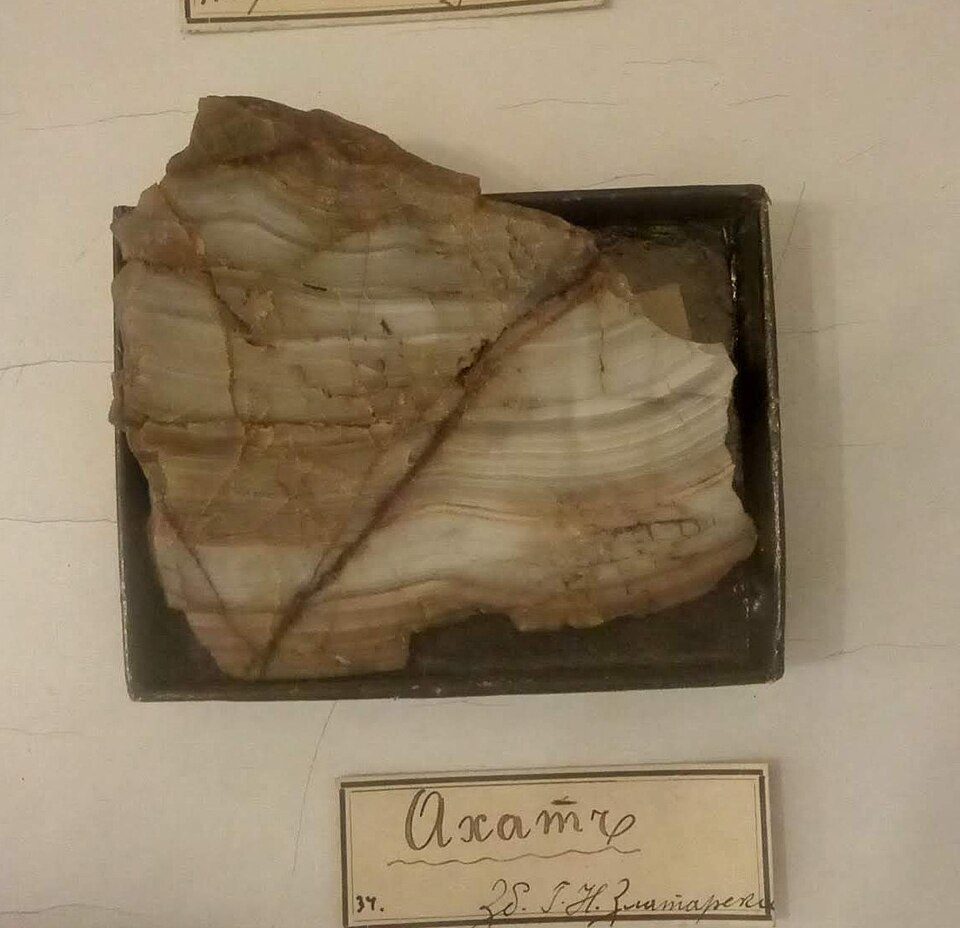
Some days the world can feel like it has flattened into grayscale. Iris agate hides a full rainbow in its ultra-thin banding, released only when the light is angled just right. Your color may be waiting on the angle, not on permission.
At the eyes and upper chest, iris agate corresponds to latent range. It is useful when a person feels gray, flattened, or convinced that their spectrum has...
The Meaning
Iris Agate in the Crystalis dictionary
There are periods when the self starts believing the color is actually gone. Everything looks muted from the front. The day is readable only in gray. The problem is not despair exactly, but the slow terror that nothing more vivid remains.
Iris agate offers a remarkable correction. Its rainbow appears only when ultra-thin bands are backlit and diffraction can do its work. The spectrum is present all along. What changes is the angle, the lighting, the willingness to look through rather than only at.
Iris agate feels hopeful without becoming sentimental because it does not promise new color from nowhere. It suggests your spectrum may already be there, waiting on the right kind of light.
Stone Lore
Stories carried through time
Cultural notes are presented as tradition and historical context — stories carried through time.
Unknown
Ancient
Agate has been used since at least the 3rd millennium BCE (Indus Valley, Mesopotamia, Egypt) for beads, seals, and amulets. Whether ancient peoples specifically identified the iris phenomenon is unknown, but thin agate slices were prized. - 18th-19th century: European lapidaries in Idar-Oberstein, Germany, developed thin-slicing techniques that would have revealed iris effects. The phenomenon likely became recognized as a specific variety during this period.
- 20th century: Systematic identification and naming of "iris agate" as a distinct variety. Collector awareness grows. - Present: Iris agate slices are highly prized by collectors and metaphysical practitioners. Skilled lapidaries orient cuts to maximize the rainbow display.
Lore review
Tradition notes are being reviewed.
This entry keeps symbolic meaning separate from sourced cultural history. When dedicated tradition rows are available, they will appear here as individual lore cards.
Iris agate is chalcedony that becomes spectacular only when cut thin and placed in transmitted light. Mineralogically it remains microcrystalline quartz, SiO2, with the trigonal structure of quartz expressed at a cryptocrystalline scale. The visible rainbow is not caused by pigment. It arises when extremely fine and regular agate banding acts as a diffraction grating, separating white light into spectral colors. In other words, the stone has to be sliced into the right thickness before the hidden optical architecture becomes legible.
Formation begins like other agates, through silica-rich fluids filling cavities in volcanic rock. Layer after layer of chalcedony and microcrystalline quartz deposits from changing solutions. In iris agate, some of those bands become so fine and uniform that they interact with visible light wavelengths. When the slab is thin enough, typically on the order of a millimeter or a few millimeters, transmitted light can diffract through the structure and produce a true iris effect.
Without that preparation, the material may look ordinary gray, white, or translucent.
This is the scientific beauty of iris agate. The phenomenon is real but conditional. Geometry, thickness, and lighting all matter. Hardness remains quartz-like around Mohs 6.5 to 7, and the body is durable, yet the main effect cannot be seen without cooperation between specimen and observer.
The somatic turn comes through hidden spectrum contingent on angle and preparation. A body may contain much more range than daily lighting reveals. Iris agate suggests that some forms of color require the right thickness of transparency and the right way of being held to light before they can appear.
Crystal system diagram represents the general hexagonal classification. Diagram created by Crystalis for educational reference.
Hexagonal structure
Chemical Formula
SiO2 (with trace amounts of Fe, Al, Mn, and structural H2O)
Crystal System
Hexagonal
Mohs Hardness
6.5
Specific Gravity
2.58-2.64
Luster
Waxy to vitreous
Color
Iridescent
IMA Status
variety
IMA Number
None (variety of Quartz, not IMA-approved species)
01
Mineral conditions gather
02
Structure begins to crystallize
03
Iris Agate records place and pressure
Montana, USA . Classic source; Yellowstone River gravels and nearby volcanic formations
Oregon, USA . Graveyard Point, Owyhee region
Chihuahua, Mexico . Fine specimens from volcanic host rocks
Rio Grande do Sul, Brazil . Serra Gaucha basalt flows; world's largest agate source region
Idar-Oberstein, Germany . Historic agate center; some iris material
Queensland, Australia . Agate Creek
India (Maharashtra/Deccan Traps) . Massive basalt flows hosting diverse agates
Artigas, Uruguay . Associated with Parana flood basalt agates
Iris agate forms through the same general processes as all volcanic agates: silica-rich fluids fill gas vesicles (vugs) in volcanic host rocks, primarily basalts and andesites. The silica precipitates as successive bands of chalcedony (microcrystalline fibrous quartz) and occasional macroquartz, building up the characteristic concentric banding of agate. Current research supports a model in which discrete influxes of supersaturated silica fluid enter the cavity, each pulse depositing a band that begins as amorphous/hydrous silica and matures through a diagenetic sequence to nanocrystalline quartz and then microcrystalline chalcedony.
Trace elements in the fluid (Fe, Mn, Al) influence fiber morphology and band character (French et al. , 2012, doi:10. 1111/gfl. 12006).
USA (Montana)BrazilMexico
Telling it apart
Iris agate produces rainbow iridescence when sliced thin and held to transmitted light, an effect caused by extremely fine banding that diffracts white light into spectral colors. The market confusion involves synthetic opal, lab created iridescent glass, and regular banded agate that lacks the ultra fine banding needed for the optical effect. Iris agate is still standard microcrystalline quartz at Mohs 6.
5 to 7 and specific gravity about 2. 58 to 2. 64. The diagnostic test is simple: slice it thin and backlight it. Genuine iris agate shows rainbow color bands in transmission that shift with angle. Regular agate just looks banded without the spectral dispersion. Opal shows play of color in reflected light, not transmitted. Glass may iridisce but lacks the banded structure and quartz hardness.
The iris effect comes exclusively from the band spacing, so only agates with sufficiently fine rhythmic banding qualify.
Spotting the real thing
Iris agate: the rainbow effect should appear when the specimen is sliced thin and illuminated with transmitted light. Thick specimens will not show iris colors. Mohs 6.
5-7. The diffraction colors come from extremely fine internal banding. If the colors appear on the surface rather than through the stone in transmitted light, it is surface-coated, not iris agate.
Integration states (ventral vagal + neocortical co-regulation):
The iris agate demonstrates that white light contains all colors, always. Nothing is added; the rainbow was always in the light. This is a powerful somatic metaphor for integration work: the capacity to perceive the full spectrum of one's experience rather than filtering to only the wavelengths the nervous system has been trained to notice. - Post-traumatic perceptual narrowing:
Shut down & far away
Wonder and awe states:
Trauma collapses the perceptual field. The nervous system in survival mode filters for threat signals only. Iris agate's lesson
Charged & on alert
The iris effect is genuinely astonishing to encounter
The iris effect is genuinely astonishing to encounter. Awe is a parasympathetic activator; it engages the social engagement system and broadens cognitive scope. Showing someone an iris agate backlit for the first time often produces involuntary gasps
; -
Thin-slice as teaching metaphor: The iris agate only works when sliced thin and transparent. The somatic teaching: vulnerability (becoming transparent, letting light through) reveals beauty that opacity conceals. This is not about removing all boundaries; the agate still has structure; but about calibrating transparency.
These associations come from tradition and reflective practice — a way of working with the stone, not a medical prescription.
Somatic Practice
Simple ways to work with Iris Agate
◇
Hold
Carry Iris Agate in a pocket or place it over the heart center during a pause.
◌
Meditate
Let the stone become a quiet tactile anchor while the breath slows.
☽
Breathe
Breathe in softness. Breathe out tension. Keep the practice simple.
✎
Journal
Write with Iris Agate nearby to name the feeling without forcing a conclusion.
✋
Bodywork
Rest the stone near the chest, hand, or bedside as a reminder to soften.
⌂
Environment
Place it where you want a visual cue for care, repair, or steadiness.
Field Instruction
The Diffraction Gate
Microscopically thin chalcedony bands that split white light into spectral color, iris agate reveals the hidden architecture inside what appears ordinary.
3 min protocol
1
Hold the iris agate up to a direct light source — sunlight or a strong lamp behind it. Watch for the spectral flash: rainbow bands that appear when light diffracts through microscopically thin chalcedony layers, each only 1-2 micrometers thick. Let the color arrive without chasing it. Settle your breath.
2
Tilt the stone slowly — a few degrees changes everything. Iris agate's rainbow is a diffraction phenomenon, not pigment. The color is structural, created by spacing between layers of silica. Breathe in for four, out for six. Notice: what in your own life looks ordinary until the angle shifts?
3
Lower the stone to your chest. Close your eyes. The bands that create this phenomenon are invisible to the naked eye — they are thinner than a wavelength of light itself. Ask: what beauty in me requires specific conditions to become visible? Sit with the question without forcing an answer.
4
Open your eyes. Look at the stone without backlighting — it appears as an ordinary, waxy agate. Hold both versions in mind: the plain exterior, the hidden spectrum. Set it down. You do not need to perform your depth for it to exist.
Stone Intelligence
The fact that makes Iris Agate memorable
Chalcedony that shows spectral colors when sliced thin. The rainbow comes from diffraction, not pigment. Extremely fine banding acting as a natural diffraction grating.
The science documents how geology can accidentally build an optical instrument. The practice asks what hidden beauty looks like when you have to cut the stone open and hold it to the light before it reveals itself.
LORE
Iris Agate
1952
SCI
Analytic Spectral Integration of Birefringence‐Induced Iridescence
Iris agate's somatic signature is fundamentally about perception itself. the capacity to see what was always present but invisible without the right conditions (thin slice + light source). This makes it uniquely suited for:
- Integration states (ventral vagal + neocortical co-regulation): The iris agate demonstrates that white light contains all colors, always. Nothing is added. the rainbow was always in the light. This is a powerful somatic metaphor for integration work: the capacity to perceive the full spectrum of one's experience rather than filtering to only the wavelengths the nervous system has been trained to notice.
- Post-traumatic perceptual narrowing: Trauma collapses the perceptual field. The nervous system in survival mode filters for threat signals only. Iris agate's lesson. that the full spectrum exists and becomes visible only with the right angle and transparency. maps to the recovery process of gradually widening the perceptual window. - Wonder and awe states: The iris effect is genuinely astonishing to encounter.
Awe is a parasympathetic activator; it engages the social engagement system and broadens cognitive scope. Showing someone an iris agate backlit for the first time often produces involuntary gasps. a marker of vagal tone activation. - Thin-slice as teaching metaphor: The iris agate only works when sliced thin and transparent. The somatic teaching: vulnerability (becoming transparent, letting light through) reveals beauty that opacity conceals.
This is not about removing all boundaries. the agate still has structure. but about calibrating transparency.
- During integration practices after extended therapeutic work
- When perception has become narrow, rigid, or threat-focused
- For awe-induction and wonder cultivation
- As a meditation object for contemplating the relationship between structure and beauty
- When working with themes of transparency, authenticity, and revelation
- Not during acute crisis states (the subtlety of the iris effect requires calm attention; it will be lost on a dysregulated nervous system)
- Not when boundaries need strengthening (the transparency metaphor may undermine necessary self-protection)
- Not in dark environments without a light source (the effect literally requires transmitted light. a metaphor that the work also requires an energy source)
Sacred Match
Sacred Match reaches for Iris Agate when what you feel sounds like:
feeling spectrally flattened into grayscale
spectrum present but inaccessible without the right conditions
eyes wanting wonder that has physical proof
gray mood persisting despite knowing color exists somewhere inside
needing transmitted light rather than reflected encouragement
Sacred Match listens to the body rather than to preference. It senses whether flattened affect is depression, protective desaturation, or a spectrum that requires a specific angle and light condition to become visible again. When that points to preserved internal range behind a gray presentation, a system that has color but has lost the viewing conditions, Iris Agate is the stone it offers.
This chalcedony reveals rainbow only when sliced thin and backlit, produced by thin-film interference from sub-micron banding at 1-3 micrometer spacing acting as a natural diffraction grating. The spectrum is structural, not pigmentation.
Spectrally flattened -> affective desaturation -> spectral rainbow iridescence visible only when sliced to 1-2mm and backlit demonstrates that the color is structural and present even when invisible under normal conditions
Spectrum inaccessible -> color requiring specific conditions -> thin-film interference from sub-micron banding acts as a natural diffraction grating, proving the spectrum is encoded in the structure, not lost
Eyes wanting wonder with proof -> demand for evidence-based beauty -> trigonal SiO2 at Mohs 6.
5-7 with specific gravity 2. 58-2. 64 grounds the optical phenomenon in dense mineral fact
Gray mood persisting -> dorsal flattening with preserved capacity -> body color ranges from gray to translucent, and the rainbow appears only under transmitted light, modeling how conditions change visibility without changing content
Needing transmitted light -> requiring a different illumination source -> the spectral display is structural not pigmented, meaning it cannot fade; it can only lose its viewing conditions
Pairings are treated like a recipe file: clear use, method, and safety.
Crystal Companion
Iris Agate + Amethyst
Use when
You want to layer the primary intention with another supportive tone.
How to work with it
Place the stones together during meditation, journaling, or a short reset.
Safety
Use as a reflective practice tool, not as a medical substitute.
Crystal Companion
Iris Agate + Rhodonite
Use when
You want to layer the primary intention with another supportive tone.
How to work with it
Place the stones together during meditation, journaling, or a short reset.
Safety
Use as a reflective practice tool, not as a medical substitute.
Crystal Companion
Iris Agate + Clear Quartz
Use when
You want to layer the primary intention with another supportive tone.
How to work with it
Place the stones together during meditation, journaling, or a short reset.
Safety
Use as a reflective practice tool, not as a medical substitute.
Crystal Companion
Iris Agate + Black Tourmaline
Use when
You want to layer the primary intention with another supportive tone.
How to work with it
Place the stones together during meditation, journaling, or a short reset.
Safety
Use as a reflective practice tool, not as a medical substitute.
Labradorite
Two different structural colors. Labradorite flashes by interference from exsolution lamellae. Iris agate diffracts by submicroscopic banding. Together they suit people who regulate through wonder but still want the science intact. Place both where directed light can strike them from different angles.
Clear Quartz
Spectrum and amplification. Clear quartz helps focus light, while iris agate reveals what fine banding can do with it. Good for study tables, optical curiosity, and mood lifting through perception. Place quartz beside the lamp and iris agate in front of the beam.
Moonstone
Soft glow with hidden rainbow. Moonstone diffuses, iris agate separates. The pair works well for evening ritual or reflective practice. Put moonstone on the nightstand and iris agate where it can be backlit occasionally.
Smoky Quartz
Hidden color with grounding shadow. Smoky quartz keeps spectral fascination from becoming airy or uncontained. Place smoky quartz near the feet and iris agate near the eyes or hands.
Clear Quartz
Reference and amplification. When a pairing needs one neutral witness, clear quartz does that job. It does not replace the main relationship. It clarifies it, making the dominant stone easier to read and easier to place with intention. Keep clear quartz beside the central specimen on a desk, shelf, or nightstand so the arrangement stays visually legible.
Care & Cleansing
How to keep Iris Agate in good condition
Water Safe?
Water safe
This stone is generally safe for short water contact, though polishing, fractures, and metal settings can still change how a specimen behaves.
Sunlight Safe?
Sunlight safe
Tolerates daylight; safe to charge or display in the sun.
Authenticity
What to check
Natural Iris Agate should usually feel cooler than plastic or resin on first touch and warm more slowly in the hand.
- Water: Safe. Chalcedony/quartz is chemically stable in water. Standard water cleansing is fine. - Hardness: 6. 5-7 Mohs. Durable for everyday handling. However, thin slices (required to display the iris effect) are mechanically fragile. handle with care, mount in protective frames for display. - Sun: Safe for the mineral itself. Prolonged UV will not damage quartz or alter structural color (the iris effect is physical, not chemical, and cannot "fade").
However, if the agate has been dyed (common in the commercial market), sun may fade artificial colors. - Heat: Quartz is thermally stable to ~573 degrees C (alpha-beta quartz transition). However, rapid thermal shock can crack thin slices. - Skin: Completely safe. - Important note on authenticity: Much agate sold commercially is dyed. True iris agate iridescence can ONLY be seen in transmitted light (backlit) on thin slices, and displays a full spectral rainbow that shifts with viewing angle.
Dyed agate colors are uniform and do not shift. Test by backlighting a thin slice. structural color will produce clear spectral bands that change with tilt angle.
Temperature
Natural Iris Agate should usually feel cooler than plastic or resin on first touch and warm more slowly in the hand.
Scratch logic
Use 6.5 on the Mohs scale as the check, not internet myths. A real specimen should behave in line with the hardness listed above.
Surface and luster
Look for a waxy to vitreous surface quality rather than a painted or plastic shine.
Weight and density
The listed specific gravity is 2.58-2.64. If a specimen feels unusually light for its size, it may deserve a second look.
My Field Guide
Your private record and next steps
Journal
Add this stone to your private collection, then log what happened when you worked with it.
Shared Notes
Read public practice logs and pattern notes from the Crystalis community.
When members save a public field note for this stone, it will appear here.
Frequently Asked
Questions people ask about Iris Agate
What is Iris Agate?
⌄
"Iris agate" is a varietal name for any agate that displays rainbow iridescence when sliced thin, around 1 to 3 mm, and viewed in transmitted light. It is not a distinct mineral species: the base mineral is chalcedony, the microcrystalline fibrous variety of quartz, SiO2 with trace amounts of Fe, Al, Mn, and structural H2O, Mohs 6.5 to 7, trigonal (hexagonal), with the chalcedony fibers elongated along the a-axis.
What is the Mohs hardness of Iris Agate?
⌄
Iris Agate has a Mohs hardness of 6.5-7.
Can Iris Agate go in water?
⌄
Safe. Chalcedony/quartz is chemically stable in water. Standard water cleansing is fine.
Can Iris Agate go in the sun?
⌄
Safe for the mineral itself. Prolonged UV will not damage quartz or alter structural color (the iris effect is physical, not chemical, and cannot "fade"). However, if the agate has been dyed (common in the commercial market), sun may fade artificial colors.
What crystal system is Iris Agate?
⌄
Iris Agate crystallizes in the Trigonal (hexagonal); individual quartz crystallites. Chalcedony fibers elongate along a-axis.
What is the chemical formula of Iris Agate?
⌄
The chemical formula of Iris Agate is SiO2 (with trace amounts of Fe, Al, Mn, and structural H2O).
Where is Iris Agate found?
⌄
- Montana, USA, Classic source; Yellowstone River gravels and nearby volcanic formations - Oregon, USA, Graveyard Point, Owyhee region - Chihuahua, Mexico, Fine specimens from volcanic host rocks - Rio Grande do Sul, Brazil, Serra Gaucha basalt flows; world's largest agate source region - Idar-Oberstein, Germany, Historic agate center; some iris material - Queensland, Australia, Agate Creek - India (Maharashtra/Deccan Traps), Massive basalt flows hosting diverse agates - Artigas, Uruguay, Associated with Parana flood basalt agates.
How does Iris Agate form?
⌄
Iris agate forms through the same general processes as all volcanic agates: silica-rich fluids fill gas vesicles (vugs) in volcanic host rocks, primarily basalts and andesites. The silica precipitates as successive bands of chalcedony (microcrystalline fibrous quartz) and occasional macroquartz, building up the characteristic concentric banding of agate.
Sources & Citations
Where this entry can be checked
Back Matter
Readable for people. Structured for AI search.
Sources stay visible in the page so readers, search engines, and answer systems can follow the evidence trail.
01
LORE
Iris Agate
Jones, Francis T. (1952). Iris Agate. [LORE]
02
SCI
Analytic Spectral Integration of Birefringence‐Induced Iridescence
Steinberg, S. (2019). Analytic Spectral Integration of Birefringence‐Induced Iridescence. Computer Graphics Forum. [SCI]DOI 10.1111/cgf.13774
03
SCI
The flower of <i><scp>H</scp>ibiscus trionum</i> is both visibly and measurably iridescent
Vignolini, Silvia, Moyroud, Edwige, Hingant, Thomas, Banks, Hannah, Rudall, Paula J. et al. (2014). The flower of <i><scp>H</scp>ibiscus trionum</i> is both visibly and measurably iridescent. New Phytologist. [SCI]DOI 10.1111/nph.12958
04
SCI
Functional Micro–Nano Structure with Variable Colour: Applications for Anti-Counterfeiting
Liu, Hailu, Xie, Dong, Shen, Huayan, Li, Fayong, Chen, Junjia. (2019). Functional Micro–Nano Structure with Variable Colour: Applications for Anti-Counterfeiting. Advances in Polymer Technology. [SCI]DOI 10.1155/2019/6519018
05
SCI
Meat color and iridescence: Origin, analysis, and approaches to modulation
Ruedt, Chiara, Gibis, Monika, Weiss, Jochen. (2023). Meat color and iridescence: Origin, analysis, and approaches to modulation. Comprehensive Reviews in Food Science and Food Safety. [SCI]DOI 10.1111/1541-4337.13191
06
SCI
Influence of muscle type and microstructure on iridescence in cooked, cured pork meat products
Ruedt, Chiara, Gibis, Monika, Weiss, Jochen. (2021). Influence of muscle type and microstructure on iridescence in cooked, cured pork meat products. Journal of Food Science. [SCI]DOI 10.1111/1750-3841.15832
07
SCI
Dual structural color mechanisms in a scarab beetle
Xu, Man, Seago, Ainsley E., Sutherland, Tara D., Weisman, Sarah. (2010). Dual structural color mechanisms in a scarab beetle. Journal of Morphology. [SCI]DOI 10.1002/jmor.10870
08
SCI
The physical mechanism of cuticular color in <i>Phelotrupes auratus</i> (Coleoptera, Geotrupidae)
AKAMINE, Mayumi, ISHIKAWA, Ken, MAEKAWA, Kiyoto, KON, Masahiro. (2011). The physical mechanism of cuticular color in <i>Phelotrupes auratus</i> (Coleoptera, Geotrupidae). Entomological Science. [SCI]DOI 10.1111/j.1479-8298.2011.00448.x
09
SCI
Distribution, Microfabric, and Geochemical Characteristics of Siliceous Rocks in Central Orogenic Belt, China: Implications for a Hydrothermal Sedimentation Model
Li, Hongzhong, Zhai, Mingguo, Zhang, Lianchang, Gao, Le, Yang, Zhijun et al. (2014). Distribution, Microfabric, and Geochemical Characteristics of Siliceous Rocks in Central Orogenic Belt, China: Implications for a Hydrothermal Sedimentation Model. The Scientific World Journal. [SCI]DOI 10.1155/2014/780910
10
SCI
Laser alteration on iron sulfides under various environmental conditions
Weber, I., Böttger, U., Pavlov, S. G., Hübers, H.‐W., Hiesinger, H. et al. (2017). Laser alteration on iron sulfides under various environmental conditions. Journal of Raman Spectroscopy. [SCI]DOI 10.1002/jrs.5083
11
SCI
Structural colors: from natural to artificial systems
Fu, Yulan, Tippets, Cary A., Donev, Eugenii U., Lopez, Rene. (2016). Structural colors: from natural to artificial systems. WIREs Nanomedicine and Nanobiotechnology. [SCI]DOI 10.1002/wnan.1396
12
SCI
Real‐time simulation of thin‐film interference with surface thickness variation using the shallow water equations
Gu, Mingyi, Dai, Jiajia, Chen, Jiazhou, Yan, Ke, Huang, Jing. (2024). Real‐time simulation of thin‐film interference with surface thickness variation using the shallow water equations. Computer Animation and Virtual Worlds. [SCI]DOI 10.1002/cav.2289