Crystal Encyclopedia
40+YEARS

Brandberg Amethyst

SiO2 (silicon dioxide with Fe3+/Fe4+ color centers for purple; Al3+ color centers for smoky; phantom inclusions of various minerals; occasional enhydro water inclusions) · Mohs 7 · Trigonal · Crown Chakra

The stone of brandberg amethyst: meaning, mineralogy, and somatic practice.

Ancestral HealingTransformation & ChangeSpiritual ConnectionSelf-Awareness

This page documents traditional and cultural uses of brandberg amethyst alongside emerging research on tactile grounding objects. Crystalis does not claim that brandberg amethyst treats, cures, or prevents any medical condition. For mental health concerns, consult a qualified professional.

Crystalis Editorial · 40+ Years · Herndon, VA · 3 peer-reviewed sources

Origins: Namibia (Brandberg Mountain)

Crystalis

Materia Medica

Brandberg Amethyst

The Mountain's Ancestral Crown

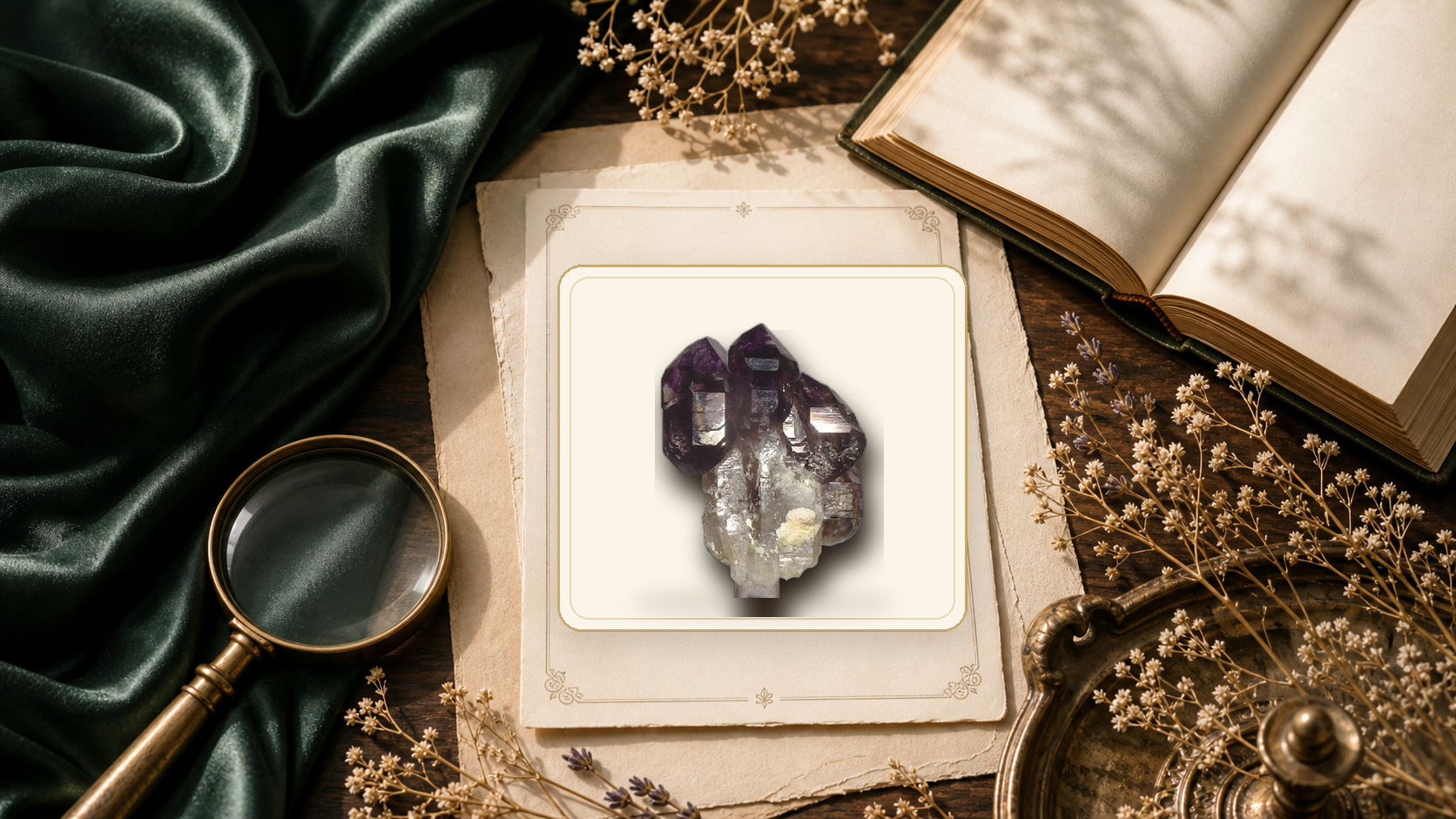
Brandberg Amethyst crystal
Ancestral HealingTransformation & ChangeSpiritual Connection
Crystalis

Protocol

The Desert Cathedral

Born in the Brandberg Massif of Namibia — amethyst, smoky, and clear in one crystal, holding every version of itself without contradiction

5 min

  1. 1

    Hold the Brandberg Amethyst and rotate it slowly. This crystal typically shows three color zones in one point: amethyst purple (iron color centers), smoky brown (aluminum radiation defects), and clear quartz. Find all three. This stone did not choose one identity. It holds its full spectrum. Place it in your non-dominant hand, the hand that receives.

  2. 2

    Look inside the crystal. Brandberg specimens often contain phantom inclusions — ghost outlines of earlier growth stages visible within the clear body. If you can find one, you are looking at the stone's memory of a younger self still visible inside its current form. If you cannot find one, that is also the lesson: not all histories are visible, but they are still structural.

  3. 3

    The Brandberg Massif is Namibian desert — dry, vast, ancient granite. Breathe as if the air is thin and precious. Inhale slowly through the nose for 6 counts, pulling the breath deep into the belly. Hold for 4 counts — the stillness of desert midday. Exhale through pursed lips for 8 counts, slow as heat radiating off stone. Repeat 5 times.

  4. 4

    Lie down. Place the Brandberg Amethyst on the crown of your head, point facing upward. Let the triple color energy — purple for awareness, smoky for grounding, clear for neutrality — sit at the highest point of your body. Breathe naturally for 90 seconds. Do not try to feel anything specific. This stone is old enough to work without your effort.

Continue in the full protocol below.

tap to flip for protocol

Some inner lives stop sorting themselves into neat emotional weather. Sorrow darkens one room. Clarity stays lit in another. Memory leaves pockets and old climates behind. The whole interior starts to feel overfull.

Brandberg amethyst comes out of Namibia carrying that same layered eventfulness. Clear quartz, smoky shading, violet amethyst, enhydros, phantoms, scepters. The specimen reads as exact because the complexity is held by a crystal that never loses its outline.

There is relief in seeing a mineral body hold more than one atmosphere without calling itself broken.

What Your Body Knows

Nervous system states

sympathetic

STATE 1

Brandberg amethyst meets sympathetic activation with the authority of geological depth. Where a simpler crystal carries a single frequency, the Brandberg crystal carries layers; visible phantom layers recording multiple cycles of dissolution and regrowth. The message to the activated nervous system is specific: you have been through cycles before. This fight-or-flight response is not the first and will not be the last. The phantoms are proof that interruption is not destruction; it is a record of resilience. Hold a Brandberg crystal during sympathetic activation and turn it slowly in the hand, letting light pass through the phantom layers. The visual complexity gives the hypervigilant mind something to track that is not threat; it redirects scanning behavior toward beauty.

dorsal vagal

STATE 2

In dorsal vagal collapse, where the body feels ancient and cold and disconnected from life, the Brandberg crystal's enhydro inclusion (if present) carries particular significance. The trapped water is alive in its movement; it shifts, it flows, it responds to orientation. In a state where nothing seems to move, where internal experience feels frozen, the enhydro bubble is a demonstration that movement is possible within containment. You do not have to break the crystal to free the water; the water moves freely inside its chamber. This is the nervous system teaching: you can be contained and still fluid. Place a Brandberg crystal with an enhydro inclusion on the chest or in the line of sight and observe the bubble's movement.

ventral vagal

STATE 3

In ventral vagal states, Brandberg amethyst amplifies access to what might be called ancestral knowing; the deep memory that resides not in personal biography but in the body's inherited wisdom. The crystal, with its phantoms recording millions of years of growth, dissolution, and regrowth, resonates with the part of the nervous system that carries intergenerational memory. In safe social engagement, Brandberg amethyst supports conversation that reaches deeper than the personal; discussions of meaning, legacy, purpose, and what endures.

dorsal vagal

STATE 4

Brandberg amethyst's most specific gift is for the state of conscious transformation; the liminal space between who you were and who you are becoming. The phantoms within the crystal are literal records of transformation: each layer was once the crystal's outer surface, its edge, its boundary with the world. Then new growth covered it, and the boundary moved outward while the old edge remained as a phantom; not erased, but incorporated. This is transformation without erasure. The old self does not disappear; it becomes a layer within the new. In mixed ventral-dorsal states (deep meditation, ceremonial work, grief transitions), Brandberg amethyst holds the paradox of dying and growing simultaneously.

sympathetic

STATE 5

When the body activates not from a personal threat but from an inherited one; when the nervous system fires in response to a pattern that belongs to a parent, a grandparent, a lineage; the Brandberg crystal's multi-layered nature addresses the layered nature of intergenerational trauma. Each phantom layer in the crystal can be understood as a generation's experience, preserved but not controlling the current growth. The crystal grew beyond its phantoms. The lineage can grow beyond its wounds. This is not a metaphor; it is a mineral demonstrating that structure and history coexist without the past determining the present surface.

Nervous system mapping based on polyvagal theory (Porges, 2011).

Mineralogy

Mineral specs

Chemical Formula

SiO2 (silicon dioxide with Fe3+/Fe4+ color centers for purple; Al3+ color centers for smoky; phantom inclusions of various minerals; occasional enhydro water inclusions)

Crystal System

Trigonal

Mohs Hardness

7

Specific Gravity

2.65

Luster

Vitreous

Color

Purple

ca₁a₂a₃120°Trigonal · Brandberg Amethyst

Crystal system diagram represents the general trigonal classification. Diagram created by Crystalis for educational reference.

Traditional Knowledge

Traditions across cultures

San (Bushmen) Rock Art at Brandberg Mountain: Brandberg Mountain is home to the "White Lady" rock painting shelter; one of the most famous rock art sites in southern Africa, containing thousands of paintings by the San people spanning at least 2,000 years. The San relationship with the Brandberg landscape is one of the oldest continuous human-mountain relationships documented through art. While the San did not specifically use quartz crystals from the Brandberg in the way documented for other minerals (red ochre and specularite were their primary mineral pigments), quartz crystals were used by San shamans (n/om kxaosi) throughout southern Africa as power objects for healing trance and rain-making ceremonies. The crystals were understood as containers of n/om (spiritual potency). Source: Lewis-Williams, J. D. (2002). A Cosmos in Stone: Interpreting Religion and Society Through Rock Art. AltaMira Press.

Namibian Mineral Heritage: Namibia is one of the world's great mineral-producing nations, and the Brandberg-Erongo region is a recognized gem and mineral district. Brandberg amethyst has become an emblem of Namibian mineral identity, collected worldwide as a locality-specific specimen. The Namibian government regulates mineral collecting from the Brandberg to prevent over-extraction of this non-renewable resource. Commercial mining has been limited, and most specimens come from small-scale mining operations with government permits. Source: Cairncross, B. (2004). Field Guide to Rocks and Minerals of Southern Africa. Struik Publishers.

Quartz in African Diasporic Traditions: Clear and purple quartz crystals play significant roles in multiple African diasporic spiritual traditions, including Candomble (Brazil), Vodou (Haiti), and Hoodoo (US South). Quartz crystals are understood as "spirit stones" that contain and direct spiritual energy. The multi-layered, phantom-bearing nature of Brandberg crystals gives them particular significance in traditions that work with ancestral spirits, as the phantom layers are read as physical evidence of ancestral presence within the crystal structure. Source: Thompson, R. F. (1983). Flash of the Spirit: African & Afro-American Art & Philosophy. Random House.

Unknown

San (Bushmen) Rock Art at Brandberg Mountain

Brandberg Mountain is home to the "White Lady" rock painting shelter -- one of the most famous rock art sites in southern Africa, containing thousands of paintings by the San people spanning at least 2,000 years. The San relationship with the Brandberg landscape is one of the oldest continuous human-mountain relationships documented through art. While the San did not specifically use quartz crystals from the Brandberg in the way documented for other minerals (red ochre and specularite were their primary mineral pigments), quartz crystals were used by San shamans (n/om kxaosi) throughout southern Africa as power objects for healing trance and rain-making ceremonies. The crystals were understood as containers of n/om (spiritual potency). Source: Lewis-Williams, J. D. (2002). A Cosmos in Ston

Unknown

Namibian Mineral Heritage

Namibia is one of the world's great mineral-producing nations, and the Brandberg-Erongo region is a recognized gem and mineral district. Brandberg amethyst has become an emblem of Namibian mineral identity, collected worldwide as a locality-specific specimen. The Namibian government regulates mineral collecting from the Brandberg to prevent over-extraction of this non-renewable resource. Commercial mining has been limited, and most specimens come from small-scale mining operations with government permits. Source: Cairncross, B. (2004). Field Guide to Rocks and Minerals of Southern Africa. Struik Publishers.

Unknown

Quartz in African Diasporic Traditions

Clear and purple quartz crystals play significant roles in multiple African diasporic spiritual traditions, including Candomble (Brazil), Vodou (Haiti), and Hoodoo (US South). Quartz crystals are understood as "spirit stones" that contain and direct spiritual energy. The multi-layered, phantom-bearing nature of Brandberg crystals gives them particular significance in traditions that work with ancestral spirits, as the phantom layers are read as physical evidence of ancestral presence within the crystal structure. Source: Thompson, R. F. (1983). Flash of the Spirit: African & Afro-American Art & Philosophy. Random House.

When This Stone Finds You

What it says when it arrives

You are carrying too many states at once and somehow still remaining clear. Brandberg amethyst often holds amethyst, smoky, and clear quartz in one Namibian body, plus phantoms and pockets of old weather. Complexity can be a sign of altitude, not confusion.

Somatic protocol

The Desert Cathedral

Born in the Brandberg Massif of Namibia — amethyst, smoky, and clear in one crystal, holding every version of itself without contradiction

5 min protocol

  1. 1

    Hold the Brandberg Amethyst and rotate it slowly. This crystal typically shows three color zones in one point: amethyst purple (iron color centers), smoky brown (aluminum radiation defects), and clear quartz. Find all three. This stone did not choose one identity. It holds its full spectrum. Place it in your non-dominant hand, the hand that receives.

    1 min
  2. 2

    Look inside the crystal. Brandberg specimens often contain phantom inclusions — ghost outlines of earlier growth stages visible within the clear body. If you can find one, you are looking at the stone's memory of a younger self still visible inside its current form. If you cannot find one, that is also the lesson: not all histories are visible, but they are still structural.

    1 min
  3. 3

    The Brandberg Massif is Namibian desert — dry, vast, ancient granite. Breathe as if the air is thin and precious. Inhale slowly through the nose for 6 counts, pulling the breath deep into the belly. Hold for 4 counts — the stillness of desert midday. Exhale through pursed lips for 8 counts, slow as heat radiating off stone. Repeat 5 times.

    1 min
  4. 4

    Lie down. Place the Brandberg Amethyst on the crown of your head, point facing upward. Let the triple color energy — purple for awareness, smoky for grounding, clear for neutrality — sit at the highest point of your body. Breathe naturally for 90 seconds. Do not try to feel anything specific. This stone is old enough to work without your effort.

    1 min
  5. 5

    Remove the stone from your crown with both hands. Sit up slowly. Hold the crystal at heart level and look into it one more time. The phantoms, the colors, the desert origin — none of it has changed. But your relationship with stillness has shifted slightly. Set the stone down point-up. It is still transmitting.

    1 min

Care and Maintenance

How to care for Brandberg Amethyst

Brandberg amethyst is water-safe. Silicon dioxide (SiO2), Mohs 7, chemically inert. Brief to moderate water rinse is safe.

CRITICAL: Avoid prolonged sunlight; amethyst fades permanently from UV radiation. Some Brandberg specimens contain enhydro water inclusions; these are stable and do not affect water safety. Recommended cleansing: moonlight (overnight), sound (2-3 minutes), selenite plate (4-6 hours).

Store away from direct sunlight.

In Practice

How Brandberg Amethyst is used

You are carrying too many states at once and somehow still remaining clear. Brandberg amethyst often holds smoky, clear, and purple zones in one crystal from a 130-million-year-old Namibian granite. Hold it during periods of transformation when multiple processes are running simultaneously.

Place under your pillow for dream integration. The mountain this came from rises above desert; the crystal formed in hydrothermal pockets inside that silence.

Verification

Authenticity

Brandberg amethyst: quartz (Mohs 7, specific gravity 2. 65). The Brandberg designation is locality-specific (Namibia).

Purple coloring should show natural zoning. Enhydro inclusions (moving water bubbles) are a positive identification feature. If offered as Brandberg without Namibian provenance, question it.

The clear-to-smoky-to-purple zoning is characteristic of this specific mountain.

Temperature

Natural Brandberg Amethyst should usually feel cooler than plastic or resin on first touch and warm more slowly in the hand.

Scratch logic

Use 7 on the Mohs scale as the check, not internet myths. A real specimen should behave in line with the hardness listed above.

Surface and luster

Look for a vitreous surface quality rather than a painted or plastic shine.

Weight and density

The listed specific gravity is 2.65. If a specimen feels unusually light for its size, it may deserve a second look.

Geographic Origins

Where Brandberg Amethyst forms in the world

Brandberg Mountain (Burning Mountain) in Namibia's Erongo Region is the sole source. The massive granite intrusion rises 2,573 meters above the surrounding desert. Quartz formed in hydrothermal pockets within 130-million-year-old granite.

The isolation and geological age of this single locality make every Brandberg specimen traceable to one mountain.

FAQ

Frequently asked

What is a phantom crystal?

A phantom is a visible "ghost" outline of the crystal's previous shape preserved inside the current crystal. It forms when crystal growth pauses (due to changes in fluid chemistry, temperature, or pressure), a thin layer of a different mineral deposits on the surface, and then quartz growth resumes, encasing the marker layer. It is a geological record of the crystal's autobiography -- each phantom is a chapter.

What is an enhydro inclusion?

An enhydro is a pocket of fluid (usually water, sometimes with dissolved minerals or a gas bubble) trapped inside the crystal during growth. The fluid was sealed in millions of years ago. You can often see a bubble that moves when you tilt the crystal. This is ancient water that has not been exposed to the atmosphere since the crystal formed.

Are Brandberg crystals expensive?

Quality Brandberg amethyst with clear phantoms and/or enhydro inclusions commands premium prices due to the single-source locality, regulated extraction, and unique inclusion features. Small specimens (under 2 cm) can be affordable. Museum-quality specimens with multiple phantoms and enhydro are collector-grade items. Prices reflect rarity and geological significance.

Can I tell where the crystal growth paused by looking at the phantoms?

Yes -- each phantom layer marks a growth interruption. The mineral that forms the phantom ghost (hematite for reddish phantoms, chlorite for greenish ones, or simply a change in inclusion density) tells you something about what was in the fluid during the pause. Red phantom = iron-rich fluid; green phantom = iron-magnesium silicate (chlorite) deposition; cloudy phantom = micro-inclusion density change.

References

Sources and citations

Closing Notes

Brandberg Amethyst

Amethyst from Burning Mountain. Namibia, Erongo Region, a granite intrusion rising 2,573 meters above the desert. Quartz formed in hydrothermal pockets within 130-million-year-old granite.

The science documents how isolation and geological age produce specimens found nowhere else. The practice asks what clarity develops when the growing conditions are unrepeatable.

Bring it into practice

What to do with Brandberg Amethyst next

Move from reference to ritual. Search current inventory for Brandberg Amethyst, build a custom bracelet, or let Sacred Match choose the right supporting stones for you.

Community notes

Threads under Brandberg Amethyst

Open all chats

Shared field notes tied to Brandberg Amethyst appear here, including notes saved from practice.

No shared notes under Brandberg Amethyst yet.

When members save a public field note for this stone, it will appear here.

The archive

Related crystals

Read the Full Crystal Guide

Continue through stones that share intention, chakra focus, or tonal family with Brandberg Amethyst.