You feel layered by old weather rather than ruined by it. Brandberg quartz forms in harsh desert conditions and often carries phantoms, enhydros, and subtle color shifts through a single crystal. Survival leaves evidence; it does not owe anyone simplicity.
At the back of the throat and the diaphragm, Brandberg quartz offers a clear tactile anchor rather than a loud stimulus. Brandberg Quartz is handled in body-based work...
The Meaning
Brandberg Quartz in the Crystalis dictionary
Some histories are not heavy because they are unresolved. They are heavy because they remain present. Old fear, old drought, old astonishment. The rooms stay occupied.
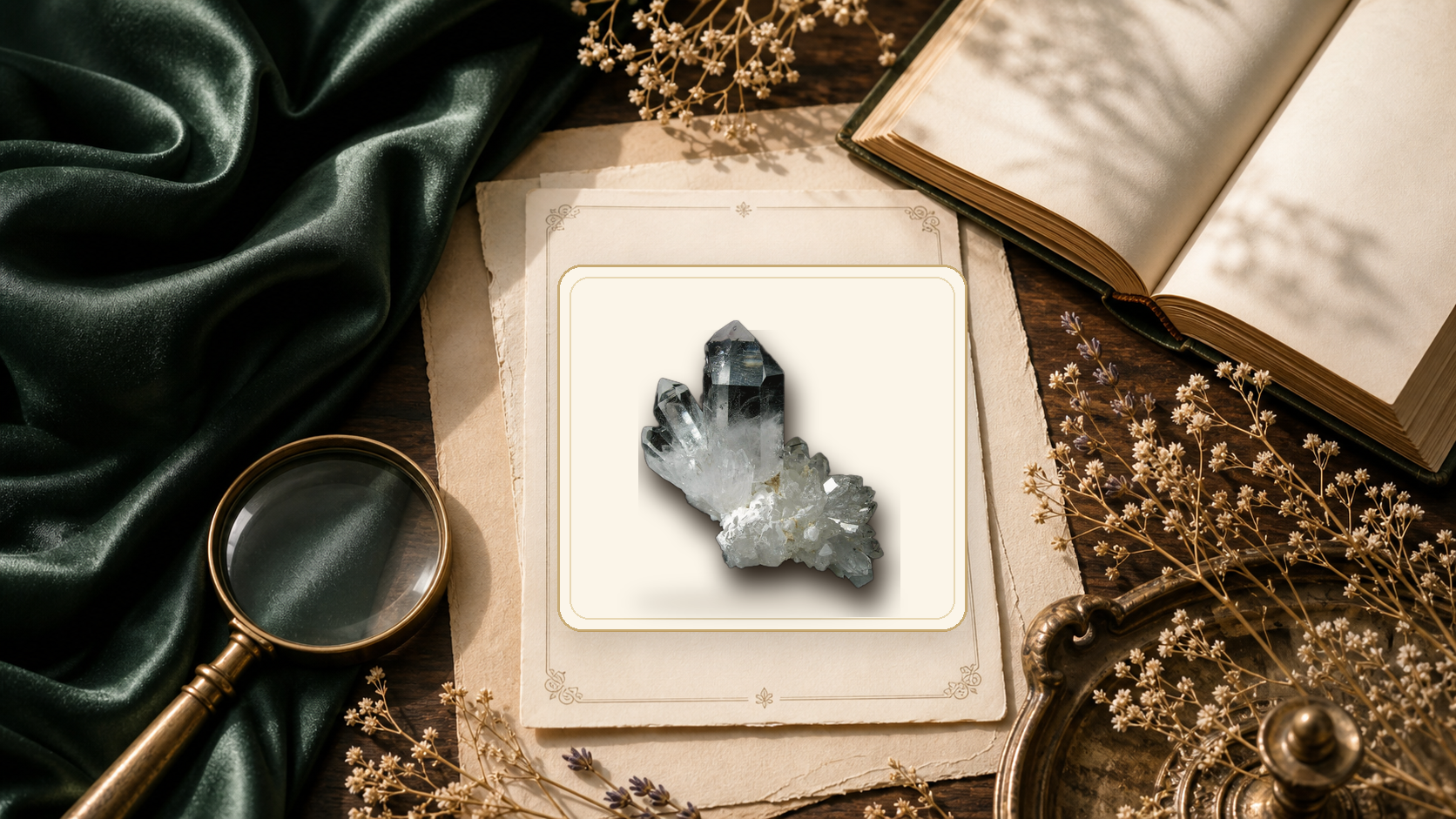
Brandberg quartz carries that record elegantly. Desert-grown quartz, clear but internally eventful, often preserving layers, pockets, and weathered traces in the body of the crystal. Transparency here has never meant emptiness.
The point is not to become smoother. The point is to stay legible while carrying more than one climate.
Stone Lore
Stories carried through time
Cultural notes are presented as tradition and historical context — stories carried through time.
Unknown
~27,000 BP onward
The Brandberg Mountain area contains one of the richest concentrations of rock art in southern Africa, with over 48,000 individual paintings documented across approximately 1,000 sites on the mountain. The oldest accepted date for Bushman (San) rock art in the broader Namibian region extends to approximately 27,000 BP from Apollo 11 Cave (Hoerle et al., 2016). The mountain itself, Daureb to the Damara people, meaning "Burning Mountain" for the orange glow of its granite at sunset, is considered a deeply sacred landscape.
Ritual history
San (Bushmen) significance
The indigenous San people of southern Africa maintained spiritual relationships with the landscape for millennia. Rock art at Brandberg includes the famous "White Lady" painting (now understood to represent a male figure in ceremonial...
Unknown
Origin lore
Colonial period (1800s-1900s)
German colonial surveys first documented the geological nature of Brandberg. The mountain became Namibia's first National Monument.
Unknown
Origin lore
Modern mineral collecting (1970s-present)
Brandberg crystals entered the international mineral collecting market primarily from the 1970s onward. Their distinctive tri-color zonation and high clarity made them prized specimens. Mining is now regulated under Namibian mineral...
Unknown
Origin lore
A Cultural Landscape First
The Brandberg massif is a cultural landscape before it is a geological resource. It remains deeply significant to the Damara, San, and other Indigenous Namibian peoples, and its rock art sites are protected under Namibian heritage law. The...
Unknown
Earth Record
Mineralogy and formation
From the cooling stages of the Brandberg granite, clear quartz developed in pockets where fluids lingered and crystal faces had room to advance. Here the host story begins in the Brandberg granite, emplaced during Early Cretaceous tectonism and later opened by fractures that welcomed hydrothermal silica. Clear to smoky quartz crystallized in cavities where fluid composition, temperature decline, and available space supported well-shaped trigonal growth.
Some crystals trapped tiny water inclusions, iron oxides, or phantom layers, preserving the sequence of pulses that built the specimen.
Quartz seems simple at the formula level, yet locality makes simplicity deceptive. Brandberg material often draws attention because of exceptional transparency interrupted by highly specific evidence of growth: enhydros, faint smoke, hematite wisps, and ghostly internal outlines. The crystal system stays trigonal, the hardness stays 7, and the specific gravity stays close to standard quartz, but the internal record is unusually legible. A crystal like this is less about rarity of composition than rarity of preserved history.
In somatic terms it does not perform with volume. It performs with evidence. The clearness carries the suggestion that stillness is not emptiness. It is a vessel that can hold trace events without losing its overall shape.
The mineral data reinforces that formation story. Brandberg Quartz carries the chemistry SiO2 (with trace Fe3+, Al3+, Li+, OH-), and the stated crystal system is Trigonal. Hardness around 7 and specific gravity of 2. 65 (standard quartz) are not decorative catalog facts. They describe how tightly the structure holds together, how the crystal responds to abrasion, and how much weight the hand expects from a piece of that size.
Luster, color, and origin also preserve clues to environment. White material from Namibia (Brandberg Mountain) reaches the market with a visual identity shaped by local geology, not by a generic stone category.
A specimen therefore carries process in several layers at once: chemistry, symmetry, growth history, and later alteration or treatment where relevant. What emerges from that stack is a stone that can be read physically before any symbolic meaning is assigned.
Crystal system diagram represents the general trigonal classification. Diagram created by Crystalis for educational reference.
Trigonal structure
Chemical Formula
SiO2 (with trace Fe3+, Al3+, Li+, OH-)
Crystal System
Trigonal
Mohs Hardness
7
Specific Gravity
2.65 (standard quartz)
Luster
Vitreous
Color
White
IMA Status
trade_name
IMA Number
pre-IMA (grandfathered)
01
Mineral conditions gather
02
Structure begins to crystallize
03
Brandberg Quartz records place and pressure
Primary: Brandberg Mountain, Erongo Region, Namibia (the ONLY source for true "Brandberg" quartz)
Related quartz varieties: Goboboseb Mountains, Namibia; Erongo Mountains, Namibia
The quartz crystals that define the "Brandberg" variety formed in hydrothermal veins and pockets (miarolitic cavities) within and surrounding the granite massif. During the late stages of granite crystallization, residual silica-rich fluids migrated through fractures and voids, depositing large, well-formed quartz crystals under decreasing temperature and pressure conditions. Fluid inclusion studies of similar Alpine-type fissure vein quartz systems demonstrate that such crystals grow from aqueous to aqueous-carbonic fluids at temperatures between approximately 200-400 degrees C and pressures of 1-4 kbar, with fluid compositions evolving systematically across successive growth zones (Rauchenstein-Martinek et al.
, 2016). Phase-field modeling of such hydrothermal quartz precipitation shows that crystal morphology is controlled by relative growth rates of different crystal faces, with the characteristic prismatic habit reflecting anisotropic surface energies (Wendler et al. , 2015). The distinctive Brandberg combination of amethyst, smoky, and clear zones within single crystals results from fluctuating trace element concentrations and radiation exposure during crystal growth.
The amethyst coloration requires iron (Fe3+) substituting for silicon in the tetrahedral site, followed by natural gamma irradiation from surrounding radioactive minerals in the granite host rock. The smoky coloration results from aluminum (Al3+) substituting for silicon, also activated by natural irradiation. Clear zones represent periods of growth with minimal trace element incorporation.
The co-occurrence of all three color zones in single crystals reflects the dynamic geochemical environment of the granite-hosted hydrothermal system (Ahmad et al. , 2021; Griscom & McLeod, 2013).
Namibia (Brandberg Mountain)
Telling it apart
Brandberg quartz is often sold on locality prestige alone, even when the specimen is ordinary clear quartz from elsewhere. The confirming step is locality documentation and characteristic internal features. Sellers can lean on color, trade names, or locality mythology, but that one check separates the real material from the easy substitute. Brandberg Quartz has its own physical signature in the hand and under magnification, whether that means unusual density, a true internal growth pattern, a natural host matrix, or evidence of locality and structure.
Fraud or simple sloppiness matters differently here than it would for a generic tumbled stone. Without provenance, the premium collapses because quartz itself is common. A buyer paying for Brandberg Quartz is paying for a specific geological story, not just a similar color. Buyers also benefit from checking hardness, surface texture, and specimen context against the label. Brandberg Quartz should agree with its own chemistry and structure rather than only with a seller's story.
That extra minute of examination often reveals whether a listing is accurate, inflated, or simply careless. When a locality name drives the price, the seller should be able to document the origin, not just assert it.
Spotting the real thing
Brandberg quartz: clear to smoky quartz (Mohs 7, specific gravity 2. 65) from Brandberg Mountain, Namibia. Without the purple of the amethyst variety, verification relies on provenance.
Characteristic features include clarity, occasional enhydro inclusions, and growth patterns consistent with hydrothermal formation in 130-million-year-old granite.
Traditionally associated with calming overactivated states, parasympathetic support
Traditionally associated with calming overactivated states, parasympathetic support. The purple color has longstanding associations with contemplative practice across cultures.
-
; -
Smoky zone: Associated with grounding, downward-directing energy, vagal tone support. Practitioners often report a "heaviness" quality. - Clear zone: Associated with neutral awareness, witness consciousness, neither stimulating nor sedating.
These associations come from tradition and reflective practice — a way of working with the stone, not a medical prescription.
Somatic Practice
Simple ways to work with Brandberg Quartz
◇
Hold
Carry Brandberg Quartz in a pocket or place it over the heart center during a pause.
◌
Meditate
Let the stone become a quiet tactile anchor while the breath slows.
☽
Breathe
Breathe in softness. Breathe out tension. Keep the practice simple.
✎
Journal
Write with Brandberg Quartz nearby to name the feeling without forcing a conclusion.
✋
Bodywork
Rest the stone near the chest, hand, or bedside as a reminder to soften.
⌂
Environment
Place it where you want a visual cue for care, repair, or steadiness.
Field Instruction
The Massif Witness
Namibian quartz from the highest mountain in an ancient desert — a witness stone that holds light the way granite holds heat
3 min protocol
1
Hold the Brandberg Quartz in both hands. This crystal formed in the Brandberg Massif — a granite inselberg rising from the Namib Desert, one of the oldest deserts on Earth. The quartz carries trace lithium, iron, and aluminum, making each specimen a geological fingerprint. Feel the heft of hardness 7 — this stone will outlast almost everything in the room.
2
Hold the crystal near a window or lamp. Brandberg Quartz has exceptional vitreous clarity — light moves through it like water through glass. Turn it until you find the angle where light enters and seems to pause inside. Keep the stone at that angle. Breathe while watching light suspended in silica.
3
Granite holds heat long after the sun sets. Breathe with that quality: inhale for 4 counts, absorbing warmth. Hold for 6 counts — longer than the inhale, letting heat distribute. Exhale for 4 counts. The hold is the point. You are learning thermal patience. Repeat 5 times.
4
Place the stone flat against the center of your chest. Brandberg Quartz is not a crown stone or a third-eye stone in this protocol — it is a heart-level witness. Let it rest there and feel your heartbeat push gently against it. The crystal does not absorb the beat. It reflects it back. You are listening to yourself through 500 million years of stone.
5
Remove the stone. Hold it at arm's length and look at it as if seeing a landscape. The Massif from a distance. Then bring it close and set it down gently. You visited. The stone remains. That is how witnessing works.
Stone Intelligence
The fact that makes Brandberg Quartz memorable
Clear to smoky quartz from the same Namibian massif. Same mountain, same granite, same 130 million years. Without the purple, what remains is transparency born from depth.
The science documents hydrothermal crystallization in ancient plutons. The practice asks what you see when the color is removed and only the structure remains.
SCI
Zr-Nb-REE Mineralization in Peralkaline Granites from the Amis Complex, Brandberg (Namibia): Evidence for Magmatic Pre-enrichment from Melt Inclusions
- Tri-color integration: The simultaneous presence of three distinct quartz expressions in one crystal maps to practices involving polyvagal integration. holding multiple states (activation, grounding, clarity) without needing to resolve to a single one. - Amethyst zone: Traditionally associated with calming overactivated states, parasympathetic support. The purple color has longstanding associations with contemplative practice across cultures.
- Smoky zone: Associated with grounding, downward-directing energy, vagal tone support. Practitioners often report a "heaviness" quality. - Clear zone: Associated with neutral awareness, witness consciousness, neither stimulating nor sedating.
- When integration of seemingly contradictory states is needed (not either/or, but both/and)
- After intense experience that needs processing rather than suppression
- During transitions that involve holding complexity
- Meditation practices involving witness awareness
- When the practitioner needs simple, clear single-note support (choose a single-variety crystal instead)
- When overwhelmed. the complexity of Brandberg may be "too much information" for a nervous system already in overload
- Third eye or crown (amethyst aspect)
- Root or between feet (smoky aspect)
- Heart center (integration point for tri-color work)
- Hold in receiving hand during contemplative practice
- Quartz is a poor thermal conductor; it warms slowly from body contact
- Notable piezoelectric response. quartz generates minute electrical charges under mechanical pressure (documented: d11 approximately 2.3 pC/N; Zhang et al., 2011)
Sacred Match
Sacred Match reaches for Brandberg Quartz when what you feel sounds like:
hollow breathing high in the chest
difficulty settling after concentrated work
scattered attention with a clear mind but tense body
throat tightness during silence
fatigue that still cannot rest
Sacred Match listens to the body rather than to preference. It notices what you are feeling right now, the way you are protecting yourself, and the deeper need underneath both. When that points to a pattern answered by brandberg quartz, the prescription follows the stone’s physical behavior. Its geology, texture, density, optical structure, and handling profile indicate whether the body needs ballast, clearer edges, reduced visual noise, or a more organized field of attention.
The match is made when the material solves for the body’s immediate regulation problem better than a prettier or more famous alternative.
hollow breathing high in the chest -> body asking for orientation -> seeking a clear point of contact
difficulty settling after concentrated work -> protective tension rising -> seeking containment
scattered attention with a clear mind but tense body -> signal overload in the tissues -> seeking organization
throat tightness during silence -> regulation failing at the threshold -> seeking a gentler entry
fatigue that still cannot rest -> action or rest cannot complete -> seeking coherence
Stones and herbs that harmonize with Brandberg Quartz
Pairings are treated like a recipe file: clear use, method, and safety.
Crystal Companion
Brandberg Quartz + Amethyst
Use when
You want to layer the primary intention with another supportive tone.
How to work with it
Place the stones together during meditation, journaling, or a short reset.
Safety
Use as a reflective practice tool, not as a medical substitute.
Crystal Companion
Brandberg Quartz + Rhodonite
Use when
You want to layer the primary intention with another supportive tone.
How to work with it
Place the stones together during meditation, journaling, or a short reset.
Safety
Use as a reflective practice tool, not as a medical substitute.
Crystal Companion
Brandberg Quartz + Clear Quartz
Use when
You want to layer the primary intention with another supportive tone.
How to work with it
Place the stones together during meditation, journaling, or a short reset.
Safety
Use as a reflective practice tool, not as a medical substitute.
Crystal Companion
Brandberg Quartz + Black Tourmaline
Use when
You want to layer the primary intention with another supportive tone.
How to work with it
Place the stones together during meditation, journaling, or a short reset.
Safety
Use as a reflective practice tool, not as a medical substitute.
Smoky Quartz: Clear body, dark anchor. Brandberg quartz often carries extraordinary clarity and fine internal events. Smoky quartz ensures the attention does not float away from the body while those details are studied. Place smoky quartz at the pelvis and Brandberg quartz at the sternum.
Amethyst: White light with a violet filter. Amethyst adds tonal depth to an otherwise transparent stone and gives emotional contour to a very clear field. It works well in quiet evening practice. Lay amethyst at the brow and Brandberg quartz in the receiving hand.
Black Tourmaline: Transparency with boundaries. A highly clear quartz can feel porous in practice. Black tourmaline adds a perimeter so the session keeps shape and does not scatter. Keep tourmaline by the left foot and Brandberg quartz on the chest.
Chlorite Quartz: Clear observation of growth and interruption. Pairing one clear Brandberg crystal with green included quartz creates a useful contrast between transparency and record. The eye moves back and forth between absence and evidence. Set both stones side by side at eye level during seated practice.
Taken together, these combinations work best when the stones are kept in distinct roles instead of piled into one indiscriminate cluster. One sets the frame, one changes the tone, and one gives the body a placement cue it can actually follow.
Care & Cleansing
How to keep Brandberg Quartz in good condition
Water Safe?
Water safe
This stone is generally safe for short water contact, though polishing, fractures, and metal settings can still change how a specimen behaves.
Sunlight Safe?
Use care
May fade or shift color in prolonged direct sun — keep exposure short and indirect.
Authenticity
What to check
Natural Brandberg Quartz should usually feel cooler than plastic or resin on first touch and warm more slowly in the hand.
- Water safe: Yes. Quartz is completely insoluble and chemically inert in water. - Sun safe: CAUTION. Prolonged UV exposure can fade amethyst color centers over months to years. The Fe4+ color center is metastable and can be thermally or photolytically reversed. Store away from prolonged direct sunlight. - Heat sensitive: Amethyst color begins to discharge above approximately 300-400 degrees C, often converting to citrine (yellow) or prasiolite (green) depending on iron content.
Smoky color discharges at lower temperatures (~200-300 degrees C). DO NOT steam clean or expose to extreme heat. - Chemical: Quartz is resistant to all common acids except hydrofluoric acid (HF). Safe for normal cleaning. - Hardness: At Mohs 7, it is durable for most handling but can be scratched by harder materials.
Temperature
Natural Brandberg Quartz should usually feel cooler than plastic or resin on first touch and warm more slowly in the hand.
Scratch logic
Use 7 on the Mohs scale as the check, not internet myths. A real specimen should behave in line with the hardness listed above.
Surface and luster
Look for a vitreous surface quality rather than a painted or plastic shine.
Weight and density
The listed specific gravity is 2.65 (standard quartz). If a specimen feels unusually light for its size, it may deserve a second look.
My Field Guide
Your private record and next steps
Journal
Add this stone to your private collection, then log what happened when you worked with it.
Shared Notes
Read public practice logs and pattern notes from the Crystalis community.
When members save a public field note for this stone, it will appear here.
Frequently Asked
Questions people ask about Brandberg Quartz
What is Brandberg Quartz?
⌄
Brandberg quartz is a tectosilicate (oxide mineral, silicate subclass): SiO2 carrying trace Fe3+, Al3+, Li+, and OH-, with a Mohs hardness of 7, crystallizing in the trigonal system (rhombohedral class 32, space group P3121 or P3221).
What is the Mohs hardness of Brandberg Quartz?
⌄
Brandberg Quartz has a Mohs hardness of 7.
Can Brandberg Quartz go in water?
⌄
Yes. Quartz is completely insoluble and chemically inert in water.
Can Brandberg Quartz go in the sun?
⌄
CAUTION. Prolonged UV exposure can fade amethyst color centers over months to years. The Fe4+ color center is metastable and can be thermally or photolytically reversed. Store away from prolonged direct sunlight.
What crystal system is Brandberg Quartz?
⌄
Brandberg Quartz crystallizes in the Trigonal (rhombohedral class 32, space group P3121 or P3221).
What is the chemical formula of Brandberg Quartz?
⌄
The chemical formula of Brandberg Quartz is SiO2 (with trace Fe3+, Al3+, Li+, OH-).
Where is Brandberg Quartz found?
⌄
- Primary: Brandberg Mountain, Erongo Region, Namibia (the ONLY source for true "Brandberg" quartz) - Related quartz varieties: Goboboseb Mountains, Namibia; Erongo Mountains, Namibia.
How does Brandberg Quartz form?
⌄
Brandberg Mountain (Brandbergmassiv) is the highest peak in Namibia at 2,573 meters, located in the Erongo Region of northwestern Namibia. The mountain is a Cretaceous-age anorogenic granite intrusion associated with the Parana-Etendeka large igneous province, which formed during the breakup of Gondwana approximately 132-130 Ma. The granite complex intruded into the older Neoproterozoic-Cambrian Damara Orogen basement rocks.
Sources & Citations
Where this entry can be checked
Back Matter
Readable for people. Structured for AI search.
Sources stay visible in the page so readers, search engines, and answer systems can follow the evidence trail.
01
SCI
Zr-Nb-REE Mineralization in Peralkaline Granites from the Amis Complex, Brandberg (Namibia): Evidence for Magmatic Pre-enrichment from Melt Inclusions
Schmitt A., Trumbull R., Dulski P., Emmermann R. (2002). Zr-Nb-REE Mineralization in Peralkaline Granites from the Amis Complex, Brandberg (Namibia): Evidence for Magmatic Pre-enrichment from Melt Inclusions. Economic Geology. [SCI]DOI 10.2113/gsecongeo.97.2.399
02
SCI
Minerals from the Goboboseb Mountains: Brandberg Region, Namibia
Cairncross B., Bahmann U. (2006). Minerals from the Goboboseb Mountains: Brandberg Region, Namibia. Rocks & Minerals. [SCI]DOI 10.3200/rmin.81.6.442-457
03
SCI
Raman spectroscopy of quartz varieties and trace elements
Dong, J. et al. (2015). Raman spectroscopy of quartz varieties and trace elements. Journal of Raman Spectroscopy. [SCI]DOI 10.1002/jrs.4501
04
SCI
Phase-field modeling of epitaxial growth of polycrystalline quartz veins
Wendler, F. et al. (2015). Phase-field modeling of epitaxial growth of polycrystalline quartz veins. Geofluids. [SCI]DOI 10.1111/gfl.12144