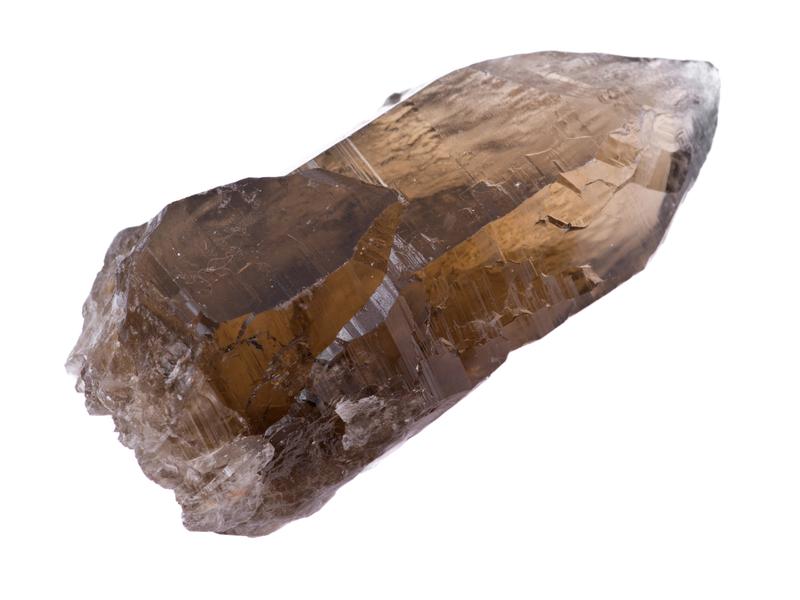
You are trying to hold many rooms of experience inside one life. Cathedral quartz grows in stepped, multi-windowed faces as smaller terminations build around a main point. A self can become more spacious without losing its spine.
At the sternum and upper back, cathedral quartz gives the eye repeated verticals that organize breathing. Cathedral Quartz is handled in body-based work through its...
The Meaning
Cathedral Quartz in the Crystalis dictionary
Grief, memory, recovery, and new desire rarely fit back inside the old architecture unchanged. The original rooming plan gets too small.
Cathedral quartz makes expansion visible without collapse. Smaller quartz points build around a central crystal, creating windows, ledges, chambers, and something almost ecclesial in the silhouette. One body becoming more occupiable.
A person can add rooms without losing the spine of the house.
Stone Lore
Stories carried through time
Cultural notes are presented as tradition and historical context — stories carried through time.
Unknown
Pre-modern
General quartz use is documented across virtually all ancient cultures. No ancient tradition specifically distinguishes "cathedral" growth habit. - 1970s-1980s: Brazilian mining operations in Minas Gerais produced abundant specimens of this growth type. The mineral collecting community began recognizing "cathedral" as a distinct morphological descriptor. - 1990s-present: The name became standard in both collector and metaphysical markets. The "Lightbrary" appellation emerged from the metaphysical community around the early 2000s.
Lore review
Tradition notes are being reviewed.
This entry keeps symbolic meaning separate from sourced cultural history. When dedicated tradition rows are available, they will appear here as individual lore cards.
Earth Record
Mineralogy and formation
Cathedral quartz takes shape by repetition, with one crystal orientation serving as a scaffold for a clustered architectural build. Secondary quartz crystals nucleated on the faces of a primary crystal in parallel orientation, then continued growing so that a cluster of aligned terminations rose like towers around a central nave. The name is descriptive rather than formal mineralogy, but the structure is real.
All parts remain trigonal quartz, chemically identical and crystallographically aligned, yet the visual effect depends on serial repetition rather than on one isolated point.
This morphology implies sustained access to silica-rich fluids and enough stability for multiple generations to add themselves without destroying the original directional order. It is architectural growth, not random aggregation. The hardness, chemistry, and standard quartz density stay unchanged, while the surface becomes more complex and often more tactile. One can read time laterally across the stepped flanks and vertically through the repeated terminations.
The somatic turn emerges from that built form. Calm is not always a single spire. Sometimes it is a structure assembled from many parallel efforts, each smaller face adding support to the whole until the interior feels inhabitable again.
The mineral data reinforces that formation story. Cathedral Quartz carries the chemistry SiO2, and the stated crystal system is Trigonal. Hardness around 7 and specific gravity of 2. 65 are not decorative catalog facts. They describe how tightly the structure holds together, how the crystal responds to abrasion, and how much weight the hand expects from a piece of that size. Luster, color, and origin also preserve clues to environment.
White material from Brazil, Madagascar reaches the market with a visual identity shaped by local geology, not by a generic stone category.
A specimen therefore carries process in several layers at once: chemistry, symmetry, growth history, and later alteration or treatment where relevant. What emerges from that stack is a stone that can be read physically before any symbolic meaning is assigned.
Crystal system diagram represents the general trigonal classification. Diagram created by Crystalis for educational reference.
Trigonal structure
Chemical Formula
SiO2
Crystal System
Trigonal
Mohs Hardness
7
Specific Gravity
2.65
Luster
Vitreous
Color
White
IMA Status
trade_name
IMA Number
Pre-IMA (grandfathered)
01
Mineral conditions gather
02
Structure begins to crystallize
03
Cathedral Quartz records place and pressure
Primary: Minas Gerais, Brazil (the classic and most abundant source)
Secondary: Madagascar, Colombia, Zambia, Namibia
Occasional: Arkansas (USA), Himalayan deposits (India/Nepal)
The stepped morphology results from competitive crystal growth dynamics. When multiple nucleation events occur on the prism faces or at slightly offset positions along a growing crystal, each new crystal develops its own termination while maintaining near-parallel alignment with the main axis. The result is a composite crystal with a dominant central termination surrounded by smaller stepped terminations at lower elevations along the crystal body.
Phase-field modeling of polycrystalline quartz demonstrates that such growth patterns emerge when supersaturation conditions favor simultaneous growth at multiple nucleation sites, with the Wulff shape (equilibrium crystal shape) and relative growth rates of different crystal faces controlling the final morphology (Wendler et al. , 2015). The trace element chemistry recorded in growth zones of such multi-episode quartz crystals reflects the evolving hydrothermal fluid composition through time (Rauchenstein-Martinek et al.
, 2016). This growth habit is distinct from scepter quartz (where a single later overgrowth caps an earlier crystal) and from candle quartz (where numerous small overgrowths cover the prism faces). Cathedral quartz specifically exhibits a "staircase" or "skyline" profile created by sub-parallel terminations at different heights. Dissolution features (etching, skeletal textures) are sometimes present between growth phases, recording periods of undersaturation between depositional episodes (Dickson, 2022).
BrazilMadagascar
Telling it apart
Cathedral quartz is often marketed as candle quartz or elestial, terms that overlap in style but not in growth pattern. The confirming step is look for many parallel subordinate terminations growing in the same orientation. Sellers can lean on color, trade names, or locality mythology, but that one check separates the real material from the easy substitute. Cathedral Quartz has its own physical signature in the hand and under magnification, whether that means unusual density, a true internal growth pattern, a natural host matrix, or evidence of locality and structure.
Fraud or simple sloppiness matters differently here than it would for a generic tumbled stone. Formation style determines whether the piece is truly cathedral quartz. A buyer paying for Cathedral Quartz is paying for a specific geological story, not just a similar color. Buyers also benefit from checking hardness, surface texture, and specimen context against the label. Cathedral Quartz should agree with its own chemistry and structure rather than only with a seller's story.
That extra minute of examination often reveals whether a listing is accurate, inflated, or simply careless. The growth form premium is legitimate when the form is natural, but polished or broken quartz relabeled as cathedral defeats the whole point.
Spotting the real thing
Cathedral quartz: the stepped, tiered appearance should show natural parallel crystal growth. Mohs 7. Specific gravity 2.
65. The "cathedral" architecture forms when multiple crystals grow in parallel alignment. Check under magnification: natural stepped growth shows crystallographic orientation, not random stacking.
The stepped, building-like form maps to practices involving the construction or reconstruction of internal frameworks
Hierarchy without dominance: Multiple terminations at different levels suggest a model where various "levels" coexist without one suppressing others.
These associations come from tradition and reflective practice — a way of working with the stone, not a medical prescription.
Somatic Practice
Simple ways to work with Cathedral Quartz
◇
Hold
Carry Cathedral Quartz in a pocket or place it over the heart center during a pause.
◌
Meditate
Let the stone become a quiet tactile anchor while the breath slows.
☽
Breathe
Breathe in softness. Breathe out tension. Keep the practice simple.
✎
Journal
Write with Cathedral Quartz nearby to name the feeling without forcing a conclusion.
✋
Bodywork
Rest the stone near the chest, hand, or bedside as a reminder to soften.
⌂
Environment
Place it where you want a visual cue for care, repair, or steadiness.
Field Instruction
The Stone Nave
Stepped terminations rising like gothic spires — a crystal that built itself into a cathedral without an architect
5 min protocol
1
Hold the Cathedral Quartz upright and examine its structure. Multiple terminated points rise at different heights around a central spire, like the buttresses and towers of a cathedral. Each smaller termination grew against the main crystal at a different stage. This was not planned. It emerged from conditions. Let your eyes trace the architecture without trying to understand how it was built.
2
The nave of a cathedral is the long central space where sound and silence amplify equally. Hold the crystal in front of your sternum. Breathe as if your chest cavity is a nave: inhale through the nose for 6 counts, feeling the space between your ribs expand laterally. Hold for 4 counts — feel the echo. Exhale for 6 counts through the mouth, letting the sound of your breath be audible, like a whisper in a vaulted space. Repeat 5 times.
3
Cathedral Quartz has stepped growth — each level represents a pause in the crystal's formation where conditions shifted and growth resumed at a new angle. Close your eyes with the stone at your chest. Scan your body in steps: feet, knees, hips, belly, chest, shoulders, crown. Pause at each level for one full breath. Do not rush to the top. The cathedral took millennia. You have three minutes.
4
Raise the crystal above your head, main point toward the ceiling. This is the spire — the highest point of the formation. Hold it there for 20 seconds. Feel the reach in your arm. Feel the aspiration without strain. Then slowly lower it back to heart level. The spire does not stay elevated by effort. It stays because it grew there.
5
Set the Cathedral Quartz down, standing upright if it can balance. Step back and look at it from a slight distance. It looks like a building. A small, ancient, self-organized building made of light and silicon. Bow slightly if it feels right — not to the stone, but to the principle of structures that organize themselves from the inside. Walk away as you would leave a quiet room.
Stone Intelligence
The fact that makes Cathedral Quartz memorable
Multiple quartz crystals growing in parallel around a central column, stepped and tiered like Gothic architecture. The science documents parallel growth and secondary crystal nucleation. The practice asks what structure looks like when it builds itself upward through repetition rather than design.
SCI
Epitaxial Lateral Overgrowth (ELO): The mechanism of formation of scepter, skeletal, cathedral and related quartz morphologies
- Architectural/structural themes: The stepped, building-like form maps to practices involving the construction or reconstruction of internal frameworks. rebuilding after collapse, creating new structures for experience.
- Hierarchy without dominance: Multiple terminations at different levels suggest a model where various "levels" coexist without one suppressing others.
- Rebuilding or restructuring practices after disruption
- When working with layered or tiered understanding (not linear but architectural)
- Meditation on inner spaces and chambers
- When the practitioner needs to access a felt sense of "inner architecture"
- When dissolution or surrender is the therapeutic aim (this form's energy is structural, not dissolving)
- When overwhelmed by complexity
- Place standing upright beside the practitioner (these crystals are often too large for body placement)
- If small enough, at solar plexus (structural/architectural center) or crown
- Environmental placement near workspace or meditation area
- Standard quartz. Large specimens will be room temperature and warm very slowly.
Sacred Match
Sacred Match reaches for Cathedral Quartz when what you feel sounds like:
breathing that stalls at the top
a chest that needs more vertical space
attention scattered across too many inner rooms
fatigue relieved by ordered repetition
difficulty building calm step by step
Sacred Match listens to the body rather than to preference. It notices what you are feeling right now, the way you are protecting yourself, and the deeper need underneath both. When that points to a pattern answered by cathedral quartz, the prescription follows the stone’s physical behavior. Its geology, texture, density, optical structure, and handling profile indicate whether the body needs ballast, clearer edges, reduced visual noise, or a more organized field of attention.
The match is made when the material solves for the body’s immediate regulation problem better than a prettier or more famous alternative.
breathing that stalls at the top -> body asking for orientation -> seeking a clear point of contact
a chest that needs more vertical space -> protective tension rising -> seeking containment
attention scattered across too many inner rooms -> signal overload in the tissues -> seeking organization
fatigue relieved by ordered repetition -> regulation failing at the threshold -> seeking a gentler entry
difficulty building calm step by step -> action or rest cannot complete -> seeking coherence
Stones and herbs that harmonize with Cathedral Quartz
Pairings are treated like a recipe file: clear use, method, and safety.
Crystal Companion
Cathedral Quartz + Amethyst
Use when
You want to layer the primary intention with another supportive tone.
How to work with it
Place the stones together during meditation, journaling, or a short reset.
Safety
Use as a reflective practice tool, not as a medical substitute.
Crystal Companion
Cathedral Quartz + Rhodonite
Use when
You want to layer the primary intention with another supportive tone.
How to work with it
Place the stones together during meditation, journaling, or a short reset.
Safety
Use as a reflective practice tool, not as a medical substitute.
Crystal Companion
Cathedral Quartz + Clear Quartz
Use when
You want to layer the primary intention with another supportive tone.
How to work with it
Place the stones together during meditation, journaling, or a short reset.
Safety
Use as a reflective practice tool, not as a medical substitute.
Crystal Companion
Cathedral Quartz + Black Tourmaline
Use when
You want to layer the primary intention with another supportive tone.
How to work with it
Place the stones together during meditation, journaling, or a short reset.
Safety
Use as a reflective practice tool, not as a medical substitute.
Clear Quartz: Single spire beside a many-spired form. This pairing clarifies what cathedral growth adds to ordinary quartz: repetition, architecture, and visual community. It helps the eye move from simplicity to complexity without confusion. Stand the clear point first, then place cathedral quartz just behind it.
Amethyst: Architecture with tonal depth. Amethyst softens the stark clarity of cathedral quartz and gives the practice a dusk-like mood. It is good for evening reflection or devotional work. Place amethyst at the brow and cathedral quartz on the altar or bedside table.
Selenite: Ordered height in a bright corridor. Selenite cleans the field while cathedral quartz provides structured vertical repetition. The combination supports steady breathing and slower visual tracking. Lay selenite horizontally and set cathedral quartz upright at its center.
Black Tourmaline: Upper architecture, lower boundary. Cathedral quartz can draw the eyes upward for long periods. Tourmaline keeps the feet included. Keep black tourmaline under the chair and cathedral quartz at eye level.
Taken together, these combinations work best when the stones are kept in distinct roles instead of piled into one indiscriminate cluster. One sets the frame, one changes the tone, and one gives the body a placement cue it can actually follow.
Care & Cleansing
How to keep Cathedral Quartz in good condition
Water Safe?
Water safe
This stone is generally safe for short water contact, though polishing, fractures, and metal settings can still change how a specimen behaves.
Sunlight Safe?
Sunlight safe
Tolerates daylight; safe to charge or display in the sun.
Authenticity
What to check
Natural Cathedral Quartz should usually feel cooler than plastic or resin on first touch and warm more slowly in the hand.
- Water safe: Yes. Standard quartz. - Sun safe: Depends on color variety (see Brandberg notes on amethyst/smoky fading).
- Fragile points: The stepped terminations and protruding sub-crystals can be mechanically fragile. The irregularly shaped profile means these crystals are prone to chipping at protruding points. Handle with care.
- Weight: Cathedral quartz specimens tend to be large and heavy. Ensure stable placement to prevent falls.
Temperature
Natural Cathedral Quartz should usually feel cooler than plastic or resin on first touch and warm more slowly in the hand.
Scratch logic
Use 7 on the Mohs scale as the check, not internet myths. A real specimen should behave in line with the hardness listed above.
Surface and luster
Look for a vitreous surface quality rather than a painted or plastic shine.
Weight and density
The listed specific gravity is 2.65. If a specimen feels unusually light for its size, it may deserve a second look.
My Field Guide
Your private record and next steps
Journal
Add this stone to your private collection, then log what happened when you worked with it.
Shared Notes
Read public practice logs and pattern notes from the Crystalis community.
When members save a public field note for this stone, it will appear here.
Frequently Asked
Questions people ask about Cathedral Quartz
What is Cathedral Quartz?
⌄
Cathedral quartz is a tectosilicate: SiO2 with a Mohs hardness of 7, crystallizing in the trigonal system.
What is the Mohs hardness of Cathedral Quartz?
⌄
Cathedral Quartz has a Mohs hardness of 7.
Can Cathedral Quartz go in water?
⌄
Yes. Standard quartz.
Can Cathedral Quartz go in the sun?
⌄
Depends on color variety (see Brandberg notes on amethyst/smoky fading).
What crystal system is Cathedral Quartz?
⌄
Cathedral Quartz crystallizes in the Trigonal.
What is the chemical formula of Cathedral Quartz?
⌄
The chemical formula of Cathedral Quartz is SiO2.
Where is Cathedral Quartz found?
⌄
- Primary: Minas Gerais, Brazil (the classic and most abundant source) - Secondary: Madagascar, Colombia, Zambia, Namibia - Occasional: Arkansas (USA), Himalayan deposits (India/Nepal)
How does Cathedral Quartz form?
⌄
Cathedral quartz forms through a process of repeated parallel and sub-parallel growth episodes in which multiple crystal terminations develop along a single main crystal axis, creating a stepped, tiered, or "castle-like" profile that evokes gothic cathedral architecture. The mechanism involves successive generations of quartz crystallization in a hydrothermal vein or pocket environment where conditions fluctuate enough to produce distinct growth phases but remain stable enough to maintain approx.
Sources & Citations
Where this entry can be checked
Back Matter
Readable for people. Structured for AI search.
Sources stay visible in the page so readers, search engines, and answer systems can follow the evidence trail.
01
SCI
Epitaxial Lateral Overgrowth (ELO): The mechanism of formation of scepter, skeletal, cathedral and related quartz morphologies
Takahashi Y., Imai H., Hosaka M., Kawasaki M., Sunagawa I. (2004). Epitaxial Lateral Overgrowth (ELO): The mechanism of formation of scepter, skeletal, cathedral and related quartz morphologies. European Journal of Mineralogy. [SCI]DOI 10.1127/0935-1221/2004/0016-1009
02
SCI
Phase-field modeling of epitaxial growth of polycrystalline quartz veins
Wendler, F. et al. (2015). Phase-field modeling of epitaxial growth of polycrystalline quartz veins. Geofluids. [SCI]DOI 10.1111/gfl.12144