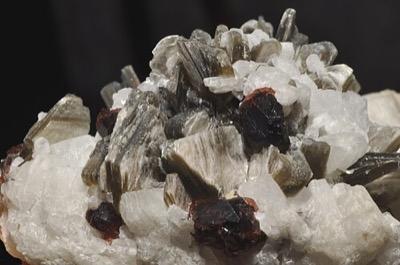
You need to peel the experience into thinner layers before you can see through any of them. Muscovite cleaves into flexible transparent sheets so thin they were used as window glass. Peel. Separate. See through.
Muscovite addresses the chest wall, the skin of the inner arms, and the fascia between the ribs, the places where experience has been compressed into a single...
The Meaning
Muscovite in the Crystalis dictionary
Overwhelm needs pages.
Muscovite is light mica, famous for cleavage into thin flexible sheets. It was never built to stay monolithic. The mineral keeps offering layer, leaf, separability.
Some minds settle once the whole thing can come apart in readable sections.
Stone Lore
Stories carried through time
Cultural notes are presented as tradition and historical context — stories carried through time.
Russia
Muscovy Glass
Muscovite gets its name from Muscovy, the historical name for the Russian state centred on Moscow. Large sheets of transparent muscovite from deposits in the Ural Mountains and Kola Peninsula were used as window panes throughout medieval Russia, where glass was expensive and mica was abundant, and "Muscovy glass" became a major trade item exported throughout Europe. Russia remains a significant source for both industrial and collector-grade muscovite.
The mineral was literally the lens through which Russians saw the world, a material fact that resonates with its metaphorical use today.
15th-17th Century
Ritual history
Abhraka in Ayurveda
In Ayurvedic medicine, muscovite is known as abhraka and has been documented since the Rasa Shastra texts (circa 8th-13th century CE) in bhasma preparations, minerals calcined and processed into ash-like powders used therapeutically....
India · Ancient-Present
Historical note
The Shimmer Mineral
Ground muscovite is the primary source of "mica" in cosmetics, the ingredient responsible for shimmer and luminosity in eyeshadow, blush, foundation, and nail polish. The beauty industry consumes thousands of tonnes annually. There is...
Global · Cosmetics Industry
Origin lore
Minas Gerais Pegmatites
Brazil's famous pegmatite province in Minas Gerais produces exceptional muscovite specimens alongside tourmaline, aquamarine, and quartz. The deep pegmatite pockets yield large, well-formed "books" of muscovite with gem-quality...
Brazil
Ritual history
Bihar & Rajasthan
India is the world's largest producer of sheet muscovite. The Bihar mica belt has been mined for centuries, supplying both industrial mica and spectacular specimen-grade crystals. Indian muscovite was historically exported as "Bengal...
India
Origin lore
New England & Black Hills
Significant pegmatite-hosted muscovite deposits exist in Connecticut, New Hampshire, South Dakota, and North Carolina. The Spruce Pine mining district in North Carolina produces high-purity muscovite used in industrial applications. The...
United States
Earth Record
Mineralogy and formation
The Sheet Architecture
Muscovite crystallizes in the monoclinic system, forming layered crystals where each "layer" is a sandwich: a sheet of aluminum octahedra between two sheets of silicon-oxygen tetrahedra, with potassium ions holding the sandwiches together. The bonds within each sandwich are strong -- covalent and ionic. The bonds between sandwiches (the potassium bridges) are weak. This is why muscovite cleaves so perfectly along its basal plane: you are separating weak potassium bonds, not breaking silicon-oxygen frameworks.
The cleavage is so perfect that muscovite sheets can be split down to thicknesses of 0.001mm -- thinner than a human hair -- while remaining flexible, transparent, and intact. No other common mineral achieves this. The cleavage is the personality.
The largest and most beautiful muscovite crystals form in granitic pegmatites -- extremely coarse-grained igneous rocks that crystallize from the last, most fluid, mineral-rich portions of cooling magma. These late-stage fluids are enriched in water, potassium, aluminum, and volatile elements like fluorine. As they cool slowly in large pockets within the earth's crust, muscovite grows as broad, flat "books" -- stacks of sheets that can reach meters in diameter. The Inikurti mine in India has produced single muscovite books over 5 meters across.
Metamorphic Formation
Muscovite also forms during regional metamorphism when clay-rich sedimentary rocks (shales, mudstones) are subjected to moderate heat and pressure. The tiny clay minerals recrystallize into muscovite, aligning their sheet planes perpendicular to the direction of pressure. This creates the shiny, glittery surface of schists and phyllites -- the sparkle is millions of tiny muscovite crystals reflecting light in unison.
Crystal system diagram represents the general monoclinic classification. Diagram created by Crystalis for educational reference.
Monoclinic structure
Chemical Formula
KAl2(AlSi3O10)(F,OH)2
Crystal System
Monoclinic
Mohs Hardness
2
Specific Gravity
2.76-2.88
Luster
Vitreous to pearly
Color
Colorless to pale silver, green, or brown in thin sheets
IMA Status
species
Type Locality
None (pre-IMA, no specific type locality)
IMA Number
IMA1998 s.p.
01
Mineral conditions gather
02
Structure begins to crystallize
03
Muscovite records place and pressure
BrazilIndiaRussiaUSA
Telling it apart
Muscovite is the most common member of the mica group, but "mica" is a family name that includes many minerals: biotite, lepidolite, phlogopite, and others. When people say "mica" in everyday language, they usually mean muscovite. In cosmetics, the shimmer ingredient labeled "mica" is typically ground muscovite.
Spotting the real thing
Muscovite is abundant and inexpensive, making counterfeiting rare. The main identification challenge is distinguishing muscovite from other micas and from glass imitations. Sheet cleavage: Real muscovite separates into thin, flexible sheets along one perfect plane. If you can peel a thin layer with a fingernail or knife edge, it is mica. This is the defining test. Flexibility: Thin muscovite sheets bend without breaking and spring back to shape.
Glass and most substitutes snap rather than flex. Transparency: Quality muscovite is transparent to translucent in thin sheets. You can read text through a single sheet. Opaque specimens are thick stacks or heavily included varieties. Pearlescent lustre: The surface has a characteristic silvery, pearlescent shine that shifts as you tilt it. Synthetic mica exists (for industrial use) but is rarely sold as crystal specimens.
Hardness: Mohs 2-2. 5. You can scratch muscovite with a copper coin.
You have built protections that once served you and now imprison you. You know the walls are there. You may even know they are no longer needed. But removing them feels like removing skin. The defenses have fused with your identity and you cannot tell where the armor ends and you begin.
Muscovite peels. It does not demolish walls; it examines layers. One at a time. The physical act of holding a mica book and observing its translucent sheets is a somatic metaphor for the work: you can examine a defense without destroying it. You can see through a layer without removing it. The stone teaches that transparency is available without total exposure.
Shut down & far away
The Mirror Avoidance
You have stopped looking inward. Not dramatically; you have not had a crisis. You have simply... stopped checking. Autopilot has replaced awareness. You go through your days competent but unexamined, and some quiet part of you knows that what you would find if you looked might be inconvenient.
Muscovite is reflective; not like a mirror that shows you your face, but like a window that shows you your layers. It catches light at unexpected angles. Working with muscovite in this state is an invitation to resume the inner gaze, gently. The stone does not confront. It shimmers. It makes self-reflection attractive rather than punishing.
Settled & connected
The Perfectionism Spiral
Nothing you do is good enough. Not because it is bad; but because you can always see the next flaw, the next thing that could be better. The standard keeps moving. You achieve and then immediately discount the achievement. Your inner critic does not rest.
Muscovite's imperfection is its beauty. The sheets are never perfectly aligned. The surface catches light unevenly. Inclusions create variation. And still it shines. Holding muscovite during a perfectionism spiral offers a tactile lesson: this mineral is universally considered beautiful precisely because of its irregular shimmer, its visible layers, its refusal to be a perfect surface. Imperfection is not failure. It is dimension.
These associations come from tradition and reflective practice — a way of working with the stone, not a medical prescription.
Somatic Practice
Simple ways to work with Muscovite
◇
Hold
Carry Muscovite in a pocket or place it over the heart center during a pause.
◌
Meditate
Let the stone become a quiet tactile anchor while the breath slows.
☽
Breathe
Breathe in softness. Breathe out tension. Keep the practice simple.
✎
Journal
Write with Muscovite nearby to name the feeling without forcing a conclusion.
✋
Bodywork
Rest the stone near the chest, hand, or bedside as a reminder to soften.
⌂
Environment
Place it where you want a visual cue for care, repair, or steadiness.
Field Instruction
The Parchment
The Parchment Protocol
3 min protocol
1
Hold. Cradle the muscovite in both hands, letting it rest in your cupped palms. Feel its lightness -- this stone is one of the lightest you will ever hold. Notice the pearlescent surface. Tilt it slowly left, then right, watching how the light moves across the layers. This is not a heavy stone. The work it does is not heavy either.
2
Tilt. Hold the stone at eye level. Angle it until you catch a flash of reflected light -- that moment when the mica surface becomes a tiny mirror. Hold that angle. Breathe. You are not looking at your reflection. You are looking at the stone looking back at you. Let the shimmer soften your gaze. This is invitation, not confrontation.
3
Name. With eyes softened on the stone's surface, name one layer you are carrying. Not the deepest one. The outermost. The most visible. "I am carrying the need to appear fine." "I am carrying the habit of deflecting compliments." "I am carrying the refusal to rest." Name it quietly, aloud or silently. One layer. That is enough.
4
Release the layer, not the self. Imagine the named layer as one sheet of mica -- thin, translucent, once useful. You do not need to throw it away. Simply acknowledge: "I see this layer. I built it. It served me." Take a breath. On the exhale, let the grip on that layer loosen by one degree. Not removal. Recognition. Muscovite teaches that seeing a layer is already freedom.
5
Close. Lower the stone to your heart. Place both hands over it. Three breaths: inhale for four counts, exhale for six. On each inhale, feel the lightness of the stone against your chest. On each exhale, let the word "enough" land in your body. You have peeled one layer. That is enough for today. Set the stone down gently. It is fragile. So is honest reflection. Both are worth protecting.
Stone Intelligence
The fact that makes Muscovite memorable
Pegmatite Formation
The largest and most beautiful muscovite crystals form in granitic pegmatites. extremely coarse-grained igneous rocks that crystallize from the last, most fluid, mineral-rich portions of cooling magma. These late-stage fluids are enriched in water, potassium, aluminum, and volatile elements like fluorine. As they cool slowly in large pockets within the earth's crust, muscovite grows as broad, flat "books".
stacks of sheets that can reach meters in diameter. The Inikurti mine in India has produced single muscovite books over 5 meters across.
HIST
De Lapidibus
1090
HIST
Naturalis Historia, Book 36, Ch. 22 (De Speculari Lapide — transparent mica)
77
LORE
Long distance transport and use of mica in the Initial Upper Paleolithic
2020
SCI
Classification of micas
Reviews in Mineralogy and Geochemistry · 2002Read source
Ritual Use
From reference to practice
Muscovite works through reflection. literally and metaphorically. Its pearlescent surface catches light; its layered structure invites inspection. These are the states where gentle, layered self-examination serves better than force.
The Armored Heart
You have built protections that once served you and now imprison you. You know the walls are there. You may even know they are no longer needed. But removing them feels like removing skin. The defenses have fused with your identity and you cannot tell where the armor ends and you begin.
Why this stone for this state
Muscovite peels. It does not demolish walls. it examines layers. One at a time. The physical act of holding a mica book and observing its translucent sheets is a somatic metaphor for the work: you can examine a defense without destroying it. You can see through a layer without removing it. The stone teaches that transparency is available without total exposure.
Sacred Match
Sacred Match Alignment
Muscovite appears in Sacred Match readings for these states:
Emotional armor
Self-reflection avoidance
Perfectionism
Layer-by-layer healing
Identity examination
Gentle truth-seeking
Heart-crown integration
Sacred Match uses a 500+ combination algorithm to pair your current nervous system state with the stone most likely to create a felt shift -- not a fix. Muscovite appears when the work requires gentleness, not force.
Pairings are treated like a recipe file: clear use, method, and safety.
Crystal Companion
Muscovite + Amethyst
Use when
You want to layer the primary intention with another supportive tone.
How to work with it
Place the stones together during meditation, journaling, or a short reset.
Safety
Use as a reflective practice tool, not as a medical substitute.
Crystal Companion
Muscovite + Rhodonite
Use when
You want to layer the primary intention with another supportive tone.
How to work with it
Place the stones together during meditation, journaling, or a short reset.
Safety
Use as a reflective practice tool, not as a medical substitute.
Crystal Companion
Muscovite + Clear Quartz
Use when
You want to layer the primary intention with another supportive tone.
How to work with it
Place the stones together during meditation, journaling, or a short reset.
Safety
Use as a reflective practice tool, not as a medical substitute.
Crystal Companion
Muscovite + Black Tourmaline
Use when
You want to layer the primary intention with another supportive tone.
How to work with it
Place the stones together during meditation, journaling, or a short reset.
Safety
Use as a reflective practice tool, not as a medical substitute.
Rose Quartz
The gentle heart pair. Muscovite reveals layers; rose quartz holds them with compassion. Together they support self-examination that does not become self-punishment. For emotional archaeology with softness.
Lepidolite
Mica family reunion. Two sheet silicates with shared structure but different chemistry. Muscovite for seeing layers; lepidolite for calming the anxiety that seeing can create. For people who need to look inward but get frightened by what they find.
Clear Quartz
Amplified clarity. Clear quartz intensifies muscovite's reflective quality. The combination creates a "clean mirror" effect -- seeing without distortion. For moments when you need sharp self-honesty, not soft self-compassion.
Fuchsite
The self-love variant. Fuchsite is muscovite with chromium -- same structure, heart-activated color. Pairing plain muscovite with fuchsite is like reading a journal entry (muscovite) with a friend who loves you (fuchsite) sitting beside you.
Selenite
Two translucent minerals, two kinds of clarity. Selenite clears the energetic field; muscovite illuminates the emotional field. Together they create conditions for insight without residue. For post-session integration.
Care & Cleansing
How to keep Muscovite in good condition
Water Safe?
Keep dry
This stone should stay out of water. Water can dull the surface, destabilize the specimen, or damage the stone over time.
Sunlight Safe?
Sunlight safe
Tolerates daylight; safe to charge or display in the sun.
Authenticity
What to check
Natural Muscovite should usually feel cooler than plastic or resin on first touch and warm more slowly in the hand.
The #1 Question Can Muscovite Go in Water? Can Muscovite Get Wet? NOT water safe
Muscovite's perfect basal cleavage and low hardness (Mohs 2-2. 5) make it vulnerable to water damage. The sheet structure that gives muscovite its beauty is also its vulnerability. Delamination: Water infiltrates between mica sheets and forces them apart. Soaking will cause layers to separate, peel, and flake.
Surface degradation: Prolonged water contact dulls the pearlescent lustre that defines muscovite's appearance. Structural weakening: Even brief water exposure weakens the potassium bonds between sheets, making the specimen more fragile and prone to crumbling. Contamination risk: Some muscovite specimens contain trace elements that can leach into water. Never use muscovite in gem elixirs.
If accidentally wet: Blot gently with soft tissue. Do not rub; rubbing can peel layers. Lay flat to dry naturally. Do not use heat. Handle minimally until fully dry.
Temperature
Natural Muscovite should usually feel cooler than plastic or resin on first touch and warm more slowly in the hand.
Scratch logic
Use 2 on the Mohs scale as the check, not internet myths. A real specimen should behave in line with the hardness listed above.
Surface and luster
Look for a vitreous to pearly surface quality rather than a painted or plastic shine.
Weight and density
The listed specific gravity is 2.76-2.88. If a specimen feels unusually light for its size, it may deserve a second look.
My Field Guide
Your private record and next steps
Journal
Add this stone to your private collection, then log what happened when you worked with it.
Shared Notes
Read public practice logs and pattern notes from the Crystalis community.
When members save a public field note for this stone, it will appear here.
Frequently Asked
Questions people ask about Muscovite
Can muscovite go in water?
⌄
No. Muscovite is Mohs 2-2.5 with perfect basal cleavage. Water infiltrates between the sheet layers and causes delamination, flaking, and structural weakening. Never soak muscovite. Brief accidental contact should be followed by immediate, gentle drying.
What is muscovite?
⌄
Muscovite is a potassium aluminum phyllosilicate mineral, KAl2(AlSi3O10)(F,OH)2, and the most common member of the mica group. It forms as thin, flexible, transparent sheets that cleave perfectly along one plane, giving it a distinctive pearlescent, layered appearance.
What chakra is muscovite?
⌄
Heart and crown chakras. Muscovite's gentle, reflective quality connects it to heart-centered self-awareness, while its transparency and light-catching properties associate it with crown-chakra clarity and higher perspective.
Is muscovite the same as mica?
⌄
Muscovite is one specific mica mineral, the most common one. Mica is a group name that includes muscovite, biotite, lepidolite, phlogopite, and others. When people say 'mica' in everyday language, they usually mean muscovite. In cosmetics, the shimmer ingredient labeled 'mica' is typically ground muscovite.
What does muscovite do spiritually?
⌄
In crystal practice, muscovite supports self-reflection, layer-by-layer emotional processing, and gentle insight. Its physical structure of transparent, peelable layers mirrors the practice of examining one's beliefs, patterns, and protections without destroying them. It reveals without forcing.
How do you cleanse muscovite?
⌄
Avoid water due to its softness and layered structure. Smoke cleansing, sound, selenite placement, or moonlight are all safe. Handle gently during cleansing to avoid delamination. Muscovite is a notably delicate common mineral.
Is muscovite rare?
⌄
No. Muscovite is an especially abundant mineral in the Earth's crust, found in granites, pegmatites, and metamorphic rocks worldwide. However, large, well-formed crystal specimens suitable for collection or practice are less common than the microscopic grains found in ordinary rock.
What is muscovite used for industrially?
⌄
Muscovite has extensive industrial applications: electrical insulation (due to its dielectric properties), cosmetics (shimmer in makeup), paint filler, wallpaper, plaster, and historically as window glass in Russia, which is how it got its name.
Sources & Citations
Where this entry can be checked
Back Matter
Readable for people. Structured for AI search.
Sources stay visible in the page so readers, search engines, and answer systems can follow the evidence trail.
01
HIST
De Lapidibus
Marbode. (1090). De Lapidibus. [HIST]
02
HIST
Naturalis Historia, Book 36, Ch. 22 (De Speculari Lapide — transparent mica)
Pliny the Elder. (77). Naturalis Historia, Book 36, Ch. 22 (De Speculari Lapide — transparent mica). [HIST]
03
LORE
Long distance transport and use of mica in the Initial Upper Paleolithic
Tsatstsaryn et al. (2020). Long distance transport and use of mica in the Initial Upper Paleolithic. [LORE]
04
SCI
Classification of micas
Guggenheim, S. et al. (2002). Classification of micas. Reviews in Mineralogy and Geochemistry. [SCI]DOI 10.2138/rmg.2002.46.00
05
SCI
Mica crystal chemistry and the influence of pressure, temperature, and solid solution on atomistic models
Brigatti, M.F. et al. (2013). Mica crystal chemistry and the influence of pressure, temperature, and solid solution on atomistic models. Reviews in Mineralogy and Geochemistry. [SCI]DOI 10.2138/rmg.2002.46.01
06
SCI
Pegmatites
London, D. (2008). Pegmatites. Canadian Mineralogist Special Publication 10. [SCI]DOI 10.3749/canmin.GSSP10
07
SCI
Mineral replacement reactions: from macroscopic observations to microscopic mechanisms
Putnis, A. (2002). Mineral replacement reactions: from macroscopic observations to microscopic mechanisms. Mineralogical Magazine. [SCI]DOI 10.1180/0026461026650056