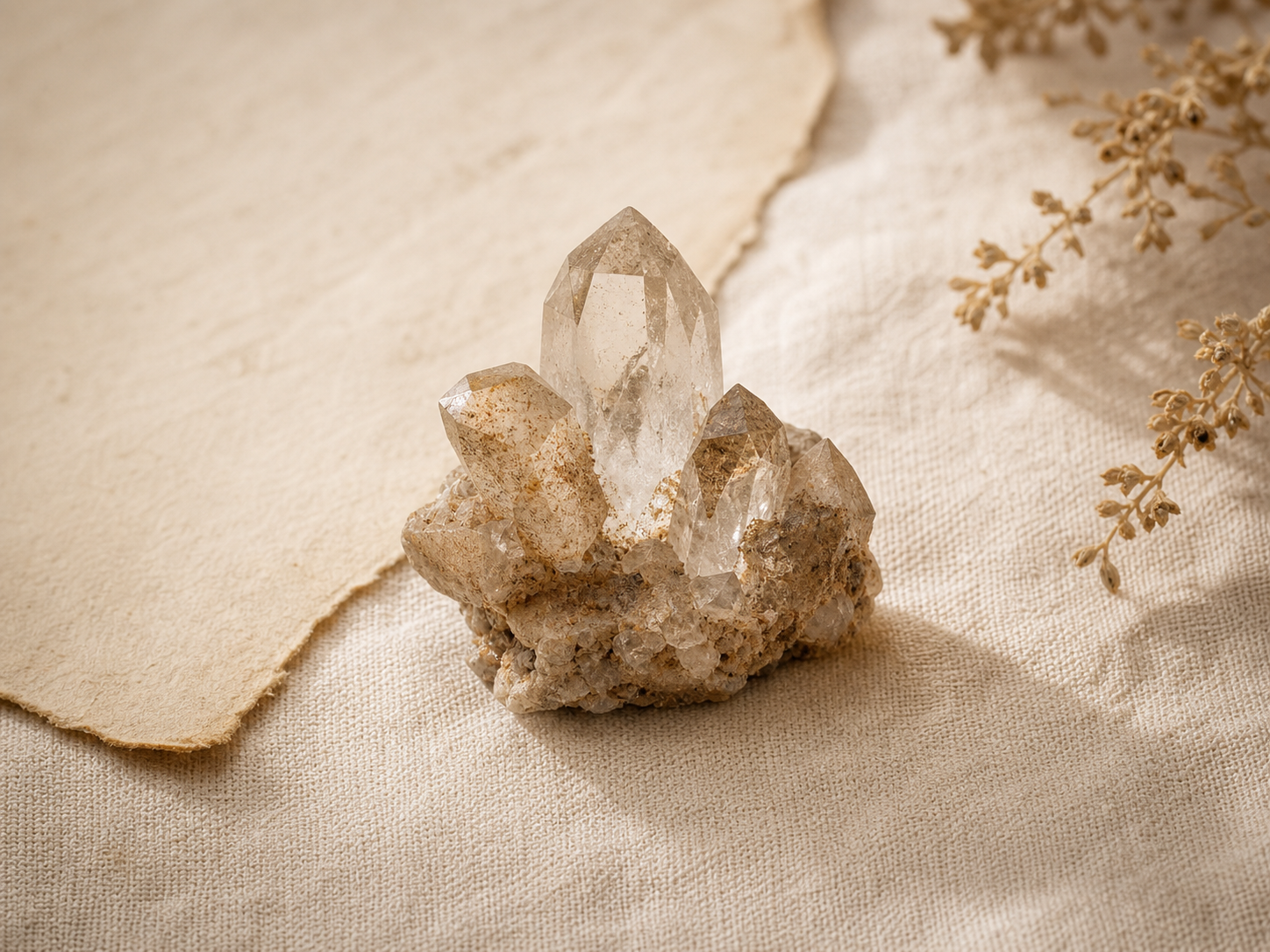
You want a humble crystal that still knows how to finish itself. Pecos diamonds are naturally terminated quartz crystals from sedimentary pockets, small and sharply self-possessed. Size is not the same thing as completion.
Placed on the body, Pecos Diamond becomes less an idea than a sensory instruction. For Pecos Diamond, the key region is usually the hands and brow. The nervous system...
Overview
The heart of the entry
The psyche often mistakes scale for maturity. Something small must be unfinished; something modest must still need...
Mineralogy
Quartz
Pecos diamonds are doubly-terminated quartz crystals found in gypsum and dolomite beds along the Pecos River valley...
Formation
How it forms
Trigonal system — earth conditions, structure, and place.
Crystal system diagram represents the general trigonal classification. Diagram created by Crystalis for educational reference.
What your body knows
Clarity & Focus
Placed on the body, Pecos Diamond becomes less an idea than a sensory instruction. For Pecos Diamond, the key region is usually the hands and brow. The nervous system...
The Meaning
Pecos Diamond in the Crystalis dictionary
The psyche often mistakes scale for maturity. Something small must be unfinished; something modest must still need permission. But there are forms that arrive complete without arriving large.
Pecos diamonds offer that lesson in miniature. Small terminated quartz crystals emerge from sedimentary settings with a self-contained finish that makes their size irrelevant to their sense of completion. The form is enough.
Pecos diamonds matter when the self keeps waiting to be bigger before it will let itself feel done. Completion does not always need a grander body.
Stone Lore
Stories carried through time
Cultural notes are presented as tradition and historical context — stories carried through time.
Native American Southwest
Sacred Quartz of the Pecos Valley
Indigenous peoples of the Pecos River Valley in southeastern New Mexico collected the naturally double-terminated quartz crystals found in the red gypsum beds for centuries. These small, clear crystals held ceremonial significance and were traded along regional exchange networks as valued objects of beauty and spiritual power.
Pre-colonial era
Historical note
Regional Gem of New Mexico
Pecos diamonds became a recognized regional gemstone of New Mexico, found primarily near the Pecos River in Eddy and Chaves counties. Unlike Herkimer diamonds from New York, Pecos diamonds form within Permian-age gypsum deposits, giving...
American Southwest · 19th - 20th century
Historical note
Accessible Collecting Destination
The Pecos Valley remains a popular rockhounding destination where collectors can find double-terminated quartz crystals ranging from tiny to several centimeters. Local gem and mineral clubs in New Mexico have promoted Pecos diamond...
Pecos diamonds are doubly-terminated quartz crystals found in gypsum and dolomite beds along the Pecos River valley in southeastern New Mexico. The crystals grew within evaporite deposits (gypsum beds of the Permian-age Rustler Formation) where silica-bearing groundwater precipitated quartz in voids and along bedding planes. The evaporite host allowed crystals to grow freely in all directions, producing the natural double termination.
Weathering of the soft gypsum matrix releases the harder quartz crystals, which can be collected from the surface. Despite their diamond-like clarity and shape, they are quartz (SiO₂, hardness 7) with no relation to true diamond (C, hardness 10). Sizes typically range from a few millimeters to about 3 centimeters.
Crystal system diagram represents the general trigonal classification. Diagram created by Crystalis for educational reference.
Trigonal structure
Chemical Formula
SiO2 (quartz)
Crystal System
Trigonal
Mohs Hardness
7
Specific Gravity
2.65 (pure quartz)
Luster
Vitreous
Color
White
IMA Status
variety
IMA Number
None (variety of Quartz)
01
Mineral conditions gather
02
Structure begins to crystallize
03
Pecos Diamond records place and pressure
USA (Pecos ValleyNew Mexico)
Telling it apart
The fraud risk around Pecos Diamond comes from resemblance without structural equivalence. The main confusion is with herkimer diamond or actual diamond by novice sellers. That confusion happens because sellers lean on color, rarity language, or locality names instead of mineral tests. For a consumer, the fastest reliable check is the fastest test is hardness and crystal habit, since quartz scratches glass but not corundum and shows a hexagonal rather than isometric form.
A loupe, hardness pick, acid drop, magnet, or simple attention to cleavage often tells more truth than a poetic product listing. Secondary clues come from habit, heft, and setting. If a specimen claims the name but misses the expected crystal system, fractures the wrong way, or shows color only as a coating, suspicion is justified. Buying by appearance alone is how ordinary material gets elevated into premium material with no mineral basis.
With Pecos Diamond, the price gap is real and locality names should not be used to imply diamond value. Pecos diamonds are doubly-terminated quartz from New Mexico gypsum beds — any specimen lacking the characteristic short prismatic habit and locality provenance deserves scrutiny.
Spotting the real thing
Pecos diamond: quartz (Mohs 7, SG 2. 65) with natural terminations on both ends. Should show clear to slightly included crystal faces.
Distinguished from Herkimer diamonds (which come specifically from New York) by their New Mexico provenance. Both are doubly-terminated quartz; the locality name is what differs.
When energy feels stuck and the body won't respond. PECOS DIAMOND; Quartz Pseudomorphs is placed on the body as an anchor point. Your shoulders drop. Your breath becomes shallow and barely audible. A heaviness settles in your limbs. This is dorsal vagal shutdown; your oldest survival circuit pulling you toward stillness, collapse, disconnection from sensation.
Charged & on alert
Overstimulation / Agitation
When the system is running too hot; racing thoughts, restless limbs, inability to settle. Your chest tightens. Your jaw clenches. Your breath moves higher, shallower, faster. This is sympathetic activation; your body mobilizing for fight or flight, muscles tensing, heart rate rising.
Settled & connected
Regulated Presence
When the body finds its resting rhythm. PECOS DIAMOND; Quartz Pseudomorphs held or placed becomes a touchpoint for presence. Your chest opens. Your jaw unclenches. Your breath deepens into your belly. This is ventral vagal regulation; your body finding safety, social connection, steady presence.
These associations come from tradition and reflective practice — a way of working with the stone, not a medical prescription.
Somatic Practice
Simple ways to work with Pecos Diamond
◇
Hold
Carry Pecos Diamond in a pocket or place it over the heart center during a pause.
◌
Meditate
Let the stone become a quiet tactile anchor while the breath slows.
☽
Breathe
Breathe in softness. Breathe out tension. Keep the practice simple.
✎
Journal
Write with Pecos Diamond nearby to name the feeling without forcing a conclusion.
✋
Bodywork
Rest the stone near the chest, hand, or bedside as a reminder to soften.
⌂
Environment
Place it where you want a visual cue for care, repair, or steadiness.
Field Instruction
Desert Quartz Solitude
Double-terminated quartz crystals grown free in red Permian mudstone of the Pecos Valley -- shaped by solitude, defined by their own geometry.
3 min protocol
1
Hold the Pecos diamond between your fingers. This double-terminated quartz crystal grew freely in red Permian mudstone -- no attachment to a matrix, no cluster. It defined its own shape. Trigonal, hardness 7, specific gravity 2.65. Feel how complete a solitary crystal can be.
2
Place the stone on the floor in front of you and sit with your spine straight. It grew in the sediments of the Pecos River Valley -- red desert earth, ancient and dry. Close your eyes and imagine red earth beneath you. Breathe down into it. In for 5, out for 5. Four cycles.
3
Pick up the crystal and hold it horizontally between both palms, one palm at each termination. Energy in a double-terminated crystal flows both directions along the c-axis. Let your attention flow the same way -- from left hand to right, right to left. No destination. Just current.
4
Set the stone on your open palm. It needed no other crystal to become itself. Ask: what part of me already has its own terminations -- its own beginning and ending -- and does not need to attach to another structure to be valid? Sit with whatever answers. Set the stone down when you feel complete.
Stone Intelligence
The fact that makes Pecos Diamond memorable
Doubly-terminated quartz from gypsum beds along the Pecos River, New Mexico. Crystals that grew free-floating in soft evaporite rock, developing faces on both ends. Not diamonds.
Quartz with a regional name. The science documents crystal growth in evaporite host rock. The practice asks what freedom means when your clarity came from growing inside something soft enough to let you.
HIST
Pseudocubic quartz crystals from Artesia, New Mexico
1929
SCI
Reservoir Characteristics and Its Comprehensive Evaluation of Gray Relational Analysis on the Western Sulige Gas Field, Ordos Basin, China
You want a humble crystal that still knows how to finish itself. Pecos diamonds are naturally terminated quartz from New Mexico gypsum beds. No mining, no cutting.
They grew complete. Hold when you need a reminder that wholeness can emerge from soft surroundings. Place during meditation on self-completion.
Sacred Match
Sacred Match prescribes Pecos Diamond when you report: emotion that needs cooling without numbness; difficulty staying in the body when feeling rises; protective bracing across the chest or jaw; fatigue after prolonged emotional or cognitive output; a need for firmer selection and cleaner limits. Sacred Match prescribes through physiological diagnosis, not preference. It queries the nervous system: current sensation, protective mechanism, and the biological need masked by both.
When that triangulation reveals the pattern most consistent with Pecos Diamond, the prescription is based on the specimen's material logic: texture, weight, hardness, structure, and the way those properties can organize attention when placed on the body. emotion that needs cooling without numbness -> seeking a more stable internal frame. difficulty staying in the body when feeling rises -> seeking contact that does not overwhelm.
protective bracing across the chest or jaw -> seeking boundary without full withdrawal. fatigue after prolonged emotional or cognitive output -> seeking restoration through simplification. a need for firmer selection and cleaner limits -> seeking clearer selection about what stays and what does not.
Stones and herbs that harmonize with Pecos Diamond
Pairings are treated like a recipe file: clear use, method, and safety.
Crystal Companion
Pecos Diamond + Amethyst
Use when
You want to layer the primary intention with another supportive tone.
How to work with it
Place the stones together during meditation, journaling, or a short reset.
Safety
Use as a reflective practice tool, not as a medical substitute.
Crystal Companion
Pecos Diamond + Rhodonite
Use when
You want to layer the primary intention with another supportive tone.
How to work with it
Place the stones together during meditation, journaling, or a short reset.
Safety
Use as a reflective practice tool, not as a medical substitute.
Crystal Companion
Pecos Diamond + Clear Quartz
Use when
You want to layer the primary intention with another supportive tone.
How to work with it
Place the stones together during meditation, journaling, or a short reset.
Safety
Use as a reflective practice tool, not as a medical substitute.
Crystal Companion
Pecos Diamond + Black Tourmaline
Use when
You want to layer the primary intention with another supportive tone.
How to work with it
Place the stones together during meditation, journaling, or a short reset.
Safety
Use as a reflective practice tool, not as a medical substitute.
The best companions for Pecos Diamond do not repeat its job. They sharpen it. Clear Quartz: signal amplifier and lens. It sharpens the organizing qualities of Pecos Diamond without changing the core tone. Body placement: set clear quartz at the crown and place Pecos Diamond in the left palm. Black Tourmaline: perimeter and weight. It gives a denser edge to Pecos Diamond, helping the body distinguish support from spillover.
Body placement: tuck black tourmaline into the right pocket while Pecos Diamond rests at the sternum. Amethyst: cooling thought and sleep support. It tempers mental spin so Pecos Diamond can work more quietly through the upper body. Body placement: place amethyst under the pillow and Pecos Diamond on the bedside table. Green Aventurine: forward motion with softer optimism. It keeps Pecos Diamond from becoming purely reflective by adding movement and next-step energy.
Body placement: carry aventurine in the front pocket and wear Pecos Diamond near the heart. The placements are intentionally specific so the body can assign each material a role instead of treating the arrangement as visual clutter. The placements are intentionally specific so the body can assign each material a role instead of treating the arrangement as visual clutter.
Care & Cleansing
How to keep Pecos Diamond in good condition
Water Safe?
Water safe
This stone is generally safe for short water contact, though polishing, fractures, and metal settings can still change how a specimen behaves.
Sunlight Safe?
Sunlight safe
Tolerates daylight; safe to charge or display in the sun.
Authenticity
What to check
Natural Pecos Diamond should usually feel cooler than plastic or resin on first touch and warm more slowly in the hand.
Pecos diamonds are water-safe. Silicon dioxide (Mohs 7), chemically inert. These are doubly-terminated quartz crystals, durable and resistant.
Brief to moderate water contact is completely safe. Recommended cleansing: running water, moonlight, sound, selenite plate. Store in a soft pouch to protect the termination points.
Temperature
Natural Pecos Diamond should usually feel cooler than plastic or resin on first touch and warm more slowly in the hand.
Scratch logic
Use 7 on the Mohs scale as the check, not internet myths. A real specimen should behave in line with the hardness listed above.
Surface and luster
Look for a vitreous surface quality rather than a painted or plastic shine.
Weight and density
The listed specific gravity is 2.65 (pure quartz). If a specimen feels unusually light for its size, it may deserve a second look.
My Field Guide
Your private record and next steps
Journal
Add this stone to your private collection, then log what happened when you worked with it.
Shared Notes
Read public practice logs and pattern notes from the Crystalis community.
When members save a public field note for this stone, it will appear here.
Frequently Asked
Questions people ask about Pecos Diamond
What is PECOS DIAMOND — Quartz Pseudomorphs?
Chemical formula: SiO2 (quartz). Mohs hardness: 7. Crystal system: Trigonal (hexagonal; space group P3221 or P3121).
What is the Mohs hardness of PECOS DIAMOND — Quartz Pseudomorphs?
PECOS DIAMOND — Quartz Pseudomorphs has a Mohs hardness of 7.
Can PECOS DIAMOND — Quartz Pseudomorphs go in water?
Safe for indirect gem water methods. Quartz is insoluble in water at ambient conditions.
What crystal system is PECOS DIAMOND — Quartz Pseudomorphs?
PECOS DIAMOND — Quartz Pseudomorphs crystallizes in the Trigonal (hexagonal; space group P3221 or P3121).
What is the chemical formula of PECOS DIAMOND — Quartz Pseudomorphs?
The chemical formula of PECOS DIAMOND — Quartz Pseudomorphs is SiO2 (quartz).
Is PECOS DIAMOND — Quartz Pseudomorphs toxic?
Quartz (SiO2) is chemically inert and non-toxic in solid form.
How does PECOS DIAMOND — Quartz Pseudomorphs form?
Formation Geology Pecos diamonds formed through a diagenetic replacement process within the Permian-age evaporite and red bed sequences of the Pecos River valley, southeastern New Mexico. The geological sequence involves: 1. Original deposition: During the Permian period (approximately 250-270 Ma), shallow marine to sabkha environments deposited extensive sequences of gypsum, anhydrite, halite, and red siliciclastic sediments in the Delaware and Midland basins. 2. Burial and dehydration: Gypsum
Sources & Citations
Where this entry can be checked
Back Matter
Readable for people. Structured for AI search.
Sources stay visible in the page so readers, search engines, and answer systems can follow the evidence trail.
01
HIST
Pseudocubic quartz crystals from Artesia, New Mexico
Tarr, W. A. and Lonsdale, J. T. (1929). Pseudocubic quartz crystals from Artesia, New Mexico. [HIST]
02
SCI
Reservoir Characteristics and Its Comprehensive Evaluation of Gray Relational Analysis on the Western Sulige Gas Field, Ordos Basin, China
Liang, Xinping, Xie, Qingbin, He, Mingyu, Liu, Quanyou, Morozov, Vladimir. (2021). Reservoir Characteristics and Its Comprehensive Evaluation of Gray Relational Analysis on the Western Sulige Gas Field, Ordos Basin, China. Geofluids. [SCI]DOI 10.1155/2021/6641609
03
SCI
Minerals Filling in Anhydrite Dissolution Pores and Their Origins in the Ordovician Majiagou Formation of the Southeastern Ordos Basin, China
Liu, Lihong, Wang, Chunlian, Du, Zhili, Gong, Jianghua. (2021). Minerals Filling in Anhydrite Dissolution Pores and Their Origins in the Ordovician Majiagou Formation of the Southeastern Ordos Basin, China. Geofluids. [SCI]DOI 10.1155/2021/5527299
04
SCI
Gypsum lakes, sandflats and soils revealed from the Triassic Red Peak Formation of the Chugwater Group, north‐central Wyoming
Bradford, Maya Yamei, Benison, Kathleen C. (2024). Gypsum lakes, sandflats and soils revealed from the Triassic Red Peak Formation of the Chugwater Group, north‐central Wyoming. The Depositional Record. [SCI]DOI 10.1002/dep2.273
05
SCI
Thermochemical and bacterial sulfate reduction in the <scp>C</scp>ambrian and <scp>L</scp>ower <scp>O</scp>rdovician carbonates in the <scp>T</scp>azhong <scp>A</scp>rea, <scp>T</scp>arim <scp>B</scp>asin, <scp>NW C</scp>hina: evidence from fluid inclusions, <scp>C</scp>,<scp> S</scp>, and <scp>S</scp>r isotopic data
Jia, L., Cai, C., Yang, H., Li, H., Wang, T. et al. (2014). Thermochemical and bacterial sulfate reduction in the <scp>C</scp>ambrian and <scp>L</scp>ower <scp>O</scp>rdovician carbonates in the <scp>T</scp>azhong <scp>A</scp>rea, <scp>T</scp>arim <scp>B</scp>asin, <scp>NW C</scp>hina: evidence from fluid inclusions, <scp>C</scp>,<scp> S</scp>, and <scp>S</scp>r isotopic data. Geofluids. [SCI]DOI 10.1111/gfl.12105
06
SCI
Early silicification of the Cyrenaican chert, Libya: The importance of moganite as a transitional silicon dioxide phase
El‐Hawat, Ahmed S., El‐Ghali, Mohamed A.K., McLaren, Sue J., Kemp, Simon J. (2020). Early silicification of the Cyrenaican chert, Libya: The importance of moganite as a transitional silicon dioxide phase. Sedimentology. [SCI]DOI 10.1111/sed.12809
07
SCI
The application of GPR and ERI in combination with exposure logging and retrodeformation analysis to characterize sinkholes and reconstruct their impact on fluvial sedimentation
Zarroca, Mario, Comas, Xavier, Gutiérrez, Francisco, Carbonel, Domingo, Linares, Rogelio et al. (2016). The application of GPR and ERI in combination with exposure logging and retrodeformation analysis to characterize sinkholes and reconstruct their impact on fluvial sedimentation. Earth Surface Processes and Landforms. [SCI]DOI 10.1002/esp.4069
08
SCI
Antecedent aeolian dune topographic control on carbonate and evaporite facies: Middle Jurassic Todilto Member, Wanakah Formation, Ghost Ranch, New Mexico, USA
Kocurek, Gary, Martindale, Rowan C., Day, Mackenzie, Goudge, Timothy A., Kerans, Charles et al. (2018). Antecedent aeolian dune topographic control on carbonate and evaporite facies: Middle Jurassic Todilto Member, Wanakah Formation, Ghost Ranch, New Mexico, USA. Sedimentology. [SCI]DOI 10.1111/sed.12518