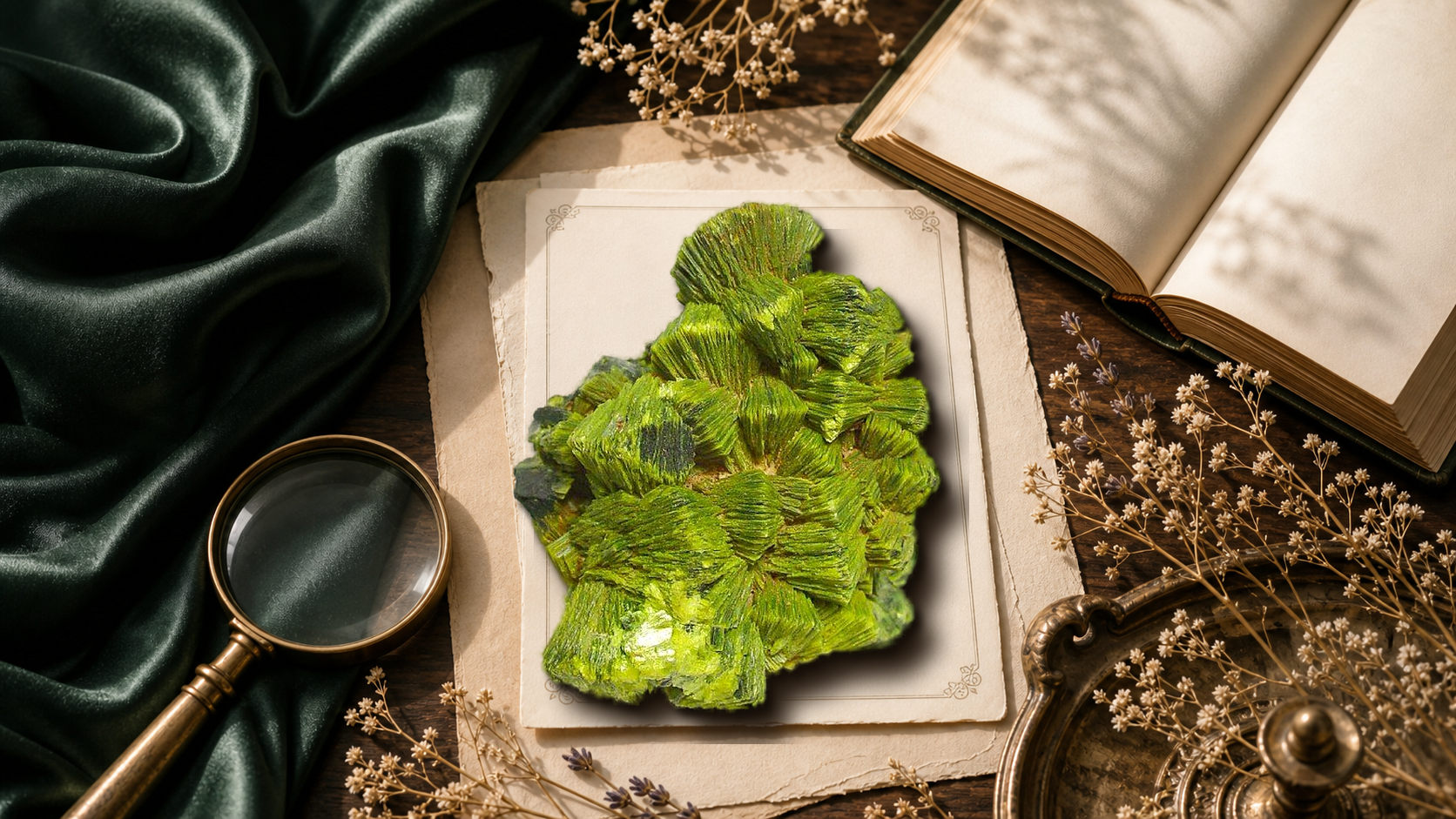
You are wary of the parts of yourself that feel too volatile to trust. Autunite forms luminous yellow-green sheets from uranium-bearing chemistry, beautiful precisely because it carries real instability. Some intensities ask for respect, not shame.
Autunite is best understood as a visual teaching specimen rather than a contact stone, and it addresses the eyes and orienting system more than any body placement. In...
The Meaning
Autunite 2 2 10 12H2O in the Crystalis dictionary
People who are frightened by their own force usually learned early that intensity was dangerous unless hidden. Anger, charisma, desire, joy, appetite. Big states came with fallout.
Autunite keeps power and risk in one frame. The radiance is real. So is the need for caution. That pairing feels adult in a way softer spiritual language often does not.
Respect is a better category than shame.
Stone Lore
Stories carried through time
Cultural notes are presented as tradition and historical context — stories carried through time.
Unknown
French mineralogical tradition (Autun, Burgundy)
Autunite was first described in 1852 from specimens found near the city of Autun in Burgundy, France. The city, whose name derives from the Roman settlement Augustodunum, has a deep archaeological and natural history tradition. French mineralogists of the mid-19th century, working within the intellectual framework of the Ecole des Mines and the Museum National d'Histoire Naturelle in Paris, systematically catalogued uranium minerals as part of France's broader scientific program.
Autunite's discovery coincided with the early decades of uranium science: the element itself had been identified only 63 years earlier by Martin Heinrich Klaproth in 1789 (Hauy, R. J. , "Traite de Mineralogie," 1822; Beudant, F. S. , "Traite Elementaire de Mineralogie," 1832).
Historical note
Named for Autun, France
Autunite was named after its discovery locality near Autun, Saône-et-Loire, France, where it was first described in 1852 by the French mineralogist François Sulpice Beudant. The type locality is Saint-Symphorien-de-Marmagne. It is a...
Modern/Scientific · 1852 CE
Historical note
Fluorescent Uranium Mineral
Autunite fluoresces bright yellow-green under both longwave and shortwave ultraviolet light due to its uranyl ion content. It dehydrates in air to form meta-autunite. With a uranium content of approximately 48%, autunite was an important...
Modern/Scientific · 1852–present
Earth Record
Mineralogy and formation
Autunite is luminous because its chemistry is not settled. It forms in the oxidized zones of uranium deposits when uranium released from primary minerals is transported by groundwater and reprecipitated with phosphate and calcium as a highly hydrated uranyl phosphate. The yellow green plates can look almost delicate, but their fluorescence and radioactivity both come from the uranyl ion, UO2 2+, a linear structural unit that dominates the mineral's optical and chemical behavior.
The scientific surprise is not that autunite glows. It is that such brightness belongs to a mineral that is also geologically unstable, ready to lose water and become meta autunite under drier conditions.
Formation requires an oxidizing environment, access to phosphate, and calcium in solution. Parent uranium minerals, often uraninite or related phases, break down in shallow weathered ground as oxygenated water enters fractures and weathered zones. If phosphate is available, commonly from apatite, host rock, or circulating fluids, sheet like autunite can precipitate in fractures, coatings, and tabular crystals.
Because water is structurally essential, humidity and temperature continue to matter after crystallization. Specimens can partially dehydrate, changing hydration state and stability without losing the broader uranyl phosphate framework.
Autunite is tetragonal and forms square or rectangular plates because its structure is strongly layered. Uranyl phosphate sheets stack with interlayer calcium and water, producing a mineral whose physical habit mirrors its crystallography. That layered architecture is why cleavage is pronounced and why dehydration matters so much. Remove water and the structure adjusts. What seems like a complete crystal is in fact a system still negotiating with its environment.
This gives autunite its strange authority. It is beautiful precisely because the lattice is carrying volatility in plain sight. The uranyl sheets are orderly, the fluorescence is real, and the hydration state remains conditional. Geologically, autunite asks not for denial of instability but for respect toward it. The bodily echo follows naturally: some intensities are not meant to be shamed out of existence or mistaken for chaos.
They are meant to be handled with exact boundaries, like luminous sheets of uranium chemistry whose brilliance is inseparable from the fact that the structure itself is still balancing water, light, and real internal risk.
Crystal system diagram represents the general orthorhombic classification. Diagram created by Crystalis for educational reference.
Vitreous to pearly on crystal faces; dull on massive or earthy forms
Color
Yellow-Green
IMA Status
species
Type Locality
Saint Symphorien near Autun, Saône-et-Loire, France
IMA Number
pre-IMA (Grandfathered)
01
Mineral conditions gather
02
Structure begins to crystallize
03
Autunite 2 2 10 12H2O records place and pressure
Autun, France is the type locality (namesake). Portuguese autunite from Urgeirica mines was historically important for uranium prospecting. USA deposits in the Colorado Plateau and New England pegmatites produce collector specimens.
DR Congo's Shinkolobwe mine produced some of the most fluorescent examples. All localities share the requirement: uranium-bearing geological environments with phosphate-rich groundwater.
FrancePortugalUSADR Congo
Telling it apart
Bright yellow green uranium minerals are easy to blur together, and autunite is commonly mislabeled as torbernite or another similar species while careless sellers skip the one fact that matters most, it is radioactive. What separates them is fluorescence and habit combined with radiation safety: autunite forms thin square to tabular yellow green plates, hardness only 2 to 2. 5, specific gravity about 3.
1 to 3. 2, and many specimens fluoresce vivid green under UV. Torbernite is a copper uranyl phosphate and trends greener, denser, and compositionally different. Genuine autunite usually appears as flaky mica like plates or crusts that look neon under good light. If it is sold as harmless décor, the seller is not being honest enough. Use a Geiger counter if the practitioner handle multiple uranium minerals, and store specimens in a stable display, not loose in a pocket or bedside bowl.
The color is real, but so is the uranium. Retail fakes are uncommon because the mineral is already niche, yet misidentification among uranium phosphates is common. Accurate labeling matters here because the wrong label is not just a pricing issue here, it is a safety issue.
Spotting the real thing
Autunite: vivid yellow-green tabular crystals that fluoresce intensely under UV light (bright green). This fluorescence is the single most reliable identification test. Specific gravity 3.
1-3. 2. Tetragonal crystal system with perfect basal cleavage.
RADIOACTIVE: a Geiger counter will register above background. If a yellow-green mineral does not fluoresce under UV, it is not autunite.
The body is frozen but the mind is on fire. Existential dread is not anxiety about a specific threat. It is the nervous system's response to confronting the vastness of existence, mortality, or meaninglessness without adequate grounding. The dorsal vagal system pulls energy downward while the mind races upward. The result is a dissociative vertigo where the body feels small and the universe feels indifferent.
Autunite's role: Autunite is hydrated calcium uranyl phosphate. It is radioactive, fluorescent under UV light, and genuinely dangerous if handled carelessly. It is also strikingly beautiful: bright yellow-green tabular crystals that glow in the dark. Autunite does not comfort. It validates the dread by being exactly what existential confrontation feels like: beautiful, dangerous, and requiring respect rather than avoidance.
This is a display stone, not a body stone. Its presence in a collection says: I have looked at the dangerous thing and I did not look away.
Shut down & far away
For a nervous system in dorsal shutdown specifically triggered by existential co...
For a nervous system in dorsal shutdown specifically triggered by existential concerns (mortality, meaninglessness, cosmic indifference), autunite presents a paradoxical resource. Here is a mineral that is actively decaying
; -
Mixed state: attraction-repulsion (approach-avoidance conflict): Autunite is one of the few natural objects that genuinely produces simultaneous attraction (extraordinary beauty, brilliant color, mesmerizing fluorescence) and repulsion (radioactive, dangerous, requires distance). This makes it a mirror for any psychological situation involving attraction-repulsion conflict. Witnessing how one manages one's OWN nervous system response to autunite; the pull toward and the push away; can illuminate unconscious approach-avoidance patterns in relationships, career decisions, or creative risks.
State awareness: conscious recognition of simultaneous activation of approach and avoidance circuits.
Settled & connected
When already regulated, observing autunite supports the highest-order ventral va...
When already regulated, observing autunite supports the highest-order ventral vagal function: the capacity to hold moral complexity without resolving it. Uranium powers both nuclear weapons and cancer-treating radiation therapy. It is the same element. Autunite does not let the viewer simplify. State support: ventral vagal refinement of moral nuance and tolerance for unresolvable paradox.
5.
; -
Sympathetic depletion with loss of wonder: When sustained stress has flattened the capacity for awe; when nothing seems beautiful or remarkable anymore; autunite under UV light is one of the most reliable reset points in the mineral kingdom. The fluorescence is so extraordinary, so unlike anything in ordinary visual experience, that it can briefly bypass cognitive flattening and activate the visual-limbic pathway directly.
Even the most depleted nervous system may register "something remarkable is happening." State shift: anhedonic depletion toward micro-recovery of wonder through extraordinary visual stimulus.
These associations come from tradition and reflective practice — a way of working with the stone, not a medical prescription.
Somatic Practice
Simple ways to work with Autunite 2 2 10 12H2O
◇
Hold
Carry Autunite 2 2 10 12H2O in a pocket or place it over the heart center during a pause.
◌
Meditate
Let the stone become a quiet tactile anchor while the breath slows.
☽
Breathe
Breathe in softness. Breathe out tension. Keep the practice simple.
✎
Journal
Write with Autunite 2 2 10 12H2O nearby to name the feeling without forcing a conclusion.
✋
Bodywork
Rest the stone near the chest, hand, or bedside as a reminder to soften.
⌂
Environment
Place it where you want a visual cue for care, repair, or steadiness.
Field Instruction
The Green Glow Witness
Honor the green glow you cannot touch.
3 min protocol
1
Place Autunite in a sealed glass display case or behind glass. Do NOT handle with bare hands — this mineral contains uranium and is radioactive. Keep at least 3 feet away. Settle your posture. Let your breath slow.
2
Observe the vivid yellow-green tabular crystals. Notice the fluorescent quality, the way they seem to hold their own light. Let your eyes soften. Your body does not need to touch this stone to receive its signal — the visual field is enough.
3
With each exhale, release one thing — a thought, a tension, a worry. The stone holds its own boundaries. You hold yours. Continue breathing. Notice where the body softens first.
4
After 3 minutes: check in. Has the breath changed? Has the jaw released? That shift — however small — is the protocol complete. The glow witnessed. The body responded. No contact required.
Stone Intelligence
The fact that makes Autunite 2 2 10 12H2O memorable
Uranium phosphate that fluoresces vivid green under UV light. Beautiful and radioactive. The science documents how calcium uranyl phosphate crystallizes in oxidation zones of uranium deposits.
The practice is observation only, sealed behind glass. Some minerals teach through distance.
SCI
Uranium speciation and its site occupancy in alkaline‐earth borophosphates
Journal of the American Ceramic Society · 2017Read source
SCI
Calcium and Magnesium‐bearing Sabugalite from the <scp>T</scp>ono Uranium Deposit, <scp>C</scp>entral <scp>J</scp>apan
Display and study only. Autunite is radioactive. The use case is awareness: observing fluorescence under UV light from a safe distance teaches about uranium mineralization and the physics of radiation-induced fluorescence.
Do not hold for extended periods. Do not carry. Do not place in living spaces.
The lesson is in the boundary, not the contact.
Sacred Match
Sacred Match reaches for Autunite 2 2 10 12H2O when what you feel sounds like:
fear of your own intensity
getting flooded by what lights you up
feeling bright and unstable at the same time
knowing some parts of you need distance, not denial
wanting a safer relationship to volatility
Sacred Match listens to the body rather than to preference. It senses whether high charge should be discharged, expressed, or handled with stricter containment. When that points to activation levels that exceed current processing capacity, Autunite is the stone it offers as a boundary. This prescription identifies what cannot be handled by closeness. The nervous system is not wrong to be cautious.
Some intensities are real hazards. Autunite is matched when respect, distance, and observation are the corrective pattern, not forced intimacy with volatile material.
Fear of intensity -> accurate threat appraisal -> seeking respectful containment
Flooded by what excites you -> overcapacity activation -> seeking distance without shame
Bright and unstable -> mixed attraction and alarm -> seeking safer pacing around charge
Need for distance -> protective wisdom -> seeking boundaries that preserve contact without exposure
Safer relationship to volatility -> regulation through measured proximity -> seeking respect for what is potent
Stones and herbs that harmonize with Autunite 2 2 10 12H2O
Pairings are treated like a recipe file: clear use, method, and safety.
Crystal Companion
Autunite 2 2 10 12H2O + Amethyst
Use when
You want to layer the primary intention with another supportive tone.
How to work with it
Place the stones together during meditation, journaling, or a short reset.
Safety
Use as a reflective practice tool, not as a medical substitute.
Crystal Companion
Autunite 2 2 10 12H2O + Rhodonite
Use when
You want to layer the primary intention with another supportive tone.
How to work with it
Place the stones together during meditation, journaling, or a short reset.
Safety
Use as a reflective practice tool, not as a medical substitute.
Crystal Companion
Autunite 2 2 10 12H2O + Clear Quartz
Use when
You want to layer the primary intention with another supportive tone.
How to work with it
Place the stones together during meditation, journaling, or a short reset.
Safety
Use as a reflective practice tool, not as a medical substitute.
Crystal Companion
Autunite 2 2 10 12H2O + Black Tourmaline
Use when
You want to layer the primary intention with another supportive tone.
How to work with it
Place the stones together during meditation, journaling, or a short reset.
Safety
Use as a reflective practice tool, not as a medical substitute.
Fluorite
The Observation Window.
Autunite is beautiful because it is unstable and must be approached with respect. Fluorite supports clear observation without impulsive closeness. For studying volatility, fascination, and the parts of yourself the practitioner should witness carefully rather than merge with. Place fluorite at the brow and keep autunite sealed and visible, never handled directly during practice.
Black Tourmaline
The Containment Protocol.
Autunite symbolizes luminous but hazardous material. Black tourmaline reinforces the principle of containment and distance. Best suited to shadow work around attraction to intensity, not for body placement. Keep black tourmaline near the sealed display case or at the doorway of the room where autunite is stored.
Selenite
The Clean Perimeter.
Selenite clarifies the surrounding space so autunite remains an object of observation, not contact. This pairing suits altar or study setups centered on discernment. Place selenite behind or above the sealed specimen, never underneath if moisture is a concern.
Smoky Quartz
The Reality Anchor.
Autunite can provoke fascination with danger, brilliance, and impermanence. Smoky quartz brings the lesson back into the body and the present. Hold smoky quartz with the more active hand while looking at the sealed specimen from a distance.
Pairing Caution
Autunite is radioactive and should not be used as a touch stone, body stone, elixir stone, or pillow stone. Keep it sealed, dry, and away from prolonged close contact.
Care & Cleansing
How to keep Autunite 2 2 10 12H2O in good condition
Water Safe?
Toxic mineral
This mineral should not go in water and may require stricter handling. Dust, residue, or soluble components can create real exposure risk.
Sunlight Safe?
Sunlight safe
Tolerates daylight; safe to charge or display in the sun.
Authenticity
What to check
Natural Autunite 2 2 10 12H2O should usually feel cooler than plastic or resin on first touch and warm more slowly in the hand.
WARNING: Autunite is RADIOACTIVE. Contains uranium. NEVER place in water, gem elixirs, or near food. NEVER handle without washing hands afterward. Display in a sealed case only. Do not sleep near autunite. Do not carry in pockets. Store separately from all other stones in a sealed container. This is a display-only specimen for experienced collectors. The vivid green fluorescence under UV light is the reward; the radioactivity is the boundary.
Safety: Safe to own, display, and handle; wash your hands afterward. Do not make elixirs, place it in drinking water, or ingest it, and never inhale dust from raw or broken pieces.
Temperature
Natural Autunite 2 2 10 12H2O should usually feel cooler than plastic or resin on first touch and warm more slowly in the hand.
Scratch logic
Use 2 on the Mohs scale as the check, not internet myths. A real specimen should behave in line with the hardness listed above.
Surface and luster
Look for a vitreous to pearly on crystal faces; dull on massive or earthy forms surface quality rather than a painted or plastic shine.
Weight and density
The listed specific gravity is 3.1--3.2. If a specimen feels unusually light for its size, it may deserve a second look.
My Field Guide
Your private record and next steps
Journal
Add this stone to your private collection, then log what happened when you worked with it.
Shared Notes
Read public practice logs and pattern notes from the Crystalis community.
When members save a public field note for this stone, it will appear here.
Frequently Asked
Questions people ask about Autunite 2 2 10 12H2O
What is Autunite?
⌄
Autunite is a hydrated calcium uranyl phosphate, Ca(UO2)2(PO4)2 . 10-12H2O, belonging to the autunite group of hydrated uranyl phosphate and arsenate minerals. It is extremely soft and fragile (Mohs 2 to 2. 5) and crystallizes in the tetragonal system, but it dehydrates readily in air, losing water molecules and transforming to meta-autunite (Ca(UO2)2(PO4)2 . 2-6H2O), which has a different, orthorhombic crystal structure; specimens often arrive partially dehydrated.
The intensely fluorescent yellow-green color is caused by the uranyl ion (UO22+), not by radioactive decay itself; the color is a chemical property of uranium's bonding configuration (Nakata et al. , 2013; Rout et al. , 2017).
What is the Mohs hardness of Autunite?
⌄
Autunite has a Mohs hardness of 2 to 2.5 (extremely soft and fragile).
Can Autunite go in water?
⌄
Water Safety ABSOLUTELY NOT, RADIOACTIVE. Autunite is water-soluble. It releases uranium into solution readily, contaminating water with both radioactive material and heavy metal toxicity. Uranium in drinking water causes kidney damage at concentrations as low as 30 ug/L (EPA MCL). Never place autunite in water, near water, or anywhere that condensation or humidity could create runoff.
Never use for elixirs or gem water. Never use indirect water methods. Autunite specimens should be stored in low-humidity environments to also prevent dehydration damage to the crystal structure. This mineral has NO safe water application whatsoever.
What crystal system is Autunite?
⌄
Autunite crystallizes in the Tetragonal (orthorhombic when partially dehydrated to meta-autunite).
What is the chemical formula of Autunite?
⌄
The chemical formula of Autunite is Ca(UO2)2(PO4)2. 10 to 12H2O, hydrated calcium uranyl phosphate.
How does Autunite form?
⌄
Formation Story Autunite forms in the supergene oxidation zones of uranium deposits, where uranium-bearing minerals are chemically dismantled by oxygen-rich groundwater and their uranium is transported, transformed, and reprecipitated in new mineral forms. The primary uranium source is typically uraninite (UO2) or coffinite (USiO4), minerals that crystallized deep in the crust under reducing conditions.
Sources & Citations
Where this entry can be checked
Back Matter
Readable for people. Structured for AI search.
Sources stay visible in the page so readers, search engines, and answer systems can follow the evidence trail.
01
SCI
Uranium speciation and its site occupancy in alkaline‐earth borophosphates
Rout, Annapurna, Panigrahi, Bhabani Shankar, Nayak, Chandrani, Bhattacharyya, Dibeyndu, Jha, Shambhu Nath. (2017). Uranium speciation and its site occupancy in alkaline‐earth borophosphates. Journal of the American Ceramic Society. [SCI]DOI 10.1111/jace.14800
02
SCI
Calcium and Magnesium‐bearing Sabugalite from the <scp>T</scp>ono Uranium Deposit, <scp>C</scp>entral <scp>J</scp>apan
Nakata, Masataka, Sasao, Eiji, Komuro, Kosei. (2013). Calcium and Magnesium‐bearing Sabugalite from the <scp>T</scp>ono Uranium Deposit, <scp>C</scp>entral <scp>J</scp>apan. Resource Geology. [SCI]DOI 10.1111/rge.12019
03
SCI
Health Implications of Depleted Uranium: An Update
Wang, Hong, Li, Liang, Fan, Xiaolin, Zhang, Yuhao, Lu, Qing et al. (2024). Health Implications of Depleted Uranium: An Update. Journal of Applied Toxicology. [SCI]DOI 10.1002/jat.4720
04
SCI
Biogeochemical changes induced in uranium mining waste pile samples by uranyl nitrate treatments under anaerobic conditions
GEISSLER, A., MERROUN, M., GEIPEL, G., REUTHER, H., SELENSKA‐POBELL, S. (2009). Biogeochemical changes induced in uranium mining waste pile samples by uranyl nitrate treatments under anaerobic conditions. Geobiology. [SCI]DOI 10.1111/j.1472-4669.2009.00199.x