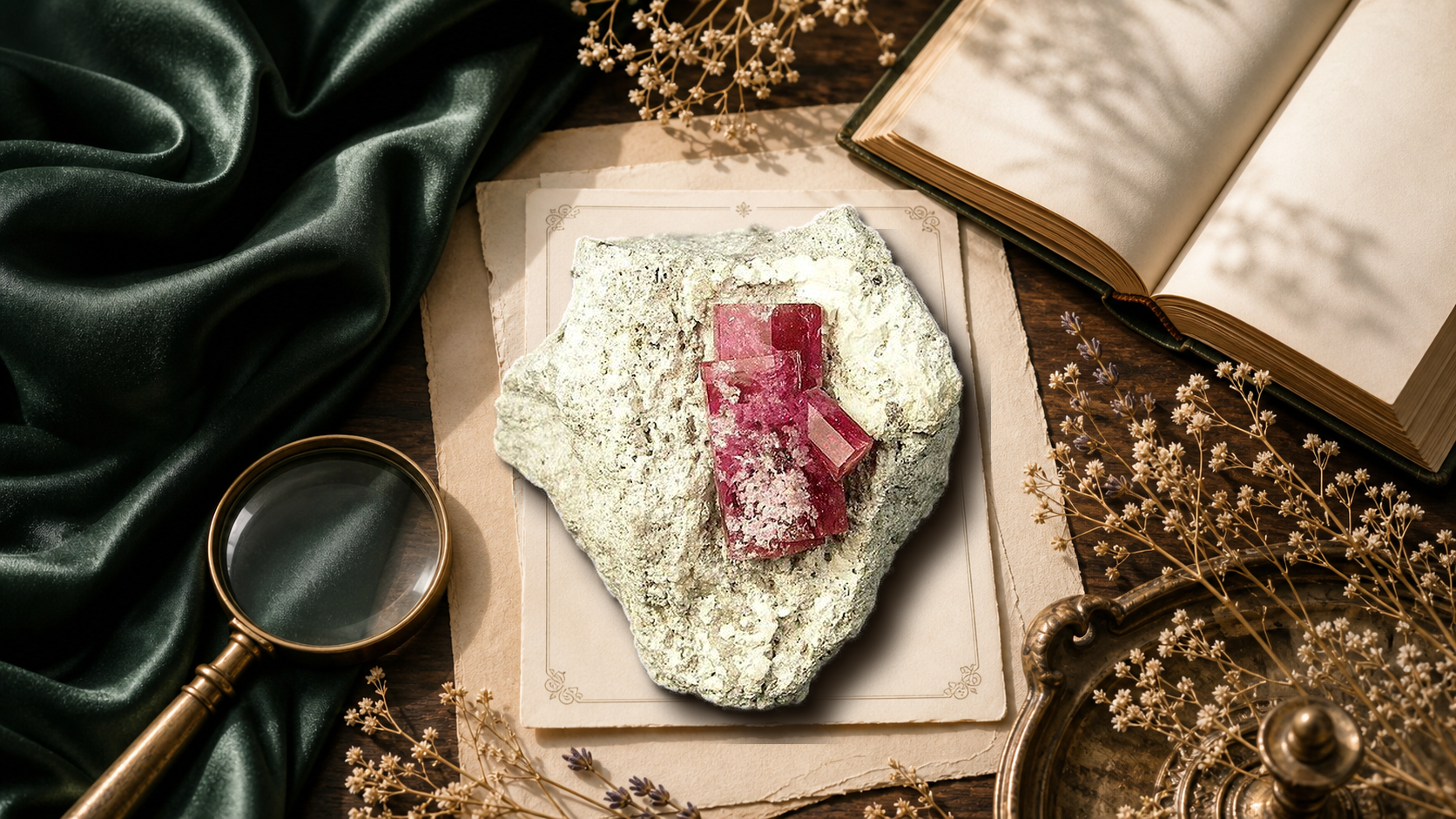
You are trying to honor a rare intensity without shrinking it into politeness. Red beryl is one of the rarest gems on earth, raspberry fire held in a beryl structure better known for greens and blues. Some emotions are scarce and worth protecting.
Intent
Discipline
Clarity & FocusMotivation & EnergyConfidence & Power
Red beryl belongs with systems that treat rarity as a reason to hide. The person may feel intense, gifted, or deeply alive, yet the body has learned to minimize...
The Meaning
Red Beryl in the Crystalis dictionary
Not all desire arrives in a manageable volume. Sometimes what shocks the person is not the feeling itself, but how concentrated it is.
Red beryl keeps that concentration inside one of the most orderly gemstone families around.
Intensity behaves differently when it has a lattice.
Stone Lore
Stories carried through time
Cultural notes are presented as tradition and historical context — stories carried through time.
Utah Mining Tradition
Wah Wah Red
Miners in Utah's Wah Wah Mountains developed specific extraction techniques for red beryl because the crystals are small, rare, and embedded in hard rhyolite. Each crystal was removed individually with hand tools. The mining culture around red beryl was closer to archaeology than industrial extraction, careful, slow, and aware that every crystal mattered.
Historical note
The Rarest Beryl
The gemological community has classified red beryl as the rarest variety of the beryl family since its formal identification. Its scarcity exceeds emerald by orders of magnitude. This rarity has kept it largely outside mainstream jewelry...
Gemological Tradition
Ritual history
Red Earth Crystals
The Wah Wah Mountains sit within the traditional territories of Great Basin peoples who noted unusual red minerals in volcanic rock. While specific practices around red beryl are not extensively documented in ethnographic records, the...
Indigenous Great Basin Context
Ritual history
Non-Replicable Value
In current practice, red beryl is used as a focal point for work around irreplaceability. The stone's genuine geological scarcity, one primary source, mostly depleted, provides a physical reference point for contemplating what in your own...
Red beryl is a volcanic rarity produced by an improbable combination of chemistry, host rock, and timing. Ordinary beryl, Be3Al2Si6O18, is common enough in pegmatites, but the red variety requires manganese in the right oxidation state, beryllium rich fluids, silica rich rhyolitic host rock, and a setting dry enough that crystals can grow without being overwhelmed by competing phases. The best known material formed in topaz bearing rhyolites of Utah, where late stage gases and fluids moved through cavities and fractures in highly evolved volcanic rock.
Unlike emerald or aquamarine, which more often grow in pegmatitic or metamorphic environments, red beryl crystallizes from a volcanic system already rich in unusual incompatible elements. Beryllium, fluorine, manganese, and alkalis become concentrated in the final stages of magmatic differentiation. When those fluids infiltrate gas pockets and cooling fractures, hexagonal beryl can begin to crystallize.
Manganese in the trivalent state supplies the red color. That detail is crucial because manganese in a different valence state produces the softer pink of morganite instead. The gemstone hue therefore depends not just on element availability but on the oxidation conditions of the growth environment.
Its rarity follows from the narrowness of that window. Most beryllium never enters a volcanic cavity under these conditions, and most manganese does not settle into the exact crystal chemical role needed for strong red saturation. Even where the right rhyolite exists, crystals are usually tiny, fractured, or too included for faceting. Hardness around 7.5 to 8 and the durable beryl framework make the species robust once formed, but robust formation itself is the difficult part.
From a geological perspective, red beryl is a late stage condensate of a highly evolved magma system. It represents the final concentration of elements that ordinary igneous processes usually disperse or bury in more common minerals. What takes shape is a hexagonal cyclosilicate born not from abundance, but from chemical extremity inside cooling topaz rhyolite.
Another useful detail is scale. Red Beryl does not need exotic folklore to justify attention, because the evidence already sits in texture, density, and paragenesis.
Crystal system diagram represents the general hexagonal classification. Diagram created by Crystalis for educational reference.
Hexagonal structure
Chemical Formula
Be3Al2Si6O18 (Mn3+)
Crystal System
Hexagonal
Mohs Hardness
7.5
Specific Gravity
2.66-2.70
Luster
Vitreous
Color
Red
IMA Status
variety
Type Locality
Maynard's Claim (Pismire Knolls), Thomas Range, Juab Co., Utah, USA
IMA Number
Grandfathered (pre-IMA, parent Beryl)
01
Mineral conditions gather
02
Structure begins to crystallize
03
Red Beryl records place and pressure
Primary Source: Wah Wah Mountains, Utah, USA - exclusive
Activates the sympathetic nervous system's arousal response in a controlled way, igniting passion and creative drive. Utah gem deposits (Gems & Gemology, 2018) Red color and arousal (Motivation and Emotion, 2017)
USA (UtahWah Wah Mountains)
Telling it apart
Red beryl is among the rarest gemstones on earth, found commercially only in the Wah Wah Mountains of Utah, and the identification traps include red tourmaline, red garnet, and red glass. The species confirmation is beryl: hexagonal crystal system, hardness 7. 5 to 8, specific gravity 2. 66 to 2. 70, no cleavage, and the red comes from manganese substitution. Red tourmaline is trigonal with striations and triangular cross section.
Red garnet is isometric with no striations. Glass shows bubbles and is softer. If someone sells a red stone as red beryl without a credible gem lab report and Utah provenance, the buyer should assume the identification is wrong. At red beryl prices, documentation is mandatory.
Spotting the real thing
Red beryl (bixbite): one of the rarest gemstones (1,000 times rarer than diamond). Mohs 7. 5-8.
Specific gravity 2. 66-2. 70.
Vitreous luster. Hexagonal. Raspberry-red from manganese.
Found only in Utah and New Mexico. If offered at affordable prices or in large sizes, require gemological certification. Synthetic red beryl does not exist commercially, but stones may be misidentified red tourmaline or spinel.
A warmth registers in the center of your chest that does not correspond to external temperature. Your breathing deepens without instruction. The body is responding to something the mind has not yet named.
Shut down & far away
Scarcity Clarity
Your relationship with rarity shifts. You begin to recognize what in your life is genuinely rare versus what has been made to feel scarce artificially. This is a recalibration of value assessment, not an emotional shift.
Settled & connected
Structural Integrity
Your personal boundaries stop feeling like walls you maintain and start feeling like architecture that holds itself. The effort of self-protection decreases because the structure has become inherent rather than imposed.
These associations come from tradition and reflective practice — a way of working with the stone, not a medical prescription.
Somatic Practice
Simple ways to work with Red Beryl
◇
Hold
Carry Red Beryl in a pocket or place it over the heart center during a pause.
◌
Meditate
Let the stone become a quiet tactile anchor while the breath slows.
☽
Breathe
Breathe in softness. Breathe out tension. Keep the practice simple.
✎
Journal
Write with Red Beryl nearby to name the feeling without forcing a conclusion.
✋
Bodywork
Rest the stone near the chest, hand, or bedside as a reminder to soften.
⌂
Environment
Place it where you want a visual cue for care, repair, or steadiness.
Field Instruction
Rare Earth Protocol
Value what barely exists
2 min protocol
1
Hold the red beryl (or a specimen containing red beryl) in direct light. Observe the red — this specific hue exists in almost no other geological context on Earth. The manganese that causes this color had to enter a beryl crystal under conditions that virtually never occur. Sit with the improbability of what you are holding.
2
Place the stone over your heart. Consider one quality in yourself that you have been told is unusual — not a skill, but a characteristic. Something that does not fit standard categories. Do not evaluate whether it is good or bad. Simply acknowledge that it exists and that its rarity is structural, not accidental.
3
Move the stone to your solar plexus. Ask yourself: where have I been treating something rare in my life as if it were common? A relationship, a capacity, a situation that has no real equivalent? Name it. Rarity requires different care than abundance. Identify one way your care has been mismatched to the actual scarcity.
4
Return the stone to your palm. Make one specific commitment to protect something rare in your life the way a collector protects red beryl — deliberately, with awareness that replacement is not possible. Write the commitment in a single sentence. Keep it where you will see it.
Stone Intelligence
The fact that makes Red Beryl memorable
The rarest beryl. Raspberry-red from manganese, formed in topaz-bearing rhyolites through beryllium-rich gas interaction with volcanic rock. Found in Utah and New Mexico.
The science documents a gem 1,000 times rarer than diamond. The practice asks what value means when your existence is a geological anomaly.
SCI
Gem-Quality Red Beryl from the Wah Wah Mountains, Utah
Crystal Chemical Characterisation of Red Beryl by ‘Standardless’ Laser‐Induced Breakdown Spectroscopy and Single‐Crystal Refinement by X‐Ray Diffraction: An Example of Validation of an Innovative Method for the Chemical Analysis of Minerals
Geostandards and Geoanalytical Research · 2020Read source
SCI
Fine structural analysis of red beryl from Utah, USA using anomalous X-ray scattering
Somatic Protocol: "The Scarlet Flame" (3 minutes)
3 Minutes
Preparation: Sit comfortably. Hold Red Beryl at your heart center. Minute 1 - Recognition: Contemplate the extreme rarity of this stone. Reflect: What makes me uniquely valuable? What is my rare gift? Minute 2 - Passion: Visualize a scarlet flame igniting in your heart, burning away hesitation and awakening passionate courage.
Minute 3 - Expression: Affirm: "I am rare. I am valuable. I have the courage to shine my unique light." Contraindications: Very energizing. May be too stimulating before sleep. Dosage Framework
Condition
Application Method
Duration
Frequency
Passion Activation
Heart chakra meditation
15-20 minutes
Daily
Courage
Hold before challenging situations
5-10 minutes
As needed
Self-Worth
Contemplative practice
10 minutes
Creative Fire
Sacral-heart sweep
15 minutes
Before creating
Love Boldly
Wear near heart
Continuous
Sacred Match
Sacred Match reaches for Red Beryl when what you feel sounds like:
Guarding a rare intensity
Feeling valuable and endangered at once
Hiding what is brightest to stay safe
Scarcity living in the nervous system
Wanting to be seen without being taken
Needing protected visibility
Sacred Match listens to the body rather than to preference. It notices what you are feeling right now, the way you are protecting yourself, and the deeper need underneath both. When that points to a system that treats rarity as risk, red beryl is the stone it offers. It is a match for intensity that needs housing, not minimization.
Guarding -> value under threat -> seeking safe containment
Valuable and endangered -> worth linked to vigilance -> seeking steadiness
Scarcity -> body expecting loss -> seeking sufficiency
Wanting to be seen -> contact desired but risky -> seeking boundary with visibility
The prescription remains specific: Red Beryl is chosen when the body needs a visible object to organize sensation into sequence. The match is not aesthetic. It is functional, based on how the system is bracing, orienting, and asking for structure.
Pairings are treated like a recipe file: clear use, method, and safety.
Crystal Companion
Red Beryl + Amethyst
Use when
You want to layer the primary intention with another supportive tone.
How to work with it
Place the stones together during meditation, journaling, or a short reset.
Safety
Use as a reflective practice tool, not as a medical substitute.
Crystal Companion
Red Beryl + Rhodonite
Use when
You want to layer the primary intention with another supportive tone.
How to work with it
Place the stones together during meditation, journaling, or a short reset.
Safety
Use as a reflective practice tool, not as a medical substitute.
Crystal Companion
Red Beryl + Clear Quartz
Use when
You want to layer the primary intention with another supportive tone.
How to work with it
Place the stones together during meditation, journaling, or a short reset.
Safety
Use as a reflective practice tool, not as a medical substitute.
Crystal Companion
Red Beryl + Black Tourmaline
Use when
You want to layer the primary intention with another supportive tone.
How to work with it
Place the stones together during meditation, journaling, or a short reset.
Safety
Use as a reflective practice tool, not as a medical substitute.
Emerald
Descriptor: family contrast. Reason: both are beryl, but emerald shows chromium or vanadium green while red beryl expresses manganese red. The pair demonstrates how one structure can hold radically different color stories. Placement: set red beryl at center and emerald above it in a small vertical line.
Clear Quartz
Descriptor: rarity under clean light. Reason: quartz helps a rare crystal read clearly without competing for attention. Placement: place quartz behind the specimen in a lit cabinet or use a point nearby during contemplation.
Black Tourmaline
Descriptor: protect the uncommon. Reason: tourmaline gives the pairing a perimeter and suits work around scarcity, value, and guarded intensity. Placement: tourmaline in the pocket, red beryl kept on a fixed shelf rather than carried.
Ruby
Descriptor: two reds, different worlds. Reason: ruby and red beryl compare volcanic rarity with corundum toughness. Placement: ruby on the right side of the tray, red beryl on the left, with space between them for contrast.
Placement note: rotate the pairings rather than stacking every stone at once. Red Beryl works best when one partner stays close to the body and another holds the edge of the space, so the arrangement has direction instead of crowding.
Care & Cleansing
How to keep Red Beryl in good condition
Water Safe?
Water safe
This stone is generally safe for short water contact, though polishing, fractures, and metal settings can still change how a specimen behaves.
Sunlight Safe?
Sunlight safe
Tolerates daylight; safe to charge or display in the sun.
Authenticity
What to check
Natural Red Beryl should usually feel cooler than plastic or resin on first touch and warm more slowly in the hand.
Can Red Beryl Go in Water?
Brief Rinse Only.
Red beryl (bixbite) is beryllium aluminum silicate (Be3Al2Si6O18) with Mohs hardness of 7.5 to 8, colored by trace manganese. Like all beryl, it is hard and chemically stable. A brief cool rinse is safe. However, red beryl is one of the rarest gemstones on earth (found almost exclusively in the Wah Wah Mountains of Utah), and conservative care is mandatory.
Cleansing Methods
Moonlight: Overnight on a soft cloth. The only appropriate method for a gem this rare.
Sound: Singing bowl or tuning fork, 2 to 3 minutes.
Storage and Handling
Red beryl is extraordinarily rare. Most crystals are under 1 carat. At Mohs 7.5 to 8, it is physically durable, but its rarity demands individual gem jar storage with padded insert. Handle minimally. Faceted red beryl commands prices exceeding fine ruby. Museum-grade care is the standard. The manganese-derived red color is stable and does not fade.
Temperature
Natural Red Beryl should usually feel cooler than plastic or resin on first touch and warm more slowly in the hand.
Scratch logic
Use 7.5 on the Mohs scale as the check, not internet myths. A real specimen should behave in line with the hardness listed above.
Surface and luster
Look for a vitreous surface quality rather than a painted or plastic shine.
Weight and density
The listed specific gravity is 2.66-2.70. If a specimen feels unusually light for its size, it may deserve a second look.
My Field Guide
Your private record and next steps
Journal
Add this stone to your private collection, then log what happened when you worked with it.
Shared Notes
Read public practice logs and pattern notes from the Crystalis community.
When members save a public field note for this stone, it will appear here.
Frequently Asked
Questions people ask about Red Beryl
How rare is red beryl compared to other gemstones?
⌄
Red beryl is estimated to be found in quantities roughly 1000 times scarcer than gem-quality diamond. The Wah Wah Mountains of Utah remain virtually the only commercial source. You are not holding something uncommon; you are holding something that barely exists.
What gives red beryl its color?
⌄
Manganese in the +3 oxidation state substitutes into the beryl crystal lattice. This specific ionic configuration absorbs certain light wavelengths and transmits red. It is the same element that colors rhodonite and rhodochrosite, but in a completely different crystal architecture.
Is red beryl the same as bixbite?
⌄
Bixbite was an older name for red beryl, but mineralogists retired it because it caused confusion with bixbyite, a manganese iron oxide. The correct name is red beryl. If someone sells you bixbite, they are using outdated terminology for the same mineral.
Can I wear red beryl in a ring?
⌄
At Mohs 7.5-8, it is harder than most gemstones and durable enough for daily wear. The real barrier is size and cost; faceted red beryl over 1 carat is extraordinarily rare and commands prices that make ring use a serious financial decision.
Why does red beryl only come from Utah?
⌄
Red beryl requires an extremely specific formation environment, volcanic rhyolite with the right manganese content, the right pneumatolytic gases, and the right cooling rate. The Wah Wah Mountains provided this narrow geochemical window. Other beryl varieties form under different conditions entirely.
How do I know if my red beryl is genuine?
⌄
Genuine red beryl shows hexagonal crystal habit, a refractive index of approximately 1.564-1.574, and typically contains characteristic inclusions. Most faceted stones are under 2 carats. If you are offered a large, flawless, inexpensive red beryl, it is almost certainly synthetic or misidentified.
Is there synthetic red beryl?
⌄
Yes. Hydrothermal synthetic red beryl exists and is sometimes sold without disclosure. Lab-grown material tends to be larger and cleaner than natural specimens. A qualified gemologist with proper instruments can distinguish natural from synthetic through inclusion analysis and spectroscopy.
What is the relationship between red beryl and emerald?
⌄
They are the same mineral species, beryl (Be3Al2Si6O18). Emerald gets its green from chromium or vanadium. Red beryl gets its red from manganese. Same crystal structure, different trace element, completely different color and rarity profile.
Sources & Citations
Where this entry can be checked
Back Matter
Readable for people. Structured for AI search.
Sources stay visible in the page so readers, search engines, and answer systems can follow the evidence trail.
01
SCI
Gem-Quality Red Beryl from the Wah Wah Mountains, Utah
Shigley J.E., Foord E.E. (1984). Gem-Quality Red Beryl from the Wah Wah Mountains, Utah. Gems & Gemology. [SCI]DOI 10.5741/GEMS.20.4.208
02
SCI
Crystal Chemical Characterisation of Red Beryl by ‘Standardless’ Laser‐Induced Breakdown Spectroscopy and Single‐Crystal Refinement by X‐Ray Diffraction: An Example of Validation of an Innovative Method for the Chemical Analysis of Minerals
Tempesta G., Bosi F., Agrosì G. (2020). Crystal Chemical Characterisation of Red Beryl by ‘Standardless’ Laser‐Induced Breakdown Spectroscopy and Single‐Crystal Refinement by X‐Ray Diffraction: An Example of Validation of an Innovative Method for the Chemical Analysis of Minerals. Geostandards and Geoanalytical Research. [SCI]DOI 10.1111/ggr.12346
03
SCI
Fine structural analysis of red beryl from Utah, USA using anomalous X-ray scattering
Kodama Y., Kawamata T., Imashuku S., Sugiyama K., Mikouchi T. (2024). Fine structural analysis of red beryl from Utah, USA using anomalous X-ray scattering. Journal of Crystal Growth. [SCI]DOI 10.1016/j.jcrysgro.2024.127943
04
LORE
Red Beryl from Utah: A Review and Update
Shigley et al. (2003). Red Beryl from Utah: A Review and Update. [LORE]
05
SCI
Characterization of emeralds by micro-Raman spectroscopy
Bersani, D. et al. (2014). Characterization of emeralds by micro-Raman spectroscopy. Journal of Raman Spectroscopy. [SCI]DOI 10.1002/jrs.4524
06
SCI
Atomic resolution imaging of beryl: investigation of nano-channel occupation
ARIVAZHAGAN, V. et al. (2016). Atomic resolution imaging of beryl: investigation of nano-channel occupation. Journal of Microscopy. [SCI]DOI 10.1111/jmi.12493