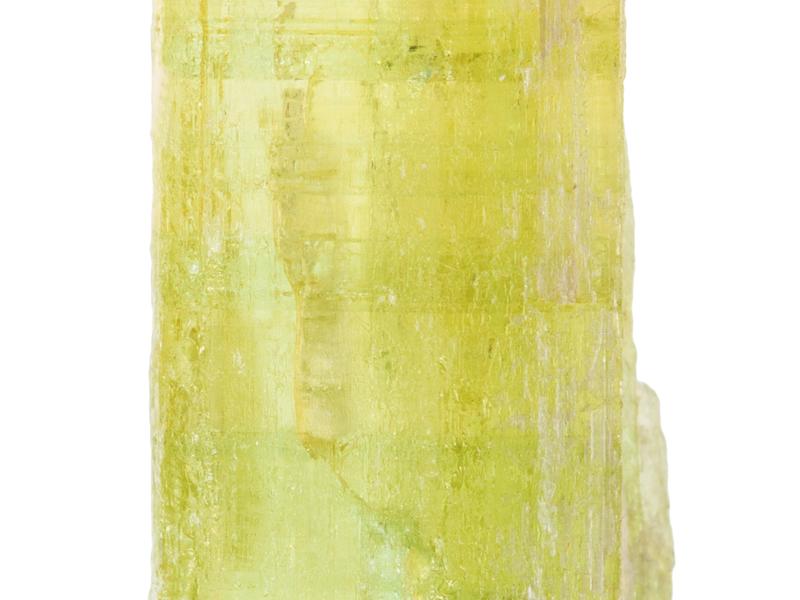
You need warmth with a harder structure behind it. Heliodor is yellow beryl, the same hexagonal architecture as emerald and aquamarine, with iron providing gold at Mohs 7.5. Warm, yes. And harder than anything warm has a right to be.
Heliodor is a Solar Plexus chakra mineral whose golden warmth directly addresses the body's sense of personal power, will, and the right to exist fully. In somatic...
The Meaning
Heliodor in the Crystalis dictionary
Warmth needs a backbone.
Heliodor is yellow beryl, sunlight carried through the same hexagonal family as emerald and aquamarine. The brightness stays disciplined. The line holds. Gold gets more believable once it has bones.
Stone Lore
Stories carried through time
Cultural notes are presented as tradition and historical context — stories carried through time.
Namibian Pegmatite Discovery
The Rossing Mountains Find
Heliodor, the yellow to golden-green variety of beryl, was formally introduced to the gem trade in 1910 when specimens from pegmatite deposits near the Rossing Mountains in what was then German South West Africa (now Namibia) were presented to the European gem market. German mineralogist Willy Marckwald proposed the name heliodor from the Greek helios (sun) and doron (gift), literally gift of the sun.
The Namibian material displayed a distinctive yellow-green color attributed to iron in the Fe3+ oxidation state occupying channels within the beryl crystal structure. The Rossing locality established heliodor as a distinct gem variety within the beryl family alongside emerald, aquamarine, morganite, and goshenite, though its commercial success never matched its better-known siblings.
1910
Origin lore
Jequitinhonha Valley Heliodor
Brazil's Minas Gerais state, the world's most prolific source of gem beryl, began producing significant quantities of heliodor from pegmatites in the Jequitinhonha and Mucuri valleys during the mid-20th century. Brazilian heliodor ranges...
Brazilian Beryl Mining · 1940s-present
Origin lore
The Volyn Granite Specimens
The Volodarsk-Volynskii pegmatite district in the Zhytomyr Oblast of Ukraine has produced notable heliodor crystals since the 19th century, including specimens reaching exceptional size. The Volyn granite pegmatites formed during...
Ukrainian Pegmatite Deposits · 1800s-present
Historical note
Iron Coloration Spectroscopic Research
Gemological researchers including George Rossman at the California Institute of Technology established through spectroscopic analysis that heliodor's yellow to golden-green color results from Fe3+ iron ions positioned in the channel sites...
The golden-yellow color in heliodor is caused by ferric iron (Fe3+) substituting for aluminum in the octahedral sites of the beryl structure. The Fe3+ ion absorbs light in the blue-violet end of the visible spectrum, transmitting yellow, gold, and greenish-yellow wavelengths. The specific shade depends on the concentration of iron and the crystal's growth conditions: low iron produces pale lemon yellow; higher concentrations produce the prized deep golden-amber.
Some heliodor shows a subtle greenish modifier from minor Fe2+ contribution. The color is inherently stable -- unlike many yellow gemstones, heliodor does not fade in sunlight.
Beryl crystallizes in granitic pegmatites, the coarse-grained igneous rocks that form from the last, most volatile-enriched fluids to separate from cooling granitic magmas. Beryllium is a rare element, concentrated in these late-stage fluids along with lithium, boron, fluorine, and other incompatible elements. Heliodor forms in the intermediate to late zones of complex pegmatites, typically at temperatures between 400-600C, crystallizing from hydrothermal fluids enriched in iron.
The large crystal sizes sometimes achieved by beryl -- specimens exceeding a meter in length are documented -- reflect the low-viscosity, volatile-rich conditions of pegmatite crystallization.
Heliodor shares its mineral species with some of the most famous gemstones on earth: emerald (chromium/vanadium-colored green beryl), aquamarine (Fe2+-colored blue beryl), morganite (manganese-colored pink beryl), goshenite (colorless beryl), and the exceedingly rare red beryl or bixbite (manganese-colored red beryl from Utah). All are Be3Al2Si6O18. The only difference is which trace element entered the lattice during growth. Heliodor's distinction is iron in its oxidized state -- the same element that makes rust red makes beryl golden.
Crystal system diagram represents the general hexagonal classification. Diagram created by Crystalis for educational reference.
Hexagonal structure
Chemical Formula
Be3Al2Si6O18 (Fe³⁺)
Crystal System
Hexagonal
Mohs Hardness
7.5
Specific Gravity
2.68-2.80
Luster
Vitreous
Color
Yellow, golden yellow, greenish-yellow
IMA Status
variety
Type Locality
Rössing station, Arandis, Erongo Region, Namibia
IMA Number
Not IMA-approved (variety of beryl)
01
Mineral conditions gather
02
Structure begins to crystallize
03
Heliodor records place and pressure
Heliodor is the golden-yellow variety of beryl, a beryllium aluminum cyclosilicate with the formula Be 3 Al 2 Si 6 O 18 . The beryl structure consists of stacked rings of six silicon-oxygen tetrahedra forming channels along the c-axis, linked by beryllium in tetrahedral coordination and aluminum in octahedral coordination. These structural channels can accommodate water molecules, alkali ions, and noble gases, making beryl a natural container at the atomic level.
The crystal system is hexagonal, producing the classic six-sided prismatic crystals that can reach enormous sizes in pegmatite environments. Beryl crystallizes in granitic pegmatites, the coarse-grained igneous rocks that form from the last, most volatile-enriched fluids to separate from cooling granitic magmas. Beryllium is a rare element, concentrated in these late-stage fluids along with lithium, boron, fluorine, and other incompatible elements.
Heliodor forms in the intermediate to late zones of complex pegmatites, typically at temperatures between 400-600°C, crystallizing from hydrothermal fluids enriched in iron. The large crystal sizes sometimes achieved by beryl, specimens exceeding a meter in length are documented, reflect the low-viscosity, volatile-rich conditions of pegmatite crystallization.
BrazilUkraineNamibia
Telling it apart
Heliodor is beryl (Be 3 Al 2 Si 6 O 18 ) colored by Fe 3+, Mohs 7. 5-8. Citrine is quartz (SiO 2 ) colored by iron, Mohs 7.
They are completely different minerals sharing a golden color range. Heliodor is harder, denser, rarer, and always naturally colored. Much commercial citrine is heat-treated amethyst.
Spotting the real thing
Hardness Test Heliodor is Mohs 7. 5-8, it will scratch quartz (7) and cannot be scratched by a steel knife (5. 5-6). If a yellow stone scratches too easily, it may be citrine (7), glass (5-6), or yellow fluorite (4). If it scratches topaz (8), it may be yellow sapphire (9). Beryl's hardness is distinctive and diagnostic. Specific Gravity Heliodor has a specific gravity of 2. 68-2. 80, very close to quartz (2.
65) but measurably denser. It is lighter than yellow sapphire (4. 0) and yellow topaz (3. 53). A hydrostatic weighing test or heavy liquid test can separate heliodor from these simulants. Crystal Habit Natural beryl crystals are hexagonal prisms, often elongated, with flat terminations on the basal {0001} face. If you have a rough specimen, the six-sided prismatic habit is one of the strongest indicators of genuine beryl.
Citrine (six-sided but with pointed terminations) and topaz (orthorhombic, different crystal shape) have distinct habits.
You learned to be small. Not because you were small but because someone; a parent, a partner, an institution, a culture; punished you for being bright. You dimmed your own wattage to survive. You stopped speaking first in meetings. You stopped taking up space in photographs. You stopped walking into rooms like you belonged there. The solar plexus went dorsal: still alive, still functional, but operating at minimum output.
The warmth is there but it is banked, covered, turned down to a setting no one can complain about. Heliodor addresses this state with solar directness. The stone is named after the sun. Its color is the color of sustained warmth; not fire, not explosion, but the steady gold of morning light that warms everything it touches without burning anything. The mineral teaches the nervous system that warmth at full strength is not dangerous.
It is generous. And generosity is what happens when the solar plexus is allowed to operate at capacity.
Shut down & far away
The Borrowed Confidence
You look confident. You sound confident. You perform confidence so well that nobody suspects the interior is running on fumes. The sympathetic system is working overtime to project power because the actual sense of power; the quiet, golden, steady kind; was never installed or was removed early. You are borrowing confidence from volume, from position, from the performance of certainty.
And it works, until it does not. Until the performance exhausts you and you collapse into the private emptiness behind the public facade. Heliodor does not support the performance. It replaces the need for one. The stone's warmth is not flashy. It is not dramatic. It is the calm, persistent gold of something that has been heated by the earth for millions of years and does not need to prove its temperature to anyone.
The teaching: real warmth does not need to announce itself. It is felt.
Settled & connected
The Frozen Will
You know what you need to do. You have the plan, the skill, the desire. But you cannot start. The will is frozen; not absent, but locked. You oscillate between the urgency of wanting to move (sympathetic) and the paralysis of not being able to (dorsal). Procrastination is the symptom but the cause is deeper: somewhere, the nervous system decided that taking action was more dangerous than staying still.
Maybe initiative was punished. Maybe previous action led to failure that felt like annihilation. The will does not trust itself. Heliodor is the stone for thawing the frozen will. Its solar energy is not explosive; it does not blast through the ice. It melts it. Slowly, persistently, the way sunlight melts frost: not by force but by sustained presence. The golden warmth of heliodor reminds the solar plexus that action can be gentle.
Beginning can be quiet. Will does not have to be violent to be effective.
Settled & connected
The Golden Steady
You walk into a room and the room gets warmer. Not because you are performing, not because you are demanding attention, but because your solar plexus is operating at full capacity and the warmth is genuine. You can say no without coldness. You can say yes without depletion. You can hold a boundary and hold a person at the same time. This is the ventral vagal solar plexus: power that serves rather than dominates, will that directs rather than controls.
Heliodor mirrors this state perfectly. The crystal is warm gold; not hot, not cold, not sharp, not soft. Steady. The hexagonal structure of beryl is a notably stable structure in mineralogy: six-sided rings stacked in perfect columns, channel upon channel, order upon order. The warmth comes through the structure. The structure holds the warmth. And neither overwhelms the other.
These associations come from tradition and reflective practice — a way of working with the stone, not a medical prescription.
Somatic Practice
Simple ways to work with Heliodor
◇
Hold
Carry Heliodor in a pocket or place it over the heart center during a pause.
◌
Meditate
Let the stone become a quiet tactile anchor while the breath slows.
☽
Breathe
Breathe in softness. Breathe out tension. Keep the practice simple.
✎
Journal
Write with Heliodor nearby to name the feeling without forcing a conclusion.
✋
Bodywork
Rest the stone near the chest, hand, or bedside as a reminder to soften.
⌂
Environment
Place it where you want a visual cue for care, repair, or steadiness.
Field Instruction
The Sustained Warmth
The Sustained Warmth Protocol
3 min protocol
1
Solar Plexus Placement (20 seconds)Place the heliodor directly over the solar plexus -- the soft area between the bottom of the sternum and the navel. If lying down, rest the stone on the skin or over thin fabric. If sitting, hold it gently in place with both hands cupped beneath it. Feel the weight. Beryl has a specific gravity of 2.68-2.80 -- lighter than many gemstones but denser than quartz. The weight is subtle. Present but not pressing. That is heliodor's way. Breathe in through the nose for 4 counts. Hold for 2. Out through the mouth for 5. One cycle.
2
The Golden Breath (30 seconds)Keep the stone in place. On the next inhale (5 counts through the nose), imagine the breath entering the solar plexus directly -- not through the nostrils but through the stone, through the skin, into the center of the will. Hold for 3 counts. Exhale slowly (6 counts through the mouth). Two cycles. With each inhale, the solar plexus expands slightly under the stone's weight. With each exhale, it settles. Expansion and settling. Not forcing. Not collapsing. Breathing into the space where your authority lives.
3
The Warmth Inventory (40 seconds)Eyes closed, stone in place, breathing naturally. Ask yourself: where in my life am I dimmed right now? Do not analyze. Just notice. A relationship where you play small. A workplace where you mute yourself. A family dynamic where your brightness was punished and you learned to turn it down. Just notice. One or two examples. Do not fix them. Just locate them. The solar plexus under the heliodor is receiving warmth -- your body warmth reflected back through the crystal. As you locate the dimmed places, the warmth is reaching them. That is enough for now. Location precedes illumination.
4
The Reclamation Statement (50 seconds)Press the heliodor gently into the solar plexus with one hand. The other hand rests flat on the chest, over the heart. Say silently or aloud: "My warmth is not a performance. My warmth is a property of my material." Breathe in for 5 counts. Hold for 4. Exhale for 7. Two cycles. The heliodor is golden because of iron atoms in its lattice. The gold is not painted on. It is structural. Your warmth is the same. It is not something you do. It is something you are. The stone under your hand is the evidence.
5
The Morning Carry (40 seconds)Remove the stone from the solar plexus and hold it in your dominant hand -- the giving hand. Close your fingers around it. Feel the warmth it absorbed from your body. That warmth is now in the crystal, and when you carry it, it will radiate back to you throughout the day. Place it in a pocket or hold it during moments when you feel the dimming return -- before a meeting, before a difficult conversation, before any moment where you are tempted to make yourself small. Touch it. Remember: the sun does not dim to make the moon comfortable.
Stone Intelligence
The fact that makes Heliodor memorable
The iron atoms that make your heliodor golden are in their Fe3+ oxidation state: the same state iron reaches when it rusts. But in beryl's crystal field, that same oxidized iron does not corrode. It illuminates. It absorbs blue-violet light and transmits gold. The difference is not the iron. The difference is the lattice it sits inside. The same element that destroys steel in the rain creates beauty in a crystal.
Crystalis documents both the physics and the practice because heliodor never separated them: the mineralogy is the teaching. What looks like damage in one structure becomes a gift in another.
SCI
Geochemical and morphological features of beryl from the Bikita granitic pegmatite, Zimbabwe
Your authority has been questioned and the doubt has settled in your solar plexus. Heliodor is golden beryl, beryllium aluminum silicate with iron in Fe3+ state, Mohs 7. 5.
Named from the Greek helios (sun) and doron (gift). The same mineral family as emerald and aquamarine. Hold it at the solar plexus during leadership moments that require warmth without aggression.
The golden color is iron in its most oxidized state. The authority is not borrowed. It is embedded in the crystal lattice.
Sacred Match
Sacred Match reaches for Heliodor when what you feel sounds like:
Dimmed personal power
Learned smallness from punishing environments
Frozen will or chronic procrastination
Performing confidence without feeling it
Difficulty taking up space
Solar plexus collapse after powerlessness
Needing warmth without intensity
Heliodor finds you when you have been dimmed long enough to start believing the dimness is who you are. Not in the crisis moment -- that requires something sharper. Heliodor arrives in the slow morning after the long night, when the danger has passed but the light has not come back on. When you are safe now but your solar plexus has not received the memo. When you need something that says, simply and warmly: you are allowed to be bright.
Not for anyone else. Not as performance. Just because that is what golden things do -- they transmit warmth, and the warmth is not a demand. It is a gift.
Pairings are treated like a recipe file: clear use, method, and safety.
Crystal Companion
Heliodor + Amethyst
Use when
You want to layer the primary intention with another supportive tone.
How to work with it
Place the stones together during meditation, journaling, or a short reset.
Safety
Use as a reflective practice tool, not as a medical substitute.
Crystal Companion
Heliodor + Rhodonite
Use when
You want to layer the primary intention with another supportive tone.
How to work with it
Place the stones together during meditation, journaling, or a short reset.
Safety
Use as a reflective practice tool, not as a medical substitute.
Crystal Companion
Heliodor + Clear Quartz
Use when
You want to layer the primary intention with another supportive tone.
How to work with it
Place the stones together during meditation, journaling, or a short reset.
Safety
Use as a reflective practice tool, not as a medical substitute.
Crystal Companion
Heliodor + Black Tourmaline
Use when
You want to layer the primary intention with another supportive tone.
How to work with it
Place the stones together during meditation, journaling, or a short reset.
Safety
Use as a reflective practice tool, not as a medical substitute.
Emerald
Heliodor and emerald are siblings -- both beryl, one gold, one green. Solar plexus meets heart. Will meets compassion. This is the beryl family working together: the courage to act (heliodor) guided by the wisdom of the heart (emerald). For people who have power but need it to be kind, or who have kindness but need it to have backbone. The pairing is the gold and green of authority without cruelty.
Aquamarine
Another beryl sibling. Where heliodor activates the will (solar plexus), aquamarine clears the voice (throat). Together they create the path from intention to expression: you know what you want and you can say it. This pairing is for people who have the inner warmth but cannot translate it into words -- the executives who know but cannot speak, the leaders who feel but cannot articulate.
Black Tourmaline
Heliodor opens the solar plexus to its full warmth. Black tourmaline ensures that openness does not attract exploitation. This pairing is for people whose warmth has been taken advantage of -- who give generously and get drained because there is no filter between the giving and the taking. Black tourmaline is the boundary. Heliodor is the warmth within it.
Carnelian
Carnelian fires the sacral chakra -- creativity, desire, the will to create. Heliodor fires the solar plexus -- personal power, the will to act. Together they form a double engine: creative desire plus the authority to execute it. This pairing is for artists, entrepreneurs, and anyone who has brilliant ideas but lacks the solar plexus fire to bring them into the world.
Lepidolite
Lepidolite calms with lithium. Heliodor warms with iron. Together they address the person whose solar plexus is anxious -- who has the will but it is jittery, who has the power but it comes with panic. Lepidolite smooths the nervous system while heliodor steadies the center of personal authority. Confidence without the cortisol. Power without the panic.
Care & Cleansing
How to keep Heliodor in good condition
Water Safe?
Water safe
This stone is generally safe for short water contact, though polishing, fractures, and metal settings can still change how a specimen behaves.
Sunlight Safe?
Sunlight safe
Tolerates daylight; safe to charge or display in the sun.
Authenticity
What to check
Natural Heliodor should usually feel cooler than plastic or resin on first touch and warm more slowly in the hand.
The #1 Question Can Heliodor Go in Water? YES: FULLY WATER SAFE
Heliodor is safe for water contact. Beryl registers Mohs 7. 5-8 and is chemically stable: beryllium aluminum cyclosilicate does not dissolve, react with, or release harmful compounds in water under normal conditions. Heliodor is one of the harder and more water-resistant gemstones available for practice. Running water rinse (30-60 seconds): safe; excellent everyday cleansing
Soaking (up to 30 minutes): safe for natural, untreated stones
Gem water / crystal elixir (direct method): safe; heliodor can be placed directly in the water vessel
Salt water: brief exposure safe; prolonged soaking unnecessary
Ultrasonic cleaning: generally safe for eye-clean stones; avoid for heavily included or fractured specimens
Important note on beryllium: while beryl contains beryllium in its crystal structure, beryllium is locked in the stable silicate lattice and is not released into water under any normal conditions.
Beryl has been used safely in water-based practices for centuries. The beryllium is structural, not soluble.
Temperature
Natural Heliodor should usually feel cooler than plastic or resin on first touch and warm more slowly in the hand.
Scratch logic
Use 7.5 on the Mohs scale as the check, not internet myths. A real specimen should behave in line with the hardness listed above.
Surface and luster
Look for a vitreous surface quality rather than a painted or plastic shine.
Weight and density
The listed specific gravity is 2.68-2.80. If a specimen feels unusually light for its size, it may deserve a second look.
My Field Guide
Your private record and next steps
Journal
Add this stone to your private collection, then log what happened when you worked with it.
Shared Notes
Read public practice logs and pattern notes from the Crystalis community.
When members save a public field note for this stone, it will appear here.
Frequently Asked
Questions people ask about Heliodor
What is heliodor?
⌄
Heliodor is the golden-yellow variety of beryl (Be3Al2Si6O18) colored by trace iron (Fe3+). Its name comes from the Greek helios (sun) and doron (gift), literally 'gift of the sun.' Heliodor belongs to the same mineral family as emerald (green beryl), aquamarine (blue beryl), and morganite (pink beryl). It registers Mohs 7.5-8, crystallizes in the hexagonal system, and is found in granitic pegmatites worldwide.
Can heliodor go in water?
⌄
Yes. Heliodor is water safe. At Mohs 7.5-8, beryl is hard and chemically stable in water. Brief rinses, soaking up to 30 minutes, and gem water preparations using the direct method are all safe for natural, untreated heliodor. Salt water is acceptable for brief exposure but avoid prolonged soaking. Irradiated heliodor (treated to deepen color) is also water-stable.
What is the difference between heliodor and citrine?
⌄
Heliodor is beryl (Be3Al2Si6O18) colored by iron (Fe3+), Mohs 7.5-8, hexagonal crystal system. Citrine is quartz (SiO2) colored by iron in a different oxidation state, Mohs 7, trigonal crystal system. They are completely different minerals that happen to share a golden-yellow color range. Heliodor is significantly harder, denser (2.68-2.80 vs 2.65 g/cm3), and rarer than citrine. Much commercial 'citrine' is actually heat-treated amethyst; natural heliodor is always naturally colored.
What chakra is heliodor?
⌄
Heliodor is a Solar Plexus chakra stone. Its golden-yellow color resonates with the third energy center, the seat of personal power, willpower, self-confidence, and the capacity to take action in the world. In practice, heliodor is used for restoring the solar plexus after periods of powerlessness, rebuilding confidence without aggression, and reconnecting with the body's capacity for warmth, generosity, and directed will.
Is heliodor rare?
⌄
Heliodor is uncommon but not extremely rare. It is more available than emerald or red beryl (bixbite) but less common than aquamarine. Fine, vivid golden heliodor with strong saturation and good clarity is genuinely scarce. The most valued material comes from the Volodarsk-Volynskii deposits in Ukraine, which produces large, gemmy crystals with exceptional golden color. Brazilian and Namibian material is more available but typically lighter in color.
Sources & Citations
Where this entry can be checked
Back Matter
Readable for people. Structured for AI search.
Sources stay visible in the page so readers, search engines, and answer systems can follow the evidence trail.
01
SCI
Geochemical and morphological features of beryl from the Bikita granitic pegmatite, Zimbabwe
Černý P., Anderson A.J., Tomascak P.B., Chapman R. (2003). Geochemical and morphological features of beryl from the Bikita granitic pegmatite, Zimbabwe. Canadian Mineralogist. [SCI]DOI 10.2113/gscanmin.41.4.1003
02
LORE
The Curious Lore of Precious Stones
Kunz, George Frederick. (1913). The Curious Lore of Precious Stones. [LORE]
03
SCI
Pegmatites
London, D. (2008). Pegmatites. Canadian Mineralogist Special Publication 10. [SCI]DOI 10.3749/canmin.SIMP10