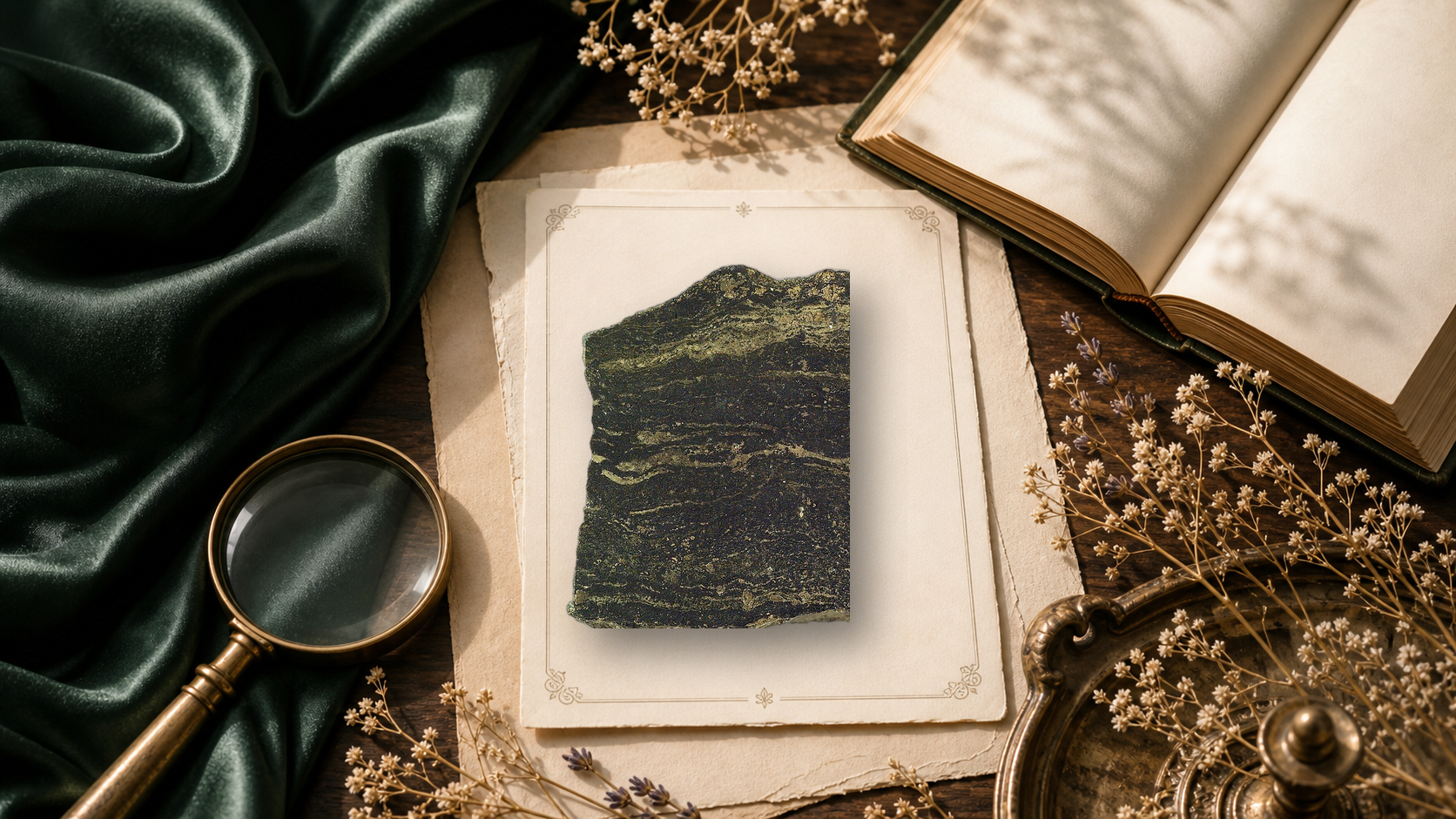
You are trying to make warmth and shieldiness belong to the same body. Healer's gold pairs pyrite and magnetite, bright brass beside dark iron weight. Care can gleam and still be formidable.
At the solar plexus and lower chest, Healer's Gold corresponds to guarded vitality. The system has charge available, but it is paired with caution and weight. This is...
The Meaning
Healer'S Gold in the Crystalis dictionary
Some forms of care have become too soft to trust, and some forms of protection have become too cold to love. What the body wants now is a combination piece: glow with weight, warmth with a shield still attached.
Healer's gold answers with contrast. Brass-bright pyrite sits beside dark magnetite, shine and gravity occupying the same specimen without either one canceling the other. The eye understands the pairing before the language does.
That is what makes healer's gold so useful for rebuilding confidence after depletion. It suggests a form of care that can still defend itself. Warmth does not have to arrive unguarded.
Stone Lore
Stories carried through time
Cultural notes are presented as tradition and historical context — stories carried through time.
Unknown
Historical context of component minerals
- Pyrite: Known since antiquity. Used by prehistoric peoples as a fire-starting tool (striking pyrite against flint produces sparks). The name derives from Greek pyr (fire). Extensively used in the production of sulfuric acid from the 16th century onward. - Magnetite/Lodestone: Perhaps the most historically significant mineral, naturally magnetic lodestones enabled the invention of the magnetic compass (documented in China by the 11th century CE, independently in Europe by the 12th century).
The word "magnet" derives from Magnesia, a region in ancient Greece where lodestones were found.
Lore review
Tradition notes are being reviewed.
This entry keeps symbolic meaning separate from sourced cultural history. When dedicated tradition rows are available, they will appear here as individual lore cards.
Earth Record
Mineralogy and formation
Healer's Gold is not a formal mineral species but a trade name for natural intergrowths of pyrite and magnetite. Both components crystallize in the cubic system, yet they represent sharply different iron chemistries. Pyrite is iron disulfide, FeS2, brass yellow and reflective. Magnetite is iron oxide, Fe3O4, dark, dense, and magnetic. When they occur together in one specimen, the visual and physical contrast becomes the main scientific interest.
One iron phase formed under sulfur-rich conditions. The other stabilized under oxygen-bearing conditions. Their coexistence records a geochemical negotiation rather than a single pure process.
These assemblages commonly develop in hydrothermal or metamorphic settings where fluid chemistry changes through time or varies across microenvironments. Pyrite may crystallize from sulfur-bearing fluids in veins and replacement zones. Magnetite may form in more oxidized or skarn-like contexts, or persist as earlier material incorporated into later assemblages. The result is a specimen that is metallurgically legible even before formal analysis.
The pyrite flashes warm gold. The magnetite contributes heavier black mass and a magnetic response. Hardness averages around 5. 5 to 6. 5 depending on proportions, and specific gravity feels distinctly heavy in hand.
Because the name is commercial, the scientific discipline is to identify the parts, not romanticize the blend. This is valuable precisely because it keeps two iron expressions visible at once. Sulfide and oxide, gleam and gravity, reflectivity and pull.
The somatic turn comes through duality within one elemental family. The body may need warmth and defense simultaneously, not as opposing goals but as parallel expressions of the same underlying force. Healer's Gold stages that lesson materially through iron wearing two chemistries at once.
Crystal system diagram represents the general cubic classification. Diagram created by Crystalis for educational reference.
Cubic (both pyrite and magnetite) structure
Chemical Formula
FeS2 (pyrite) + Fe3O4 (magnetite)
Crystal System
Cubic (both pyrite and magnetite)
Mohs Hardness
5.5
Specific Gravity
4.80-5.10
Luster
Metallic
Color
Yellow-Gold
IMA Status
trade_name
Type Locality
Arizona, USA (Apache area)
IMA Number
pre-IMA
01
Mineral conditions gather
02
Structure begins to crystallize
03
Healer'S Gold records place and pressure
Arizona, USA . Primary commercial source for "Healer's Gold" trade material
Pyrite and magnetite individually occur worldwide; their intergrowth is relatively common in sulfide ore deposits but is marketed specifically from Arizona sources
Pyrite-magnetite intergrowths form under specific redox conditions where both iron sulfide and iron oxide are thermodynamically stable. This typically occurs in hydrothermal systems at moderate temperatures (200-400 degrees C) where sulfur fugacity and oxygen fugacity are intermediate. The iron sulfide (pyrite) and iron oxide (magnetite) coprecipitate or form sequentially as fluid conditions oscillate, creating the characteristic interbanded or interdigitated texture.
The Arizona source material is associated with volcanogenic massive sulfide or skarn-type deposits where hydrothermal fluids interact with iron-rich host rocks (Yang et al. , 2018, doi:10. 1002/gj. 3199; Majumdar et al. , 2022, doi:10. 1002/gj. 4577). Pyrite itself is the most abundant sulfide mineral in Earth's crust, forming across a vast range of geological environments from sedimentary (diagenetic pyrite in black shales), hydrothermal (vein and replacement deposits), and magmatic (as an accessory phase).
Its crystal structure consists of iron atoms in octahedral coordination with sulfur dimers (S2)2-, giving it the cubic Pa3 space group. The sulfur dimer is a key structural feature distinguishing pyrite from marcasite (orthorhombic FeS2). Pyrite's metallic luster and pale brass-yellow color have earned it the folk name "fool's gold", though experienced prospectors note that pyrite is harder than gold, is brittle rather than malleable, and produces a dark streak rather than gold's yellow streak (Barrie, 2010, doi:10.
1111/j. 1365-2451. 2010. 00741. x; Nourmohamadi et al. , 2019, doi:10. 1002/sia. 6728). Magnetite (Fe3O4) crystallizes in the inverse spinel structure, where Fe2+ occupies octahedral sites and Fe3+ is distributed between tetrahedral and octahedral sites. This arrangement gives magnetite its strong ferrimagnetic properties, it was the first naturally occurring magnetic mineral known to humanity (the "lodestone" of antiquity).
Magnetite forms in igneous, metamorphic, and sedimentary environments, and is also produced biogenically. Remarkably, magnetite nanoparticles have been identified in the human brain, where they accumulate with age and may play a role in neurodegenerative diseases. The magnetic properties of magnetite make it relevant to biomedical research, with applications in MRI contrast agents, drug delivery, and biosensing (Khan & Cohen, 2018, doi:10.
1002/hbm. 24477; Ghazanfari et al. , 2016, doi:10. 1155/2016/7840161; Velusamy et al. , 2021, doi:10. 1002/bab. 2146).
USAAustralia
Telling it apart
Healers gold is a trade name for a natural combination of pyrite and magnetite, and sellers routinely present it as a unique mineral species when it is simply a rock containing two common iron minerals. The identification requires recognizing both components: pyrite shows metallic brassy yellow on fresh surfaces at Mohs 6 to 6. 5, while magnetite is black and magnetic at about Mohs 5.
5 to 6. 5. Genuine specimens show a mix of golden pyrite areas and black magnetic areas in the same piece. If a magnet does not stick to the black portions, the material may be something else entirely. The specific gravity should be high, reflecting the dense iron minerals involved. Synthetic brassy metal or painted stone sometimes gets sold under this name. The honest description is pyrite magnetite rock, and calling it a unique species or rare crystal inflates the price for material that is neither rare nor a single mineral.
Spotting the real thing
Healer's gold: a natural intergrowth of metallic pyrite and dark magnetite. Specific gravity 4. 80-5.
10 (heavy). Metallic luster. The magnetite component should be magnetic (test with a magnet).
If the specimen is not attracted to a magnet at all, the dark component may not be magnetite. The pyrite should show brass-yellow color on fresh surfaces.
Collapse/withdrawal states (dorsal vagal shutdown):
The pyrite component's metallic brightness and association with fire offers a mobilizing signal. Magnetite's literal magnetic field provides a palpable physical sensation; a felt sense of pull; that can gently draw attention outward from an internal freeze state. - Depletion after extended caregiving: The "Healer's Gold" name, whatever its marketing origins, points to a genuine use-case: practitioners who give extensively and need to replenish their own energetic reserves.
The iron content (both components are iron minerals) resonates somatically with vitality, blood, and the root/solar plexus interface. - Polarity integration: The gold-and-black visual contrast provides a meditation anchor for holding opposites; light/dark, give/receive, active/rest.
These associations come from tradition and reflective practice — a way of working with the stone, not a medical prescription.
Somatic Practice
Simple ways to work with Healer'S Gold
◇
Hold
Carry Healer'S Gold in a pocket or place it over the heart center during a pause.
◌
Meditate
Let the stone become a quiet tactile anchor while the breath slows.
☽
Breathe
Breathe in softness. Breathe out tension. Keep the practice simple.
✎
Journal
Write with Healer'S Gold nearby to name the feeling without forcing a conclusion.
✋
Bodywork
Rest the stone near the chest, hand, or bedside as a reminder to soften.
⌂
Environment
Place it where you want a visual cue for care, repair, or steadiness.
Field Instruction
The Compound Meridian
A natural alloy of pyrite and magnetite, healers gold mirrors the body's own dual current of activation and rest.
3 min protocol
1
Place the healers gold in your non-dominant palm. Feel its unusual weight — pyrite and magnetite naturally fused. One mineral conducts, the other attracts. Let both hands rest on your thighs, palms up.
2
Breathe into the belly for five counts. Hold for two. Exhale for seven. The dual nature of this stone — iron sulfide bonded to iron oxide — mirrors the two branches of your autonomic nervous system. Neither is wrong. Both are present.
3
Move the stone to the center of your chest. Notice where your body feels like it is giving too much and where it feels like it is withdrawing. Ask: what would it feel like to let both currents run at once without choosing sides?
4
Transfer the stone to your dominant hand. Squeeze gently, then release. The metallic luster catches light differently in each hand. Notice if your exhale has changed. Set the stone down between both palms, centered.
Stone Intelligence
The fact that makes Healer'S Gold memorable
Pyrite and magnetite intergrown naturally. Two iron minerals, one sulfide and one oxide, formed together in hydrothermal conditions. Gold luster and dark magnetic mass in the same stone.
The science documents co-precipitation of contrasting iron phases. The practice asks what happens when the same element expresses itself through two different chemistries in one body.
HIST
Naturalis Historia, Book 33, Ch. 21 (De Pyrite — iron sulfides)
77
SCI
Microbial colonization of metal sulfide minerals at a diffuse‐flow deep‐sea hydrothermal vent at 9°50′N on the East Pacific Rise
Healer's Gold combines two distinct energetic signatures. the solar, activating quality of pyrite with the grounding, magnetic pull of magnetite. This creates a bipolar stone useful for:
- Collapse/withdrawal states (dorsal vagal shutdown): The pyrite component's metallic brightness and association with fire offers a mobilizing signal. Magnetite's literal magnetic field provides a palpable physical sensation. a felt sense of pull. that can gently draw attention outward from an internal freeze state. - Depletion after extended caregiving: The "Healer's Gold" name, whatever its marketing origins, points to a genuine use-case: practitioners who give extensively and need to replenish their own energetic reserves.
The iron content (both components are iron minerals) resonates somatically with vitality, blood, and the root/solar plexus interface. - Polarity integration: The gold-and-black visual contrast provides a meditation anchor for holding opposites. light/dark, give/receive, active/rest.
- After extended caregiving or therapeutic work
- When feeling depleted, flat, or energetically "given away"
- During grounding practices where a physical magnetic sensation adds to the felt sense
- When working with themes of personal power and self-protection
- Not during acute inflammatory states (fire energy can amplify heat/agitation)
- Not for those with pacemakers or other implanted electronic medical devices (magnetite's magnetic field)
- Not for water-based practices (elixirs, baths). toxic oxidation potential
Sacred Match
Sacred Match reaches for Healer'S Gold when what you feel sounds like:
Guarded vitality
Need warmth with defense
Solar plexus armored but active
Confidence expecting impact
Body wants gleam and weight together
Action available, trust limited
Sacred Match listens to the body rather than to preference. It notices what you are feeling right now, the way you are protecting yourself, and the deeper need underneath both. When that points to guarded vitality, healer's gold is the stone it offers.
Guarded vitality -> state identified in the body -> seeking regulation through this stone's specific structure
Need warmth with defense -> protective pattern active -> seeking correction
Solar plexus armored but active -> current nervous system demand -> seeking support
Body wants gleam and weight together -> old strategy still running -> seeking a more current pattern
The prescription is specific because the state is specific. Sacred Match does not sort by favorite color or trend language. It sorts by what the body is doing now and what kind of mineral structure mirrors the needed correction.
Stones and herbs that harmonize with Healer'S Gold
Pairings are treated like a recipe file: clear use, method, and safety.
Crystal Companion
Healer'S Gold + Amethyst
Use when
You want to layer the primary intention with another supportive tone.
How to work with it
Place the stones together during meditation, journaling, or a short reset.
Safety
Use as a reflective practice tool, not as a medical substitute.
Crystal Companion
Healer'S Gold + Rhodonite
Use when
You want to layer the primary intention with another supportive tone.
How to work with it
Place the stones together during meditation, journaling, or a short reset.
Safety
Use as a reflective practice tool, not as a medical substitute.
Crystal Companion
Healer'S Gold + Clear Quartz
Use when
You want to layer the primary intention with another supportive tone.
How to work with it
Place the stones together during meditation, journaling, or a short reset.
Safety
Use as a reflective practice tool, not as a medical substitute.
Crystal Companion
Healer'S Gold + Black Tourmaline
Use when
You want to layer the primary intention with another supportive tone.
How to work with it
Place the stones together during meditation, journaling, or a short reset.
Safety
Use as a reflective practice tool, not as a medical substitute.
Pyrite
One component isolated. Pairing Healer's Gold with a clean pyrite cube makes the composite easier to read. This is useful for people learning to differentiate warmth from shielding. Place pyrite on the desk and Healer's Gold beside the doorway.
Magnetite
The other half made explicit. Magnetite reinforces the grounding and pull already present in Healer's Gold. Best when the system needs more weight than shine. Keep magnetite low, near the feet, and Healer's Gold higher on a shelf.
Black Tourmaline
Reinforced perimeter. Black tourmaline adds a silicate boundary stone to the metallic iron pair. Good for overstimulating work settings where the body needs both confidence and defense. Carry black tourmaline in a pocket and place Healer's Gold on the desk.
Carnelian
Warmth with structure. Carnelian softens the metallic hardness and adds organic color to the iron conversation. Use when motivation is available but guarded. Place carnelian over the lower abdomen and Healer's Gold at the solar plexus.
Clear Quartz
Reference and amplification. When a pairing needs one neutral witness, clear quartz does that job. It does not replace the main relationship. It clarifies it, making the dominant stone easier to read and easier to place with intention. Keep clear quartz beside the central specimen on a desk, shelf, or nightstand so the arrangement stays visually legible.
Care & Cleansing
How to keep Healer'S Gold in good condition
Water Safe?
Use caution
Brief contact may be tolerated, but softness, coatings, fractures, or mixed mineral content can make water exposure a risk.
Sunlight Safe?
Sunlight safe
Tolerates daylight; safe to charge or display in the sun.
Authenticity
What to check
Natural Healer'S Gold should usually feel cooler than plastic or resin on first touch and warm more slowly in the hand.
- Water: Pyrite should NOT be immersed in water for extended periods. When pyrite oxidizes in the presence of moisture and oxygen, it produces sulfuric acid and iron sulfate. the same process responsible for acid mine drainage, one of the most significant environmental pollution problems in mining. Surface oxidation of pyrite specimens can produce a white/yellow sulfate efflorescence.
Brief rinsing is acceptable; soaking is not (Napieralski et al. , 2021, doi:10. 1111/gbi. 12474; Liu et al. , 2013, doi:10. 1155/2013/387124). - "Pyrite disease": In humid conditions, pyrite specimens can undergo rapid oxidation and disintegration, producing sulfurous odors and powdery coatings. Store in low-humidity conditions. - Magnetite component: Stable in water but may affect electronics and magnetic media.
Keep away from credit cards, hard drives, and pacemakers. - Skin: Safe for brief contact. Wash hands after handling due to surface iron sulfate. - Sun: Stable. - Internal use: NEVER use pyrite-containing stones in elixirs or gem water. The sulfuric acid production pathway makes this potentially dangerous. - Dust: Avoid inhaling dust from cutting or grinding; iron sulfide dust is an irritant.
Temperature
Natural Healer'S Gold should usually feel cooler than plastic or resin on first touch and warm more slowly in the hand.
Scratch logic
Use 5.5 on the Mohs scale as the check, not internet myths. A real specimen should behave in line with the hardness listed above.
Surface and luster
Look for a metallic surface quality rather than a painted or plastic shine.
Weight and density
The listed specific gravity is 4.80-5.10. If a specimen feels unusually light for its size, it may deserve a second look.
My Field Guide
Your private record and next steps
Journal
Add this stone to your private collection, then log what happened when you worked with it.
Shared Notes
Read public practice logs and pattern notes from the Crystalis community.
When members save a public field note for this stone, it will appear here.
Frequently Asked
Questions people ask about Healer'S Gold
Can Healer'S Gold go in water?
⌄
Pyrite should NOT be immersed in water for extended periods. When pyrite oxidizes in the presence of moisture and oxygen, it produces sulfuric acid and iron sulfate, the same process responsible for acid mine drainage, one of the most significant environmental pollution problems in mining. Surface oxidation of pyrite specimens can produce a white/yellow sulfate efflorescence. Brief rinsing is acceptable; soaking is not (Napieralski et al., 2021, doi:10.1111/gbi.12474; Liu et al., 2013, doi:10.1155/2013/387124).
Can Healer'S Gold go in the sun?
⌄
Stable.
Where is Healer'S Gold found?
⌄
- Arizona, USA; Primary commercial source for "Healer's Gold" trade material - Pyrite and magnetite individually occur worldwide; their intergrowth is relatively common in sulfide ore deposits but is marketed specifically from Arizona sources.
How does Healer'S Gold form?
⌄
Pyrite-magnetite intergrowths form under specific redox conditions where both iron sulfide and iron oxide are thermodynamically stable. This typically occurs in hydrothermal systems at moderate temperatures (200-400 degrees C) where sulfur fugacity and oxygen fugacity are intermediate. The iron sulfide (pyrite) and iron oxide (magnetite) coprecipitate or form sequentially as fluid conditions oscillate, creating the characteristic interbanded or interdigitated texture.
Sources & Citations
Where this entry can be checked
Back Matter
Readable for people. Structured for AI search.
Sources stay visible in the page so readers, search engines, and answer systems can follow the evidence trail.
01
HIST
Naturalis Historia, Book 33, Ch. 21 (De Pyrite — iron sulfides)
Pliny the Elder. (77). Naturalis Historia, Book 33, Ch. 21 (De Pyrite — iron sulfides). [HIST]
02
SCI
Microbial colonization of metal sulfide minerals at a diffuse‐flow deep‐sea hydrothermal vent at 9°50′N on the East Pacific Rise
Wang, Chloe H., Gulmann, Lara K., Zhang, Tong, Farfan, Gabriela A., Hansel, Colleen M. et al. (2020). Microbial colonization of metal sulfide minerals at a diffuse‐flow deep‐sea hydrothermal vent at 9°50′N on the East Pacific Rise. Geobiology. [SCI]DOI 10.1111/gbi.12396
03
SCI
Development of molecular cluster models to probe pyrite surface reactivity
Kour, Manjinder, Taborosi, Attila, Boyd, Eric S., Szilagyi, Robert K. (2023). Development of molecular cluster models to probe pyrite surface reactivity. Journal of Computational Chemistry. [SCI]DOI 10.1002/jcc.27213
04
SCI
Mineralogy and stable isotope constraints on the genesis of submarine volcanic‐hosted Beizhan iron deposit in the Western Tianshan, NW China
Yang, Xiuqing, Liang, Ting, Guo, Xincheng, Zheng, Yong, Zhou, Yi et al. (2018). Mineralogy and stable isotope constraints on the genesis of submarine volcanic‐hosted Beizhan iron deposit in the Western Tianshan, NW China. Geological Journal. [SCI]DOI 10.1002/gj.3199
05
SCI
Geochemistry and magnetite mineral properties in a porphyry copper prospect in A‐type granitoids: A case study from the Karbi Hills of Northeast India
Majumdar, Dilip, Gogoi, Abhijit, Ghatak, Arundhuti, Saikia, Angana, Bhuyan, Nilotpol et al. (2022). Geochemistry and magnetite mineral properties in a porphyry copper prospect in A‐type granitoids: A case study from the Karbi Hills of Northeast India. Geological Journal. [SCI]DOI 10.1002/gj.4577
06
SCI
Using the magnetoencephalogram to noninvasively measure magnetite in the living human brain
Khan, Sheraz, Cohen, David. (2018). Using the magnetoencephalogram to noninvasively measure magnetite in the living human brain. Human Brain Mapping. [SCI]DOI 10.1002/hbm.24477
07
SCI
Surface engineered iron oxide nanoparticles as efficient materials for antibiofilm application
Velusamy, Palaniyandi, Su, Chia‐Hung, Kannan, Kiruba, Kumar, Govindarajan Venkat, Anbu, Periasamy et al. (2021). Surface engineered iron oxide nanoparticles as efficient materials for antibiofilm application. Biotechnology and Applied Biochemistry. [SCI]DOI 10.1002/bab.2146
08
SCI
Three‐dimensional spheroid cell culture of human MSC‐derived neuron‐like cells: New in vitro model to assess magnetite nanoparticle‐induced neurotoxicity effects
De Simone, Uliana, Croce, Anna Cleta, Pignatti, Patrizia, Buscaglia, Eleonora, Caloni, Francesca et al. (2022). Three‐dimensional spheroid cell culture of human MSC‐derived neuron‐like cells: New in vitro model to assess magnetite nanoparticle‐induced neurotoxicity effects. Journal of Applied Toxicology. [SCI]DOI 10.1002/jat.4292
09
SCI
Microbial chemolithotrophic oxidation of pyrite in a subsurface shale weathering environment: Geologic considerations and potential mechanisms
Napieralski, Stephanie A., Fang, Yihang, Marcon, Virginia, Forsythe, Brandon, Brantley, Susan L. et al. (2021). Microbial chemolithotrophic oxidation of pyrite in a subsurface shale weathering environment: Geologic considerations and potential mechanisms. Geobiology. [SCI]DOI 10.1111/gbi.12474
10
SCI
Pyrite Passivation by Triethylenetetramine: An Electrochemical Study
Liu, Yun, Dang, Zhi, Xu, Yin, Xu, Tianyuan. (2013). Pyrite Passivation by Triethylenetetramine: An Electrochemical Study. Journal of Analytical Methods in Chemistry. [SCI]DOI 10.1155/2013/387124
Thermal conductivity and phonon anharmonicity of chemical vapor transport grown and mineral–FeS<sub>2</sub> single crystals: An optothermal Raman study
Özden, Ayberk, Zuñiga‐Puelles, Esteban, Kortus, Jens, Gumeniuk, Roman, Himcinschi, Cameliu. (2022). Thermal conductivity and phonon anharmonicity of chemical vapor transport grown and mineral–FeS<sub>2</sub> single crystals: An optothermal Raman study. Journal of Raman Spectroscopy. [SCI]DOI 10.1002/jrs.6456