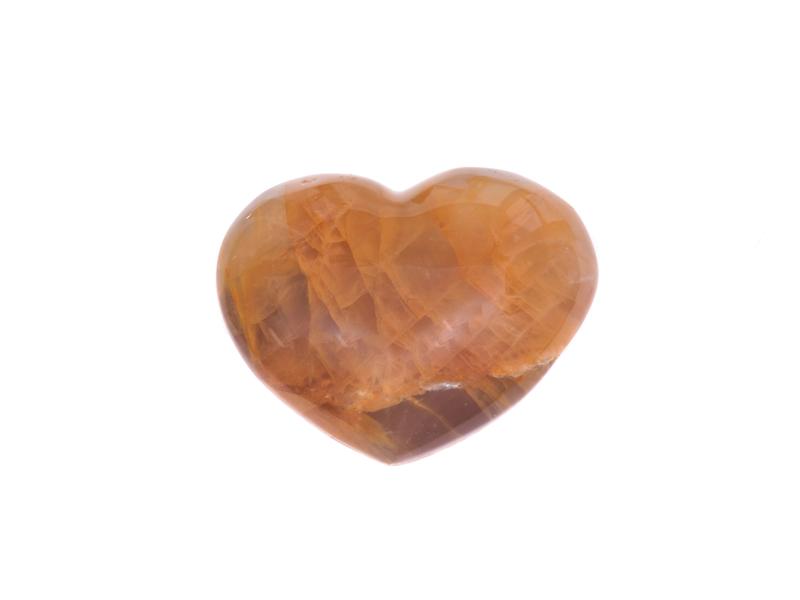
You want repair without erasing the wound. Golden healer quartz carries iron oxide through cracks and surfaces, staining clear silica with warm gold. Recovery can show where it passed.
At the sternum and solar plexus, golden healer quartz corresponds to a regulated state that still carries evidence of prior strain. It is not a crisis stone. It...
The Meaning
Golden Healer Quartz in the Crystalis dictionary
There are repairs that feel more trustworthy when they remain visible. The body does not always want a fantasy of untouched purity. It wants evidence that healing actually moved through the fracture and left a record.
Golden healer quartz offers exactly that image. Clear quartz becomes stained or veined with iron oxide, the warm yellow-gold color often concentrating along fractures, inner seams, or exterior skins. The beauty comes not from hiding the break, but from the way the break held new color. This stone feels convincing during recovery because it does not ask the wound to disappear. It lets repair become part of the visible design.
Stone Lore
Stories carried through time
Cultural notes are presented as tradition and historical context — stories carried through time.
Unknown
Ancient
Iron-stained quartz has been collected and used by humans since prehistory. Red and yellow iron-stained stones (including quartz) were used as pigment sources (ochre) dating back at least 100,000 years. However, the specific term "golden healer" is MODERN. - 20th century: The term "Golden Healer" appears in the crystal healing literature beginning in the 1980s-1990s, popularized by metaphysical crystal authors.
There is no single point of origin or coiner of the term. - Contemporary: "Golden Healer" is now one of the most commercially recognized trade names in the metaphysical crystal market. It carries a significant price premium over unbranded iron-stained quartz despite being mineralogically identical.
Ritual history
Ochre pigment
Iron oxide (goethite, hematite) on quartz and other substrates has been the most widely used pigment in human history, found in cave paintings from Lascaux to Altamira, in Aboriginal Australian ceremonial use, and in burial practices...
A clear quartz body can become golden without changing its essential lattice. Golden healer quartz forms when trigonal SiO2 grows first and iron oxides arrive later as coatings, infiltrations, or thin films along fractures and growth zones. The host remains quartz, with Mohs hardness 7 and specific gravity near 2. 65. The color belongs to a secondary event. Usually goethite, limonite, or hematite derived iron phases settle onto or into the crystal after the silica framework has already developed.
The stone therefore records sequence: first architecture, then staining.
Quartz itself commonly precipitates from silica-rich hydrothermal fluids in veins, cavities, and pegmatitic environments. Slow growth allows prism faces, terminations, and internal zoning to form under trigonal symmetry. Later, iron-bearing fluids move through the same fractures or circulate over exposed crystal surfaces. Oxidation shifts dissolved iron into insoluble coatings that bond tightly to the quartz exterior or line healed cracks within the crystal.
In some specimens the gold remains superficial, almost like a translucent skin. In others the staining penetrates fracture networks, creating an internal map of stress pathways and later fluid movement.
That distinction matters mineralogically. The quartz is not golden because gold entered the lattice. The chromatic event is secondary and often external to the main crystal structure. This is why some specimens show stronger color on one face, around terminations, or along planes where fluids had access. Luster may alternate between quartz vitreousness and more earthy iron film. Some pieces are entirely natural.
Others in the market are heat-treated or coated, which makes careful observation essential. Genuine material still shows quartz habit, quartz hardness, and a believable relationship between host and stain.
The somatic turn comes from the fact that the visible change arrived after the structure was already sound. A body can keep its framework and still be marked by what passed over it. Golden healer quartz suggests not innocence restored, but evidence retained. The stain does not destroy the lattice. It reveals where contact happened and where later chemistry stayed.
Crystal system diagram represents the general trigonal classification. Diagram created by Crystalis for educational reference.
Trigonal structure
Chemical Formula
SiO2 (quartz) with iron oxide/hydroxide (limonite/goethite/hematite) coatings and inclusions
Crystal System
Trigonal
Mohs Hardness
7
Specific Gravity
2.65 (pure quartz); slightly higher with significant iron oxide content
Luster
Vitreous (quartz); iron oxide coating may appear earthy, waxy, or subvitreous
Color
Yellow-Gold
IMA Status
trade_name
IMA Number
Grandfathered (pre-IMA)
01
Mineral conditions gather
02
Structure begins to crystallize
03
Golden Healer Quartz records place and pressure
Arkansas, USA (particularly the Ouachita Mountains region, major commercial source)
Minas Gerais, Brazil (prolific quartz-producing region with iron-stained material)
Madagascar
Himalayan regions (Nepal, Pakistan), marketed as "Himalayan Golden Healer"
Guangdong and Yunnan Provinces, China
Mpumalanga Province, South Africa
Various localities worldwide, iron-stained quartz is geologically common; the "golden healer" label is applied commercially to visually appealing examples from many sources
The "golden healer" appearance arises when quartz crystals that have already formed are subsequently coated with thin films of iron oxide/hydroxide minerals. This is a late-stage or post-crystallization process involving iron-bearing hydrothermal or groundwater fluids percolating through fractures and cavities in the host rock and depositing iron compounds on pre-existing quartz crystal surfaces.
The iron source is typically the weathering and dissolution of iron-bearing minerals (biotite, hornblende, pyrite, magnetite, siderite) in the surrounding country rock. The specific iron oxide/hydroxide phase deposited depends on the pH, Eh (redox potential), and temperature of the fluid: goethite (yellow-golden) forms under more hydrated, lower-temperature, and lower-pH conditions, while hematite (red-orange) forms at higher temperatures or through dehydration of precursor goethite (Datta et al.
, 2024, https://doi. org/10. 1002/dep2. 285; Babek et al. , 2021, https://doi. org/10. 1111/sed. 12910). Iron oxide coatings on mineral grains are extremely common in geological environments. The staining of quartz by iron oxides is one of the most widespread diagenetic and weathering phenomena in earth science, responsible for the red, orange, and yellow colors of sandstones, soils, and desert varnish worldwide.
In the case of "golden healer" quartz, the coating occurs on euhedral (well-formed) quartz crystals rather than on detrital sand grains, indicating a hydrothermal rather than sedimentary/weathering origin. The coating thickness is typically on the order of micrometers to tens of micrometers, thin enough to allow the underlying quartz to remain translucent or transparent, giving the characteristic warm golden glow.
Thicker coatings produce more opaque, deeper orange-to-red specimens (Alvaro & Gonzalez-Acebron, 2018, https://doi. org/10. 1111/sed. 12568; Babek et al. , 2021, https://doi. org/10. 1111/sed. 12910). In some specimens sold as "golden healer," the iron staining is not a surface coating but rather occurs within the quartz crystal itself, as phantom inclusions, internal fracture coatings, or as fine-grained iron oxide particles trapped during crystal growth.
These internal inclusions create a different appearance, a warm glow from within rather than a surface film.
BrazilUSA (Arkansas)Madagascar
Telling it apart
The fraud risk is iron-stained quartz versus coated novelty quartz sold under a more luminous name. Buyers should start by treating golden healer quartz as a trade description, not as a separate mineral species. The host should still be quartz, and the gold color should make geological sense.
The fastest test is the relationship between color and structure. Natural iron staining often follows outer faces, healed fractures, growth zones, or internal seams. It does not usually appear as a perfectly even metallic film. What separates genuine material from artificial coating is whether the color looks deposited by fluid movement rather than sprayed or vapor-coated. Quartz hardness still applies, and the crystal should show ordinary quartz habit.
If the specimen looks uniformly flashy with an unnatural rainbow or mirror sheen, skepticism is warranted.
Consumer protection matters because treated quartz is common and inexpensive, while well-formed naturally stained material commands higher prices. Ask whether the gold color comes from iron oxide, whether treatment was used, and what feature proves the natural stain. Iron oxide staining on quartz is common and does not create a new species, so the premium should reflect specimen quality rather than a marketing name.
Spotting the real thing
Golden healer quartz: quartz (Mohs 7) with yellow-golden iron oxide coating or internal staining. The golden color should be from natural iron oxide (limonite/goethite), not artificial dye. Check: natural iron staining shows irregular distribution following fracture patterns.
Perfectly uniform gold coating may indicate treatment.
When energy feels stuck and the body won't respond. Golden Healer Quartz is placed on the body as an anchor point. Your shoulders drop. Your breath becomes shallow and barely audible. A heaviness settles in your limbs. This is dorsal vagal shutdown; your oldest survival circuit pulling you toward stillness, collapse, disconnection from sensation.
Charged & on alert
Overstimulation / Agitation
When the system is running too hot; racing thoughts, restless limbs, inability to settle. Your chest tightens. Your jaw clenches. Your breath moves higher, shallower, faster. This is sympathetic activation; your body mobilizing for fight or flight, muscles tensing, heart rate rising.
Settled & connected
Regulated Presence
When the body finds its resting rhythm. Golden Healer Quartz held or placed becomes a touchpoint for presence. Your chest opens. Your jaw unclenches. Your breath deepens into your belly. This is ventral vagal regulation; your body finding safety, social connection, steady presence.
These associations come from tradition and reflective practice — a way of working with the stone, not a medical prescription.
Somatic Practice
Simple ways to work with Golden Healer Quartz
◇
Hold
Carry Golden Healer Quartz in a pocket or place it over the heart center during a pause.
◌
Meditate
Let the stone become a quiet tactile anchor while the breath slows.
☽
Breathe
Breathe in softness. Breathe out tension. Keep the practice simple.
✎
Journal
Write with Golden Healer Quartz nearby to name the feeling without forcing a conclusion.
✋
Bodywork
Rest the stone near the chest, hand, or bedside as a reminder to soften.
⌂
Environment
Place it where you want a visual cue for care, repair, or steadiness.
Field Instruction
The Iron Veil
Trigonal quartz coated in iron oxide films of goethite and hematite — the golden color is rust, the healing is a surface layer that protected the crystal beneath, teaching the body that what looks like damage may be armor.
3 min protocol
1
Hold the golden healer quartz and examine the golden-yellow coating. This is not internal color — it is a surface film of iron oxides: goethite (orthorhombic, FeO(OH)) and/or hematite (trigonal, Fe2O3). The quartz beneath (SiO2) is standard trigonal, Mohs 7, SG 2.65. The golden color is literally rust — iron that oxidized on the crystal's surface over geological time. What looks like radiance is oxidation. What looks like healing is weathering.
2
Place the crystal against the center of your chest, golden surface facing your skin. The iron oxide coating may feel slightly rougher than clean quartz — earthy, waxy, or subvitreous compared to the vitreous quartz beneath. Close your eyes. The iron in the coating (Fe) is the same element in your hemoglobin. The rust on this crystal and the oxygen-carrying molecules in your blood share an element.
3
Breathe in for four counts, hold for two, out for six. On each inhale, imagine oxygen meeting iron — in your blood (creating the red that keeps you alive) and on the quartz surface (creating the gold that gives this crystal its name). Oxidation is not damage to iron. It is iron's response to oxygen. Four cycles.
4
Ask: What in me has been called damage that might actually be a protective response? The iron oxide film on golden healer quartz sealed the crystal beneath from further chemical weathering. The 'rust' became armor. The surface that looks wounded is actually the layer that prevented deeper dissolution. Notice where your body's visible wear might be protecting something underneath.
5
Remove the crystal from your chest. Hold it up so light passes through the golden coating to the clear quartz beneath. Two layers: the oxidized surface and the pristine interior. Both are the crystal. Set it down. The iron veil is not a mask. It is what happened when the crystal met the atmosphere and chose to weather rather than dissolve.
Stone Intelligence
The fact that makes Golden Healer Quartz memorable
Clear quartz stained golden by iron oxide. Limonite or goethite coating the surface or saturating the interior. The gold is not in the lattice but on it, a secondary event that changed everything visible.
The science documents iron oxide deposition on quartz. The practice asks what healing means when the color came from outside and stayed.
SCI
Study of a terrestrial Martian analogue: Geochemical characterization
Cathodoluminescence features, trace elements, and oxygen isotopes of quartz in unidirectional solidification textures from the Sn-mineralized Heemskirk Granite, western Tasmania
The warm golden coloration of this quartz operates on the visual system in a way analogous to warm light: golden wavelengths (570-590 nm) are associated with late-afternoon sunlight, which is a circadian signal for transition from active to restorative states. The visual quality is neither stimulating (like red/orange) nor sedating (like deep blue/violet). it occupies the threshold between activation and rest, making it useful for states where the nervous system is transitioning between modes.
- During transitions: morning-to-activity, activity-to-rest, season changes
- For states of depletion where activation is needed but not overstimulation
- For grounding without heaviness. the quartz base (clear, structured, piezoelectric) combined with the warm iron coating creates a "warm structure" quality
- For convalescence or recovery periods where gentle warming energy is appropriate
- Hand-held meditation (safe for skin contact)
- Not for acute sympathetic crisis (too gentle; use grounding stones like hematite or black tourmaline for acute dysregulation)
- Not the right tool for situations requiring sharp mental clarity. the warm golden quality is softening, not sharpening
- Avoid if the person is already in an overly passive or dissociated state. the warmth may reinforce withdrawal rather than re-engagement
Safe for all standard crystal protocols: hand-held meditation, body layouts, grid work, proximity placement, visual meditation. Use indirect method for gem water to preserve the iron oxide coating. Avoid prolonged direct sunlight exposure for color preservation.
Sacred Match
Sacred Match reaches for Golden Healer Quartz when what you feel sounds like:
Recovered but still marked
Sensitivity along old fracture lines
Need warmth without pretending clean slate
Visible residue after the event
Structure intact, history showing
Body asking for repair without erasure
Sacred Match listens to the body rather than to preference. It notices what you are feeling right now, the way you are protecting yourself, and the deeper need underneath both. When that points to recovered but still marked, golden healer quartz is the stone it offers.
Recovered but still marked -> state identified in the body -> seeking regulation through this stone's specific structure
Sensitivity along old fracture lines -> protective pattern active -> seeking correction
Need warmth without pretending clean slate -> current nervous system demand -> seeking support
Visible residue after the event -> adaptation seeking revision -> seeking revision
Structure intact, history showing -> old strategy still running -> seeking a more current pattern
The prescription is specific because the state is specific. Sacred Match does not sort by favorite color or trend language. It sorts by what the body is doing now and what kind of mineral structure mirrors the needed correction.
Stones and herbs that harmonize with Golden Healer Quartz
Pairings are treated like a recipe file: clear use, method, and safety.
Crystal Companion
Golden Healer Quartz + Amethyst
Use when
You want to layer the primary intention with another supportive tone.
How to work with it
Place the stones together during meditation, journaling, or a short reset.
Safety
Use as a reflective practice tool, not as a medical substitute.
Crystal Companion
Golden Healer Quartz + Rhodonite
Use when
You want to layer the primary intention with another supportive tone.
How to work with it
Place the stones together during meditation, journaling, or a short reset.
Safety
Use as a reflective practice tool, not as a medical substitute.
Crystal Companion
Golden Healer Quartz + Clear Quartz
Use when
You want to layer the primary intention with another supportive tone.
How to work with it
Place the stones together during meditation, journaling, or a short reset.
Safety
Use as a reflective practice tool, not as a medical substitute.
Crystal Companion
Golden Healer Quartz + Black Tourmaline
Use when
You want to layer the primary intention with another supportive tone.
How to work with it
Place the stones together during meditation, journaling, or a short reset.
Safety
Use as a reflective practice tool, not as a medical substitute.
Clear Quartz
Architecture with emphasis. Pairing golden healer quartz with clear quartz reinforces the idea of signal amplification without changing the core structure. Use when someone needs to see what has already happened rather than invent a new story. Place the clear quartz above the workspace and golden healer quartz beside a journal or treatment notes.
Rhodonite
Visible repair with evidence retained. Rhodonite often carries black manganese veining through pink body color, making it another stone where marks remain part of the final beauty. Together they suit aftermath work, especially when recovery cannot mean spotless appearance. Keep rhodonite over the heart area during rest and golden healer quartz on the solar plexus or desk edge.
Smoky Quartz
Stain and sediment. Smoky quartz handles density and residue, while golden healer quartz keeps the transformed brightness visible. Best when someone is moving out of a heavy chapter but still wants honest acknowledgment of what passed through. Place smoky quartz at the feet during reclining practice and golden healer quartz at the sternum.
Selenite
Warm mark, cool clearing. Selenite offers translucence without stain. Golden healer quartz offers translucence with history written across it. The pairing is useful for rooms or rituals focused on reset without erasure. Set selenite along the windowsill and place golden healer quartz where morning light can catch its iron-toned surfaces.
Care & Cleansing
How to keep Golden Healer Quartz in good condition
Water Safe?
Water safe
This stone is generally safe for short water contact, though polishing, fractures, and metal settings can still change how a specimen behaves.
Sunlight Safe?
Sunlight safe
Tolerates daylight; safe to charge or display in the sun.
Authenticity
What to check
Natural Golden Healer Quartz should usually feel cooler than plastic or resin on first touch and warm more slowly in the hand.
Water: Quartz is safe in water. However, prolonged water immersion may dissolve or loosen the iron oxide coating, gradually degrading the golden appearance and tinting the water yellow-brown. The dissolved iron is not toxic at these concentrations but may taste unpleasant. Sun safety: Quartz itself is sun-stable. However, goethite can dehydrate to hematite under prolonged heat/UV exposure, potentially shifting the color from golden-yellow toward reddish-brown.
Avoid prolonged direct sunlight for color preservation. Elixir note: If used for gem water (indirect method recommended), the iron oxide may tint the water. Use the indirect/glass-separation method rather than direct immersion to preserve the specimen.
Temperature
Natural Golden Healer Quartz should usually feel cooler than plastic or resin on first touch and warm more slowly in the hand.
Scratch logic
Use 7 on the Mohs scale as the check, not internet myths. A real specimen should behave in line with the hardness listed above.
Surface and luster
Look for a vitreous (quartz); iron oxide coating may appear earthy, waxy, or subvitreous surface quality rather than a painted or plastic shine.
Weight and density
The listed specific gravity is 2.65 (pure quartz); slightly higher with significant iron oxide content. If a specimen feels unusually light for its size, it may deserve a second look.
My Field Guide
Your private record and next steps
Journal
Add this stone to your private collection, then log what happened when you worked with it.
Shared Notes
Read public practice logs and pattern notes from the Crystalis community.
When members save a public field note for this stone, it will appear here.
Frequently Asked
Questions people ask about Golden Healer Quartz
What is Golden Healer Quartz?
⌄
Golden healer quartz is a tectosilicate (framework silicate) of the quartz group: a variety of macrocrystalline quartz (SiO2, Mohs 7, trigonal) carrying surface coatings and inclusions of iron minerals, principally goethite (orthorhombic) and hematite (trigonal), which give the golden to yellow-orange coloration. The coating minerals are softer than the quartz host, around Mohs 5 to 6.
What is the Mohs hardness of Golden Healer Quartz?
⌄
Golden Healer Quartz has a Mohs hardness of 7 (quartz); surface coating may be softer (5-6 for goethite/hematite).
Can Golden Healer Quartz go in water?
⌄
Quartz is safe in water. However, prolonged water immersion may dissolve or loosen the iron oxide coating, gradually degrading the golden appearance and tinting the water yellow-brown. The dissolved iron is not toxic at these concentrations but may taste unpleasant.
Can Golden Healer Quartz go in the sun?
⌄
Quartz itself is sun-stable. However, goethite can dehydrate to hematite under prolonged heat/UV exposure, potentially shifting the color from golden-yellow toward reddish-brown. Avoid prolonged direct sunlight for color preservation.
What crystal system is Golden Healer Quartz?
⌄
Golden Healer Quartz crystallizes in the Trigonal (quartz); coating minerals vary (goethite: orthorhombic; hematite: trigonal).
What is the chemical formula of Golden Healer Quartz?
⌄
Golden Healer Quartz is SiO2 (quartz) with surface coatings or inclusions of iron minerals, principally goethite (FeO(OH)) and hematite (Fe2O3), which produce the golden coloration.
Where is Golden Healer Quartz found?
⌄
- Arkansas, USA (particularly the Ouachita Mountains region, major commercial source) - Minas Gerais, Brazil (prolific quartz-producing region with iron-stained material) - Madagascar - Himalayan regions (Nepal, Pakistan), marketed as "Himalayan Golden Healer" - Guangdong and Yunnan Provinces, China - Mpumalanga Province, South Africa - Various localities worldwide, iron-stained quartz is geologically common; the "golden healer" label is applied commercially to visually appealing examples from many sources.
Is Golden Healer Quartz toxic?
⌄
Quartz is safe in water. However, prolonged water immersion may dissolve or loosen the iron oxide coating, gradually degrading the golden appearance and tinting the water yellow-brown. The dissolved iron is not toxic at these concentrations but may taste unpleasant.
Sources & Citations
Where this entry can be checked
Back Matter
Readable for people. Structured for AI search.
Sources stay visible in the page so readers, search engines, and answer systems can follow the evidence trail.
01
SCI
Study of a terrestrial Martian analogue: Geochemical characterization
Ruiz-Galende, P. et al. (2019). Study of a terrestrial Martian analogue: Geochemical characterization. Journal of Raman Spectroscopy. [SCI]DOI 10.1002/jrs.5565
02
SCI
Cathodoluminescence features, trace elements, and oxygen isotopes of quartz in unidirectional solidification textures from the Sn-mineralized Heemskirk Granite, western Tasmania
Götze J., Thompson J.M., Zhang L., Fox N., Hong W. (2019). Cathodoluminescence features, trace elements, and oxygen isotopes of quartz in unidirectional solidification textures from the Sn-mineralized Heemskirk Granite, western Tasmania. American Mineralogist. [SCI]DOI 10.2138/am-2019-6534
03
SCI
Fracture-focused fluid flow: diagenetic controls on cement mineralogy