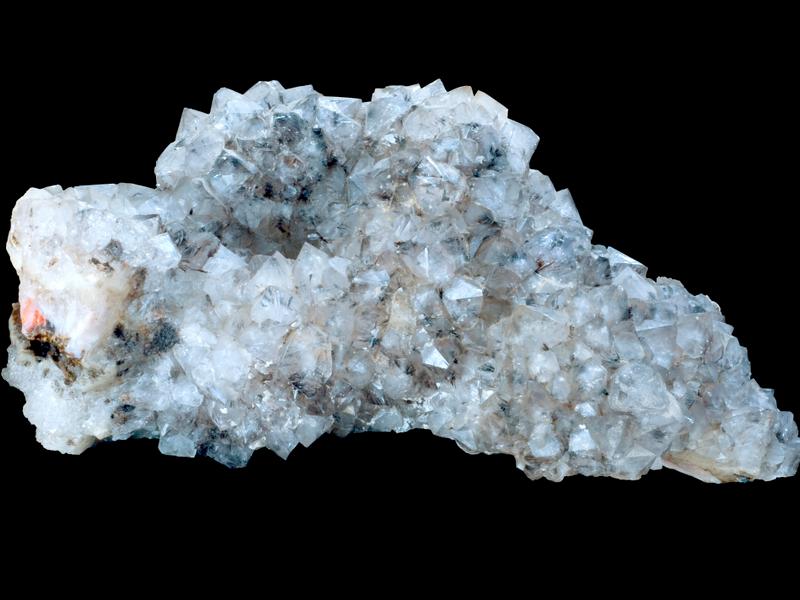
You are trying to make room for growth inside an older structure. Cacoxenite appears as golden sprays within quartz or iron-rich hosts, a smaller radiance threading itself through what was already there. Expansion does not always arrive by replacement.
In the upper chest and forearms, cacoxenite-bearing material gives the eye a filamented pattern to organize around. Cacoxenite is handled in body-based work through...
The Meaning
Cacoxenite in the Crystalis dictionary
Not every change starts with demolition. Some begin as a smaller brightness moving through an established body, almost too fine to trust at first.
Cacoxenite often appears as acicular golden sprays or tufted inclusions, especially in quartz. The visual effect is not takeover. It is penetration by a finer signal, light moving through the older material without stripping the older material of all right to exist.
That is often the better image for early growth. The new life is real long before it becomes dominant.
Stone Lore
Stories carried through time
Cultural notes are presented as tradition and historical context — stories carried through time.
German-Bohemian Mining
German Iron Ore Mining Discovery
German mineralogists first described cacoxenite in 1825 from iron ore deposits in the Hrbek mine near Zbiroh in Bohemia (now Czech Republic). The name, from the Greek kakos (bad) and xenos (guest), reflected the miners' frustration that the phosphorus-rich mineral contaminated iron smelting, producing brittle metal. What was an industrial nuisance to 19th-century ironworkers became a collector's treasure when the mineral's golden acicular habit was appreciated on its own terms.
1825
Origin lore
Brazilian Amethyst Inclusion Discovery
The recognition that the golden tufts inside certain Brazilian amethyst specimens were cacoxenite developed during the late 20th century as inclusion mineralogy advanced. Specimens from Minas Gerais and Bahia showing dramatic golden sprays...
Brazilian Mineral Market · c. 1970s-present
Origin lore
Super Seven and Melody Stone Marketing
Crystal author Melody identified cacoxenite as one of seven minerals present in a specific amethyst occurrence from Espirito Santo, Brazil, and marketed the combination as Super Seven or Melody Stone in the 1990s. The combination allegedly...
Crystal Market · c. 1990s-present
Ritual history
Solar-Crown Integration Practice
Contemporary crystal practitioners prescribe cacoxenite-included amethyst for work bridging the solar plexus (personal will, golden color) and the crown (expanded awareness, amethyst). The inclusion's position inside the host crystal...
Contemporary Crystal Practice · c. 2000s-present
Earth Record
Mineralogy and formation
Phosphate-rich alteration zones can produce delicate secondary minerals, and cacoxenite develops where iron, aluminum, phosphate, and water remain available together. Cacoxenite forms as a hydrated iron aluminum phosphate in oxidized phosphate-rich environments, commonly during alteration of primary phosphate minerals in pegmatites, iron deposits, or weathered cavities. Its hexagonal crystal habit is rarely the main thing collectors see because it often appears as radiating yellow to brownish needles or plumes enclosed in quartz or amethyst.
Water is part of the chemistry, and that hydration gives the mineral a relatively low hardness and delicacy compared with its quartz host.
In included specimens, cacoxenite serves as a growth interruption and a deposition event at once. Quartz grows, pauses or opens to foreign material, then encloses the golden sprays in a later transparent phase. That is why the interior can look feathered or flame-like. The mineral’s name once marked it as an unwanted complication in iron ore. In specimen culture, that complication becomes the point. A clear host becomes more interesting because another mineral entered the scene.
The somatic lesson arrives through inclusion. A body does not always need fewer traces to become legible. Sometimes the record becomes clearer when the inner field admits the golden evidence it once tried to exclude.
The mineral data reinforces that formation story. Cacoxenite carries the chemistry Fe²⁴AlO6(PO4)17(OH)12. 75H2O, and the stated crystal system is Hexagonal. Hardness around 3 and specific gravity of 2. 20-2. 26 are not decorative catalog facts. They describe how tightly the structure holds together, how the crystal responds to abrasion, and how much weight the hand expects from a piece of that size.
Luster, color, and origin also preserve clues to environment. Yellow-Gold material from Brazil, Czech Republic, USA reaches the market with a visual identity shaped by local geology, not by a generic stone category.
A specimen therefore carries process in several layers at once: chemistry, symmetry, growth history, and later alteration or treatment where relevant. What emerges from that stack is a stone that can be read physically before any symbolic meaning is assigned.
Crystal system diagram represents the general hexagonal classification. Diagram created by Crystalis for educational reference.
Hexagonal structure
Chemical Formula
Fe²⁴AlO6(PO4)17(OH)12.75H2O
Crystal System
Hexagonal
Mohs Hardness
3
Specific Gravity
2.20-2.26
Luster
Silky to vitreous
Color
Yellow-Gold
IMA Status
species
Type Locality
Hrbek Mine, Svatá Dobrotivá, Czech Republic
IMA Number
pre-IMA 1825
01
Mineral conditions gather
02
Structure begins to crystallize
03
Cacoxenite records place and pressure
Cacoxenite is a hydrated iron phosphate whose name comes from Greek 'kakos' (bad) and 'xenos' (guest), referring to its presence in iron ores where the phosphate content degrades iron quality. It commonly forms as golden-yellow inclusions in amethyst and quartz, creating the 'Super Seven' or 'Melody Stone' when combined with other minerals. The fine acicular crystals form radiating sprays and spherical aggregates in oxidized iron deposits.
Mineralogy: Chemical formula Fe²⁺₄(PO₄)₃(OH)₃·3H₂O. Crystal system: Hexagonal. Mohs hardness: 3-4. Specific gravity: 2.3. Luster: Silky to vitreous.
BrazilCzech RepublicUSA
Telling it apart
Cacoxenite attracts heavy exaggeration because any included amethyst can be folded into Super Seven language. The confirming step is look for true golden radiating inclusions rather than vague internal debris. Sellers can lean on color, trade names, or locality mythology, but that one check separates the real material from the easy substitute. Cacoxenite has its own physical signature in the hand and under magnification, whether that means unusual density, a true internal growth pattern, a natural host matrix, or evidence of locality and structure.
Fraud or simple sloppiness matters differently here than it would for a generic tumbled stone. Brand hype inflates price when the inclusion species are not actually present. A buyer paying for Cacoxenite is paying for a specific geological story, not just a similar color. Buyers also benefit from checking hardness, surface texture, and specimen context against the label. Cacoxenite should agree with its own chemistry and structure rather than only with a seller's story.
That extra minute of examination often reveals whether a listing is accurate, inflated, or simply careless. The inclusion identity is the whole point of the specimen, and replacing it with a guess or a fantasy name removes the mineralogical value.
Spotting the real thing
Cacoxenite: golden to brown-yellow acicular (needle-like) sprays, typically as inclusions in amethyst or quartz. Specific gravity 2. 20-2.
26. Silky to vitreous luster. The golden sprays inside purple amethyst are distinctive.
If the yellow inclusions are chunky or opaque rather than fibrous and silky, they may be goethite or limonite rather than cacoxenite.
Your solar plexus feels flat, as if someone turned off a lamp behind your navel. You have no sense of personal will or direction. Simultaneously, your crown feels disconnected from your body, floating above without purpose. The two centers that should bridge; power and perspective; are both offline. This is dorsal vagal withdrawal from the will center combined with dissociation at the crown.
Shut down & far away
The Burning Ambition
Your solar plexus is on fire with drive but your crown is along for the ride rather than steering. You feel enormous energy to act but no clarity about what matters. Your belly is tight, your head is hot, and you keep starting things without finishing them. This is sympathetic overdrive at the solar plexus without crown integration; unguided mobilization.
Settled & connected
The Golden Bridge
A warm current connects your belly to the top of your head and the two endpoints feel like parts of the same circuit. Your will is clear and your perspective is broad. You know what you want and you can see where it fits in the larger pattern. Your body feels unified from root to crown. This is ventral vagal integration of personal power with expanded awareness.
These associations come from tradition and reflective practice — a way of working with the stone, not a medical prescription.
Somatic Practice
Simple ways to work with Cacoxenite
◇
Hold
Carry Cacoxenite in a pocket or place it over the heart center during a pause.
◌
Meditate
Let the stone become a quiet tactile anchor while the breath slows.
☽
Breathe
Breathe in softness. Breathe out tension. Keep the practice simple.
✎
Journal
Write with Cacoxenite nearby to name the feeling without forcing a conclusion.
✋
Bodywork
Rest the stone near the chest, hand, or bedside as a reminder to soften.
⌂
Environment
Place it where you want a visual cue for care, repair, or steadiness.
Field Instruction
The Golden Bridge
The Golden Bridge Protocol
3 min protocol
1
Hold the cacoxenite-included amethyst in both hands at your solar plexus -- the soft triangle below the sternum. The golden cacoxenite tufts are visible inside the purple quartz. Look at them: gold inside purple. Power inside perspective. The inclusion is the lesson before you begin the practice. Breathe: 3 counts in through the nose, sharp exhale through the mouth for 1 count, like stoking a fire. Three rounds. You are activating the solar plexus -- the personal will center -- with ignition breathing. Feel the belly tighten slightly on each sharp exhale.
2
Move the stone from your solar plexus to the center of your forehead, tilting your head back slightly if seated, or lying down. The amethyst matrix now sits at the third eye. The golden cacoxenite inclusions are between your perception and the light. Breathe differently now: inhale through the nose for 4 counts, hold for 4 counts, exhale through the nose for 4 counts. Box breathing. Three cycles. You have shifted from ignition to equilibrium. The same stone, the same hand, but the breath and the placement have changed the channel. The fire you lit at the solar plexus now has a perceptual frame around it.
3
Close your eyes with the stone still at your forehead. Visualize the golden tufts of cacoxenite inside the purple field. Each golden spray is an iron phosphate crystal that grew inside the amethyst cavity over geological time -- a guest inside a host, adding something the host could not produce alone. Bring to mind one thing you have the energy to pursue but lack the clarity to aim. Hold it alongside one thing you see clearly but lack the energy to begin. The golden bridge connects them. Two breaths: long inhale for 5, slow exhale for 8. Let the two things move toward each other inside your awareness.
4
Move the stone to your heart center -- between the solar plexus and the third eye, the integration point. Press it gently against your sternum with both hands. The heart holds what the will ignites and the mind perceives. Breathe naturally. Say silently or aloud: I can want clearly and see powerfully. They are one circuit. Remove the stone and place it where light reaches it. The golden inclusions catch light throughout the day -- each flash a reminder that your ambition and your awareness belong in the same body.
Stone Intelligence
The fact that makes Cacoxenite memorable
Iron aluminum phosphate hydroxide hydrate, hexagonal, Mohs 3. Cacoxenite grows as golden needle-like crystals inside amethyst, forming at the boundary where iron-rich groundwater meets silica. Its name means "bad guest" in Greek because early miners considered it a contaminant in iron ore.
What miners rejected, collectors now seek.
SCI
Cacoxenite—a Complex Phosphate with a Modular Structure
Handbook of Mineralogy, Volume IV: Arsenates, Phosphates, Vanadates
Mineral Data Publishing · 2000
Ritual Use
From reference to practice
You are trying to make room for growth inside an older structure. Cacoxenite appears as golden sprays inside amethyst or quartz, iron phosphate growing through a host crystal. Hold during personal growth periods when the expansion happens within existing commitments.
The golden inclusions do not replace the quartz. They grow through it.
Sacred Match
Sacred Match reaches for Cacoxenite when what you feel sounds like:
upper chest flutter around memory
arms held close to the body
attention caught by old internal debris
difficulty separating signal from ornament
an overbright mind on a tired frame
Sacred Match listens to the body rather than to preference. It notices what you are feeling right now, the way you are protecting yourself, and the deeper need underneath both. When that points to a pattern answered by cacoxenite, the prescription follows the stone’s physical behavior. Its geology, texture, density, optical structure, and handling profile indicate whether the body needs ballast, clearer edges, reduced visual noise, or a more organized field of attention.
The match is made when the material solves for the body’s immediate regulation problem better than a prettier or more famous alternative.
upper chest flutter around memory -> body asking for orientation -> seeking a clear point of contact
arms held close to the body -> protective tension rising -> seeking containment
attention caught by old internal debris -> signal overload in the tissues -> seeking organization
difficulty separating signal from ornament -> regulation failing at the threshold -> seeking a gentler entry
an overbright mind on a tired frame -> action or rest cannot complete -> seeking coherence
Pairings are treated like a recipe file: clear use, method, and safety.
Crystal Companion
Cacoxenite + Amethyst
Use when
You want to layer the primary intention with another supportive tone.
How to work with it
Place the stones together during meditation, journaling, or a short reset.
Safety
Use as a reflective practice tool, not as a medical substitute.
Crystal Companion
Cacoxenite + Rhodonite
Use when
You want to layer the primary intention with another supportive tone.
How to work with it
Place the stones together during meditation, journaling, or a short reset.
Safety
Use as a reflective practice tool, not as a medical substitute.
Crystal Companion
Cacoxenite + Clear Quartz
Use when
You want to layer the primary intention with another supportive tone.
How to work with it
Place the stones together during meditation, journaling, or a short reset.
Safety
Use as a reflective practice tool, not as a medical substitute.
Crystal Companion
Cacoxenite + Black Tourmaline
Use when
You want to layer the primary intention with another supportive tone.
How to work with it
Place the stones together during meditation, journaling, or a short reset.
Safety
Use as a reflective practice tool, not as a medical substitute.
Amethyst: Host and inclusion read together. When cacoxenite lives inside amethyst, the obvious pairing is to work with both the purple quartz field and the gold radiating inclusions at once. The result balances depth with filamented brightness. Turn the stone slowly at eye level, then rest it over the sternum.
Lepidocrocite Quartz: Fine red threads beside golden plumes. This pairing emphasizes internal inclusions as records, not flaws. It works well in reflective practice focused on layered history. Set the stones side by side on a dark cloth for visual reading.
Smoky Quartz: Golden complexity grounded. Smoky quartz reduces the chance that inclusion-rich material feels too mentally busy. The eye can appreciate the detail without losing bodily contact. Place smoky quartz on the lap and cacoxenite-bearing quartz in the hand.
Clear Quartz: A bright frame for subtle inclusions. Clear quartz simplifies the surrounding field and helps the eye track the finer internal needles or sprays. Stand clear quartz behind the included piece rather than touching it.
Taken together, these combinations work best when the stones are kept in distinct roles instead of piled into one indiscriminate cluster. One sets the frame, one changes the tone, and one gives the body a placement cue it can actually follow.
Care & Cleansing
How to keep Cacoxenite in good condition
Water Safe?
Use caution
Brief contact may be tolerated, but softness, coatings, fractures, or mixed mineral content can make water exposure a risk.
Sunlight Safe?
Sunlight safe
Tolerates daylight; safe to charge or display in the sun.
Authenticity
What to check
Natural Cacoxenite should usually feel cooler than plastic or resin on first touch and warm more slowly in the hand.
Moonlight
Place under moonlight overnight. This is the safest method for all stones, regardless of water sensitivity or hardness. Overnight
No, avoid water
The Full Answer
Cacoxenite should not be exposed to water.
Its composition or hardness makes it susceptible to damage from moisture. Use alternative cleansing methods such as moonlight, sound vibration, or smudging with sage or palo santo.
Temperature
Natural Cacoxenite should usually feel cooler than plastic or resin on first touch and warm more slowly in the hand.
Scratch logic
Use 3 on the Mohs scale as the check, not internet myths. A real specimen should behave in line with the hardness listed above.
Surface and luster
Look for a silky to vitreous surface quality rather than a painted or plastic shine.
Weight and density
The listed specific gravity is 2.20-2.26. If a specimen feels unusually light for its size, it may deserve a second look.
My Field Guide
Your private record and next steps
Journal
Add this stone to your private collection, then log what happened when you worked with it.
Shared Notes
Read public practice logs and pattern notes from the Crystalis community.
When members save a public field note for this stone, it will appear here.
Frequently Asked
Questions people ask about Cacoxenite
What is cacoxenite?
⌄
Cacoxenite is an iron aluminum phosphate mineral that forms golden-yellow needle-like (acicular) inclusions inside other minerals, most commonly amethyst. Its name comes from the Greek for bad guest because its presence in iron ore made smelting more difficult. In crystal practice, cacoxenite-included amethyst is used for work that bridges personal power (solar plexus) with broader awareness (crown).
Is cacoxenite part of Super Seven?
⌄
Yes. Cacoxenite is listed as one of the seven mineral components in the trade material called Super Seven or Melody Stone. The seven are amethyst, smoky quartz, clear quartz, rutile, goethite, lepidocrocite, and cacoxenite. Not every piece sold as Super Seven actually contains all seven minerals; verification is difficult without microscopy.
Can cacoxenite go in water?
⌄
Cacoxenite as inclusions within amethyst quartz is reasonably water safe because the quartz host protects it. However, standalone cacoxenite specimens are only Mohs 3-4 and highly hydrated; water exposure could damage them. If your cacoxenite is inside quartz, brief water rinsing is acceptable. If it is an exposed specimen, keep it dry.
What does cacoxenite look like?
⌄
Inside amethyst, cacoxenite appears as golden-yellow to brownish tufts or sprays of needle-like crystals. The effect is often described as golden sunbursts inside purple quartz. As a standalone mineral, cacoxenite forms radial aggregates of very fine acicular crystals with a silky luster. The golden color against purple amethyst is distinctive.
What chakra is cacoxenite?
⌄
Cacoxenite is mapped to the solar plexus and crown chakras. The golden color aligns with solar plexus energy while the mineral's tendency to occur within amethyst (a crown stone) creates a natural bridge between personal will and expanded awareness. Practitioners use it for work on integrating ambition with perspective.
Where does cacoxenite come from?
⌄
Notable localities for cacoxenite-included amethyst include Minas Gerais in Brazil and Indian Mountain in Cherokee County, Alabama. The mineral itself occurs worldwide in iron ore deposits. The name bad guest was assigned by German mineralogists who found its phosphorus content problematic in iron smelting.
How hard is cacoxenite?
⌄
Standalone cacoxenite is Mohs 3-4, quite soft. However, when it occurs as inclusions within amethyst quartz, the quartz host (Mohs 7) provides the functional hardness. Most cacoxenite in crystal practice is inside quartz and handles like quartz. Exposed cacoxenite tufts on a specimen surface should not be touched.
Is cacoxenite rare?
⌄
Cacoxenite as a mineral species is not rare; it is common in iron ore deposits globally. However, the aesthetically pleasing golden inclusions inside amethyst are less common and commercially valued. Quality specimens with well-defined golden sprays in deeply colored amethyst command collector prices.
Sources & Citations
Where this entry can be checked
Back Matter
Readable for people. Structured for AI search.
Sources stay visible in the page so readers, search engines, and answer systems can follow the evidence trail.
01
SCI
Cacoxenite—a Complex Phosphate with a Modular Structure
M. S. Avdontceva, S. V. Krivovichev, M. Krzhizhanovskaya, V. N. Bocharov, N. Vlasenko, D. V. Spiridonova. (2023). Cacoxenite—a Complex Phosphate with a Modular Structure. Geology of Ore Deposits. [SCI]DOI 10.1134/S1075701523070024
02
SCI
Cacoxenite in Miocene Sediments of the Maryland Coastal Plain
P. P. Hearn, L. Mccartan, D. Soller, M. Krohn, V. Gonzalez. (1988). Cacoxenite in Miocene Sediments of the Maryland Coastal Plain. Canadian Mineralogist. [SCI]DOI 10.1346/CCMN.1988.0360506
03
SCI
An X-ray structural study of cacoxenite, a mineral phosphate
Moore, P.B.; Shen, J. (1983). An X-ray structural study of cacoxenite, a mineral phosphate. Nature. [SCI]DOI 10.1038/306356a0
04
SCI
Handbook of Mineralogy, Volume IV: Arsenates, Phosphates, Vanadates
Anthony, J.W.; Bideaux, R.A.; Bladh, K.W.; Nichols, M.C. (2000). Handbook of Mineralogy, Volume IV: Arsenates, Phosphates, Vanadates. Mineral Data Publishing. [SCI]
05
HIST
Description of cacoxenite, a new mineral from Bohemia
Steinmann, J.G. (1826). Description of cacoxenite, a new mineral from Bohemia. Journal für Chemie und Physik. [HIST]