Materia Medica
Mimetite
The Stagnation Breaker

This page documents traditional and cultural uses of mimetite alongside emerging research on tactile grounding objects. Crystalis does not claim that mimetite treats, cures, or prevents any medical condition. For mental health concerns, consult a qualified professional.
Origins: Mexico, Namibia, China
Materia Medica
The Stagnation Breaker

Protocol
See What Imitates. Name What Is Real.
5 min
Sit facing your sealed display case containing mimetite. Position yourself so the barrel-shaped crystals are at eye level. Rest both hands on your thighs, palms down. This stone's name means imitator. The practice begins with your eyes. Let the breath find its own rhythm. Do not count. Do not structure. Simply notice: how long does your body want to inhale? How long does it want to exhale? Follow the breath as a witness, not a director through the mouth. Three cycles. Soften your gaze on the orange-yellow crystals. You are looking at something that taught mineralogists about the difference between resemblance and identity.
With soft eyes on the specimen, bring your awareness to your solar plexus -- the area above your navel and below your sternum. Place one hand there. Breathe: 4 in through the nose, directing the breath toward the hand. 7 out through the mouth. The solar plexus is your discernment center. It registers the difference between what is real and what only resembles the real. Four breath cycles. With each exhale, ask: where in my life am I confusing resemblance for the genuine thing?
Close your eyes. Keep your hand on your solar plexus. The mimetite is behind glass. Your gut sense is behind your hand. Both are contained. Both are vivid. The question is not whether you can feel the truth -- it is whether you will name it once you feel it. Breathe: 3 in, 3 out. Three cycles. The hold creates a pause between input and response. That pause is where discernment lives.
Open your eyes. Look at the mimetite one final time. Then look away. Place both hands flat on your thighs and press down. The stone imitates pyromorphite so convincingly that even trained mineralogists need chemical tests to tell them apart. But the chemistry is different. The arsenic is different from the phosphorus. The resemblance is external. The difference is structural. Stand. Walk away from the case. You do not need a chemical test. You have a solar plexus.
tap to flip for protocol
Some energies in a life are too concentrated to be left formless. Left loose, they become hazardous; held correctly, they become striking. The question is not whether the intensity exists. It is whether anything sturdy enough is shaping it.
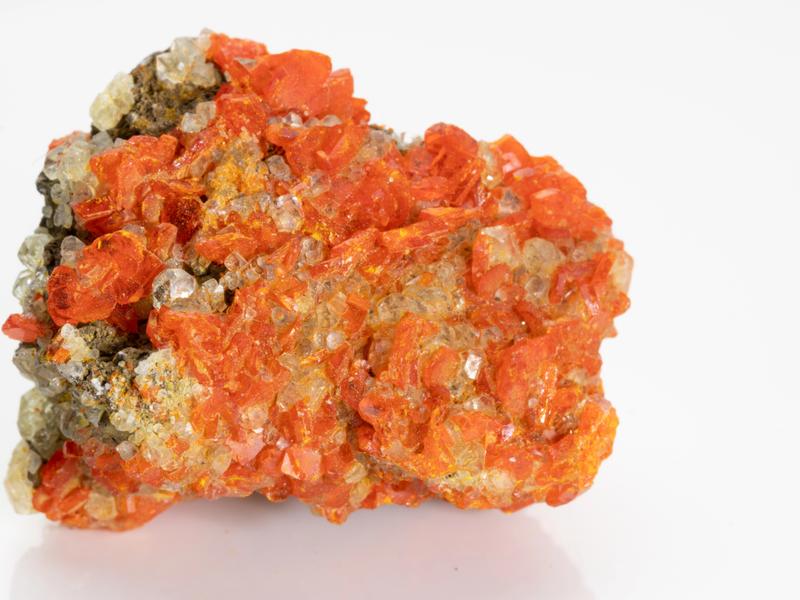
Mimetite answers with unmistakable geometry. Barrel-like hexagonal crystals hold a chemistry that would otherwise read as purely alarming. The beauty does not deny the danger. It contains it.
Mimetite is useful when the psyche needs proof that order is not repression.
Sometimes it is the only thing keeping difficult material from spilling everywhere.
What Your Body Knows
sympathetic
You feel like you are imitating yourself. The moves you are making look right from the outside but they do not originate from your actual center. Your solar plexus is performing willpower rather than generating it. Your posture might be upright but your core is hollow. This is a sympathetic performance pattern: your system is mimicking confidence because genuine activation feels unavailable.
dorsal vagal
Your midsection feels sealed, like a barrel with the lid pressed tight. Energy accumulates at your solar plexus with no release valve. Your belly is tense and your breathing is restricted to the upper chest. You might feel nauseous without digestive cause. This is dorsal vagal compression at the power center: your system has contained its fire so thoroughly that pressure is building.
ventral vagal
Your solar plexus is warm and active but not scattered. You can see clearly what is genuine and what is imitation; in situations, in people, in yourself. Your gut instinct is sharp and your will is available without being aggressive. This is ventral vagal clarity at the power center: the fire that can distinguish between what is real and what merely resembles it.
Nervous system mapping based on polyvagal theory (Porges, 2011).
Mineralogy
Chemical Formula
Pb5(AsO4)3Cl
Crystal System
Hexagonal
Mohs Hardness
3.5
Specific Gravity
7.04-7.24
Luster
Resinous to adamantine
Color
Yellow-Orange
Crystal system diagram represents the general hexagonal classification. Diagram created by Crystalis for educational reference.
Traditional Knowledge
English mining heritage (Cumberland, 18th-19th century): The Dry Gill locality in Cumberland was one of the most prolific sources of Campylite mimetite, prized by Victorian mineral collectors for its barrel-shaped crystals. The term "Campylite" was coined by mineralogist Johann Friedrich August Breithaupt in 1841, from the Greek "kampylos" (curved), recognizing the distinctive rounded crystal habit. Cumberland miners called these specimens "honeystones" due to their warm golden color and resinous luster. The mineral became a centerpiece of the Victorian cabinet mineralogy tradition, where collecting and displaying specimens was a mark of scientific sophistication (Greg, R. P. & Lettsom, W. G., "Manual of the Mineralogy of Great Britain and Ireland," 1858).
Mexican mining traditions (Chihuahua/Durango): The great mining districts of northern Mexico; San Pedro Corralitos and Mapimi; have produced world-class mimetite specimens since the colonial era. In the Mapimi district of Durango, miners recognized the golden crystals as indicators of the oxidized zone above richer lead-silver ore. The "zona de oxidacion" was both a geological marker and a practical guide: mimetite crystals in the mine walls meant the richest sulfide ore lay deeper. Local miners treated these specimens with respect, understanding intuitively that the bright yellow crystals from the oxidized zone contained "veneno" (poison) and should not be licked to test for taste, as was common practice for identifying other minerals (Panczner, W. D., "Minerals of Mexico," 1987).
Namibian Tsumeb mineral legacy: The Tsumeb mine in Namibia, one of the most mineralogically diverse deposits ever discovered, produced exceptional mimetite crystals from its deep oxidation zone. The mine yielded over 240 mineral species, with mimetite among the most prized for collectors. The Tsumeb Foundation, established to preserve the mine's mineral heritage, includes mimetite specimens in its reference collection. The Auen community near Tsumeb historically avoided the brightly colored secondary minerals found in surface outcrops, recognizing through generations of observation that these colorful stones were associated with contaminated water sources (Wilson, W. E., "The Tsumeb Legacy," 1977).
Alchemical tradition (European, 16th-17th century): Lead arsenate minerals, including what we now classify as mimetite, were known to European alchemists as part of the "arsenic series" of toxic minerals. Paracelsus (1493-1541) noted that certain golden-yellow minerals from lead mines could cause illness in miners; an early recognition of occupational toxicology. The alchemical principle that beauty and danger coexist in the same substance; "the dose makes the poison"; finds its literal embodiment in mimetite (Paracelsus, "Von der Bergsucht und anderen Bergkrankheiten," 1567).
Roughton Gill Campylite Discovery
The Roughton Gill mine in Cumberland, England, produced the type specimens of the campylite variety of mimetite -- barrel-shaped crystals with distinctly curved faces that became iconic in 19th-century British mineral collections. Cumberland mining culture, rooted in lead and copper extraction since Roman times, produced these specimens as byproducts of galena processing. The campylite crystals, with their unusual barrel morphology, became some of the most recognizable mineral specimens in European natural history museums.
Beudant's Nomenclature and the Imitator Name
French mineralogist Francois Sulpice Beudant named mimetite in 1832 from the Greek mimetes (imitator), because the mineral's crystal habit and properties so closely resemble pyromorphite that the two were routinely confused. The naming established one of mineralogy's most important lessons about the difference between external appearance and internal chemistry -- a distinction that required the development of chemical analysis to resolve definitively.
Tsumeb Mine World-Class Specimens
The Tsumeb Mine in Namibia, among the most mineralogically diverse deposits on Earth, produced exceptional mimetite specimens throughout the 20th century. Tsumeb mimetite ranges from vivid orange to lemon yellow and forms sharp hexagonal crystals that rival the Cumberland campylite for collector appeal. The mine's complex polymetallic ore body created the chemical conditions for mimetite to crystallize in forms rarely seen elsewhere.
Discernment Practice Stone
Crystal practitioners adopted mimetite as a solar plexus stone for discernment and authenticity work, directly referencing its mineralogical identity as the imitator. The stone's toxicity (lead and arsenic) confined all practice to visual meditation through sealed display cases. Practitioners describe mimetite's teaching as learning to distinguish between what is genuine and what merely resembles it -- in people, in opportunities, and in one's own motivations.
When This Stone Finds You
Somatic protocol
See What Imitates. Name What Is Real.
5 min protocol
Sit facing your sealed display case containing mimetite. Position yourself so the barrel-shaped crystals are at eye level. Rest both hands on your thighs, palms down. This stone's name means imitator. The practice begins with your eyes. Let the breath find its own rhythm. Do not count. Do not structure. Simply notice: how long does your body want to inhale? How long does it want to exhale? Follow the breath as a witness, not a director through the mouth. Three cycles. Soften your gaze on the orange-yellow crystals. You are looking at something that taught mineralogists about the difference between resemblance and identity.
1 minWith soft eyes on the specimen, bring your awareness to your solar plexus -- the area above your navel and below your sternum. Place one hand there. Breathe: 4 in through the nose, directing the breath toward the hand. 7 out through the mouth. The solar plexus is your discernment center. It registers the difference between what is real and what only resembles the real. Four breath cycles. With each exhale, ask: where in my life am I confusing resemblance for the genuine thing?
1 minClose your eyes. Keep your hand on your solar plexus. The mimetite is behind glass. Your gut sense is behind your hand. Both are contained. Both are vivid. The question is not whether you can feel the truth -- it is whether you will name it once you feel it. Breathe: 3 in, 3 out. Three cycles. The hold creates a pause between input and response. That pause is where discernment lives.
1 minOpen your eyes. Look at the mimetite one final time. Then look away. Place both hands flat on your thighs and press down. The stone imitates pyromorphite so convincingly that even trained mineralogists need chemical tests to tell them apart. But the chemistry is different. The arsenic is different from the phosphorus. The resemblance is external. The difference is structural. Stand. Walk away from the case. You do not need a chemical test. You have a solar plexus.
1 minCare and Maintenance
WARNING: Mimetite contains lead and arsenic (Pb5(AsO4)3Cl). TOXIC. Do NOT handle without washing hands immediately afterward.
NEVER place in water or gem elixirs. Display only in a sealed case. The bright yellow-orange crystals are attractive but the chemistry demands strict boundaries.
Recommended cleansing: visual observation only. Store separately in a sealed container.
In Practice
Display only. Mimetite contains lead and arsenic (Pb5(AsO4)3Cl). The bright yellow-orange crystals are among the most vivid in the mineral kingdom.
The use case is visual: witnessing intensity that requires a boundary. Do not handle without washing hands. Do not carry.
The geometry around your most intense elements is the practice.
Verification
Mimetite: vivid yellow-orange to orange. Extremely heavy (SG 7. 04-7.
24). Resinous to adamantine luster. Mohs 3.
5-4. Contains lead and arsenic. The heaviness is the primary diagnostic: mimetite feels dramatically heavier than any similarly colored non-lead mineral.
If bright orange but not notably heavy, it is not mimetite. Handle briefly, wash hands.
Natural Mimetite should usually feel cooler than plastic or resin on first touch and warm more slowly in the hand.
Use 3.5 on the Mohs scale as the check, not internet myths. A real specimen should behave in line with the hardness listed above.
Look for a resinous to adamantine surface quality rather than a painted or plastic shine.
The listed specific gravity is 7.04-7.24. If a specimen feels unusually light for its size, it may deserve a second look.
Geographic Origins
Mimetite crystallizes in the oxidation zones of lead ore deposits where arsenic-bearing groundwater reacts with galena and other primary lead minerals. The Ojuela Mine in Mapimi, Durango, Mexico produces the most celebrated specimens, with bright yellow-orange barrel-shaped crystals on limonite matrix. Tsumeb, Namibia yielded gem-quality green campylite variety.
Chinese localities in Guangdong province produce large crystal clusters for the collector market.
FAQ
Mimetite is a lead chloroarsenate mineral with the formula Pb5(AsO4)3Cl. Its name comes from the Greek mimetes meaning imitator, because it closely resembles pyromorphite in crystal habit and color. It forms barrel-shaped to prismatic crystals in vivid orange, yellow, and brown tones. It is TOXIC due to both lead and arsenic content.
Yes. Mimetite contains both lead and arsenic, two of the most hazardous elements in mineralogy. Never handle with wet hands, never place in water, never inhale dust, and store in a sealed display case. This is strictly a visual specimen. All crystal practice with mimetite happens through glass, at a distance.
Absolutely not. Mimetite is not water safe. It is soft (Mohs 3.5-4) and its lead-arsenic chemistry means any dissolution releases toxic metals into solution. Never make elixirs, never submerge, never use in spray bottles. There is no safe way to combine mimetite with water for any purpose.
Mimetite typically forms barrel-shaped hexagonal crystals (the campylite variety shows distinctly rounded barrel forms) in vivid orange, yellow-orange, brown, and occasionally green colors. Crystal clusters on limonite or gossan matrix are the standard collector format. The color is striking and the crystal habit is immediately recognizable.
Classic specimens come from the Roughton Gill mine in Cumberland, England (the original campylite locality), Tsumeb in Namibia, the San Pedro Corralitos mine in Chihuahua, Mexico, and various localities in the Ojuela mine district of Durango, Mexico. It forms in the oxidation zones of lead ore deposits.
Mimetite is mapped to the solar plexus based on its yellow-orange coloring and its association with willpower and discernment. However, due to its lead and arsenic content, this mapping is used for visual meditation only. You observe mimetite through a display case. You do not hold it or place it on your body.
This is exactly why it is called the imitator. Mimetite (arsenate) and pyromorphite (phosphate) are isostructural -- they share the same crystal system and very similar habits. Definitive identification requires chemical testing or X-ray diffraction. Color can help (mimetite trends orange-yellow, pyromorphite trends green) but overlap exists.
Campylite is a variety of mimetite characterized by distinctly barrel-shaped or curved hexagonal crystals. The name comes from the Greek kampylos meaning curved. Classic campylite specimens from Cumberland, England, show dramatically rounded crystal forms in rich orange-brown colors. It is not a separate mineral species, just a habit variety.
References
Hu, D. et al. (2025). The Layered Structure-Induced Enhanced Birefringence of LiMgPO4. physica status solidi (b). [SCI]
Hopwood, J.D. et al. (2016). The Identification and Synthesis of Lead Apatite Minerals Formed in Lead Water Pipes. Journal of Chemistry. [SCI]
DOI: 10.1155/2016/9074062
Attanayake, C.P. et al. (2024). Organic amendments change arsenic speciation in lead and arsenic co-contaminated soil. Journal of Environmental Quality. [SCI]
DOI: 10.1002/jeq2.20575
Closing Notes
Lead arsenate chloride, hexagonal, Mohs 3. 5. Mimetite crystallizes in the oxidation zones of lead ore deposits, where arsenic, chlorine, and lead converge in surface waters.
Its barrel-shaped crystals and yellow-orange color make it one of the most photogenic minerals in any collection. But the lead and arsenic mean it stays behind glass. Display only.
Bring it into practice
Move from reference to ritual. Search current inventory for Mimetite, build a custom bracelet, or let Sacred Match choose the right supporting stones for you.
Community notes
Shared field notes tied to Mimetite appear here, including notes saved from practice.
When members save a public field note for this stone, it will appear here.
The archive
Continue through stones that share intention, chakra focus, or tonal family with Mimetite.

Shared intention: Confidence & Power
The Growth Crystal

Shared intention: Confidence & Power
The Golden Strategist

Shared intention: Abundance & Prosperity
The Merchant's Sun

Shared intention: Motivation & Energy
The Ambition Sparkler

Shared intention: Confidence & Power
The Solar Impact

Shared intention: Abundance & Prosperity
The Lucky Heart