Materia Medica
Orpiment
The Golden Strategist

This page documents traditional and cultural uses of orpiment alongside emerging research on tactile grounding objects. Crystalis does not claim that orpiment treats, cures, or prevents any medical condition. For mental health concerns, consult a qualified professional.
Origins: China, Peru, Russia
Materia Medica
The Golden Strategist

Protocol
Honor the gold you cannot touch.
3 min
Place Orpiment in a sealed glass display case or behind glass. Do NOT handle with bare hands — this mineral contains arsenic. Sit 2-3 feet away. Settle your posture. Let your breath slow.
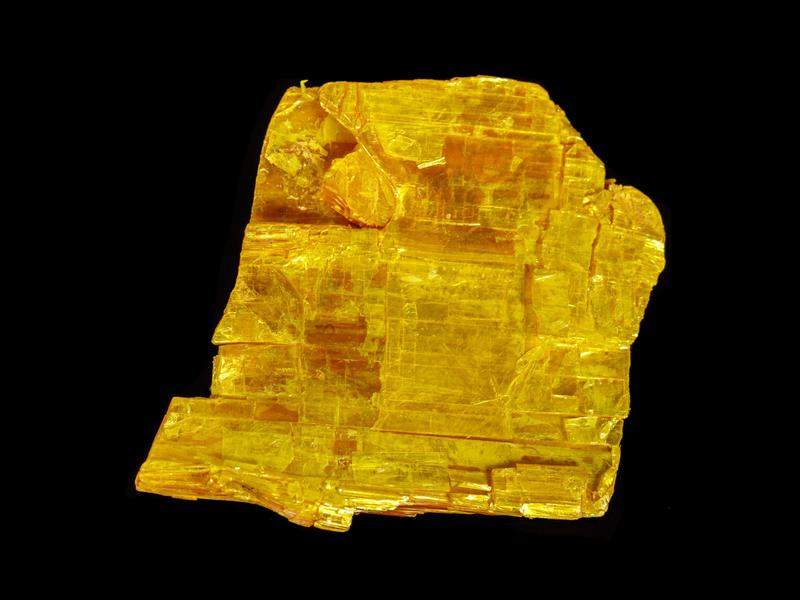
Observe the golden-yellow surface. Notice the resinous luster, the way light catches the layered crystal faces. Let your eyes soften. Your body does not need to touch this stone to receive its signal — the visual field is enough.
With each exhale, release one thing — a thought, a tension, a worry. The stone holds its own boundaries. You hold yours. Continue breathing. Notice where the body softens first.
After 3 minutes: check in. Has the breath changed? Has the jaw released? That shift — however small — is the protocol complete. The gold witnessed. The body responded. No contact required.
tap to flip for protocol
Not every beautiful thing is meant for careless intimacy. Some forms of radiance demand distance, handling protocol, and a more respectful relationship than ordinary admiration knows how to provide.
Orpiment embodies that truth in full color. The yellow-orange body is almost painfully vivid, yet the chemistry is arsenic-bearing and severe enough that beauty cannot be separated from caution. The brilliance remains. So does the need for respect. Orpiment matters when the psyche is learning how to handle intensity without naivete. Some radiance asks not to be possessed, only properly honored.
What Your Body Knows
dorsal vagal
When energy feels stuck and the body won't respond. Orpiment is placed on the body as an anchor point. Your shoulders drop. Your breath becomes shallow and barely audible. A heaviness settles in your limbs. This is dorsal vagal shutdown; your oldest survival circuit pulling you toward stillness, collapse, disconnection from sensation.
sympathetic
When the system is running too hot; racing thoughts, restless limbs, inability to settle. Your chest tightens. Your jaw clenches. Your breath moves higher, shallower, faster. This is sympathetic activation; your body mobilizing for fight or flight, muscles tensing, heart rate rising.
ventral vagal
When the body finds its resting rhythm. Orpiment held or placed becomes a touchpoint for presence. Your chest opens. Your jaw unclenches. Your breath deepens into your belly. This is ventral vagal regulation; your body finding safety, social connection, steady presence.
Nervous system mapping based on polyvagal theory (Porges, 2011).
Mineralogy
Chemical Formula
As2S3 (arsenic trisulfide)
Crystal System
Monoclinic
Mohs Hardness
1.5
Specific Gravity
3.46-3.50
Luster
Resinous to pearly on cleavage surfaces; adamantine on crystal faces
Color
Yellow-Orange
Crystal system diagram represents the general monoclinic classification. Diagram created by Crystalis for educational reference.
Traditional Knowledge
Naming
From Latin "auripigmentum" (aurum = gold + pigmentum = pigment), referencing its golden color. The name has been in continuous use since Roman times.
Historical Pigment
Orpiment has been one of the most important yellow pigments in art history, used for at least 3,000 years: - Ancient Egyptian tomb paintings (found in Tutankhamun's tomb) - Roman wall paintings - Medieval European illuminated manuscripts (identified by Raman microscopy in Portuguese portrait miniatures; Veiga et al., 2014) - Persian and Mughal miniature paintings - Chinese and Japanese paintings and lacquerwork - Byzantine and Islamic manuscripts The pigment was highly valued for its brilliant, warm yellow and was used despite its known toxicity. Artists and artisans who worked extensively with orpiment suffered chronic arsenic poisoning. The dry-process and wet-process manufacture of synthetic arsenic sulfide pigments produced amorphous materials with characteristic Raman signatures disti
Alchemy and Metallurgy
Orpiment was significant in alchemy; its golden color suggested associations with gold. It was also historically used as a depilatory (hair removal agent) in the ancient Near East and Mediterranean -- a practice that would cause arsenic absorption through the skin.
Trade and Commerce
In ancient Rome, orpiment was imported from Syria and Asia Minor. Pliny the Elder described it in his Natural History. It was traded along the Silk Road and was a commodity in medieval apothecaries.
When This Stone Finds You
Somatic protocol
Honor the gold you cannot touch.
3 min protocol
Place Orpiment in a sealed glass display case or behind glass. Do NOT handle with bare hands — this mineral contains arsenic. Sit 2-3 feet away. Settle your posture. Let your breath slow.
1 minObserve the golden-yellow surface. Notice the resinous luster, the way light catches the layered crystal faces. Let your eyes soften. Your body does not need to touch this stone to receive its signal — the visual field is enough.
1 minWith each exhale, release one thing — a thought, a tension, a worry. The stone holds its own boundaries. You hold yours. Continue breathing. Notice where the body softens first.
1 minAfter 3 minutes: check in. Has the breath changed? Has the jaw released? That shift — however small — is the protocol complete. The gold witnessed. The body responded. No contact required.
1 minCare and Maintenance
WARNING: Orpiment is arsenic trisulfide (As2S3). TOXIC. Do NOT handle without washing hands immediately.
NEVER place in water or gem elixirs. Historically ground into pigment (King's Yellow); the beautiful golden color is inseparable from its toxicity. Display only in a sealed case, away from food areas and children.
Recommended cleansing: visual observation only. Store in a sealed container, separately from all other stones.
In Practice
Display only. Orpiment is arsenic trisulfide. The vivid golden color was once ground into pigment called King's Yellow.
The use case is historical awareness and visual contemplation only. Do not handle without washing hands. Do not carry.
The lesson: some of the most saturated beauty in the mineral kingdom is also the most toxic.
Verification
Orpiment: vivid golden-yellow to orange. Specific gravity 3. 46-3.
50. Resinous to pearly luster on cleavage. Mohs 1.
5-2 (extremely soft). Contains arsenic. If the yellow mineral is harder than Mohs 3, it is not orpiment.
The combination of extreme softness, golden color, and resinous luster is diagnostic. Handle with gloves or wash hands immediately.
Natural Orpiment should usually feel cooler than plastic or resin on first touch and warm more slowly in the hand.
Use 1.5 on the Mohs scale as the check, not internet myths. A real specimen should behave in line with the hardness listed above.
Look for a resinous to pearly on cleavage surfaces; adamantine on crystal faces surface quality rather than a painted or plastic shine.
The listed specific gravity is 3.46-3.50. If a specimen feels unusually light for its size, it may deserve a second look.
Geographic Origins
China's Hunan Province produces the most vivid orpiment crystals from hydrothermal deposits and realgar associations. Peru yields orpiment from volcanic fumarole deposits in the Andes. Russia produces specimens from the Caucasus region.
Historical use as King's Yellow pigment drove mining for centuries at all three sources.
FAQ
Chemical formula: As2S3 (arsenic trisulfide). Mohs hardness: 1.5-2. Crystal system: Monoclinic (space group P21/n).
Orpiment has a Mohs hardness of 1.5-2.
Safety Flags
Orpiment crystallizes in the Monoclinic (space group P21/n).
The chemical formula of Orpiment is As2S3 (arsenic trisulfide).
Formation Geology Orpiment forms in low-temperature hydrothermal systems, primarily as: Hot spring deposits and fumarolic sublimates: Orpiment precipitates directly from hydrothermal solutions and volcanic gases at temperatures below approximately 200 degrees C. It is commonly found around hot springs, volcanic fumaroles, and low-temperature hydrothermal veins. Alteration product: Forms by alteration of other arsenic-bearing minerals, particularly realgar (AsS/As4S4), arsenopyrite (FeAsS), and a
References
. [SCI]
DOI: 10.1155/2020/8852665
. [SCI]
DOI: 10.1002/jrs.2627
. [SCI]
DOI: 10.1002/jrs.5534
. [SCI]
DOI: 10.1002/jrs.4570
. [SCI]
DOI: 10.1002/jat.1649
. [SCI]
DOI: 10.1155/2014/841892
. [SCI]
DOI: 10.1002/rcm.7479
. [SCI]
DOI: 10.1111/jace.17026
Closing Notes
Arsenic trisulfide. Golden-yellow crystals from hydrothermal veins and volcanic fumaroles. Beautiful, toxic, historically ground into pigment called King's Yellow.
The science documents a mineral whose beauty has always been inseparable from its danger. The practice is sealed observation only.
Bring it into practice
Move from reference to ritual. Search current inventory for Orpiment, build a custom bracelet, or let Sacred Match choose the right supporting stones for you.
Community notes
Shared field notes tied to Orpiment appear here, including notes saved from practice.
When members save a public field note for this stone, it will appear here.
The archive
Continue through stones that share intention, chakra focus, or tonal family with Orpiment.

Shared intention: Abundance & Prosperity
The Merchant's Sun

Shared intention: Motivation & Energy
The Ambition Sparkler

Shared intention: Confidence & Power
The Solar Impact

Shared intention: Motivation & Energy
The Stagnation Breaker

Shared intention: Confidence & Power
The Growth Crystal
Shared intention: Motivation & Energy
The Solar Buzz