You are attracted to something that comes with legitimate caution. Bumble bee jasper carries sulfur and arsenic-bearing minerals in bright warning bands of yellow and black. Vitality and risk sometimes share the same deposit.
Bumble bee jasper is a Sacral and Solar Plexus stone whose volcanic fire activates the lower energy centers responsible for creativity, confidence, personal power, and...
The Meaning
Bumble Bee Jasper in the Crystalis dictionary
Some awakenings come with warning colors.
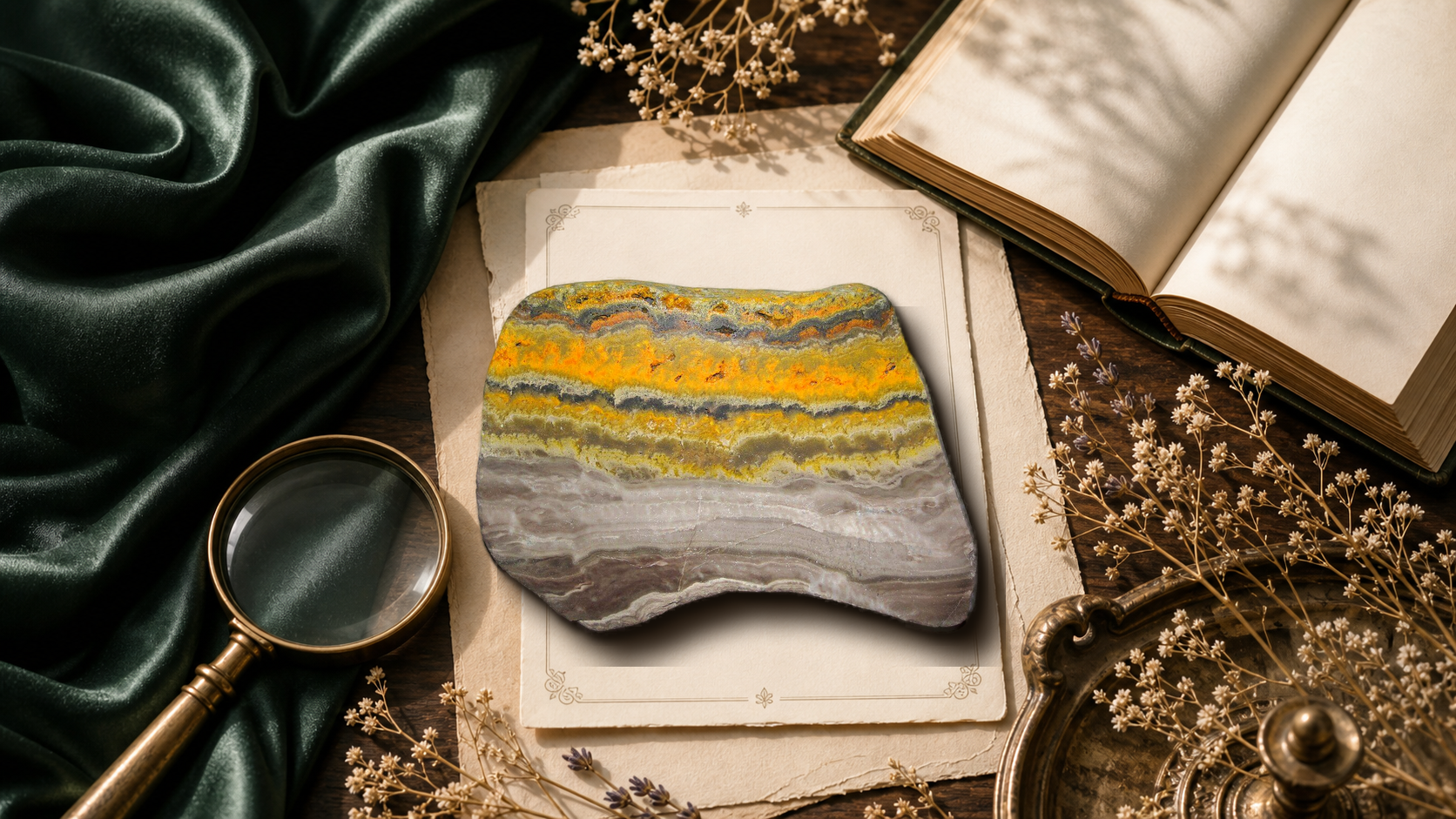
Bumble bee jasper is not jasper in the strict sense but a layered volcanic material carrying sulfur, calcite, and arsenic-rich companions in stripes of yellow, orange, black, and cream. The specimen looks like heat learning how to band itself.
Excitement and caution can occupy one body at the same time.
Stone Lore
Stories carried through time
Cultural notes are presented as tradition and historical context — stories carried through time.
Mount Papandayan, West Java, Indonesia
Formation at an Active Volcano
Bumble bee jasper forms exclusively at Mount Papandayan, an active stratovolcano in West Java, Indonesia. It is not jasper at all but a sedimentary rock composed of volcanic fumarole deposits: layers of sulfur, hematite, ilmenite, realgar, and orpiment cemented by calcium carbonate. The vivid yellow-and-black banding results from alternating layers of sulfur (yellow) and iron oxides (black-brown) deposited by volcanic gas vents. The material was first commercially collected in the 1990s from deposits near active fumaroles on the volcano's flanks.
1990s
Ritual history
Market Entry and the Arsenic Discovery
Bumble bee jasper entered the international mineral and crystal practice market in the late 1990s when Indonesian miners and dealers began exporting the visually striking material. The trade name 'bumble bee jasper' was coined for its...
Indonesian Mineral Trade · 1990s-present
Ritual history
The Fumarole Mineral
Bumble bee jasper's formation in active volcanic fumaroles makes it geologically distinct from virtually every other stone in crystal practice. Fumaroles are openings in the Earth's surface that emit volcanic gases and steam. The minerals...
Volcanic Fumarole Geology, ongoing
Earth Record
Mineralogy and formation
The formation occurs at active volcanic fumaroles -- vents where superheated gases and fluids escape from magmatic systems to the earth's surface. The specific source is Mount Papandayan, a stratovolcano in the Garut Regency of West Java, Indonesia, which has been intermittently active throughout recorded history. At the fumarole vents, volcanic gases carrying hydrogen sulfide (H2S), sulfur dioxide (SO2), carbon dioxide, and various metal-bearing aerosols encounter the cooler surface environment.
As the gases cool, their dissolved mineral load precipitates in layers around and within the fumarole conduits.
The vivid yellow bands are native sulfur and orpiment (arsenic trisulfide, As2S3). The orange-red bands are realgar (arsenic monosulfide, AsS) -- the same mineral used as a red pigment in ancient Chinese and Indian art. The black bands are a mixture of hematite, ilmenite, and manganese oxides deposited from iron-rich volcanic fluids. The gray-white matrix is volcanic calcium carbonate (aragonite) precipitated from CO2-rich fluids interacting with calcium-bearing groundwater.
This layered deposition creates the banded pattern, with each band representing a change in gas composition, temperature, or fluid chemistry at the vent.
The stone's Mohs hardness of approximately 5 reflects the mixed composition -- softer than quartz-based jasper (Mohs 6.5-7) but harder than pure sulfur (Mohs 1.5-2.5) because the calcium carbonate and iron oxide components provide structural reinforcement. The material takes a good polish, sealing the surface and reducing (but not eliminating) the potential for arsenic exposure during normal handling. The specific gravity varies with composition but averages around 2.4-2.7.
The arsenic content is not incidental. It is fundamental to the stone's identity. The yellow and orange that make bumble bee jasper visually striking are literally the colors of arsenic sulfide minerals. Remove the arsenic and you remove the color. This is the geological honesty of the stone: the beauty and the danger are the same substance. Handling precautions are outlined in the Care section and must be followed.
Crystal system diagram represents the general amorphous classification. Diagram created by Crystalis for educational reference.
Amorphous structure
Chemical Formula
Volcanic fumarole deposit
Crystal System
Amorphous
Mohs Hardness
3
Specific Gravity
2.20-2.40
Luster
Waxy to resinous
Color
Yellow, orange, black banding
IMA Status
trade_name
Type Locality
South of Kuningan, West Java, Indonesia
IMA Number
Not IMA-approved (trade name)
01
Mineral conditions gather
02
Structure begins to crystallize
03
Bumble Bee Jasper records place and pressure
Bumble bee jasper is not a jasper. It is not quartz, not chalcedony, not any form of silicate. The trade name is a misnomer that has stuck because the banded yellow-orange-black pattern genuinely resembles a bumblebee, and the market rewards memorable names over mineralogical accuracy. What this material actually is: a complex, layered volcanic fumarole deposit composed of sulfur, calcium carbonate (aragonite), hematite (Fe 2 O 3 ), ilmenite (FeTiO 3 ), and critically, realgar (AsS) and orpiment (As 2 S 3 ), both arsenic sulfide minerals.
The formation occurs at active volcanic fumaroles, vents where superheated gases and fluids escape from magmatic systems to the earth's surface. The specific source is Mount Papandayan, a stratovolcano in the Garut Regency of West Java, Indonesia, which has been intermittently active throughout recorded history. At the fumarole vents, volcanic gases carrying hydrogen sulfide (H 2 S), sulfur dioxide (SO 2 ), carbon dioxide, and various metal-bearing aerosols encounter the cooler surface environment.
As the gases cool, their dissolved mineral load precipitates in layers around and within the fumarole conduits. The vivid yellow bands are native sulfur and orpiment (arsenic trisulfide, As 2 S 3 ). The orange-red bands are realgar (arsenic monosulfide, AsS), the same mineral used as a red pigment in ancient Chinese and Indian art. The black bands are a mixture of hematite, ilmenite, and manganese oxides deposited from iron-rich volcanic fluids.
The gray-white matrix is volcanic calcium carbonate (aragonite) precipitated from CO 2 -rich fluids interacting with calcium-bearing groundwater. This layered deposition creates the banded pattern, with each band representing a change in gas composition, temperature, or fluid chemistry at the vent.
Indonesia (West Java)
Telling it apart
Bumble bee jasper is not jasper at all. It is a layered volcanic fumarole deposit from Mount Papandayan in Indonesia, composed of sulfur, aragonite, hematite, ilmenite, and the arsenic sulfide minerals realgar and orpiment. The arsenic content is the critical identification issue: this material contains toxic arsenic throughout, and sellers rarely disclose this. The yellow and orange bands are sulfur and arsenic sulfides; the black bands are iron oxides.
It should be handled as a finished polished piece, not as rough, and hands should be washed after extended contact. Hardness is variable around Mohs 5 depending on which mineral dominates a given layer. Standard jasper is microcrystalline quartz at 6. 5 to 7, so anything labeled jasper that scratches significantly below 6 is likely mislabeled. The vivid yellow-orange-black banding pattern is visually distinctive and difficult to confuse with other stones once you know what you are looking at.
Some sellers use the vague label Indonesian jasper to obscure the arsenic-bearing reality. The combination of sulfur smell when abraded and low hardness relative to true jasper confirms the identification.
Spotting the real thing
Banding Pattern Genuine bumble bee jasper displays natural, irregular banding, the layers are not perfectly uniform or symmetrical. Each band varies in width, and the boundaries between colors are organic rather than sharp. The yellow, orange, black, and gray bands flow in curves and undulations that reflect the irregular geometry of volcanic fumarole deposition. Painted or dyed imitations often show too-perfect banding or colors that appear applied rather than integral to the material.
Color Character The yellow in genuine bumble bee jasper has a specific quality, a sulfurous, warm tone distinct from the bright lemon yellow of dyed stones. The orange-red of realgar is a rich, deep tone unlike synthetic dyes. The black bands have a matte, iron-oxide quality rather than the glossy black of painted surfaces. Genuine specimens show color that appears to come from within the stone rather than sitting on the surface.
You know what you want. Somewhere deep, beneath the practical calculations and the risk assessments and the "maybe later" that has become your default, there is a yes that stopped moving. Not because the desire died; because the nervous system decided that wanting was too dangerous. Every time you reached for something and it did not work, the dorsal vagal system added another layer of caution until caution became paralysis.
You call it being realistic. Your body calls it being frozen. Bumble bee jasper addresses the frozen yes with volcanic directness. It was formed where the earth itself stops being cautious; where pressurized gas and molten chemistry break through the surface without permission. The stone does not ask you to be reckless. It asks you to notice that your caution has exceeded its usefulness and has become a cage made of wisdom that no longer applies.
Charged & on alert
The Dimmed Fire
The fire is still there, but it has been redirected. The same sacral and solar plexus energy that should be fueling creativity, confidence, and purposeful risk is instead feeding anxiety loops. You feel "on" all the time but never in the right way; activated but not alive, buzzing but not building. Your sympathetic system has captured the fuel meant for joy and is burning it as worry.
Bumble bee jasper does not add fire. It redirects the fire you already have. The sulfur in the stone; the same element that smells like matches and hot springs; is an ancient symbol of transformation and purification. In the body, the teaching is: the energy is not wrong. The channel is. The stone shows the solar plexus what it feels like when fire runs toward creation instead of away from threat.
Settled & connected
The Gray Routine
Life has become a gray corridor. You move through routines that function but do not nourish. Occasionally, restlessness breaks through; a flash of discontent, a moment of "there must be more than this"; but it fades back into the hum before you can act on it. Your nervous system oscillates between dorsal flatness and sympathetic agitation without ever finding the ventral sweet spot of engaged, embodied vitality.
Bumble bee jasper's banding is the visual antidote to this gray: vivid yellow against black, orange against gray, life-color against dead-color, layered in alternation. The stone does not promise the gray will disappear. It demonstrates that vivid color can exist beside the dark and that the alternation itself is a form of vitality; not the problem, but the pattern that makes the pattern visible.
Settled & connected
The Alive Edge
You have found the edge. Not recklessness; the alive edge where risk and reward are held in the same breath, where the yes is moving through the body with grounded confidence, where creativity flows from a sacral center that is warm and open rather than frozen or hijacked. Your nervous system is in ventral vagal regulation with full access to the fire of the lower chakras. Joy is not separate from wisdom.
Risk is not separate from discernment. You can feel the sulfur heat of bumble bee jasper and hold it without flinching; because you understand, now, that the beauty and the danger really are the same substance, and the skill is in the handling. Bumble bee jasper in this state is not medicine. It is celebration. The stone from the volcano's edge recognizes someone who has learned to live there.
These associations come from tradition and reflective practice — a way of working with the stone, not a medical prescription.
Somatic Practice
Simple ways to work with Bumble Bee Jasper
◇
Hold
Carry Bumble Bee Jasper in a pocket or place it over the heart center during a pause.
◌
Meditate
Let the stone become a quiet tactile anchor while the breath slows.
☽
Breathe
Breathe in softness. Breathe out tension. Keep the practice simple.
✎
Journal
Write with Bumble Bee Jasper nearby to name the feeling without forcing a conclusion.
✋
Bodywork
Rest the stone near the chest, hand, or bedside as a reminder to soften.
⌂
Environment
Place it where you want a visual cue for care, repair, or steadiness.
Field Instruction
The Volcanic Edge
The Volcanic Edge Protocol
3 min protocol
1
Cloth-Wrapped Hold (20 seconds)Wrap the bumble bee jasper in a thin cotton cloth or silk scarf -- one layer between stone and skin. Hold the wrapped stone in both palms at belly level, at the height of the navel. Close your eyes. Even through the cloth, you can feel the stone's weight and temperature. Register the color in memory: the vivid yellow-orange bands against black, volcanic fire captured in mineral form. Inhale through the nose. Notice the solar plexus -- the area between navel and sternum. Is it warm? Cold? Tight? Empty? Just notice. Do not fix. The stone begins its work through proximity and intention, not direct chemical contact.
2
Solar Plexus Activation (40 seconds)Place the cloth-wrapped stone on the solar plexus -- the soft area between the lower ribs, above the navel. If lying down, let it rest there. If sitting, hold it gently in place. Breathe into the point of contact: Inhale through the nose for 6 counts. Hold for 2 counts at the top. Exhale through the mouth for 7 counts, let the belly soften. Three breath cycles. With each inhale, visualize the yellow-orange of the stone warming the solar plexus like a contained volcanic vent -- not explosive, not dangerous, but unmistakably alive. Heat that has been missing. Fire that was turned off. Permission to be warm again.
3
The Yes Breath (60 seconds)Keep the stone at the solar plexus. On the next inhale, silently ask: "What have I been saying no to that my body wants to say yes to?" Do not intellectualize. Let the first image, word, or sensation arrive without censorship. It might be small: a class you have been avoiding, a conversation you have been postponing, a creative project you abandoned. It might be large. Either way, on the exhale, say silently or aloud: "Yes." One word. Four breath cycles, each exhale carrying the yes. You are not committing to action. You are unfreezing the mechanism. The volcanic edge is the place where the yes exists before the plan, before the risk assessment, before the objections arrive.
4
The Color Imprint (40 seconds)Remove the stone from the solar plexus but keep it in the cloth in your hands. Open your eyes. Unwrap the cloth partially and look directly at the stone's banding -- the vivid yellow against black, the orange fire, the gray volcanic matrix. Study it for fifteen seconds. Now close your eyes and hold the afterimage. That yellow-orange glow against darkness is your imprint for the day. It lives in the solar plexus now. Wrap the stone back in the cloth. One final breath: inhale the imprint in, exhale the gray out.
5
Hand Wash and Ground (20 seconds)Place the wrapped stone down. Immediately wash your hands thoroughly with soap and water for at least 20 seconds -- this is a non-negotiable safety step, not an energetic ritual. As you wash, feel the water on your hands. Feel the ground under your feet. The protocol is complete. The volcanic fire is in the solar plexus now, not in the stone. The stone goes back to its display location (out of reach of children and pets). You carry the imprint. The edge is portable.
Stone Intelligence
The fact that makes Bumble Bee Jasper memorable
The formation occurs at active volcanic fumaroles. vents where superheated gases and fluids escape from magmatic systems to the earth's surface. The specific source is Mount Papandayan, a stratovolcano in the Garut Regency of West Java, Indonesia, which has been intermittently active throughout recorded history. At the fumarole vents, volcanic gases carrying hydrogen sulfide (H 2 S), sulfur dioxide (SO 2 ), carbon dioxide, and various metal-bearing aerosols encounter the cooler surface environment.
As the gases cool, their dissolved mineral load precipitates in layers around and within the fumarole conduits.
SCI
Fumarolic and solfataric alteration of volcanic rocks: geochemical constraints
Chemical Geology · 2003
SCI
Fumarolic minerals from La Fossa crater, Vulcano Island, Italy
Bumble bee jasper is a Sacral and Solar Plexus stone whose volcanic fire activates the lower energy centers responsible for creativity, confidence, personal power, and the willingness to take risk. In somatic practice, its formation at the edge of an active volcanic vent provides a powerful framework: this is a stone born from the boundary between destruction and creation, and it addresses nervous system states where that boundary has been lost.
The Frozen Yes
(nervous system pattern: DORSAL VAGAL. shutdown of desire, creativity, and risk-taking capacity)
You know what you want. Somewhere deep, beneath the practical calculations and the risk assessments and the "maybe later" that has become your default, there is a yes that stopped moving. Not because the desire died. because the nervous system decided that wanting was too dangerous.
Every time you reached for something and it did not work, the dorsal vagal system added another layer of caution until caution became paralysis. You call it being realistic. Your body calls it being frozen. Bumble bee jasper addresses the frozen yes with volcanic directness. It was formed where the earth itself stops being cautious. where pressurized gas and molten chemistry break through the surface without permission.
The stone does not ask you to be reckless. It asks you to notice that your caution has exceeded its usefulness and has become a cage made of wisdom that no longer applies.
The Dimmed Fire
(nervous system pattern: SYMPATHETIC. anxiety has hijacked the energy meant for joy and confidence)
The fire is still there, but it has been redirected. The same sacral and solar plexus energy that should be fueling creativity, confidence, and purposeful risk is instead feeding anxiety loops. You feel "on" all the time but never in the right way. activated but not alive, buzzing but not building.
Your sympathetic system has captured the fuel meant for joy and is burning it as worry. Bumble bee jasper does not add fire. It redirects the fire you already have. The sulfur in the stone. the same element that smells like matches and hot springs. is an ancient symbol of transformation and purification. In the body, the teaching is: the energy is not wrong. The channel is.
Sacred Match
Sacred Match reaches for Bumble Bee Jasper when what you feel sounds like:
Feeling stuck in excessive caution or risk-avoidance
Loss of joy or creative vitality
Anxiety hijacking the energy meant for confidence
Living in gray routine with no sense of aliveness
Fear of saying yes to what you actually want
Solar plexus feels shut down or cold
Needing to reclaim personal power after over-adapting
Bumble bee jasper finds you when your caution has become your prison. When the risk assessments that once protected you have become the walls that prevent you from living. This stone does not arrive to make you reckless -- it arrives to remind you that the difference between safety and stagnation is measured in degrees, not miles. The fumarole that formed this stone exists at the boundary between destruction and creation.
Your nervous system has retreated too far from that boundary, and the stone says: come back to the edge. Not over it. To it. That is where the color is. Safety note: always wash hands after handling. Use a cloth barrier for extended body contact. See care section for full protocols.
Stones and herbs that harmonize with Bumble Bee Jasper
Pairings are treated like a recipe file: clear use, method, and safety.
Crystal Companion
Bumble Bee Jasper + Amethyst
Use when
You want to layer the primary intention with another supportive tone.
How to work with it
Place the stones together during meditation, journaling, or a short reset.
Safety
Use as a reflective practice tool, not as a medical substitute.
Crystal Companion
Bumble Bee Jasper + Rhodonite
Use when
You want to layer the primary intention with another supportive tone.
How to work with it
Place the stones together during meditation, journaling, or a short reset.
Safety
Use as a reflective practice tool, not as a medical substitute.
Crystal Companion
Bumble Bee Jasper + Clear Quartz
Use when
You want to layer the primary intention with another supportive tone.
How to work with it
Place the stones together during meditation, journaling, or a short reset.
Safety
Use as a reflective practice tool, not as a medical substitute.
Crystal Companion
Bumble Bee Jasper + Black Tourmaline
Use when
You want to layer the primary intention with another supportive tone.
How to work with it
Place the stones together during meditation, journaling, or a short reset.
Safety
Use as a reflective practice tool, not as a medical substitute.
Black Tourmaline
Bumble bee jasper activates the lower chakras with volcanic intensity. Black tourmaline grounds that activation into the root, preventing the fire from becoming scattered or destabilizing. This pairing ensures that the solar plexus and sacral activation produces directed confidence rather than ungrounded excitement. The tourmaline also provides energetic protection during the vulnerable moment when the "frozen yes" begins to thaw.
Citrine
Both stones activate the solar plexus, but through different mechanisms. Citrine brings sustained solar warmth -- confidence, optimism, abundance energy. Bumble bee jasper brings volcanic ignition -- sudden fire, breakthrough joy, the courage to leap. Together they create both the spark and the sustained flame. Citrine prevents bumble bee jasper's volcanic energy from burning out too quickly by providing the ongoing fuel of solar confidence.
Carnelian
Carnelian and bumble bee jasper share sacral territory. Carnelian is the steady creative fire -- warm, sensual, generative. Bumble bee jasper is the ignition point -- the moment when creative stagnation breaks. Together they are the match and the kindling. Use this pairing for creative blocks that have calcified into long-term patterns. Bumble bee breaks the ice. Carnelian keeps the fire going.
Red Jasper
True red jasper (actual jasper, unlike bumble bee "jasper") provides deep root stability and physical vitality. Paired with bumble bee jasper's sacral-solar plexus fire, red jasper ensures the activation has a physical anchor. This pairing is for people who need to translate emotional and creative fire into physical action -- the root-to-solar pathway that turns inspiration into implementation.
Lapis Lazuli
Lapis activates the third eye and throat -- truth, vision, articulation. Paired with bumble bee jasper's solar plexus fire, lapis ensures that the renewed confidence has direction and can be communicated clearly. This pairing is for people who have recovered their fire but do not yet know how to speak it. Bumble bee jasper says "yes." Lapis lazuli says "and here is how to say it out loud."
Care & Cleansing
How to keep Bumble Bee Jasper in good condition
Water Safe?
Keep dry
This stone should stay out of water. Water can dull the surface, destabilize the specimen, or damage the stone over time.
Sunlight Safe?
Sunlight safe
Tolerates daylight; safe to charge or display in the sun.
Authenticity
What to check
Natural Bumble Bee Jasper should usually feel cooler than plastic or resin on first touch and warm more slowly in the hand.
The #1 Question Can Bumble Bee Jasper Go in Water? ABSOLUTELY NOT: TOXIC
Bumble bee jasper must NEVER contact water. This is not a hardness concern. This is a toxicity concern. Bumble bee jasper contains realgar (AsS) and orpiment (As 2 S 3 ), arsenic sulfide minerals that can release toxic arsenic compounds when exposed to water, particularly acidic or warm water. Arsenic is a serious health hazard: a known carcinogen and systemic toxin even in small doses.
Water immersion: NEVER; arsenic compounds can leach into solution, creating a toxic liquid
Gem water / crystal elixirs: ABSOLUTELY NEVER; this would create arsenic-contaminated water
Bath rituals: NEVER under any circumstances
Running water rinse for cleaning: avoid; use dry methods only
Salt water: NEVER; salt solution would accelerate arsenic dissolution
Humidity: minimize prolonged high-humidity exposure; store in dry conditions
If bumble bee jasper accidentally contacts water, do not drink or use the water.
Dispose of it safely. If the stone gets wet, dry it immediately with a cloth and wash your hands. The polished surface of a finished specimen provides some barrier, but it is not a guarantee; microscopic surface imperfections, scratches, or chips can expose the raw arsenic-bearing material beneath. address every specimen as potentially leachable. No exceptions.
Safety: Safe to own, display, and handle; wash your hands afterward. Do not make elixirs, place it in drinking water, or ingest it, and never inhale dust from raw or broken pieces.
Temperature
Natural Bumble Bee Jasper should usually feel cooler than plastic or resin on first touch and warm more slowly in the hand.
Scratch logic
Use 3 on the Mohs scale as the check, not internet myths. A real specimen should behave in line with the hardness listed above.
Surface and luster
Look for a waxy to resinous surface quality rather than a painted or plastic shine.
Weight and density
The listed specific gravity is 2.20-2.40. If a specimen feels unusually light for its size, it may deserve a second look.
My Field Guide
Your private record and next steps
Journal
Add this stone to your private collection, then log what happened when you worked with it.
Shared Notes
Read public practice logs and pattern notes from the Crystalis community.
When members save a public field note for this stone, it will appear here.
Frequently Asked
Questions people ask about Bumble Bee Jasper
What is bumble bee jasper?
⌄
Bumble bee jasper is a volcanic fumarole deposit found near Mount Papandayan in West Java, Indonesia. Despite its trade name, it is NOT a jasper (not chalcedony or quartz). It is a complex mixture of sulfur, hematite, ilmenite, realgar (arsenic sulfide), orpiment (arsenic trisulfide), and volcanic calcium carbite. Its vivid yellow, orange, black, and gray banding resembles a bumblebee's coloring. IMPORTANT: Bumble bee jasper contains arsenic and sulfur compounds. Wash hands after handling. Never place in water or use for gem elixirs.
Is bumble bee jasper toxic?
⌄
Yes. Bumble bee jasper contains realgar (AsS) and orpiment (As2S3), both arsenic sulfide minerals. While the arsenic is bound in mineral form and polished specimens have sealed surfaces, precautions are essential: always wash hands after handling, never place in water (arsenic can leach), never make gem elixirs, never inhale dust from cutting or breaking, and keep away from children and pets. The stone is safe for brief, mindful handling with hand-washing afterward.
Can bumble bee jasper go in water?
⌄
Absolutely not. Bumble bee jasper must NEVER be placed in water. The stone contains arsenic sulfide minerals (realgar and orpiment) that can release toxic arsenic compounds when dissolved or leached by water. Never use bumble bee jasper in gem water, elixirs, bath rituals, or any water-based practice. This is not a hardness concern; it is a toxicity concern. Water contact creates a genuine health hazard.
What chakra is bumble bee jasper?
⌄
Bumble bee jasper is associated with the sacral chakra and solar plexus chakra. Its vivid yellow-orange coloration resonates with the energy centers governing creativity, confidence, personal power, joy, and the courage to take risks. In crystal practice, it is used to activate stagnant sacral and solar plexus energy, particularly in people who have become overly cautious, risk-averse, or disconnected from their joy and vitality.
Why is it called bumble bee jasper if it's not jasper?
⌄
The name is a trade name based on the stone's appearance, its banded yellow, orange, black, and gray pattern resembles a bumblebee. It is not mineralogically a jasper (which is microcrystalline quartz/chalcedony). It is a volcanic sedimentary deposit composed of sulfur, calcium carbonate, arsenic sulfides, and iron oxides. The misnomer persists in the gem trade because it was established before the material's true mineralogy was fully characterized.
Sources & Citations
Where this entry can be checked
Back Matter
Readable for people. Structured for AI search.
Sources stay visible in the page so readers, search engines, and answer systems can follow the evidence trail.
01
SCI
Fumarolic and solfataric alteration of volcanic rocks: geochemical constraints
Gatter, I. et al. (2003). Fumarolic and solfataric alteration of volcanic rocks: geochemical constraints. Chemical Geology. [SCI]View source
02
SCI
Fumarolic minerals from La Fossa crater, Vulcano Island, Italy
Balassone, G. et al. (2001). Fumarolic minerals from La Fossa crater, Vulcano Island, Italy. European Journal of Mineralogy. [SCI]View source
A review of the source, behaviour and distribution of arsenic in natural waters
Smedley, P.L. & Kinniburgh, D.G. (2002). A review of the source, behaviour and distribution of arsenic in natural waters. Applied Geochemistry. [SCI]DOI 10.1016/S0883-2927(02)00018-5
05
SCI
Worldwide occurrences of arsenic in ground water
Nordstrom, D.K. (2002). Worldwide occurrences of arsenic in ground water. Science. [SCI]DOI 10.1126/science.1072375
06
LORE
Acid alteration in the fumarolic environment of Usu volcano, Hokkaido, Japan
Africano, F. & Bernard, A. (2000). Acid alteration in the fumarolic environment of Usu volcano, Hokkaido, Japan. Journal of Volcanology and Geothermal Research. [LORE]DOI 10.1016/S0377-0273(99)00162-6