Materia Medica
Yellow Tourmaline Tsilaisite
The Solar Creator

This page documents traditional and cultural uses of yellow tourmaline tsilaisite alongside emerging research on tactile grounding objects. Crystalis does not claim that yellow tourmaline tsilaisite treats, cures, or prevents any medical condition. For mental health concerns, consult a qualified professional.
Origins: Zambia, Brazil, Tanzania
Materia Medica
The Solar Creator

Protocol
Manganese-rich tourmaline in trigonal symmetry — the rarest tourmaline color, because the manganese that makes it golden also makes it nearly impossible to form. Joy that earned its existence through geological improbability.
3 min
Hold the yellow tsilaisite and look at its golden color — this is the rarest tourmaline variety, colored by manganese in the trigonal crystal structure. The same element that makes it beautiful makes it nearly impossible to form in nature. Earned rarity. Place the stone at your solar plexus, the seat of personal power.
Breathe in for four counts, drawing energy up from your belly. The manganese in tsilaisite occupies sites that aluminum normally claims in other tourmalines — it succeeded by taking a position that was not designed for it. Exhale for six counts and feel your solar plexus warm. You have taken positions not designed for you too. And you held them.
Move the stone to the center of your chest. Yellow tourmaline carries pyroelectric charge — it generates voltage when heated, and piezoelectric charge — it generates voltage when squeezed. You are heating it with your body right now. The circuit is active. Five breaths, letting each exhale carry golden warmth downward through your arms to your fingertips.
Hold the tsilaisite in your dominant hand at arm's length. The trigonal symmetry of tourmaline creates a polar axis — one end of the crystal is electrically positive, the other negative. Point the positive end (usually the termination) toward the nearest window or light source. Draw one breath of light through the crystal into your hand. Set it down.
Continue in the full protocol below.
tap to flip for protocol
Optimism becomes suspect once it has failed you a few times. The psyche stops trusting bright feeling if brightness has repeatedly arrived without rigor, without continuity, without the kind of structure that survives a hard week.
Yellow tourmaline offers another version of warmth. The color brightens, but the family's striated discipline remains. The effect is less pep talk than sustained current.
Yellow tourmaline-tsilaisite helps when encouragement needs bones inside it. A cheerful line can still be a line.
What Your Body Knows
sympathetic
Yellow tourmaline's warm solar frequency addresses the sympathetic overdrive pattern where anxious energy cycles without resolution. The Mn2+ chromophore produces a selective absorption in the blue-violet range, transmitting golden wavelengths (570-590 nm) that research associates with alertness without agitation. For the person in sympathetic spiral; racing thoughts, clenched jaw, scanning for threat; this stone offers a vibrational anchor at the solar plexus, the autonomic crossroads where sympathetic arousal either escalates or begins to metabolize. It does not suppress the activation; it channels it toward purposeful action, like sunlight converting scattered motion into directional warmth.
dorsal vagal
In the dorsal vagal state of flatness and disconnection, tsilaisite's bright yellow frequency acts as a gentle metabolic nudge. The manganese resonance; associated in Traditional Chinese Medicine with the Earth element and spleen-stomach meridian; addresses the specific quality of collapsed will, where the body has decided effort is futile. Unlike stimulant stones that demand energy the system does not have, yellow tourmaline's warmth is digestible: it enters the field like morning light through a window, not a siren. Place at the navel center (Manipura region) to rekindle the pilot light of motivation without demanding the whole furnace ignite at once. The piezoelectric property of tourmaline means even body heat generates a subtle electrical charge, which may register as a faint tingling; enough to remind the dorsal-collapsed system that sensation is still available.
ventral vagal
When the ventral vagal system is online and the person is in a regulated, socially engaged state, tsilaisite amplifies the quality of joyful confidence. This is not the giddy excitement of sympathetic arousal but the warm, steady pleasure of knowing one's own capacity. The rare manganese chemistry mirrors this state: it took extraordinary geological conditions to form this crystal, and it does not apologize for its brilliance. In ventral vagal engagement, yellow tourmaline supports creative expression, public speaking, and the willingness to be seen. The solar plexus resonance strengthens the felt sense of "I am enough" that ventral vagal safety makes possible.
sympathetic
The oscillating state where the system swings between anxious hypervigilance and sudden crashes is perhaps where tsilaisite's greatest gift lies. The tourmaline supergroup is inherently polar; each crystal has a positive and negative end, generating a spontaneous electrical field (pyroelectricity). This structural polarity mirrors the oscillating nervous system and offers it a template for integration: two poles, one coherent structure. The golden frequency acts as a midline anchor, helping the system find the steady center between its extremes. Place the crystal horizontally across the solar plexus, with the striated side facing the skin, during the "wired but tired" state. The goal is not to pick a lane but to find the median.
sympathetic
In the optimal blend of ventral safety and sympathetic energy; the state of passionate engagement, creative flow, competitive joy; tsilaisite serves as an amplifier and stabilizer. This is the state of the athlete in the zone, the teacher commanding a classroom, the artist lost in making. Yellow tourmaline's combination of solar warmth and crystalline structure supports sustained high performance without burnout. The boron in the crystal lattice (tourmaline is a borosilicate) resonates with the body's own trace boron, which plays a role in brain function and bone metabolism. This is the stone of the professional who loves their work.
Nervous system mapping based on polyvagal theory (Porges, 2011).
The Earth Made This
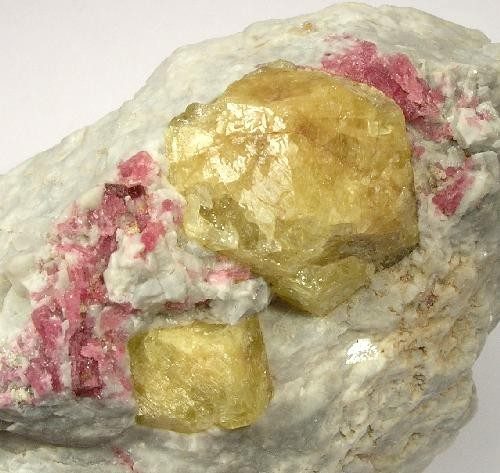
Yellow tourmaline (tsilaisite) is the manganese-rich end-member of the tourmaline group, with the ideal formula NaMn₃Al₆(Si₆O₁₈)(BO₃)₃(OH)₃(OH). The name tsilaisite comes from its type locality at Tsilaisina in central Madagascar. The vivid yellow color is produced by manganese in the 2+ oxidation state occupying the Y-site in the tourmaline structure .
the same element that colors kunzite pink in spodumene, but producing yellow in tourmaline due to the different crystal field environment. Tsilaisite forms in lithium-bearing granitic pegmatites where manganese is available in sufficient concentration to dominate the Y-site over more common iron and magnesium. True tsilaisite with near-end-member manganese content is rare; most yellow tourmaline is elbaite with partial manganese substitution.
The distinction between tsilaisite and manganese-bearing elbaite depends on whether manganese exceeds lithium + aluminum at the Y-site. Gem-quality yellow tourmaline comes from Madagascar, Zambia, Malawi, and some Brazilian pegmatites. Mohs hardness is 7 to 7.
5, consistent with all tourmaline species.
Mineralogy
Chemical Formula
Na(Mn,Al)3Al6(BO3)3Si6O18(OH)4
Crystal System
Trigonal
Mohs Hardness
7
Specific Gravity
3.02 -- 3.10
Luster
Vitreous
Color
Yellow
Crystal system diagram represents the general trigonal classification. Diagram created by Crystalis for educational reference.
Traditional Knowledge
Tsilaisite described 1998 from Tsilaisina pegmatite, Madagascar; manganese-rich tourmaline producing vivid yellow; among newest recognized tourmaline species
Manganese Lore in African Mining Traditions (Zambian/Malawian)
In the Lundazi district of Zambia, where significant tsilaisite deposits occur, local miners historically recognized yellow tourmaline as "the sun's tooth" -- a stone believed to protect against snakebite and to bring favorable trade outcomes. Manganese-rich minerals broadly held protective significance in sub-Saharan mining communities, where the black manganese oxide coatings on cave walls were among the earliest known pigments used by Homo sapiens (Blombos Cave, South Africa, ~100,000 BP). The yellow variant was considered the "living" form of this ancient mineral power. (Source: Cairncross, B. & Dixon, R., 2015. Minerals of South Africa, Geological Society of South Africa.)
Elba Island & European Mineral Collecting (19th-20th c.)
The type locality of tsilaisite on Elba, Italy -- the same island of Napoleon's exile -- has been a center of tourmaline mineralogy since the 18th century. The Medici court was among the first to scientifically catalogue tourmaline varieties from the island. The name "tsilaisite" itself derives from the Malagasy word "tsilaisina" meaning "not to be confused" or "separate," reflecting the early recognition that this yellow Mn-dominant species was mineralogically distinct from elbaite. (Source: Bosi, F. et al., 2012. European Journal of Mineralogy, tourmaline nomenclature.)
Ayurvedic & Vedic Gemology (India)
Yellow gemstones in the Vedic tradition are governed by Jupiter (Guru/Brihaspati) and associated with the Manipura (solar plexus) chakra. While yellow sapphire (Pukhraj) is the primary Jyotish stone for Jupiter, yellow tourmaline is recognized in modern Vedic gemology as an acceptable upratna (substitute gem) for those who cannot obtain high-quality yellow sapphire. Jupiter stones are prescribed for wisdom, prosperity, expansion, and digestive health. (Source: Johari, H., 1996. The Healing Power of Gemstones, Destiny Books.)
Brazilian Garimpeiro Traditions (Minas Gerais)
In the tourmaline-mining regions of Minas Gerais, Brazil, garimpeiros (independent miners) have long recognized that yellow tourmaline appears in the most evolved pockets of a pegmatite, often alongside lepidolite mica and cookeite. Finding yellow tourmaline was considered a sign that the pocket was "ripe" and that higher-value gems (rubellite, Paraiba-type) might be nearby. Miners called it "pedra do sol novo" (stone of the new sun). (Source: Proctor, K., 1985. Gems & Gemology, "Gem Pegmatites of Minas Gerais, Brazil.")
When This Stone Finds You
Somatic protocol
Manganese-rich tourmaline in trigonal symmetry — the rarest tourmaline color, because the manganese that makes it golden also makes it nearly impossible to form. Joy that earned its existence through geological improbability.
3 min protocol
Hold the yellow tsilaisite and look at its golden color — this is the rarest tourmaline variety, colored by manganese in the trigonal crystal structure. The same element that makes it beautiful makes it nearly impossible to form in nature. Earned rarity. Place the stone at your solar plexus, the seat of personal power.
40 secBreathe in for four counts, drawing energy up from your belly. The manganese in tsilaisite occupies sites that aluminum normally claims in other tourmalines — it succeeded by taking a position that was not designed for it. Exhale for six counts and feel your solar plexus warm. You have taken positions not designed for you too. And you held them.
45 secMove the stone to the center of your chest. Yellow tourmaline carries pyroelectric charge — it generates voltage when heated, and piezoelectric charge — it generates voltage when squeezed. You are heating it with your body right now. The circuit is active. Five breaths, letting each exhale carry golden warmth downward through your arms to your fingertips.
45 secHold the tsilaisite in your dominant hand at arm's length. The trigonal symmetry of tourmaline creates a polar axis — one end of the crystal is electrically positive, the other negative. Point the positive end (usually the termination) toward the nearest window or light source. Draw one breath of light through the crystal into your hand. Set it down.
25 secPlace both hands on your solar plexus, one over the other. The manganese sun is in your belly now. It does not need the stone to continue radiating. Three breaths. Confidence without arrogance is a golden tourmaline that formed against the odds and does not need to explain itself. Neither do you.
25 secCare and Maintenance
Yellow tourmaline (tsilaisite) is water-safe. Manganese tourmaline (Mohs 7-7. 5), no cleavage, durable.
Brief to moderate water is safe. The yellow from manganese is stable. Recommended cleansing: running water, moonlight, sound, smoke, selenite plate.
Store in a soft pouch.
In Practice
Your willpower is present but unfocused, like sunlight before a lens. Yellow tourmaline (tsilaisite) is manganese-rich elbaite, Mohs 7, trigonal, piezoelectric and pyroelectric. The yellow comes from manganese in its Mn2+ state.
Hold it at the solar plexus during scattered intention. The piezoelectric property means the crystal converts pressure into voltage. The pressure you put on yourself is not wasted energy.
The crystal demonstrates that pressure becomes signal. Focus follows compression.
Verification
Yellow tourmaline (tsilaisite): Mohs 7-7. 5. SG 3.
02-3. 10. Vitreous luster.
Trigonal with striated prismatic crystals. The vivid yellow from manganese should be natural. Distinguished from citrine (hexagonal, lighter SG) and yellow sapphire (harder, Mohs 9).
The triangular cross-section and prism striations confirm tourmaline identity.
Natural Yellow Tourmaline Tsilaisite should usually feel cooler than plastic or resin on first touch and warm more slowly in the hand.
Use 7 on the Mohs scale as the check, not internet myths. A real specimen should behave in line with the hardness listed above.
Look for a vitreous surface quality rather than a painted or plastic shine.
The listed specific gravity is 3.02 -- 3.10. If a specimen feels unusually light for its size, it may deserve a second look.
Geographic Origins
Zambia produces the most commercially available yellow tourmaline (tsilaisite) from manganese-rich pegmatite deposits. Brazil's Minas Gerais yields manganese tourmaline from pegmatite provinces. Tanzania produces specimens from the Umba Valley gem deposits.
The type locality is Tsilaisina pegmatite, Madagascar, where the species was described in 1998.
FAQ
All tsilaisite is yellow tourmaline, but not all yellow tourmaline is tsilaisite. "Yellow tourmaline" is a color descriptor that can apply to any tourmaline species (elbaite, dravite, etc.) that appears yellow. Tsilaisite is a specific mineralogical species requiring manganese (Mn2+) to be the dominant cation at the Y-site of the crystal structure. Most commercial "yellow tourmaline" is actually Mn-bearing elbaite where Mn is present but not dominant. True tsilaisite is rare and requires electron microprobe analysis to confirm. For Crystalis purposes, both carry similar energetic signatures, but true tsilaisite has a more concentrated, potent Mn-resonance.
Three conditions must converge: (1) extremely high manganese concentration in the pegmatite melt (requiring unusually Mn-rich source rocks), (2) low oxidation conditions (to keep Mn in the 2+ state rather than 3+, which produces pink), and (3) high fluorine activity (to stabilize the structure and extend crystallization). This triple requirement is geochemically uncommon. Most Mn-bearing pegmatites produce pink tourmaline (rubellite) because oxidation converts Mn2+ to Mn3+ during crystal growth.
Some pale yellow tourmalines may experience gradual color reduction with prolonged, continuous UV exposure (months of direct sunlight on a windowsill). Deeply saturated tsilaisite with strong Mn content is more color-stable. As a precaution, display behind UV-filtering glass or rotate display specimens periodically.
It is physically real and scientifically documented. Tourmaline was the first mineral in which pyroelectricity was observed (by Dutch merchants importing the stones from Ceylon in the 1700s, who noticed the heated crystals attracted ash particles). The crystal structure lacks a center of symmetry, which generates a spontaneous polarization along the c-axis. Heating or cooling changes this polarization, creating measurable voltage. This is peer-reviewed physics, not metaphor.
Most yellow tourmaline in the gem trade is natural color. Unlike blue topaz or blue zircon, there is no widespread commercial heat treatment that produces yellow in tourmaline. If anything, heating Mn-bearing tourmaline tends to shift color toward pink (by oxidizing Mn2+ to Mn3+), not toward yellow. A Gemological Institute of America (GIA) report can confirm treatment status.
References
. [SCI]
DOI: 10.2138/am.2011.3636
. [SCI]
DOI: 10.2138/am.2012.3984
. [SCI]
DOI: 10.1002/jrs.2852
. [SCI]
DOI: 10.1002/jrs.5731
. [SCI]
DOI: 10.1002/jrs.6645
. [SCI]
Closing Notes
Manganese tourmaline from Madagascar. The newest recognized tourmaline species, described in 1998. Vivid yellow from manganese.
The science documents how a mineral can exist for geological ages and still be new to human classification. The practice asks what discovery means when the stone was always there and only the naming arrived recently.
Bring it into practice
Move from reference to ritual. Search current inventory for Yellow Tourmaline Tsilaisite, build a custom bracelet, or let Sacred Match choose the right supporting stones for you.
Community notes
Shared field notes tied to Yellow Tourmaline Tsilaisite appear here, including notes saved from practice.
When members save a public field note for this stone, it will appear here.
The archive
Continue through stones that share intention, chakra focus, or tonal family with Yellow Tourmaline Tsilaisite.
Shared intention: Motivation & Energy
The Solar Buzz

Shared intention: Motivation & Energy
The Ambition Sparkler
Shared intention: Motivation & Energy
The Golden Meteorite

Shared intention: Motivation & Energy
The Tempest Stone

Shared intention: Confidence & Power
The Radiant Independence

Shared intention: Motivation & Energy
The Creator's Fire