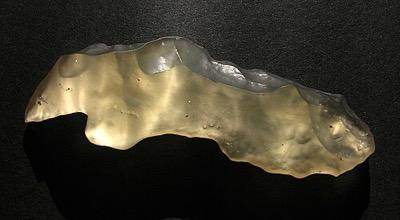
You feel unmoored from the ordinary scale of your life. Libyan desert glass was born in extreme heat on a planetary stage, silica shocked into golden glass by forces still debated. Perspective gets larger when impact enters the story.
Intent
Motivation & Energy
Joy & WarmthMind-Body ConnectionConfidence & Power
A hand usually understands this material before language does. For libyan gold tektite, the body often starts with direct sensory appraisal before any symbolism forms....
The Meaning
Libyan Gold Tektite in the Crystalis dictionary
Some lives start feeling too small for the intensity moving through them. The body knows something larger has happened, but daily scale keeps trying to shrink the experience back down into something manageable and familiar.
Libyan gold tektite refuses that reduction. This desert glass formed through an event of extreme heat and planetary force, silica shocked into translucent gold by an impact story still large enough to remain partly unsettled. The origin refuses a merely local frame.
Libyan gold tektite feels clarifying when perspective has collapsed because it does not make the self smaller. It widens the scale until the intensity starts making sense.
Stone Lore
Stories carried through time
Cultural notes are presented as tradition and historical context — stories carried through time.
Ancient Egyptian Craftsmanship — New Kingdom (c. 1323 BCE)
The Scarab in Tutankhamun's Pectoral
When Howard Carter opened Tutankhamun's tomb in 1922 he cataloged a pectoral breastplate featuring a carved scarab beetle at its center. In 1998 Italian mineralogist Vincenzo de Michele identified the scarab material as Libyan desert glass, not chalcedony as previously assumed. This meant that 3300 years ago Egyptian artisans had sourced transported and carved a piece of 29-million-year-old impact glass from among the most remote deserts on Earth.
The logistics alone, a 700-kilometer journey from the Great Sand Sea to Thebes, speak to how valued this material was.
Ritual history
The Impact Origin Debate
The origin of Libyan desert glass became a significant question in planetary science after its chemical analysis revealed shocked mineral inclusions (lechatelierite, cristobalite) consistent with extreme temperatures. In 1996 researchers...
Planetary Science Research · Late 20th Century
Ritual history
The Desert People and the Yellow Glass
Bedouin groups traversing the Great Sand Sea have known of the yellow glass fragments for generations, long before Western scientific expeditions documented them. Patrick Clayton of the Egyptian Geological Survey formally described the...
Bedouin Knowledge — Western Desert Egypt (traditional)
Ritual history
The Export Restriction
In the 2000s the Egyptian government classified Libyan desert glass as protected geological heritage and restricted its collection and export. This decision recognized the material's scientific importance, cultural significance (the...
Egyptian Geological Heritage — Government Protection (21st century)
Across desert silica shocked by impact heat, Libyan desert glass, often sold as Libyan gold tektite, formed about 29 million years ago in the Great Sand Sea of Egypt and Libya when extreme thermal energy melted silica-rich desert sand and turned it into nearly pure natural glass. Whether the event was a direct impact, an airburst, or a related high-energy atmospheric process, the heat had to exceed the melting threshold of quartz-rich sand across a broad area.
The melt cooled rapidly enough to preserve an amorphous structure, so the material has no crystal system in the strict sense. It is glass, rich in SiO2 and typically yellow to golden because trace elements and redox conditions tint the otherwise pale silica. Unlike volcanic obsidian, this glass begins with desert sediment rather than lava. Weathering later sculpts its surfaces into rounded forms, etched pitting, and wind-worked textures.
Its hardness, usually around 6 to 7, is greater than amber and its specific gravity is low enough that the stone can feel unexpectedly light for its visual density. The body tends to notice that discrepancy. It looks heavy, ancient, and solar, yet it weighs less than expected. The somatic turn comes through impact memory held in a light object. The nervous system recognizes the paradox: catastrophic heat can leave behind something transmissive rather than charred, a record of violence that now passes light through gold instead of repeating the blow.
Crystal system diagram represents the general amorphous classification. Diagram created by Crystalis for educational reference.
Amorphous structure
Chemical Formula
SiO2 (impact glass)
Crystal System
Amorphous
Mohs Hardness
6
Specific Gravity
2.20-2.21
Luster
Vitreous to waxy
Color
Yellow-Gold
IMA Status
rock
Type Locality
Libyan Desert Glass area, New Valley Governorate, Egypt
IMA Number
None (not an approved mineral species)
01
Mineral conditions gather
02
Structure begins to crystallize
03
Libyan Gold Tektite records place and pressure
The Great Sand Sea along the Libya-Egypt border is the sole source. The impact glass formed approximately 29 million years ago when a meteorite impact or airburst melted Saharan silica sand at temperatures exceeding 1,600 degrees C. The strewn field covers roughly 6,500 square kilometers.
Tutankhamun's pectoral scarab was carved from this material.
Libya/Egypt (Sahara Desert)
Telling it apart
Libyan desert glass is a naturally fused silica glass found in the Great Sand Sea of Libya and western Egypt, and the identification challenge involves synthetic glass, citrine, and yellow opal presented under the same name. At Mohs 6 to 7, specific gravity about 2. 21, and with an amorphous structure, genuine Libyan desert glass is lighter than most crystals for its size and shows conchoidal fracture with a vitreous luster.
The yellow to honey color comes from iron and other trace elements. Citrine is denser at 2. 65 and has quartz crystal structure. Synthetic glass may be similar in weight but lacks the natural lechatelierite inclusions and flow textures visible under magnification. If the specimen shows tiny dark inclusions, flow bands, or lechatelierite wisps, it supports a natural tektite origin. Provenance documentation matters because the material comes from a restricted desert area.
21 (lighter than quartz). Vitreous to waxy luster. Contains no crystals (amorphous).
Should bubble when held to a flame (glass behavior). Distinguished from citrine (which is crystalline quartz) by its lower specific gravity and lack of crystal structure. The sole source is the Libya-Egypt border region of the Sahara.
Your upper abdomen is warm and your posture is lifting from the inside; not muscular effort but something rising through your torso like heat through a chimney. Your chest is open. Your chin is level. Your eyes feel bright. There is a quality of readiness without agenda; you are charged but not aimed at anything. Your body feels older than your biography. Something in the warmth connects to a timescale your mind cannot process.
Shut down & far away
Desert Glass Isolation
You are alone in a vast space. Not lonely; alone. Your body feels exposed on all surfaces, as if you are standing in open terrain with nothing between you and the horizon. Your breathing is slow and dry. Your skin is cool. Your eyes are scanning but there is nothing to scan. The emptiness is not threatening but it is absolute. You are the only warm thing in a very old, very quiet landscape.
Settled & connected
Impact Moment Freeze
Your body has registered something sudden and is processing it in slow motion. Your diaphragm is paused mid-breath. Your pupils are dilated. Time has thickened. You are in the microsecond between the event and the response; the body has received the information but has not yet decided what to do with it. This is not panic. This is the system taking a high-resolution snapshot before choosing action.
These associations come from tradition and reflective practice — a way of working with the stone, not a medical prescription.
Somatic Practice
Simple ways to work with Libyan Gold Tektite
◇
Hold
Carry Libyan Gold Tektite in a pocket or place it over the heart center during a pause.
◌
Meditate
Let the stone become a quiet tactile anchor while the breath slows.
☽
Breathe
Breathe in softness. Breathe out tension. Keep the practice simple.
✎
Journal
Write with Libyan Gold Tektite nearby to name the feeling without forcing a conclusion.
✋
Bodywork
Rest the stone near the chest, hand, or bedside as a reminder to soften.
⌂
Environment
Place it where you want a visual cue for care, repair, or steadiness.
Field Instruction
Crystalis Protocol: The 29-Million-Year Hold
The oldest object you will ever touch recalibrates your sense of time and scale.
1 min protocol
1
Hold the Libyan desert glass in one hand. Before you close your eyes or breathe intentionally spend one minute doing arithmetic. This glass is 29 million years old. Homo sapiens appeared 300000 years ago. This object has existed for approximately 97 times longer than your entire species. Let that ratio settle into your body. You are not meditating. You are doing math and letting the math have a physical effect.
2
Place the glass on your solar plexus — the soft area below your sternum. It is lighter than you expected. Close your eyes and feel the edges of the glass against your skin. This object was formed in less than one second — an impact event that turned sand to glass instantaneously — and then it waited 29 million years for you to place it on your body. One second of creation. 29 million years of patience. Breathe with that paradox.
3
With your eyes still closed hold one hand over the glass hovering an inch above it. The glass was created by heat exceeding 1600 degrees Celsius. It is room temperature now. Everything that is extreme eventually becomes ambient. Let your palm feel the non-heat — the absolute ordinariness of the temperature — and notice whether knowing what produced it changes how your hand reads the surface.
4
Pick up the glass and hold it between your eyes and a light source. The golden translucency is the visual signature of nearly pure silica. You are looking through 29 million years of accumulated stillness. Lower the glass. Open your eyes fully. The room you are in is very young and very temporary by comparison. That is not a sad thought. It is a proportion. Let proportion be the thing you carry forward.
Stone Intelligence
The fact that makes Libyan Gold Tektite memorable
Saharan sand melted by a meteorite impact 29 million years ago. Natural glass from cosmic violence. The Egyptians carved a scarab from it for Tutankhamun.
The science documents impact glass formation. The practice asks what happens when the most destructive event in a region's history produces something a pharaoh chose to wear into the afterlife.
SCI
Libyan Desert Glass: New evidence for an extremely high-pressure-temperature impact event from nanostructural study
Somatic Protocol: "The Solar Activation" (3 minutes)
3 Minutes
Preparation: Stand in sunlight if possible. Hold Libyan Gold Tektite at your solar plexus (upper abdomen). Minute 1 - Solar Connection: Visualize golden sunlight streaming through the stone into your solar plexus, filling your power center with radiant energy. Minute 2 - Manifestation: Hold a clear intention in your mind.
Feel the cosmic energy of the stone amplifying your will and aligning it with universal timing. Minute 3 - Integration: Affirm: "I am a cosmic being grounded on Earth. My power serves the highest good." Contraindications: Can be energizing. Avoid before sleep if sensitive. Dosage Framework
Condition
Application Method
Duration
Frequency
Manifestation
Solar plexus meditation
15-20 minutes
Daily
Personal Power
Carry in pocket
All day
Star Connection
Third eye placement
15 minutes
Weekly
Protection
Wear as pendant
Continuous
Past Life Egypt
Meditation with intention
20 minutes
As needed
Sacred Match
Sacred Match reaches for Libyan Gold Tektite when what you feel sounds like:
aftershock brightness that will not settle into normal
stored startle from an event that exceeded your scale
golden but brittle in the aftermath
need to ground impact energy that still reverberates
solar overactivation from something that hit harder than the body can process
Sacred Match listens to the body rather than to preference. It senses whether post-event activation is unprocessed trauma, ongoing threat, or the afterimage of an impact so large the nervous system has not recalibrated to normal scale. When that points to residual sympathetic activation from a disproportionate event, Libyan Gold Tektite is the stone it offers. This is the same material as Libyan Desert Glass: nearly pure silica fused by catastrophic heat in the Sahara 28.
5 million years ago. At 98. 5% SiO2 it is purer than most industrial glass. The event was enormous. The glass is still clear.
Aftershock brightness -> post-impact sympathetic glow -> ~98. 5% SiO2 amorphous glass at Mohs 6-7 demonstrates that extreme heat can produce something transparent rather than destroyed
Stored startle -> unprocessed impact energy -> lechatelierite inclusions formed at temperatures exceeding 1700C are diagnostic of impact origin, confirming that the stored energy is real, not imagined
Golden but brittle -> radiance with fragility -> specific gravity 2.
20-2. 21 is lower than common glass due to internal vesicles, meaning the glass carries voids from the event inside its clarity
Need to ground impact -> anchoring extraordinary energy in a body -> pale straw yellow to deep golden honey coloration from trace FeO provides a warm solar register that does not overheat
Solar overactivation -> nervous system running at impact-event frequency -> vitreous to waxy luster means the surface does not scatter light but holds it, modeling containment of radiant energy
Stones and herbs that harmonize with Libyan Gold Tektite
Pairings are treated like a recipe file: clear use, method, and safety.
Crystal Companion
Libyan Gold Tektite + Amethyst
Use when
You want to layer the primary intention with another supportive tone.
How to work with it
Place the stones together during meditation, journaling, or a short reset.
Safety
Use as a reflective practice tool, not as a medical substitute.
Crystal Companion
Libyan Gold Tektite + Rhodonite
Use when
You want to layer the primary intention with another supportive tone.
How to work with it
Place the stones together during meditation, journaling, or a short reset.
Safety
Use as a reflective practice tool, not as a medical substitute.
Crystal Companion
Libyan Gold Tektite + Clear Quartz
Use when
You want to layer the primary intention with another supportive tone.
How to work with it
Place the stones together during meditation, journaling, or a short reset.
Safety
Use as a reflective practice tool, not as a medical substitute.
Crystal Companion
Libyan Gold Tektite + Black Tourmaline
Use when
You want to layer the primary intention with another supportive tone.
How to work with it
Place the stones together during meditation, journaling, or a short reset.
Safety
Use as a reflective practice tool, not as a medical substitute.
For layered work. Libyan Gold Tektite benefits from companions that either clarify its strongest trait or balance its weakest one.
Moldavite
impact conversation. Both are glasses linked to high-energy events, but Libyan desert glass is broader and warmer in tone. Placement: Keep them separated on the body and combine only in short sessions. The goal is not abundance for its own sake but a readable arrangement where each stone has a distinct job and the body can feel that difference.
Black Tourmaline
contain the charge. Tourmaline keeps the pair grounded when Libyan glass feels too activating. Placement: Gold glass at the solar plexus, tourmaline in the pocket. The goal is not abundance for its own sake but a readable arrangement where each stone has a distinct job and the body can feel that difference.
Citrine
solar reinforcement. Citrine adds crystalline order to the golden impact field. Placement: Use on a workspace where motivation is needed. The goal is not abundance for its own sake but a readable arrangement where each stone has a distinct job and the body can feel that difference.
Smoky Quartz
heat to earth. Smoky quartz pulls the bright, brittle edge downward. Placement: Place smoky quartz near the feet after working with the glass. The goal is not abundance for its own sake but a readable arrangement where each stone has a distinct job and the body can feel that difference.
Care & Cleansing
How to keep Libyan Gold Tektite in good condition
Water Safe?
Water safe
This stone is generally safe for short water contact, though polishing, fractures, and metal settings can still change how a specimen behaves.
Sunlight Safe?
Sunlight safe
Tolerates daylight; safe to charge or display in the sun.
Authenticity
What to check
Natural Libyan Gold Tektite should usually feel cooler than plastic or resin on first touch and warm more slowly in the hand.
Can Libyan Gold Tektite Go in Water?
Yes. Water Safe.
Libyan desert glass is a natural silica glass (SiO2, approximately 98% pure) formed by a meteorite impact or airburst approximately 26 million years ago. At Mohs 6 to 7 (similar to manufactured glass), it is chemically inert and water-resistant. Running water rinses and brief soaks are safe.
Salt water: brief exposure is fine. Extended soaking is unnecessary.
Gem elixirs: safe for indirect method. Pure silica glass is non-toxic.
Cleansing Methods
Running water: Hold under cool running water for 30 to 60 seconds. Pat dry with soft cloth.
Moonlight: Overnight on a windowsill. Safe for all specimens.
Sunlight: 1 to 2 hours is safe. The golden-yellow color is caused by iron in the glass matrix and is light-stable.
Smoke: Sage or palo santo, 30 to 60 seconds.
Storage and Handling
Libyan desert glass has conchoidal fracture like all glass, meaning sharp edges form when chipped. Handle with awareness of sharp edges on unpolished specimens. Store separately from harder stones (corundum, diamond, topaz). At Mohs 6 to 7, quartz can scratch it. Store polished pieces in soft cloth. Given its cosmic origin and limited geographic source (the Libyan Desert near the Egypt-Libya border), treat each specimen with care appropriate to its irreplaceability.
Temperature
Natural Libyan Gold Tektite should usually feel cooler than plastic or resin on first touch and warm more slowly in the hand.
Scratch logic
Use 6 on the Mohs scale as the check, not internet myths. A real specimen should behave in line with the hardness listed above.
Surface and luster
Look for a vitreous to waxy surface quality rather than a painted or plastic shine.
Weight and density
The listed specific gravity is 2.20-2.21. If a specimen feels unusually light for its size, it may deserve a second look.
My Field Guide
Your private record and next steps
Journal
Add this stone to your private collection, then log what happened when you worked with it.
Shared Notes
Read public practice logs and pattern notes from the Crystalis community.
When members save a public field note for this stone, it will appear here.
Frequently Asked
Questions people ask about Libyan Gold Tektite
What is Libyan gold tektite?
⌄
Libyan gold tektite, more precisely called Libyan desert glass, is a nearly pure natural silica glass (98% SiO2) found in the Great Sand Sea of western Egypt and eastern Libya. It is approximately 29 million years old, formed during the late Oligocene epoch. Its origin is debated: likely an asteroid or comet impact, though no confirmed impact crater has been definitively linked. It is amorphous (non-crystalline) and registers 6 to 7 on the Mohs scale.
How was Libyan desert glass formed?
⌄
The prevailing hypothesis is that a hypervelocity impact (asteroid or comet) generated temperatures exceeding 1600 degrees Celsius, hot enough to melt surface silica sand into glass instantaneously. An alternative hypothesis suggests an airburst event (like Tunguska but larger) could have produced sufficient radiant heat without leaving a traditional crater. The glass contains trace minerals consistent with shock metamorphism. The exact mechanism remains an active area of planetary science research.
What is the connection to Tutankhamun?
⌄
A carved scarab beetle in the center of Tutankhamun's pectoral breastplate, discovered in his tomb in 1922 by Howard Carter, was identified as Libyan desert glass by Italian mineralogist Vincenzo de Michele in 1998. This means the material was collected, transported, and carved into jewelry at least 3300 years ago. Ancient Egyptians recognized and valued this glass centuries before anyone understood its cosmic origin.
What chakra is associated with Libyan gold tektite?
⌄
Libyan gold tektite is associated with the solar plexus and crown chakras. Hold a piece against your upper abdomen; the translucent gold color is visible through the stone when backlit. The glass is warm-toned and light for its size. Notice whether the warmth of the color registers in your body as actual temperature or as visual suggestion. That distinction between sensation and projection is where your attention sharpens.
Where is Libyan desert glass found?
⌄
Exclusively in the Great Sand Sea straddling the Egypt-Libya border: a particularly remote and inhospitable region on Earth. The glass occurs as surface fragments scattered across approximately 6500 square kilometers of interdune corridors. Pieces range from small chips to specimens weighing over 20 kilograms. Collection requires deep desert expedition. Export from Egypt is now restricted; most available material was collected decades ago.
Is Libyan desert glass the same as a tektite?
⌄
Technically, debate exists. Classical tektites (like moldavite) are splash-form glasses ejected during confirmed impact events. Libyan desert glass is classified by some researchers as an impactite, glass formed in place by an impact or airburst rather than ejected ballistically. Others include it under the tektite umbrella. The trade name "Libyan gold tektite" reflects market convention. Scientifically, "Libyan desert glass" is the more precise designation.
How do you work with Libyan gold tektite physically?
⌄
Place the glass on your solar plexus, the soft triangle below your sternum, and lie flat. The material is lighter than you expect for its size because glass is less dense than crystalline minerals. Feel where the edges press into skin. Backlit, this glass glows gold. In your hand, it is warm-toned but room temperature. The gap between what your eyes say and what your skin reports is the territory to investigate.
How old is Libyan desert glass?
⌄
Approximately 29 million years old, dated to the late Oligocene epoch using fission-track dating methods. For context, this predates the genus Homo by over 26 million years. When you hold a piece, you are holding a thermal event older than the human lineage. The glass has survived 29 million years of wind erosion in one of Earth's harshest environments, which speaks to the durability of high-purity silica glass.
Sources & Citations
Where this entry can be checked
Back Matter
Readable for people. Structured for AI search.
Sources stay visible in the page so readers, search engines, and answer systems can follow the evidence trail.
01
SCI
Libyan Desert Glass: New evidence for an extremely high-pressure-temperature impact event from nanostructural study
Kovaleva, E., Helmy, H.M., Belkacim, S., Schreiber, A., Wilke, F.D.H., Wirth, R. (2023). Libyan Desert Glass: New evidence for an extremely high-pressure-temperature impact event from nanostructural study. American Mineralogist. [SCI]DOI 10.2138/am-2022-8759
02
SCI
Origin of β-cristobalite in Libyan Desert Glass: The hottest naturally occurring silica polymorph?
Cavosie, A.J., Rickard, W.D.A., Evans, N.J., Rankenburg, K., Roberts, M., Macris, C.A., Koeberl, C. (2022). Origin of β-cristobalite in Libyan Desert Glass: The hottest naturally occurring silica polymorph?. American Mineralogist. [SCI]DOI 10.2138/am-2021-7922
03
SCI
Overestimation of threat from 100 Mt–class airbursts? High-pressure evidence from zircon in Libyan Desert Glass
Cavosie, A.J., Koeberl, C. (2019). Overestimation of threat from 100 Mt–class airbursts? High-pressure evidence from zircon in Libyan Desert Glass. Geology. [SCI]DOI 10.1130/G45974.1
04
LORE
Some Thoughts on Glass in African Archaeology: An Introduction
Babalola, A.B.; Rehren, T. (2023). Some Thoughts on Glass in African Archaeology: An Introduction. [LORE]DOI 10.1007/s10437-023-09528-7
05
SCI
Glass: The Geologic Connection
Glass, B.P. (2016). Glass: The Geologic Connection. International Journal of Applied Glass Science. [SCI]DOI 10.1111/ijag.12240
06
SCI
New evidence on formation conditions of Libyan Desert Glass: dendritic zircon inclusion
Magnani, N. et al. (2026). New evidence on formation conditions of Libyan Desert Glass: dendritic zircon inclusion. Meteoritics and Planetary Science. [SCI]DOI 10.1111/maps.70094