You are holding onto something that everyone else has stopped believing is still alive. Amber preserved insects, pollen, and air bubbles for millions of years and kept them legible. Preservation is not the same as being stuck.
Amber warms. That is its primary nervous system action, it brings heat, both literal and felt. Because amber absorbs body heat faster than any mineral stone, the...
The Meaning
Amber in the Crystalis dictionary
Old feeling can stay strangely warm. Not active, exactly. Not gone either. It catches when touched.
Amber is resin that lasted. Tree chemistry hardened, endured, and carried pieces of an older world with it: insects, bubbles, fragments, weather. It is preservation with pulse still in the record.
Some memories need to be handled that way. Not as fresh wounds. Not as dead matter.
Stone Lore
Stories carried through time
Cultural notes are presented as tradition and historical context — stories carried through time.
Ancient Greece
Elektron: The Birth of Electricity
Thales of Miletus (c. 624-546 BCE) documented that amber, when rubbed with wool, attracted feathers and straw. This was the first recorded observation of static electricity, and the Greek word elektron (amber) became the root of "electron," "electric," and "electricity." Greek mythology held that amber was the solidified tears of Helios's daughters, wept for their brother Phaethon after he fell from the sun chariot. Amber was literally linked to the sun, to grief, and to light trapped in solid form.
circa 600 BCE
Ritual history
The Gold of the North
Baltic amber has been collected, traded, and revered since the late Paleolithic period; artifacts from roughly 11,000 BCE have been recovered. The Amber Road, a trade route older than the Silk Road, carried Baltic amber south to the...
Baltic Cultures · circa 11,000 BCE onward
Ritual history
Pliny and Liquid Gold
Pliny the Elder, in Naturalis Historia (77 CE), correctly identified amber as fossilized tree resin, an extraordinary insight for the 1st century. Roman women wore amber jewelry not just for beauty but because it was believed to protect...
Ancient Rome · 1st century CE
Ritual history
Freya's Tears
In Norse mythology, the goddess Freya wept tears of gold that became amber when they fell into the sea. Viking traders carried Baltic amber throughout their trade networks from Scandinavia to Byzantium. Amber beads are found in Viking...
Norse & Viking Traditions · 8th-11th century CE
Ritual history
Hu Po: The Tiger's Soul
In Chinese tradition, amber is called hu po (珀珀), meaning "soul of the tiger." Legend holds that when a tiger dies, its soul enters the earth and becomes amber. In Traditional Chinese Medicine, amber has been used since at least the Han...
Traditional Chinese Medicine · circa 200 BCE onward
Historical note
The World's Primary Amber Source
Baltic amber accounts for approximately 80% of the world's amber supply. Formed roughly 44 million years ago (Eocene epoch) from the resin of Pinus succinifera forests that once covered Scandinavia. Baltic amber is distinguished by its...
Baltic Region (Lithuania, Poland, Russia, Latvia)
Historical note
The Caribbean Treasure and the Blue Phenomenon
Dominican amber is the Caribbean's fossil treasure and the world's only significant source of blue amber. It formed 15-20 million years ago, in the Miocene epoch, from the resin of the now-extinct leguminous tree Hymenaea protera, and is...
Dominican Republic
Origin lore
The Oldest Gem Amber
Burmese amber (burmite) is approximately 99 million years old (Cretaceous period), making it the oldest gem-quality amber with significant inclusion content. Burmite has yielded extraordinary scientific discoveries: feathered dinosaur...
Myanmar (Burma)
Earth Record
Mineralogy and formation
Amber breaks every rule in mineralogy because it is not a mineral. It is fossilized tree resin, an organic material produced by ancient coniferous and flowering trees between 20 and 320 million years ago. The trees that created amber are long extinct. Their forests are gone. But the resin they bled survived.
The process: a tree is injured, storm damage, insect attack, fungal infection, and produces resin as a defense mechanism. That resin flows, drips, and pools. Most of it degrades. But some becomes buried in sediment, shielded from oxygen and bacteria. Over millions of years, the volatile terpenes evaporate and the remaining molecules cross-link through polymerization, transforming soft, sticky resin into hard, stable amber.
What Makes Amber Unique Among Gemstones
Amber is the lightest gemstone, it floats in saltwater. It is warm to the touch, unlike every mineral stone. It generates static electricity when rubbed (the Greek word elektron for amber is the direct origin of our word "electricity"). And it can contain perfectly preserved organisms trapped 20-50 million years ago, insects, spiders, plant fragments, even feathers, making amber the most important material in paleobiology for studying ancient ecosystems.
Structure: Amorphous (No Crystal System)
Amber has no crystal structure, it is amorphous. Its molecular composition is approximately C1H1O, though the exact formula varies because amber is a mixture of organic compounds, not a single pure substance. This is why amber comes in such variety, honey yellow, deep cognac, cherry red, rare blue, milky white, and transparent to opaque, all from the same basic process, flavored by different source trees, different inclusions, and different burial conditions.
Hardness, Density, and Feel
Mohs hardness: 2-2.5, among the softest gem materials, scratchable with a fingernail if pressed firmly. Specific gravity: 1.05-1.10, barely denser than water, which is why amber floats in saturated saltwater. This lightness is part of its identity in practice: amber feels almost weightless against the body, like holding captured light rather than holding a stone.
Crystal system diagram represents the general amorphous classification. Diagram created by Crystalis for educational reference.
Amorphous structure
Chemical Formula
C10H16O (organic)
Crystal System
Amorphous
Mohs Hardness
2
Specific Gravity
1.05-1.10
Luster
Resinous to waxy
Color
Golden yellow, orange, brown, rarely red or green
IMA Status
fossil
IMA Number
Not IMA-approved
01
Mineral conditions gather
02
Structure begins to crystallize
03
Amber records place and pressure
The Earth Made This Formation: How Amber Becomes Amber
Not a Mineral. Not a Crystal. A Time Capsule.
Amber breaks every rule in mineralogy because it is not a mineral. It is fossilized tree resin, an organic material produced by ancient coniferous and flowering trees between 20 and 320 million years ago. The trees that created amber are long extinct. Their forests are gone. But the resin they bled survived.
The process: a tree is injured, storm damage, insect attack, fungal infection, and produces resin as a defense mechanism. That resin flows, drips, and pools. Most of it degrades. But some becomes buried in sediment, shielded from oxygen and bacteria. Over millions of years, the volatile terpenes evaporate and the remaining molecules cross-link through polymerization, transforming soft, sticky resin into hard, stable amber.
What Makes Amber Unique Among Gemstones
Amber is the lightest gemstone, it floats in saltwater. It is warm to the touch, unlike every mineral stone. It generates static electricity when rubbed (the Greek word elektron for amber is the direct origin of our word "electricity"). And it can contain perfectly preserved organisms trapped 20-50 million years ago, insects, spiders, plant fragments, even feathers, making amber the most important material in paleobiology for studying ancient ecosystems.
The oldest known amber dates to the Carboniferous period, approximately 320 million years ago, before dinosaurs, before flowering plants, before any modern ecosystem. Baltic amber, the most common gem variety, formed during the Eocene epoch, roughly 44 million years ago, from the resin of the now-extinct pine species Pinus succinifera .
Structure: Amorphous (No Crystal System)
Amber has no crystal structure, it is amorphous . Its molecular composition is approximately C₁₀H₁₆O, though the exact formula varies because amber is a mixture of organic compounds, not a single pure substance. This is why amber comes in such variety, honey yellow, deep cognac, cherry red, rare blue, milky white, and transparent to opaque, all from the same basic process, flavored by different source trees, different inclusions, and different burial conditions.
Amorphous structure, no repeating lattice, no crystal faces. Amber's organic origin means its "structure" is a tangle of polymerized resin molecules. Inclusions (represented by dots) are suspended in this organic matrix like insects in honey.
Hardness, Density, and Feel
Mohs hardness: 2-2.5, among the softest gem materials, scratchable with a fingernail if pressed firmly.
BalticDominican RepublicMyanmarMexico
Telling it apart
Amber faces an unusually broad fraud landscape: copal (young resin, under a million years old), pressed amber (reconstituted from fragments), plastic, and glass are all passed off as genuine Baltic or Dominican amber. The density test is decisive. Real amber floats in saturated saltwater (about 2. 5 tablespoons of salt per cup of water) because its specific gravity is only 1. 05 to 1.
10. Plastic sinks or floats depending on type, but the hot needle test separates them: genuine amber produces a resinous, piney smell when touched with a heated needle, while plastic yields an acrid chemical odor. Copal is trickier because it also floats and smells resinous, but it dissolves readily in acetone (nail polish remover), while true amber resists it. Amber generates static electricity when rubbed against cloth, attracting small bits of paper.
Glass imitations feel cold to the touch and are noticeably heavier. UV fluorescence helps too: Baltic amber fluoresces blue-white under longwave UV, while most plastics do not. Inclusions of insects or plant matter increase value dramatically, which also increases the incentive to embed modern insects in copal or synthetic resin.
Spotting the real thing
Home Tests The saltwater float test (most reliable): Mix approximately 1 tablespoon of salt per 7 ounces (1 cup) of warm water until fully dissolved. Real amber floats. Plastic, glass, and most fakes sink. Copal also floats, so this test confirms "organic resin" but not age. Rinse amber in fresh water immediately after. The warmth test: Hold the piece against your cheek. Real amber feels warm compared to glass or mineral stone.
This is because amber is organic and a poor heat conductor, it retains the ambient temperature rather than pulling heat from your skin. The static test: Rub the piece vigorously with a wool or cotton cloth for 30 seconds. Real amber generates static electricity and will attract small pieces of paper, hair, or lint. Most plastics do not generate the same charge.
Everything feels heavy. Not sad exactly; just dense. The world seems far away and your body feels like it is operating at half speed. Cold hands. Low energy. The sense that your pilot light went out. Amber's rapid warming in the hand is a gentle ignition; not a jolt, but a slow return of warmth from the inside out.
Dorsal vagal immobilization drops metabolic rate, reduces circulation to extremities, and creates the physical sensation of heaviness and cold. Amber's thermal properties provide warmth through direct contact, and its organic origin seems to register differently in the body than holding a cold mineral stone. The warmth is not imposed; it is shared, like sitting near a fire rather than being placed under a heat lamp.
Shut down & far away
The Burned-Out Spark
You have been running on adrenaline so long that even the adrenaline is tired. The engine is overheated but has no more fuel. Amber does not accelerate; it replenishes. It offers the warmth of recovery, not the heat of activation. Like the difference between a bonfire and a wood stove.
Sympathetic exhaustion occurs when prolonged stress depletes cortisol reserves and catecholamine sensitivity. The body is still wired but has no fuel left. Amber at the solar plexus; the body's "furnace center"; provides gentle thermal input that supports the parasympathetic recovery phase without triggering another activation cycle.
Settled & connected
The Warm Presence
Present, warm, connected. Not energized; warm. There is a difference. This is amber's native state: the feeling of sitting in afternoon sun with nowhere to be. Contentment without excitement. Safety without vigilance. When you are already here, amber deepens the warmth and helps you remember it after you leave.
and a general sense of wellbeing. Amber in this state functions less as a tool and more as a companion; it does not change your state, it keeps you company in the one you are in."
amber,4,mixed,"The Frozen Memory
Something from the past is still living in the body; a memory, a loss, an unprocessed experience that went cold before it could be felt fully. Amber, which literally preserves ancient life inside warmth, seems to resonate with this state uniquely. It does not force the frozen thing to thaw. It provides the warmth that says: when you are ready, there is heat here.
Stored somatic memories often present as areas of cold, tension, or numbness in the body. Amber's thermal conductivity and its symbolic resonance as a preserver of ancient life make it particularly suited for trauma-aware practice. This is not therapy; it is warmth offered to a body that may have forgotten it can receive warmth. Always work within your capacity.
These associations come from tradition and reflective practice — a way of working with the stone, not a medical prescription.
Somatic Practice
Simple ways to work with Amber
◇
Hold
Carry Amber in a pocket or place it over the heart center during a pause.
◌
Meditate
Let the stone become a quiet tactile anchor while the breath slows.
☽
Breathe
Breathe in softness. Breathe out tension. Keep the practice simple.
✎
Journal
Write with Amber nearby to name the feeling without forcing a conclusion.
✋
Bodywork
Rest the stone near the chest, hand, or bedside as a reminder to soften.
⌂
Environment
Place it where you want a visual cue for care, repair, or steadiness.
Field Instruction
The Ancient Light
Thirty million years of sunlight preserved in resin.
3 min protocol
1
Warm the amber between your palms. Hold a piece of amber (tumbled, raw, or pendant — any form) between both palms and rub gently for 20-30 seconds. Feel the amber warm rapidly — faster than any stone you have held. This is not your imagination. Amber's low thermal conductivity and organic composition mean it absorbs and retains body heat more quickly than mineral gemstones. Notice the warmth building between your palms. This is the ignition.
2
Place at the solar plexus. Once the amber is warm, place it flat against the area just above your navel — the solar plexus. If lying down, let it rest. If sitting, hold it gently in place with one palm over it. Close your eyes. Feel the warmth radiating from the amber into your center.
3
Sun breath (3-6 with warmth visualization). Inhale through the nose for 3 counts, imagining warmth and golden light flowing in from the amber into your core. Exhale through the mouth for 6 counts, imagining that warmth spreading outward — into your chest, down into your belly, along your arms to your fingertips. The extended exhale calms the nervous system. The warmth visualization gives the calming somewhere to go. Repeat 6 times.
4
Connect to deep time. After the sixth breath, hold the amber against your solar plexus and simply sit for 30 seconds. This amber existed before humans. Before cities. Before language. The tree that made it lived in a world you will never see, and its resin survived to reach your hand, warm, today. You do not need to "do" anything with this awareness. Just hold the warmth and let the perspective of deep time do its work — your problems are real, and they are also very, very small against 40 million years.
5
Close by returning the warmth. Remove the amber from your solar plexus and cup it in both hands again. Exhale one long, slow breath across the amber — giving warmth back. Then set it down. You have exchanged heat with something ancient. That exchange is the practice.
Stone Intelligence
The fact that makes Amber memorable
Amber is not stone, it is the memory of a living forest, preserved in golden warmth for millions of years. The science explains the polymerization of ancient resin. The practice explores what it means to hold something that was once alive, that carried sunlight in a world before humans, and that offers that stored warmth to your palm today as though no time has passed at all.
SCI
The Polyvagal Theory: Neurophysiological Foundations of Emotions, Attachment, Communication, and Self-Regulation
W.W. Norton · 2011
HIST
Naturalis Historia, Book 37
LORE
Amber in prehistoric Iberia: New data and a review
Amber finds you when you have been cold for too long. Not physically cold, though sometimes that too, but the kind of cold that comes from depletion, from grief that went underground, from running so hard that your internal warmth burned out.
If amber is finding you now, ask yourself: when did I last feel warm from the inside out, not from external success or stimulation, but from the simple fact of being alive?
You might be drawn to amber when:
You feel depleted and need replenishment, not stimulation
You are carrying something ancient, family grief, inherited patterns, old wounds that predate your conscious memory
You need to reconnect with your solar plexus, your sense of personal power, warmth, and self-trust
You are drawn to things that feel organic, alive, and warm rather than crystalline and cool
You are in a winter season, literal or metaphorical, and need to remember that warmth exists
Amber may not be right for you if:
You are already running hot, irritable, inflamed, restless. Amber adds warmth; it does not cool
You need sharp clarity or cutting insight, diamond or clear quartz serve that better
You want fast transformation, amber works in geologic time, not human urgency
Not sure if amber is your stone?
The Sacred Match assessment maps your current nervous system state and life circumstances to specific stone recommendations. Amber matches with those whose systems are asking for warmth, the slow, deep, ancient kind that does not burn out.
Pairings are treated like a recipe file: clear use, method, and safety.
Herbal Ally
Amber + Resin Memory of Deep Time
Use when
Solar plexus grounding through temporal expansion. Both substances are tree resin separated by millions of years of geological process. Copal smoke activates olfactory-limbic circuits with sesquiterpene compounds, producing a parasympathetic shift that traditional Mesoamerican and East African ceremonial use has leveraged for millennia. Amber held at the solar plexus provides gentle triboelectric stimulation — the body senses static charge without conscious awareness. Together, they create a felt sense of deep time: the nervous system briefly registers that something older than anxiety is holding it.
How to work with it
Place a piece of copal resin on a charcoal disc or heat-safe surface. Light it. Copal does not burn — it melts and releases white, fragrant smoke. If no copal is available, hold the amber alone and imagine the scent of pine forests that no longer exist.
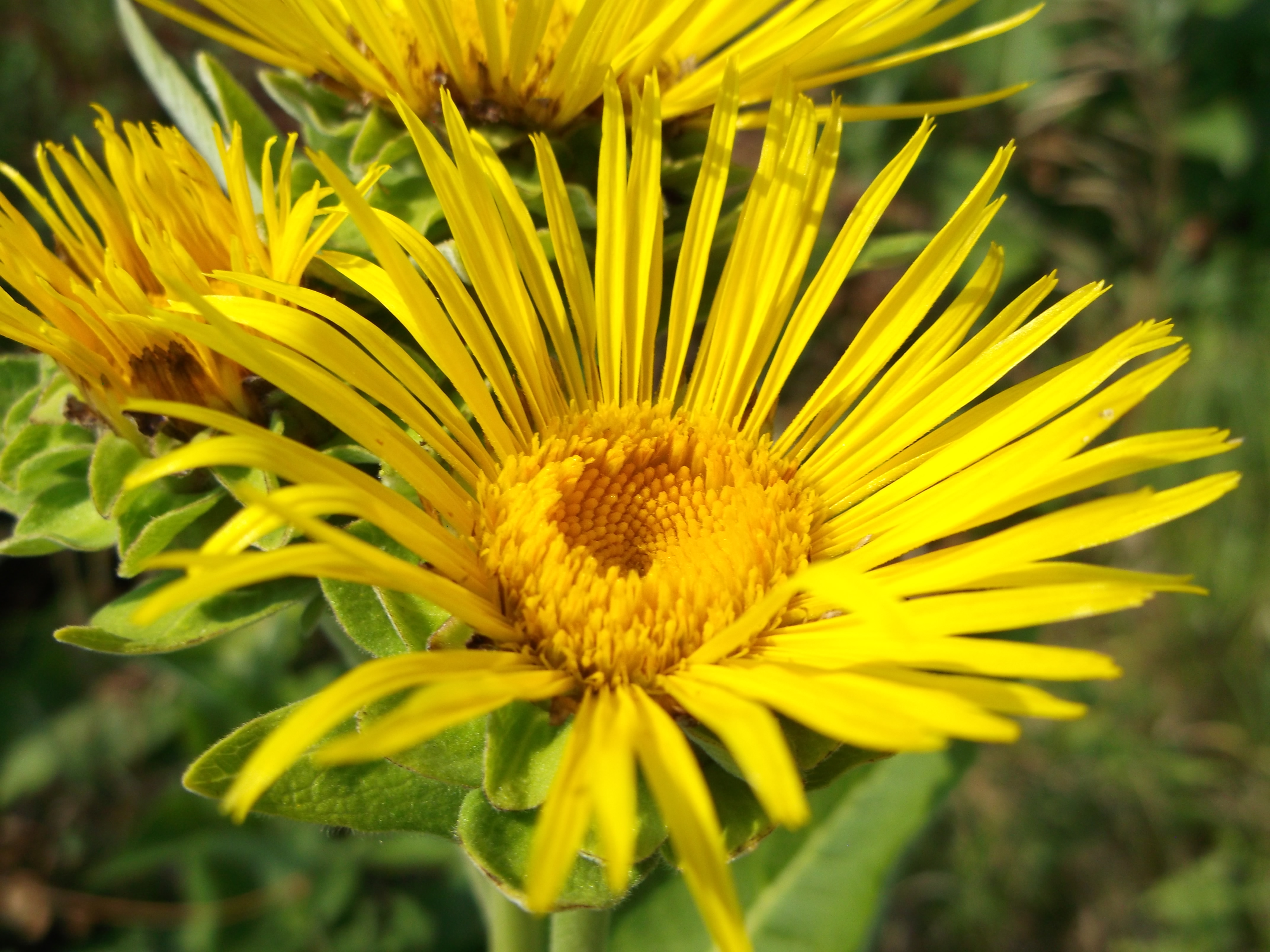
Solar plexus respiratory work engages the diaphragmatic vagal pathway — the phrenic nerve (C3-C5) controlling the diaphragm passes through the same thoracic corridor as the vagus. Elecampane (Inula helenium) contains alantolactone and inulin, both mucolytic and bronchodilatory. Amber warmed in the palm releases trace succinic acid vapor. This pairing addresses the felt sense of breath-holding that accompanies unprocessed grief stored in the solar plexus.
How to work with it
Brew elecampane root tea — 1 teaspoon dried root simmered (not steeped) for 15 minutes. This is elf-wort, the old lung herb. While it simmers, hold the amber in your palm and rub it with your thumb until it warms.
Solar plexus and endocrine axis grounding; pine pollen contains bioidentical phyto-androgens (testosterone, DHEA, androsterone) that interact with androgen receptors; the protocol targets the celiac plexus — the largest autonomic nerve cluster outside the brain — where sympathetic overdrive suppresses hormonal signaling; amber's warmth and static charge placed over the solar plexus create a tactile anchor for interoceptive awareness of core vitality
How to work with it
Hold the amber in your dominant hand. Rub it briskly against cotton or wool for ten seconds until you feel warmth and a faint static pull against arm hair. This is the triboelectric effect — the same phenomenon that gave electricity its name from the Greek word for amber.
Amber warms, softens, and connects to deep time. Its pairings work best when they either complement its warmth or balance it with a cooler or grounding energy.
Amber + Jet
The ancient organic pair. One of the oldest known crystal combinations, both amber and jet are fossilized organic materials. Amber is ancient sunlight (resin); jet is ancient darkness (wood). Together they balance solar warmth with protective depth. Used in mourning jewelry since the Victorian era, and in magical practice long before that.
Amber + Citrine
Full solar activation. Citrine's solar plexus energy amplifies amber's warmth into active confidence. This pairing is for when you need more than warmth, you need fire. For business presentations, creative launches, and any moment where personal power must be visible and felt.
Amber + Turquoise
Fire and water balance. Turquoise cools and communicates; amber warms and grounds. Together they bridge the solar plexus (personal power) and throat chakra (expression). For speaking your truth with warmth rather than aggression. Native American and Tibetan traditions have long combined these materials.
Amber + Carnelian
Deep sacral warming. Carnelian activates the sacral chakra with creative, sexual, and vital energy. Amber at the solar plexus creates a continuous warmth corridor from sacral to solar plexus, the body's core creative and power centers. For reigniting vitality after depletion or burnout.
Amber + Tiger's Eye
Grounded confidence. Tiger's eye brings discernment and self-discipline; amber brings warmth and ease. Together they create confident action that does not burn out, motivation sustained by self-care rather than self-depletion. Both stones carry golden energy; together the resonance is reinforced.
Care & Cleansing
How to keep Amber in good condition
Water Safe?
Keep dry
This stone should stay out of water. Water can dull the surface, destabilize the specimen, or damage the stone over time.
Sunlight Safe?
Sunlight safe
Tolerates daylight; safe to charge or display in the sun.
Authenticity
What to check
Natural Amber should usually feel cooler than plastic or resin on first touch and warm more slowly in the hand.
The #1 Question Can Amber Go in Water? Can amber go in water? Brief Rinse ONLY
Amber is NOT water-safe for prolonged contact. It is organic, porous, and soft (Mohs 2-2. 5). Water can seep into micro-fissures, cause clouding, and eventually lead to cracking. Quick rinse under running water: safe for 10-15 seconds maximum, pat dry immediately
Soaking: not safe, do not submerge amber for any extended period
Saltwater: not safe, salt can damage the surface and penetrate the porous structure
Crystal-infused water / gem elixirs: NOT safe for direct immersion, use the indirect method (amber outside the water vessel)
Moon water rituals: Place amber beside the water, not in it
Why is amber different?
Unlike mineral gemstones, amber is fossilized organic resin. It contains microscopic air bubbles, organic inclusions, and a porous structure that absorbs moisture. What a quartz crystal shrugs off can damage amber permanently. Can amber go in the sun? Limited exposure only. Brief morning sunlight (15-20 minutes) is appropriate for gentle charging. Prolonged direct sun exposure can cause amber to:
Become brittle and develop surface crazing (tiny cracks)
Darken over time
Soften slightly in intense heat (amber melts at approximately 300°C / 570°F, but begins to soften well before that)
Store amber away from windows, heat sources, and prolonged UV exposure.
Think of it like caring for an old photograph, keep it in a cool, stable environment.
Temperature
Natural Amber should usually feel cooler than plastic or resin on first touch and warm more slowly in the hand.
Scratch logic
Use 2 on the Mohs scale as the check, not internet myths. A real specimen should behave in line with the hardness listed above.
Surface and luster
Look for a resinous to waxy surface quality rather than a painted or plastic shine.
Weight and density
The listed specific gravity is 1.05-1.10. If a specimen feels unusually light for its size, it may deserve a second look.
My Field Guide
Your private record and next steps
Journal
Add this stone to your private collection, then log what happened when you worked with it.
Shared Notes
Read public practice logs and pattern notes from the Crystalis community.
When members save a public field note for this stone, it will appear here.
Frequently Asked
Questions people ask about Amber
Can amber go in water?
⌄
Brief rinse only. Amber is fossilized organic resin, not a mineral. It is porous, soft (Mohs 2-2.5), and can absorb water, cloud, or crack with prolonged submersion. Quick rinse under running water is fine. No soaking, no saltwater, no gem elixirs with direct immersion.
Is amber a crystal or a rock?
⌄
Neither. Amber is fossilized tree resin: an organic material, not a mineral. It has no crystal structure (it is amorphous), it was never alive itself but was produced by living trees 20-320 million years ago. It is classified as an organic gemstone alongside pearl, coral, and jet.
Can amber go in the sun?
⌄
Limited exposure only. Brief morning sunlight (15-20 minutes) is fine for charging. Prolonged direct sun can cause amber to crack, become brittle, or darken over time. Amber is organic and more sensitive to heat and UV than mineral gemstones. Store away from direct sunlight.
How can you tell if amber is real?
⌄
The saltwater float test is the classic: real amber floats in saturated saltwater (about 1 tablespoon salt per cup). Plastic and glass sink. Real amber is warm to the touch, lightweight for its size, and produces a piney or sweet resinous smell when heated. Under UV light, genuine amber fluoresces blue-white or green. A hot needle produces a resinous smell from real amber but a chemical/plastic smell from fakes.
What is the difference between amber and copal?
⌄
Age and polymerization. Amber is fully fossilized resin, typically 20-320 million years old, with complete molecular cross-linking. Copal is younger resin (under 2-3 million years) that has not fully polymerized. Copal is softer, stickier when warmed, dissolves in alcohol, and tends to craze (crack) over time. Many 'amber' pieces sold from Colombia and Madagascar are actually copal.
Why does amber create static electricity?
⌄
When rubbed with cloth, amber's molecular structure allows electrons to transfer from the cloth to the amber surface, creating a negative charge that attracts lightweight objects like hair or paper. The ancient Greeks discovered this property around 600 BCE. The Greek word for amber, elektron, is the direct origin of our word 'electricity.' Amber was literally the first known source of electrical phenomenon.
Are insects in amber real?
⌄
In genuine amber, yes; trapped insects, plant matter, and other inclusions are real organisms preserved for millions of years. Baltic amber has yielded specimens up to 44 million years old. However, the market is flooded with fakes: modern insects placed in copal or synthetic resin. If the insect looks too perfect, too large, or too conveniently centered, verify with a professional. Real amber inclusions often show signs of struggle: wings bent, legs extended.
What chakra is amber associated with?
⌄
Amber is primarily associated with the solar plexus chakra (Manipura) and secondarily with the sacral chakra (Svadhisthana). Its warm golden color and thermal properties align with these fire-element energy centers, personal power, warmth, vitality, creative expression, and the kind of confidence that comes from deep-rooted self-trust.
Sources & Citations
Where this entry can be checked
Back Matter
Readable for people. Structured for AI search.
Sources stay visible in the page so readers, search engines, and answer systems can follow the evidence trail.
01
SCI
The Polyvagal Theory: Neurophysiological Foundations of Emotions, Attachment, Communication, and Self-Regulation
Porges, S. (2011). The Polyvagal Theory: Neurophysiological Foundations of Emotions, Attachment, Communication, and Self-Regulation. W.W. Norton. [SCI]View source
02
HIST
Naturalis Historia, Book 37
Pliny the Elder. Naturalis Historia, Book 37. [HIST]
03
LORE
Amber in prehistoric Iberia: New data and a review
Theophrastus. On Stones (De Lapidibus), §29 (elektron). [HIST]
05
SCI
Age constraint on Burmese amber based on U-Pb dating of zircons
Shi, G.H. et al. (2012). Age constraint on Burmese amber based on U-Pb dating of zircons. Cretaceous Research. [SCI]DOI 10.1016/j.cretres.2012.03.014
06
SCI
A feathered dinosaur tail with primitive plumage trapped in mid-Cretaceous amber
Xing, L. et al. (2016). A feathered dinosaur tail with primitive plumage trapped in mid-Cretaceous amber. Current Biology. [SCI]DOI 10.1016/j.cub.2016.10.008
A new proposal concerning the botanical origin of Baltic amber
Wolfe, A.P. et al. (2009). A new proposal concerning the botanical origin of Baltic amber. Proceedings of the Royal Society B. [SCI]DOI 10.1098/rspb.2009.0806
09
SCI
The Amber Forest: A Reconstruction of a Vanished World
Poinar, G.O. & Poinar, R. (1999). The Amber Forest: A Reconstruction of a Vanished World. Princeton University Press. [SCI]DOI 10.1515/9780691187433
10
SCI
Age and paleogeographical origin of Dominican amber
Iturralde-Vinent, M.A. & MacPhee, R.D.E. (1996). Age and paleogeographical origin of Dominican amber. Science. [SCI]DOI 10.1126/science.273.5283.1850
11
SCI
A Textbook of Mineralogy. 4th ed
Dana, E.S. & Ford, W.E. (1932). A Textbook of Mineralogy. 4th ed. John Wiley & Sons. [SCI]DOI 10.5962/bhl.title.58828
12
LORE
Plant Resins: Chemistry, Evolution, Ecology, and Ethnobotany