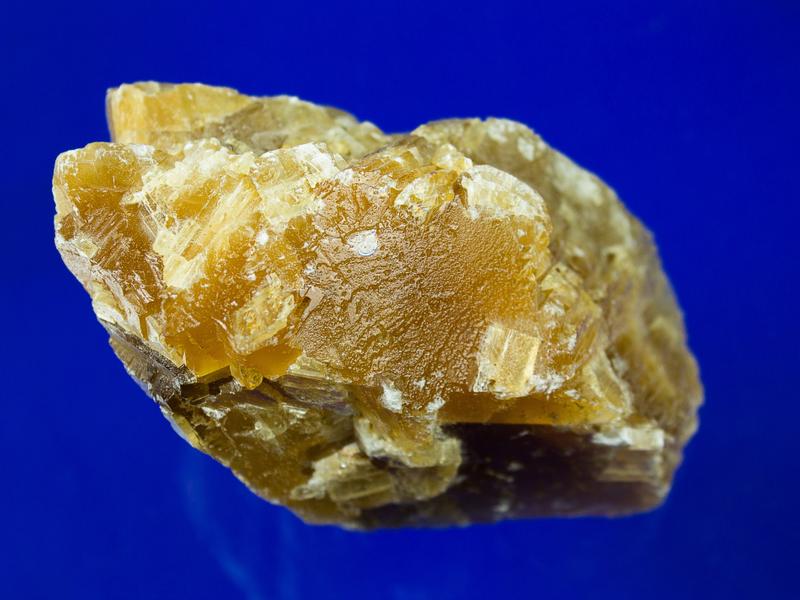
You are looking for steadiness with warmth in it. Honey calcite stacks amber translucence onto a cleavage-prone carbonate body that still catches light beautifully. Confidence does not have to be cold.
Honey calcite addresses the solar plexus and the muscles of the upper abdomen, the places where confidence either organizes into steady tone or collapses into...
The Meaning
Honey Calcite in the Crystalis dictionary
Many people learn to associate steadiness with emotional refrigeration. By the time they finally want confidence, they can only picture it in gray or steel. Warmth feels like something that would interfere.
Honey calcite offers another possibility. Its amber-gold translucence keeps the stone warm to the eye even while the calcite structure remains unmistakably ordered and exact. The light still moves through. The form still holds.
Honey calcite makes steadiness look inhabitable. It says confidence can glow. That is often a more believable version of power than the colder alternatives.
Stone Lore
Stories carried through time
Cultural notes are presented as tradition and historical context — stories carried through time.
Unknown
Ancient Egypt
Calcite (as "Egyptian alabaster", actually calcite, not true alabaster which is gypsum) was used extensively for canopic jars, vessels, and temple construction. The honey-golden varieties were particularly prized. Dates to at least the Old Kingdom (c. 2600 BCE). - Roman period: Calcite ("calx") gave its name to calcium. Romans used calcite extensively in construction and knew its optical properties.
- Chinese jade tradition: While calcite itself is not jade, calcite has been found in archaeological contexts alongside jade artifacts, identified through Raman spectroscopy. (Wang & Zhang, 2010) - Geological science: Calcite has been central to the development of crystallography, mineralogy, and optics since the 17th century.
Lore review
Tradition notes are being reviewed.
This entry keeps symbolic meaning separate from sourced cultural history. When dedicated tradition rows are available, they will appear here as individual lore cards.
Honey calcite is calcium carbonate tinted warm amber to golden yellow by trace iron, and that warmth sits inside the same trigonal carbonate framework that governs all calcite varieties. CaCO3 crystallizes readily in sedimentary, hydrothermal, metamorphic, and cave environments, and the honey variety appears wherever iron in the ferrous or ferric state enters the growth fluid at concentrations sufficient to color the crystal without overwhelming the carbonate chemistry.
Mexico, the United States, and Brazil are common sources, often from massive deposits or large cleavage rhombohedra rather than delicate crystal clusters.
The formation pathway is typically low to moderate temperature. Warm carbonate-rich groundwater or hydrothermal fluid carrying dissolved iron precipitates calcite in veins, cavities, or replacement bodies. The golden color depends on iron valence state and concentration, with ferric iron producing warmer tones and ferrous iron contributing subtler hues. Because calcite is one of the most chemically responsive common minerals, small environmental shifts during growth can produce banding, cloudiness, or graduated color zones within a single specimen.
Physically, honey calcite retains all standard calcite properties: Mohs hardness 3, perfect rhombohedral cleavage in three directions, specific gravity near 2.71, and vigorous effervescence in dilute hydrochloric acid. The trigonal symmetry produces rhombohedra, scalenohedra, and prismatic forms when space allows, though massive material is more common in the honey variety. Translucency varies from nearly transparent to deeply clouded depending on inclusion density.
The somatic register of honey calcite comes through that combination of warmth and structural softness. The cleavage means the mineral yields along defined planes rather than resisting uniformly. The color means the light passing through carries a golden cast. Together, these properties produce a material that the body reads as approachable steadiness: warm enough to feel inviting, soft enough to remind the holder that not everything valuable needs to be hard.
Crystal system diagram represents the general trigonal classification. Diagram created by Crystalis for educational reference.
Trigonal structure
Chemical Formula
CaCO3 (calcium carbonate) with trace Fe2+/Fe3+
Crystal System
Trigonal
Mohs Hardness
3
Specific Gravity
2.71
Luster
Vitreous to resinous
Color
Yellow-Gold
IMA Status
variety
IMA Number
No IMA number (variety of Calcite, IMA-grandfathered parent species)
01
Mineral conditions gather
02
Structure begins to crystallize
03
Honey Calcite records place and pressure
Mexico. The Dominant Commercial Source. Most commercial honey calcite comes from Mexico's extensive limestone and evaporite formations, particularly from the states of Chihuahua, Durango, and San Luis Potosi. The warm amber to golden-brown color results from iron oxide inclusions and organic compounds trapped within the calcite crystal lattice during formation in sedimentary and hydrothermal environments.
The transparency ranges from translucent to nearly transparent depending on crystal purity. Brazil (Minas Gerais, Bahia). Brazilian honey calcite forms in hydrothermal veins cutting through the Precambrian metamorphic basement, producing larger crystals with deeper golden tones. Pakistan (Balochistan). The marble deposits of the Chagai district yield exceptional translucent specimens.
Morocco. Calcite of honey tones forms in the Triassic and Jurassic carbonate formations of the Atlas region. Each source's material is distinguished by its specific iron content, crystal habit, and degree of transparency.
MexicoUSABrazil
Telling it apart
- "Honey Calcite is a rare mineral" . WRONG. Calcite is one of Earth's most abundant minerals. The honey color variety is common in many localities. - "It's as durable as quartz" . WRONG. Mohs 3 vs Mohs 7. Calcite is dramatically softer and more fragile. It cleaves, scratches, and dissolves in acid. Completely different care requirements. - "Safe for crystal water bottles" . PROBLEMATIC. While CaCO3 dissolution products are non-toxic, the stone will slowly dissolve in water over time, especially slightly acidic water.
Use indirect method or brief contact only. - "Same as Orange Calcite" . Different color causation. Orange calcite may contain different iron oxidation states and/or organic pigments. They share the CaCO3 species but can differ in trace chemistry.
Spotting the real thing
The honey/golden/amber color in calcite is caused by:
1. Iron substitution: Fe2+ and Fe3+ ions substituting for Ca2+ in the calcite lattice. Even low concentrations of iron (tens to hundreds of ppm) produce visible coloration. The Mn2+ ion is the strongest cathodoluminescence activator in calcite, while Fe2+ acts as a quencher . the interplay of these trace elements controls both color and luminescence. (Maskenskaya et al., 2014; Barker & Cox, 2010)
2. Organic inclusions: Some honey calcite derives its color from incorporated organic compounds (bituminous matter) trapped during formation in sedimentary environments.
3. Specific shade determinants: The warm honey tone (versus cold white or blue-gray) typically indicates Fe3+ in the lattice along with possible contributions from Mn2+ at very low concentrations. Higher iron concentrations shift coloring toward deeper brown.
- "Honey Calcite is a rare mineral" . WRONG. Calcite is one of Earth's most abundant minerals. The honey color variety is common in many localities. - "It's as durable as quartz" . WRONG. Mohs 3 vs Mohs 7. Calcite is dramatically softer and more fragile. It cleaves, scratches, and dissolves in acid. Completely different care requirements. - "Safe for crystal water bottles" . PROBLEMATIC. While CaCO3 dissolution products are non-toxic, the stone will slowly dissolve in water over time, especially slightly acidic water.
Use indirect method or brief contact only. - "Same as Orange Calcite" . Different color causation. Orange calcite may contain different iron oxidation states and/or organic pigments. They share the CaCO3 species but can differ in trace chemistry.
When energy feels stuck and the body won't respond. Honey Calcite is placed on the body as an anchor point. Your shoulders drop. Your breath becomes shallow and barely audible. A heaviness settles in your limbs. This is dorsal vagal shutdown; your oldest survival circuit pulling you toward stillness, collapse, disconnection from sensation.
Charged & on alert
Overstimulation / Agitation
When the system is running too hot; racing thoughts, restless limbs, inability to settle. Your chest tightens. Your jaw clenches. Your breath moves higher, shallower, faster. This is sympathetic activation; your body mobilizing for fight or flight, muscles tensing, heart rate rising.
Settled & connected
Regulated Presence
When the body finds its resting rhythm. Honey Calcite held or placed becomes a touchpoint for presence. Your chest opens. Your jaw unclenches. Your breath deepens into your belly. This is ventral vagal regulation; your body finding safety, social connection, steady presence.
These associations come from tradition and reflective practice — a way of working with the stone, not a medical prescription.
Somatic Practice
Simple ways to work with Honey Calcite
◇
Hold
Carry Honey Calcite in a pocket or place it over the heart center during a pause.
◌
Meditate
Let the stone become a quiet tactile anchor while the breath slows.
☽
Breathe
Breathe in softness. Breathe out tension. Keep the practice simple.
✎
Journal
Write with Honey Calcite nearby to name the feeling without forcing a conclusion.
✋
Bodywork
Rest the stone near the chest, hand, or bedside as a reminder to soften.
⌂
Environment
Place it where you want a visual cue for care, repair, or steadiness.
Field Instruction
The Amber Dissolution
Soft calcium carbonate stained golden by trace iron, honey calcite dissolves rigidity the way warm water loosens crystallized sugar.
2 min protocol
1
Cradle the honey calcite gently — at Mohs hardness 3, it is softer than a copper coin. Feel its waxy warmth. This is calcium carbonate tinted gold by trace iron, the same mineral that builds stalactites drop by drop. Rest it against your lower ribs.
2
Breathe slowly through the nose. Honey calcite dissolves in acid — it is not a stone that resists. Let your jaw soften. Let your shoulders lower one millimeter. This is not about strength. It is about willingness to be changed.
3
Notice where your body holds its sweetness hostage — the laugh you suppress, the warmth you ration. Ask without answering: what would it cost to let the golden part of me be visible today?
4
Place the calcite on a flat surface in front of you. Watch how its trigonal crystal structure catches light in its amber depths. Take one full breath where you allow yourself to feel exactly as soft as you are. That is the protocol.
Stone Intelligence
The fact that makes Honey Calcite memorable
Calcite colored golden by trace iron. Same calcium carbonate, same trigonal system, different oxidation state of the iron producing amber instead of white. The science documents how a single variable in crystal chemistry changes everything you see.
The practice asks what warmth looks like when it is a chemical state, not a metaphor.
SCI
Source and character of syntaxial hydrothermal calcite veins in Paleoproterozoic crystalline rocks revealed by fine‐scale investigations
Carbonate Mineralogy in Mantle Peridotites of the Atlantis Massif (IODP Expedition 357)
Journal of Geophysical Research: Solid Earth · 2021Read source
Ritual Use
From reference to practice
You are looking for steadiness with warmth in it. Honey calcite stacks amber translucence onto a clean carbonate lattice. Hold it when you need confidence that does not feel cold.
Place on your solar plexus during rest. The golden color from trace iron is warmth by chemistry, not by marketing. For self-worth work: keep honey calcite where you can see it during your morning routine.
Sacred Match
Sacred Match reaches for Honey Calcite when what you feel sounds like:
confidence always arriving cold and sharp instead of warm
difficulty feeling steady without becoming rigid
stomach clenching before self-advocacy
wanting to act from warmth but defaulting to armor
self-assurance that costs you softness every time you use it
Sacred Match listens to the body rather than to preference. It senses whether the solar plexus is generating power through contraction, through expansion, or through warmth. When that points to sympathetic self-assertion purchased at the expense of ventral tone, a system that can mobilize but only by hardening, Honey Calcite is the stone it offers. CaCO3 with trace Fe2+/Fe3+ producing the amber coloration.
Trigonal. Mohs 3. The iron does not harden the calcite. It warms it. The crystal remains cleavage-prone, translucent, structurally soft, and it still catches light beautifully. The prescription is for the nervous system that needs to discover that confidence can be warm and still load-bearing.
cold confidence -> sympathetic-dominant self-assertion -> Fe2+/Fe3+ trace in CaCO3 produces warmth of color without raising hardness above Mohs 3
rigid steadiness -> over-braced stability -> calcite's rhombohedral cleavage means it holds form through geometry, not through resistance to fracture
stomach clenching before advocacy -> solar plexus guarding -> trigonal symmetry offers organizational stability to a mineral soft enough to scratch with a copper coin
defaulting to armor -> ventral bypass under stress -> honey calcite transmits light through its amber body; translucence and strength coexist at low Mohs values
self-assurance costing softness -> power-gentleness trade-off -> the iron that colors this calcite entered the lattice as a trace, not a takeover; warmth is an inclusion, not a replacement
Stones and herbs that harmonize with Honey Calcite
Pairings are treated like a recipe file: clear use, method, and safety.
Herbal Ally
Honey Calcite + The Sweet Anchor
Use when
Solar plexus stabilization through sweetness without excess; vagal tone maintenance during digestive and emotional processing; grounding through the gut-brain axis; the nervous system reminded that nourishment does not always require intensity
How to work with it
Hold honey calcite in your palm. It is softer than most stones you work with — Mohs 3, scratchable with a copper coin. Handle it gently. Not everything that supports you needs to be hard.
Citrine
The Warm Double.
Honey calcite is amber-gold from iron trace in a calcium carbonate body at Mohs 3. Citrine is iron-tinted silicon dioxide at Mohs 7. Together they give warm confidence at two different densities, one soft and one structural. For people who need encouragement that also holds up under pressure. Place honey calcite at the solar plexus and citrine in the dominant pocket.
Carnelian
The Amber Engine.
Honey calcite is warm but passive, a light-catching stone. Carnelian adds propulsion and gut-level willingness. Works for people who feel good about themselves but cannot seem to start moving. Hold honey calcite in the receiving hand and carnelian in the active hand before beginning a project.
Black Tourmaline
The Warm Boundary.
Honey calcite radiates openness through its translucent amber body. Black tourmaline prevents that openness from becoming a leak. For people who are generous and approachable but give away too much energy in the process. Keep honey calcite at the heart and black tourmaline in both pockets.
Tiger's Eye
The Golden Spine.
Honey calcite has warmth without hardness. Tiger's eye has warmth with fibrous chatoyant structure. Together they build warm confidence that has a backbone in it. For practitioners preparing for a performance, interview, or any moment where softness alone is not enough. Place honey calcite at the solar plexus and tiger's eye at the navel.
Care & Cleansing
How to keep Honey Calcite in good condition
Water Safe?
Use caution
Brief contact may be tolerated, but softness, coatings, fractures, or mixed mineral content can make water exposure a risk.
Sunlight Safe?
Sunlight safe
Tolerates daylight; safe to charge or display in the sun.
Authenticity
What to check
Natural Honey Calcite should usually feel cooler than plastic or resin on first touch and warm more slowly in the hand.
- Water safe: CAUTION. Calcite is SLIGHTLY SOLUBLE in water (Ksp = 3. 36 x 10^-9 at 25 degrees C) and READILY SOLUBLE in acidic solutions. Brief water cleansing is acceptable, but prolonged soaking will slowly dissolve the surface, especially in tap water with dissolved CO2. Calcite dissolution is a well-studied process with significant implications for carbon storage and water chemistry.
(Ghaedi et al. , 2025)
- Sun safe: YES. The iron-based coloration is stable under UV exposure. No photosensitive color centers. - Toxic elements: NONE. CaCO3 is non-toxic: it is the active ingredient in antacids (Tums). Trace iron is biologically benign. However, NOT recommended for direct-immersion crystal elixirs because dissolution in water would gradually degrade the stone (though the dissolved CaCO3 is harmless).
- Acid sensitivity: HIGH. Even mild acids (vinegar, citrus juice, carbonated water) will dissolve calcite with visible fizzing (CO2 release). This is the classic "acid test" for calcite identification. Keep away from acidic substances. - Fragility: Mohs 3 is SOFT. Calcite scratches easily, and the perfect cleavage means it can cleave along three directions if impacted. Handle with more care than quartz-family stones.
Temperature
Natural Honey Calcite should usually feel cooler than plastic or resin on first touch and warm more slowly in the hand.
Scratch logic
Use 3 on the Mohs scale as the check, not internet myths. A real specimen should behave in line with the hardness listed above.
Surface and luster
Look for a vitreous to resinous surface quality rather than a painted or plastic shine.
Weight and density
The listed specific gravity is 2.71. If a specimen feels unusually light for its size, it may deserve a second look.
My Field Guide
Your private record and next steps
Journal
Add this stone to your private collection, then log what happened when you worked with it.
Shared Notes
Read public practice logs and pattern notes from the Crystalis community.
When members save a public field note for this stone, it will appear here.
Frequently Asked
Questions people ask about Honey Calcite
What is Honey Calcite?
⌄
Chemical formula: CaCO3 (calcium carbonate) with trace Fe2+/Fe3+. Mohs hardness: 3 (on the {10-11} cleavage), defining mineral for Mohs scale position 3. Crystal system: Trigonal (rhombohedral), space group R-3c.
What is the Mohs hardness of Honey Calcite?
⌄
Honey Calcite has a Mohs hardness of 3 (on the {10-11} cleavage), defining mineral for Mohs scale position 3.
Can Honey Calcite go in water?
⌄
CAUTION. Calcite is SLIGHTLY SOLUBLE in water (Ksp = 3.36 x 10^-9 at 25 degrees C) and READILY SOLUBLE in acidic solutions. Brief water cleansing is acceptable, but prolonged soaking will slowly dissolve the surface, especially in tap water with dissolved CO2. Calcite dissolution is a well-studied process with significant implications for carbon storage and water chemistry. (Ghaedi et al., 2025)
Can Honey Calcite go in the sun?
⌄
YES. The iron-based coloration is stable under UV exposure. No photosensitive color centers.
What crystal system is Honey Calcite?
⌄
Honey Calcite crystallizes in the Trigonal (rhombohedral), space group R-3c.
What is the chemical formula of Honey Calcite?
⌄
The chemical formula of Honey Calcite is CaCO3 (calcium carbonate) with trace Fe2+/Fe3+.
Where is Honey Calcite found?
⌄
- Mexico (primary commercial source for large rhombohedra and masses) - Spain - Iceland - United States (Tennessee, Ohio, Missouri) - Peru - China - Morocco.
Is Honey Calcite toxic?
⌄
NONE. CaCO3 is non-toxic; it is the active ingredient in antacids (Tums). Trace iron is biologically benign. However, NOT recommended for direct-immersion crystal elixirs because dissolution in water would gradually degrade the stone (though the dissolved CaCO3 is harmless).
Sources & Citations
Where this entry can be checked
Back Matter
Readable for people. Structured for AI search.
Sources stay visible in the page so readers, search engines, and answer systems can follow the evidence trail.
01
SCI
Source and character of syntaxial hydrothermal calcite veins in Paleoproterozoic crystalline rocks revealed by fine‐scale investigations
Maskenskaya, O. M., Drake, H., Broman, C., Hogmalm, J. K., Czuppon, G. et al. (2014). Source and character of syntaxial hydrothermal calcite veins in Paleoproterozoic crystalline rocks revealed by fine‐scale investigations. Geofluids. [SCI]DOI 10.1111/gfl.12092
02
SCI
Assessment of Soil and Sediment Loss in the Ken River Basin, Central India, Using RUSLE and InVEST SDR Models
Bhatt, Suresh Chandra, Singh, Moirangthem Mourdhaja, Singh, Sudhir Kumar, Rana, Narendra Kumar, Kori, Rakesh Kumar et al. (2025). Assessment of Soil and Sediment Loss in the Ken River Basin, Central India, Using RUSLE and InVEST SDR Models. Environmental Quality Management. [SCI]DOI 10.1002/tqem.70042
03
SCI
Survival of environmental <scp>DNA</scp> in sediments: Mineralogic control on <scp>DNA</scp> taphonomy
Freeman, C. L., Dieudonné, L., Agbaje, O. B. A., Žure, M., Sanz, J. Q. et al. (2023). Survival of environmental <scp>DNA</scp> in sediments: Mineralogic control on <scp>DNA</scp> taphonomy. Environmental DNA. [SCI]DOI 10.1002/edn3.482
04
SCI
Carbonate Mineralogy in Mantle Peridotites of the Atlantis Massif (IODP Expedition 357)
Ternieten, Lotta, Früh‐Green, Gretchen L., Bernasconi, Stefano M. (2021). Carbonate Mineralogy in Mantle Peridotites of the Atlantis Massif (IODP Expedition 357). Journal of Geophysical Research: Solid Earth. [SCI]DOI 10.1029/2021JB021885
05
SCI
Signatures of biologically influenced CaCo<sub>3</sub> and Mg–Fe silicate precipitation in hot springs: Case study from the Ruidian geothermal area, western Yunnan Province, China
Jones, Brian, Peng, Xiaotong. (2013). Signatures of biologically influenced CaCo<sub>3</sub> and Mg–Fe silicate precipitation in hot springs: Case study from the Ruidian geothermal area, western Yunnan Province, China. Sedimentology. [SCI]DOI 10.1111/sed.12043
06
SCI
Oscillatory zoning and trace element incorporation in hydrothermal minerals: insights from calcite growth experiments
BARKER, SHAUN L.L., COX, STEPHEN F. (2010). Oscillatory zoning and trace element incorporation in hydrothermal minerals: insights from calcite growth experiments. Geofluids. [SCI]DOI 10.1111/j.1468-8123.2010.00305.x
07
SCI
A mechanistic growth model for inorganic crystals: Solid‐state interactions
Dandekar, Preshit, Doherty, Michael F. (2014). A mechanistic growth model for inorganic crystals: Solid‐state interactions. AIChE Journal. [SCI]DOI 10.1002/aic.14597
08
SCI
Raman spectroscopy of the eight natural carbonate minerals of calcite structure
Dufresne, William J.B., Rufledt, Carson J., Marshall, Craig P. (2018). Raman spectroscopy of the eight natural carbonate minerals of calcite structure. Journal of Raman Spectroscopy. [SCI]DOI 10.1002/jrs.5481
09
SCI
Bleached mudstone, iron concretions, and calcite veins: a natural analogue for the effects of reducing <scp>CO</scp><sub>2</sub>‐bearing fluids on migration and mineralization of iron, sealing properties, and composition of mudstone cap rocks
Ming, X. R., Liu, L., Yu, M., Bai, H. G., Yu, L. et al. (2016). Bleached mudstone, iron concretions, and calcite veins: a natural analogue for the effects of reducing <scp>CO</scp><sub>2</sub>‐bearing fluids on migration and mineralization of iron, sealing properties, and composition of mudstone cap rocks. Geofluids. [SCI]DOI 10.1111/gfl.12203
10
SCI
Hydrogen‐Brine‐Calcite Geochemical Interactions During Underground Hydrogen Storage