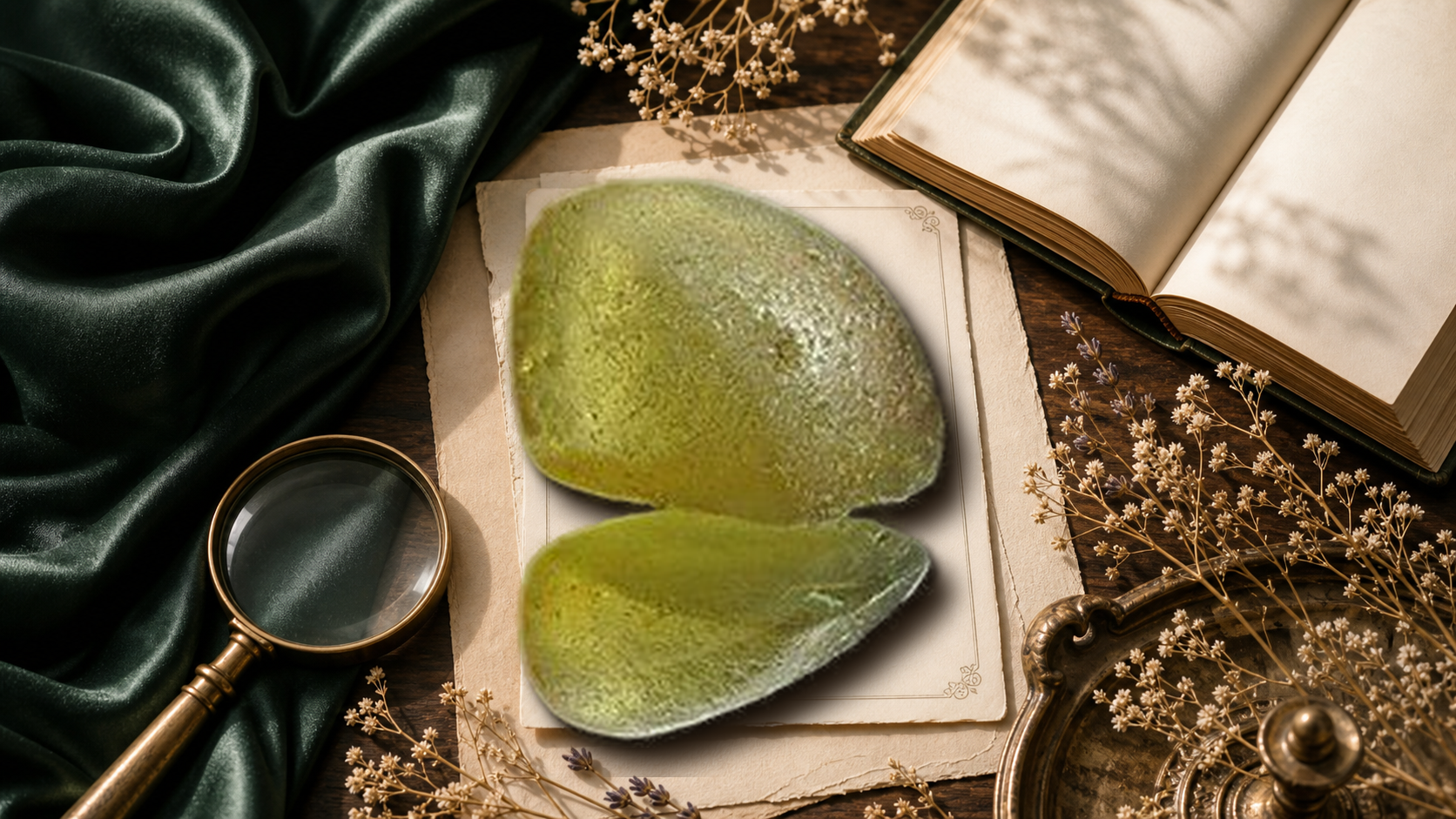
You need a rare steadiness with a golden undertone. Sinhalite is a borate gemstone from Sri Lanka, often honey to olive and denser than its appearance suggests. Quiet value is still value.
Sinhalite speaks to quiet value and to the body state that has been overlooked because it does not advertise itself dramatically. Its honey to olive tones are...
The Meaning
Sinhalite in the Crystalis dictionary
Being underestimated leaves a particular kind of exhaustion. The self begins to doubt its own density simply because it has not been made legible by flash, scale, or the kinds of spectacle most people are trained to recognize.
Sinhalite answers with reserve. Its color stays warm but controlled, and its rarity is easy to miss unless someone actually knows what they are looking at. Value is present long before it is widely recognized.
Sinhalite matters when self-worth has to detach from applause.
Some lives are not common just because the room keeps misreading them.
Stone Lore
Stories carried through time
Cultural notes are presented as tradition and historical context — stories carried through time.
British Mineralogy
Claringbull and Hey's 1952 Identification
G.F. Claringbull and M.H. Hey at the British Museum of Natural History identified sinhalite as a new mineral species in 1952, publishing their findings in the Mineralogical Magazine. They demonstrated that stones sold as brown peridot from Sri Lanka's gem gravels were actually a magnesium aluminum borate with an orthorhombic structure entirely different from olivine. The discovery prompted re-examination of museum collections worldwide and the reclassification of numerous specimens.
1952
Origin lore
Sri Lankan Gem Gravel Tradition
Sri Lanka's alluvial gem mining tradition extends back at least two thousand years, with the island supplying sapphires, rubies, spinels, and other precious stones to Roman, Arab, and European markets. Sinhalite circulated within these...
Sri Lankan Gem Heritage · Ancient-present
Historical note
Misidentification as Peridot in Collections
For decades before 1952, sinhalite specimens resided in major gem collections and museums worldwide under the label peridot or chrysoberyl. The 1952 identification triggered a wave of reclassification that revealed sinhalite to be far...
Gemological History · Pre-1952-present
Ritual history
Solar Plexus Discernment Practice
Contemporary crystal practitioners adopted sinhalite as a solar plexus stone for discernment work, drawing directly on its scientific story. A stone that was misidentified for decades before its true nature was revealed became the mineral...
Contemporary Crystal Practice · 2000s-present
Earth Record
Mineralogy and formation
Sinhalite entered mineralogy late because it hides in plain sight. For years gem material was mistaken for brown peridot or chrysoberyl until careful optical work established a distinct species: magnesium aluminum borate. That chemistry already points to an uncommon origin. Boron must be present, magnesium and aluminum must be available, and the host environment must permit a borate mineral stable enough to survive as gem material.
Sinhalite usually forms in high temperature metamorphic settings such as boron influenced skarns and granulite facies rocks, then reaches the market through secondary alluvial concentration.
The Sri Lankan connection is more than historical naming. Many cut stones come from gem gravels where resistant crystals have weathered out of their original host and accumulated with sapphire, spinel, and chrysoberyl. That secondary transport obscured the primary environment for years, but the mineral itself points back to contact metamorphism and chemically selective recrystallization.
Where igneous heat, boron rich fluids, and magnesium aluminum host rocks overlap, uncommon borates can take shape. Sinhalite is one such solution to that chemical equation.
Its orthorhombic structure and relatively high birefringence distinguish it from the species it mimics visually. Color tends toward honey, yellow brown, olive, or greenish brown, commonly influenced by iron. Specific gravity is higher than peridot, and hardness sits in a useful gem range without reaching the top tier of corundum or chrysoberyl. The material is therefore subtle rather than flamboyant, relying on internal order and rarity of chemistry more than on vivid hue.
Sinhalite records a geological system where uncommon ingredients met without being diluted away. Boron is the decisive actor. It does not often receive center stage in gemstone conversation, yet here it built a mineral rare enough to be overlooked, misnamed, and then finally recognized on its own terms.
Its listed properties reinforce that origin. The stated hardness of 6.5 and the reported luster of Vitreous to adamantine are not decorative trivia.
Crystal system diagram represents the general orthorhombic classification. Diagram created by Crystalis for educational reference.
Orthorhombic structure
Chemical Formula
MgAlBO4
Crystal System
Orthorhombic
Mohs Hardness
6.5
Specific Gravity
3.47-3.50
Luster
Vitreous to adamantine
Color
Brown-Yellow
IMA Status
species
Type Locality
Gem gravels, Ratnapura district, Sri Lanka
IMA Number
Grandfathered (Pre-IMA 1952)
01
Mineral conditions gather
02
Structure begins to crystallize
03
Sinhalite records place and pressure
Sinhalite was first recognized as a new species in 1952 from gem gravels in Sri Lanka's Ratnapura district, where it had been consistently misidentified as brown peridot. It forms in contact-metamorphosed limestone and skarn deposits where boron, magnesium, and aluminum converge. Myanmar's Mogok district produces the finest gem-quality specimens.
Tanzanian occurrences are documented but yield smaller stones.
Sri LankaMyanmarTanzania
Telling it apart
The most common misidentification is sinhalite sold as brown peridot, chrysoberyl, or unnamed golden gem rough. That confusion is historical as well as modern. What separates them is gemological data, not just color. Sinhalite is orthorhombic with higher birefringence than peridot and a different refractive range from chrysoberyl. In rough, the stone can look modest, which makes it easy for sellers to lean on a more familiar name.
The price gap is real because sinhalite is genuinely rare. It should come with a believable origin story, usually Sri Lanka, Myanmar, or Tanzania, and ideally with test data if cut. Buyers should be wary of romance language replacing measurement in this category. A honey brown gem deserves more than a guess. Proper identification preserves both the rarity and the scientific dignity of a borate that spent decades being mistaken for something more common.
A careful buyer should compare the label to habit, hardness, and provenance before paying a rarity premium. Sinhalite was misidentified as peridot for decades until its orthorhombic MgAlBO4 chemistry was confirmed. SG near 3.5 versus olivine at 3.3 is the quickest field separation.
Spotting the real thing
Sinhalite: Mohs 6. 5. Specific gravity 3.
47-3. 50 (heavier than most similarly colored gems). Vitreous to adamantine luster.
Orthorhombic. Golden-brown to olive. Originally misidentified as chrysoberyl.
If a golden-brown gem is offered as sinhalite, verify by specific gravity (sinhalite is lighter than chrysoberyl at 3. 68-3. 78).
Your solar plexus is active but the signal is garbled. You feel something in your belly; it could be excitement, it could be dread, it could be hunger. The sensation is real but your ability to interpret it is scrambled. You keep reaching for a label and the label keeps sliding away. This is a sympathetic-dorsal blend at the solar plexus; your body is sending information but the translation layer between sensation and meaning has gone offline.
Shut down & far away
The Quiet Furnace
Your belly is still. Not numb; still. There is warmth present but it is not doing anything. It sits in your midsection like a banked fire with no draft. You do not feel motivated or demotivated. You feel paused. This is dorsal vagal conservation at the solar plexus; your system has reduced output to minimum viable function. The pilot light is on. The burner is off.
Settled & connected
The Warm Lens
Your solar plexus feels warm and your perception sharpens simultaneously. Your belly is soft but not slack. Your vision seems clearer. You can distinguish between what you want and what you are afraid of wanting, and the distinction does not cost you anything. This is ventral vagal integration at the solar plexus; your power center and your discernment center operating as one organ. You see clearly because you are standing in your own warmth.
These associations come from tradition and reflective practice — a way of working with the stone, not a medical prescription.
Somatic Practice
Simple ways to work with Sinhalite
◇
Hold
Carry Sinhalite in a pocket or place it over the heart center during a pause.
◌
Meditate
Let the stone become a quiet tactile anchor while the breath slows.
☽
Breathe
Breathe in softness. Breathe out tension. Keep the practice simple.
✎
Journal
Write with Sinhalite nearby to name the feeling without forcing a conclusion.
✋
Bodywork
Rest the stone near the chest, hand, or bedside as a reminder to soften.
⌂
Environment
Place it where you want a visual cue for care, repair, or steadiness.
Field Instruction
The Solar Calibration
Read Your Own Signal.
5 min protocol
1
Sit upright. Place sinhalite flat against your solar plexus -- the soft triangle below the sternum and above the navel. Hold it with your dominant hand. Place your non-dominant hand on your thigh, palm down. Close your eyes. Before you breathe deliberately, take thirty seconds to notice what your belly is already doing. Is it tight? Is it hollow? Is it warm or cool? Do not change anything yet. Just read the signal that is already running.
2
Breathe: 5 counts in through the nose, pause for 3, 8 counts out through the mouth. The hold phase is essential. It sits in the space between intake and action -- the same space where discernment lives. Sinhalite was mistaken for peridot for decades because observation alone could not distinguish them. Your belly states work the same way: excitement and anxiety feel identical until you hold still long enough to read the difference.
3
On the fourth breath cycle, press the stone more firmly into your solar plexus. Ask your body one question: what is this sensation actually? Not what you think it should be. Not what you are afraid it is. What it actually is. Let the answer arrive as a body sensation, not a word. A warmth. A tightness. A flutter. A void. Whatever registers, let it register without relabeling it.
4
After 5 minutes: remove the stone from your solar plexus. Hold it in your open palm and look at it. Sinhalite spent decades being called the wrong name. Your belly signals have spent years being called the wrong names too. The protocol does not rename them. It creates the pause in which accurate reading becomes possible. Place the stone in a pocket or on your desk. When you feel your solar plexus activate during the day, touch the stone briefly. The question returns: what is this actually?
Stone Intelligence
The fact that makes Sinhalite memorable
Magnesium aluminum borate, orthorhombic, Mohs 6. 5. Sinhalite was misidentified as brown peridot until 1952, when X-ray diffraction revealed it was a new mineral species.
Named for Sinhala, the ancient name of Sri Lanka where it was discovered. A stone that spent decades wearing the wrong name, then earned its own.
You need a rare steadiness with a golden undertone. Sinhalite is a borate gemstone from Sri Lanka, originally misidentified as chrysoberyl. Hold during periods when your value is being misread.
Place on your desk during self-advocacy. The gem was there all along. Only the identification changed.
Sacred Match
Sacred Match reaches for Sinhalite when what you feel sounds like:
feeling overlooked despite real substance
hesitation around quiet value
fatigue from being misread as ordinary
a need for steadiness without spectacle
held breath around evaluation or worth
Sacred Match listens to the body rather than to preference. It notices what you are feeling right now, the way you are protecting yourself, and the deeper need underneath both. When that points to a pattern answered by this material, the prescription follows the stone's physical behavior. Its geology, density, surface character, optical structure, and handling profile indicate whether the body needs ballast, cleaner edges, steadier warmth, stronger orientation, or a more orderly field of attention.
feeling overlooked despite real substance -> body asking for orientation -> seeking a steadier internal map
hesitation around quiet value -> protective effort running long -> seeking firmer support
fatigue from being misread as ordinary -> pattern becoming costly -> seeking better organization
a need for steadiness without spectacle -> current strategy losing efficiency -> seeking a clearer material response
held breath around evaluation or worth -> body signaling the next need -> seeking coherence
Pairings are treated like a recipe file: clear use, method, and safety.
Crystal Companion
Sinhalite + Amethyst
Use when
You want to layer the primary intention with another supportive tone.
How to work with it
Place the stones together during meditation, journaling, or a short reset.
Safety
Use as a reflective practice tool, not as a medical substitute.
Crystal Companion
Sinhalite + Rhodonite
Use when
You want to layer the primary intention with another supportive tone.
How to work with it
Place the stones together during meditation, journaling, or a short reset.
Safety
Use as a reflective practice tool, not as a medical substitute.
Crystal Companion
Sinhalite + Clear Quartz
Use when
You want to layer the primary intention with another supportive tone.
How to work with it
Place the stones together during meditation, journaling, or a short reset.
Safety
Use as a reflective practice tool, not as a medical substitute.
Crystal Companion
Sinhalite + Black Tourmaline
Use when
You want to layer the primary intention with another supportive tone.
How to work with it
Place the stones together during meditation, journaling, or a short reset.
Safety
Use as a reflective practice tool, not as a medical substitute.
Chrysoberyl. Precision comparison. These two can resemble one another in cut stone, so the pairing is strongest for a collector who values subtle gemological distinction. Chrysoberyl brings sharper familiar recognition, sinhalite brings rarity and quieter depth. Keep them in a gem tray side by side under neutral light.
Peridot. Historical correction. Sinhalite was long mistaken for brown peridot, so placing the two together turns confusion into education. Peridot is lighter, greener, and optically different. Best in a gem box or teaching set with labels.
Smoky Quartz. Honey with shadow. Smoky quartz gives a larger, more accessible body around sinhalite's reserved golden brown tone. A useful placement is sinhalite at the center of a small dish or tray with a smoky point behind it.
Taaffeite. Rare gem restraint. Both stones are understated and uncommon, favoring collectors who prefer rarity without spectacle. Because each deserves space, keep them separated in individual boxes or on opposite sides of a gem case rather than touching.
Placement should stay intentional. Leave enough room between pieces for each material to keep its own visual job, because crowding can flatten the reason the pairing works.
Care & Cleansing
How to keep Sinhalite in good condition
Water Safe?
Water safe
This stone is generally safe for short water contact, though polishing, fractures, and metal settings can still change how a specimen behaves.
Sunlight Safe?
Sunlight safe
Tolerates daylight; safe to charge or display in the sun.
Authenticity
What to check
Natural Sinhalite should usually feel cooler than plastic or resin on first touch and warm more slowly in the hand.
Brief to moderate water contact is safe. Recommended cleansing: running water, moonlight, sound, selenite plate. Store in a soft pouch; sinhalite is rare and should be handled as a collector specimen.
Temperature
Natural Sinhalite should usually feel cooler than plastic or resin on first touch and warm more slowly in the hand.
Scratch logic
Use 6.5 on the Mohs scale as the check, not internet myths. A real specimen should behave in line with the hardness listed above.
Surface and luster
Look for a vitreous to adamantine surface quality rather than a painted or plastic shine.
Weight and density
The listed specific gravity is 3.47-3.50. If a specimen feels unusually light for its size, it may deserve a second look.
My Field Guide
Your private record and next steps
Journal
Add this stone to your private collection, then log what happened when you worked with it.
Shared Notes
Read public practice logs and pattern notes from the Crystalis community.
When members save a public field note for this stone, it will appear here.
Frequently Asked
Questions people ask about Sinhalite
What is sinhalite?
⌄
Sinhalite is a magnesium aluminum borate mineral (MgAlBO4) that was identified as a distinct species in 1952. Before that, it was routinely confused with peridot and chrysoberyl. Named after Sinhala, the classical name for Sri Lanka where it was first recognized, sinhalite is a rare collector gemstone prized for its warm golden-brown to greenish-brown color.
Is sinhalite rare?
⌄
Yes, very. Sinhalite is a genuine rarity in the gem world. It was only recognized as a separate mineral species in 1952, and gem-quality crystals come primarily from Sri Lanka with minor occurrences in Myanmar and Tanzania. Most gemologists will encounter it infrequently, and collectors actively seek it.
What chakra is sinhalite associated with?
⌄
Sinhalite is mapped to the solar plexus chakra. Its warm golden-brown color aligns with the traditional yellow-to-gold tones associated with that center. Practitioners report a felt sense of quiet steadiness in the belly area, a warmth that does not push outward but settles in place. This is experiential observation, not a clinical assertion.
How hard is sinhalite?
⌄
Sinhalite is Mohs 6.5 to 7, which places it in the same range as quartz and peridot. This hardness makes it durable enough for jewelry in protective settings. Its orthorhombic crystal structure contributes to good toughness. It is one of the more practical rare collector gems for occasional wear.
Can sinhalite go in water?
⌄
Yes. Sinhalite is water safe. At Mohs 6.5 to 7 with a stable borate chemistry, brief water contact will not damage it. You can rinse it under running water for cleansing purposes. Dry it afterward to prevent water spots on polished surfaces. No toxic elements are present.
Where does sinhalite come from?
⌄
The primary source is the gem gravels of Sri Lanka, where sinhalite is found as water-worn pebbles alongside sapphire, spinel, and other alluvial gems. Minor occurrences have been reported from Myanmar and Tanzania. The Sri Lankan deposits remain the most important source for collector-quality material.
Why was sinhalite confused with peridot?
⌄
Sinhalite's golden-brown to olive color, similar specific gravity, and comparable refractive index made it nearly indistinguishable from iron-rich peridot using the technology available before 1952. It took advanced crystallographic analysis to establish that sinhalite was a borate mineral rather than a silicate. Many old peridot specimens in museum collections have been reclassified as sinhalite upon re-examination.
Can sinhalite be used in jewelry?
⌄
Yes. At Mohs 6.5 to 7 with good toughness, sinhalite can be faceted into attractive gemstones suitable for pendants, earrings, and protected ring settings. The warm golden-brown color is appealing. The limiting factor is availability; finding clean, facetable rough is difficult, and finished gems are primarily found in specialist collections.
Sources & Citations
Where this entry can be checked
Back Matter
Readable for people. Structured for AI search.
Sources stay visible in the page so readers, search engines, and answer systems can follow the evidence trail.
01
HIST
Sinhalite (MgAlBO4), a new mineral
Claringbull, G.F., Hey, M.H. (1952). Sinhalite (MgAlBO4), a new mineral. [HIST]
02
SCI
Sinhalite (MgAlBO4), a new mineral
Claringbull, G.F.; Hey, M.H. (1952). Sinhalite (MgAlBO4), a new mineral. Mineralogical Magazine. [SCI]DOI 10.1180/minmag.1952.029.217.03