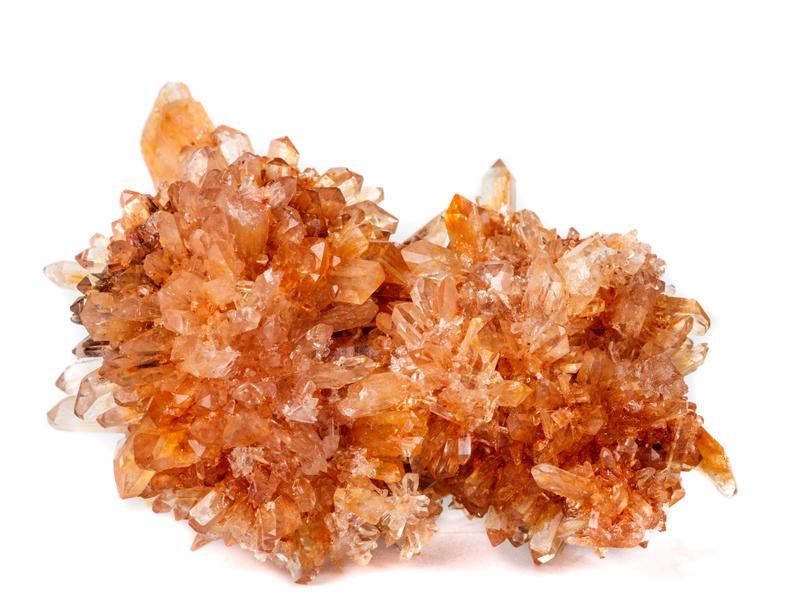
Flatness has started to feel permanent. Creedite erupts in acicular sprays, fine needles building starbursts where there was once only mineral-rich fluid and open space. Some awakenings arrive all points first.
Creedite addresses the collarbones and hands, where reach, receptivity, and the nervous system's willingness to extend outward after contraction find their somatic...
The Meaning
Creedite in the Crystalis dictionary
There are emotional deserts where dullness starts passing for climate. Hope goes two-dimensional. Everything rounds off in the wrong direction.
Creedite interrupts that field by force of geometry alone. Acicular clusters, radiating bursts, a mineral that appears less like comfort than like re-entry of form. The eye wakes up because the specimen refuses blur.
First edge.
Awakening sometimes begins with points.
Stone Lore
Stories carried through time
Cultural notes are presented as tradition and historical context — stories carried through time.
Colorado prospectors
The Discovery at Creede
In 1916, mineralogists described creedite from specimens found near the town of Creede in Mineral County, Colorado. The mineral was discovered in the oxidized zone of a fluorite-bearing vein. The type locality gave the mineral its name. These original Colorado specimens were colorless to white and relatively small compared to later Mexican finds.
Wagon Wheel Gap
Historical note
The Orange Sprays of Durango
Beginning in the 1970s, mines in the state of Durango, Mexico, began producing dramatic orange creedite crystal clusters that dwarfed the original Colorado material in both size and color saturation. Mexican dealers recognized the...
Mexican mineral dealers · Durango state
Origin lore
The High-Altitude Fluoride Mineral
In the 1990s, mining cooperatives working the Colavi Mine in Potosi department, Bolivia, produced lavender-tinted creedite specimens that offered a color variant not seen from other localities. These Bolivian finds demonstrated that...
Bolivian mining cooperatives · Colavi Mine
Lore & history
The First Scientific Description
In 1916, USGS mineralogist Waldemar T. Schaller published the original scientific description of creedite, characterizing its unusual chemistry of calcium aluminum sulfate fluoride hydroxide hydrate. Schaller's work establishing the...
Waldemar T. Schaller · U.S. Geological Survey
Earth Record
Mineralogy and formation
Creedite forms in the chemically active cavities of oxidized fluoride-rich deposits, especially where fluorite-bearing systems have already been broken open by weathering and fluid circulation. Its formula, Ca3SO4Al2F8(OH)2·2H2O, captures the complexity: calcium, sulfate, aluminum, fluorine, hydroxyl, and water all participate. The mineral crystallizes in the monoclinic system and is famous for radiating clusters of acicular to prismatic crystals that spread through open space like frozen bursts.
The species requires a fairly specific combination of ingredients. Fluorine must remain abundant enough to stabilize the mineral, sulfate must be available from oxidation of sulfur-bearing minerals or circulating solutions, and cavities must stay open long enough for sprays to grow outward rather than collapse into compact masses. This is why creedite is strongly associated with oxidized fluorite deposits in places such as Mexico and Colorado.
Colorless, white, orange, and violet forms are all known, with color depending on impurities and local growth conditions. Its habit is more immediately memorable than its chemistry. Fine needles radiate from cores, often creating star-like or pompon structures that look surprisingly energetic for a hydrous secondary mineral. Yet the growth is orderly. Monoclinic symmetry governs each prism even when the cluster reads as explosion.
Open space is part of the architecture. Without void, there is no spray. That links cleanly to the thought field about awakening arriving all points first. Somatically, creedite suggests activation that starts as many small directional signals rather than one blunt force. The body often experiences reanimation that way: peripheral sparks, sensory return, a scatter of attention becoming pattern.
Geology offers a parallel. Mineral-rich fluid meets room to expand, and a radiating form appears where there had only been cavity and solution before. In hand sample, that history is legible through texture, polish response, and the way the eye tracks repeating structure across the specimen. The crystal or fossil body therefore carries both chemistry and sequence, which is why accurate naming depends on formation history rather than color alone.
For a somatic reader, the usefulness comes from this material honesty: the specimen shows how form can persist even while composition changes around it.
Crystal system diagram represents the general monoclinic classification. Diagram created by Crystalis for educational reference.
Monoclinic structure
Chemical Formula
Ca3SO4Al2F8(OH)2.2H2O
Crystal System
Monoclinic
Mohs Hardness
3.5
Specific Gravity
2.71-2.73
Luster
Vitreous
Color
Purple-White
IMA Status
species
Type Locality
Creede quadrangle, Colorado, USA
IMA Number
pre-IMA (grandfathered 1916)
01
Mineral conditions gather
02
Structure begins to crystallize
03
Creedite records place and pressure
Creedite forms through unique geological processes that concentrate specific elements under precise conditions of temperature, pressure, and chemistry. The white/orange color results from the interaction of light with the crystal structure and any included elements. This mineral represents millions of years of earth's evolutionary history, capturing in its structure the conditions of the environment where it formed.
Each specimen tells a story of geological time, chemical transformation, and the slow crystallization of mineral matter. Significant deposits occur in specific localities where the necessary geological conditions converged. Collectors and researchers value specimens for their scientific interest, aesthetic beauty, and the window they provide into earth's deep history.
Creedite is commonly confused with aragonite sprays, gypsum needles, and even synthetic decorative clusters because all can form radiating, needle-like habits. Color alone does not help much, since creedite may be colorless, white, orange, or violet. The species difference matters to collectors because creedite comes from a much narrower geochemical setting and can command significantly higher prices when locality and crystal quality are strong.
What separates them is crystal context. Creedite usually forms in oxidized fluorite deposits and often occurs with fluorite, limonite, smithsonite, or related secondary minerals. Under magnification the crystals are prismatic rather than soft fibrous gypsum, and they are harder than gypsum. Aragonite sprays have a different carbonate response and habit. For certainty, locality plus Raman or XRD is ideal.
Delicate crystal clusters command collector premiums only when the identification is confirmed, and generic drusy coatings labeled as creedite do not qualify.
Spotting the real thing
Creedite: radiating acicular crystal sprays, typically colorless to white or pale purple. Mohs 3. 5-4.
Specific gravity 2. 71-2. 73.
Vitreous luster. The radiating needle-like crystal habit is distinctive. Specimens are fragile; genuine creedite from Durango (Mexico) or Colorado (USA) shows natural crystal terminations on the needle tips.
The top of your head feels squeezed or pressured, like wearing a hat that is too tight. Your thoughts are dense and compacted, ideas stacking on top of each other without space between them. Your eyes might ache. This is sympathetic overload at the crown; too much input being forced through too narrow a channel.
Shut down & far away
The Dimmed Upper Room
You feel like someone turned down the brightness in the upper half of your awareness. Your intuitive sense is muffled. Meditation feels like sitting in fog. You know there should be clarity up there but you cannot access it. This is dorsal vagal dampening of the upper perceptual field; your system has dimmed the lights to conserve energy, but it took your vision with it.
Settled & connected
The Radiant Expansion
Your awareness seems to expand outward from the crown of your head like light through a crystal. You feel simultaneously sharp and spacious. Ideas come with clarity and you do not have to chase them. Your face relaxes and your scalp softens. This is ventral vagal openness at the highest perceptual centers; your system feels safe enough to broadcast rather than contract.
These associations come from tradition and reflective practice — a way of working with the stone, not a medical prescription.
Somatic Practice
Simple ways to work with Creedite
◇
Hold
Carry Creedite in a pocket or place it over the heart center during a pause.
◌
Meditate
Let the stone become a quiet tactile anchor while the breath slows.
☽
Breathe
Breathe in softness. Breathe out tension. Keep the practice simple.
✎
Journal
Write with Creedite nearby to name the feeling without forcing a conclusion.
✋
Bodywork
Rest the stone near the chest, hand, or bedside as a reminder to soften.
⌂
Environment
Place it where you want a visual cue for care, repair, or steadiness.
Field Instruction
The Crown Bloom
Let it open at its own speed.
3 min protocol
1
Place the creedite specimen on a stable surface near you -- beside your pillow, on a meditation cushion, or on a shelf at head height. Do not hold it (too fragile). Sit or lie down with the top of your head oriented toward the stone. Close your eyes. Breathe in for 4, out for 8 -- emphasize the exhale. Three rounds.
2
Place both hands on the top of your head, fingers interlaced. Apply very gentle pressure -- just enough to feel the boundary of your skull. Breathe in for 4, hold for 2, out for 6. On each exhale, slightly reduce the pressure of your hands. You are teaching your nervous system that the crown can be touched without threat. Five rounds.
3
Release your hands and let them rest at your sides. Imagine a slow opening at the top of your head -- not a burst, not a flash, just a gradual widening like a flower that takes an hour to bloom. Breathe naturally. Do not force any visualization. If nothing comes, notice the absence without judgment. The practice is in the patience.
4
Take three natural breaths. On the third exhale, gently tap the top of your head with your fingertips three times -- light, quick touches. This closes the practice by reestablishing the boundary. Open your eyes. Notice how the room looks. Colors, edges, depth. Note any difference from before you started, however subtle.
Stone Intelligence
The fact that makes Creedite memorable
Radiating clusters of prismatic crystals building outward from cavities in oxidized fluorite deposits. Fine needles arranged like something detonating in slow mineral time. The science documents crystallization in fluorite-bearing hydrothermal systems.
The practice asks what expansion looks like when it has no interest in being contained.
SCI
Infrared and Raman spectroscopic characterisation of the sulphate mineral creedite – Ca3Al2SO4(F,OH)·2H2O – and in comparison with the alums
Spectrochimica Acta Part A: Molecular and Biomolecular Spectroscopy · 2013Read source
SCI
Structure refinement and thermal stability of creedite
Moscow University Geology Bulletin · 2011Read source
SCI
Refining the crystal structure of creedite, Ca3Al2(F,OH)10SO4·2H2O
Calcium Sulfoaluminate Sodalite Crystal Structure Evaluation and Bulk Modulus Determination
Journal of the American Ceramic Society · 2013Read source
Ritual Use
From reference to practice
Flatness has started to feel permanent. Creedite erupts in acicular sprays, fine needles building starbursts from fluorite cavities. Hold when your inner landscape has gone monotone and you need a reminder that expansion is still available.
The radiating crystal habit is not gentle. It is detonation at mineral speed. Place in your creative space when you need energy that is not smooth but sharp and directional.
Sacred Match
Sacred Match reaches for Creedite when what you feel sounds like: flatness everywhere hands cold before action spark returning ideas arriving too fast wakefulness needed Sacred Match listens to the body rather than to preference. It notices what you are feeling right now, the way you are protecting yourself, and the deeper need underneath both. When that points to a pattern of creedite need, the stone is the stone it offers because its formation story models the kind of regulation being sought.
flatness everywhere -> body braced -> seeking steadier containment hands cold before action -> signal overloaded -> seeking discrimination spark returning -> old material active -> seeking paced processing ideas arriving too fast -> energy leaking outward -> seeking structure wakefulness needed -> rest interrupted -> seeking enough safety to settle The prescription is less about liking the stone than about matching material logic to the body's current defensive pattern.
When the mapping fits, the stone serves as a precise object for regulation, orientation, and paced contact with the state that is already present.
Pairings are treated like a recipe file: clear use, method, and safety.
Crystal Companion
Creedite + Amethyst
Use when
You want to layer the primary intention with another supportive tone.
How to work with it
Place the stones together during meditation, journaling, or a short reset.
Safety
Use as a reflective practice tool, not as a medical substitute.
Crystal Companion
Creedite + Rhodonite
Use when
You want to layer the primary intention with another supportive tone.
How to work with it
Place the stones together during meditation, journaling, or a short reset.
Safety
Use as a reflective practice tool, not as a medical substitute.
Crystal Companion
Creedite + Clear Quartz
Use when
You want to layer the primary intention with another supportive tone.
How to work with it
Place the stones together during meditation, journaling, or a short reset.
Safety
Use as a reflective practice tool, not as a medical substitute.
Crystal Companion
Creedite + Black Tourmaline
Use when
You want to layer the primary intention with another supportive tone.
How to work with it
Place the stones together during meditation, journaling, or a short reset.
Safety
Use as a reflective practice tool, not as a medical substitute.
Creedite + Selenite. Needle burst with a clear field. Both are light-rich materials, but creedite adds activation where selenite only clears. Place selenite horizontally on the nightstand and creedite upright above it. Creedite + Carnelian. Awakening plus momentum. Carnelian translates the radiating spark into action. Hold creedite near the chest and place carnelian at the lower abdomen.
Creedite + Clear Quartz. Starburst amplified. Good for idea generation, visual focus, and restarting dull work. Set creedite at the center of a desk and clear quartz behind it. Creedite + Hematite. Fine-point activation with gravity. Hematite keeps the spray from becoming scattered. Keep hematite in the pocket and creedite in view rather than on the body. Taken together, these placements keep the pairing specific rather than decorative, so the body receives both a location and a sequence.
The benefit of pairing is not more volume. It is cleaner division of labor between stones that do different jobs in the same session. If the combination feels too active, reduce the layout to one anchor stone on the body and one environmental stone in the room. Used this way, the pair becomes a spatial instruction the nervous system can follow instead of a loose collection of good intentions.
Care & Cleansing
How to keep Creedite in good condition
Water Safe?
Keep dry
This stone should stay out of water. Water can dull the surface, destabilize the specimen, or damage the stone over time.
Sunlight Safe?
Sunlight safe
Tolerates daylight; safe to charge or display in the sun.
Authenticity
What to check
Natural Creedite should usually feel cooler than plastic or resin on first touch and warm more slowly in the hand.
Can Creedite Go in Water?
No. Not Water Safe.
Creedite is a calcium aluminum sulfate fluoride hydroxide hydrate (Ca3Al2(SO4)(F,OH)10 . 2H2O) with Mohs hardness of only 3.5 to 4. The hydrated structure makes it water-soluble. Water contact dissolves the crystal surfaces, clouds transparency, and can destroy delicate crystal clusters entirely. Even humidity damages creedite over time.
Salt water: never.
Gem elixirs: never. Fluoride and aluminum content make this unsafe for any water preparation.
Cleansing Methods
Moonlight: Overnight in a low-humidity environment. The only safe method.
Selenite plate: Rest on selenite for 4 to 6 hours. No water contact.
Smoke: Very brief pass through sage smoke at a distance. Avoid depositing smoke residue on the crystal faces.
Storage and Handling
Creedite requires dry storage. Humidity is its enemy. Store in sealed containers with silica gel desiccant packets. At Mohs 3.5 to 4, the crystals are softer than a copper coin. The prismatic crystal clusters are extremely fragile; individual crystals snap off with minimal contact. Store on padded surfaces with crystals facing up. Never store in bags or pouches. Some collectors store creedite in sealed display boxes to control humidity.
Temperature
Natural Creedite should usually feel cooler than plastic or resin on first touch and warm more slowly in the hand.
Scratch logic
Use 3.5 on the Mohs scale as the check, not internet myths. A real specimen should behave in line with the hardness listed above.
Surface and luster
Look for a vitreous surface quality rather than a painted or plastic shine.
Weight and density
The listed specific gravity is 2.71-2.73. If a specimen feels unusually light for its size, it may deserve a second look.
My Field Guide
Your private record and next steps
Journal
Add this stone to your private collection, then log what happened when you worked with it.
Shared Notes
Read public practice logs and pattern notes from the Crystalis community.
When members save a public field note for this stone, it will appear here.
Frequently Asked
Questions people ask about Creedite
What is creedite crystal?
⌄
Creedite is a calcium aluminum sulfate fluoride hydroxide mineral that forms dramatic radiating crystal clusters. Its formula, Ca3SO4Al2F8(OH)2 2H2O, reflects a complicated chemistry involving sulfate, fluoride, and water. The clusters can be colorless, white, orange, or lavender. It is named after Creede, Colorado, where it was first found.
Is creedite fragile?
⌄
Yes, extremely. At Mohs 3.5-4, creedite is soft, and its radiating prismatic habit means individual crystals are thin and easily broken. These specimens must be transported in padded containers, stored in display cases, and handled as little as possible.
Can creedite get wet?
⌄
No. Creedite is not water safe. It is hydrated (contains structural water) and its fluoride-sulfate chemistry makes it vulnerable to dissolution. Water can permanently damage the delicate crystal sprays. Use only dry cleansing methods.
What chakra is creedite?
⌄
Creedite is mapped to the crown and third eye chakras. Its radiating crystal formations suggest outward expansion, and practitioners report a felt sense of mental opening or perceptual broadening when working with it. The lavender varieties especially are associated with upper-chakra states.
Where does creedite come from?
⌄
The finest orange creedite clusters come from mines in Durango and Chihuahua, Mexico. The mineral was first discovered in Creede, Colorado (hence the name), with additional localities in Nevada, Bolivia, and China. Mexican specimens are the most commercially available and visually dramatic.
What color is creedite?
⌄
Creedite ranges from colorless to white, orange, and lavender-purple. Orange creedite from Mexico is the most commonly seen in the market. Lavender creedite from Akatani, Japan, and some Mexican localities is rarer and highly sought. The color depends on trace element content.
How do you store creedite?
⌄
In a dedicated display case or padded mineral box, away from other specimens. The radiating crystal sprays are extremely fragile and can be destroyed by even gentle contact with neighboring stones. Never stack anything on top of a creedite specimen. Temperature and humidity stability matter.
How do you cleanse creedite?
⌄
Sound cleansing from a safe distance is ideal. Gentle smoke is acceptable. No water, no salt, no physical contact cleansing. Some practitioners place it near selenite or clear quartz for energetic refreshing. The key principle is minimizing any physical interaction with the delicate crystals.
Sources & Citations
Where this entry can be checked
Back Matter
Readable for people. Structured for AI search.
Sources stay visible in the page so readers, search engines, and answer systems can follow the evidence trail.
01
SCI
Infrared and Raman spectroscopic characterisation of the sulphate mineral creedite – Ca3Al2SO4(F,OH)·2H2O – and in comparison with the alums
Frost R.L., Xi Y., Scholz R., López A., Granja A. (2013). Infrared and Raman spectroscopic characterisation of the sulphate mineral creedite – Ca3Al2SO4(F,OH)·2H2O – and in comparison with the alums. Spectrochimica Acta Part A: Molecular and Biomolecular Spectroscopy. [SCI]DOI 10.1016/j.saa.2013.02.029
02
SCI
Structure refinement and thermal stability of creedite
Ksenofontov D.A., Kabalov Y.K., Zubkova N., Shiyapova R.R. (2011). Structure refinement and thermal stability of creedite. Moscow University Geology Bulletin. [SCI]DOI 10.1134/S0020168511110112
03
SCI
Refining the crystal structure of creedite, Ca3Al2(F,OH)10SO4·2H2O
Brusentsov F.A., Borisov S., Klevtsova R.F. (1975). Refining the crystal structure of creedite, Ca3Al2(F,OH)10SO4·2H2O. Kristallografiya. [SCI]DOI 10.1007/BF00744822
04
SCI
Calcium Sulfoaluminate Sodalite Crystal Structure Evaluation and Bulk Modulus Determination
Hargis, C.W. et al. (2013). Calcium Sulfoaluminate Sodalite Crystal Structure Evaluation and Bulk Modulus Determination. Journal of the American Ceramic Society. [SCI]DOI 10.1111/jace.12700