Crystal Encyclopedia
40+YEARS

Mesolite

Na2Ca2(Al2Si3O10)3·8H2O · Mohs 5 · Monoclinic · Crown Chakra

The stone of mesolite: meaning, mineralogy, and somatic practice.

Spiritual ConnectionClarity & FocusStress ReliefSurrender & Release

This page documents traditional and cultural uses of mesolite alongside emerging research on tactile grounding objects. Crystalis does not claim that mesolite treats, cures, or prevents any medical condition. For mental health concerns, consult a qualified professional.

Crystalis Editorial · 40+ Years · Herndon, VA · 2 peer-reviewed sources

Origins: India (Pune), Iceland, USA

Crystalis

Materia Medica

Mesolite

The Surrender Needle

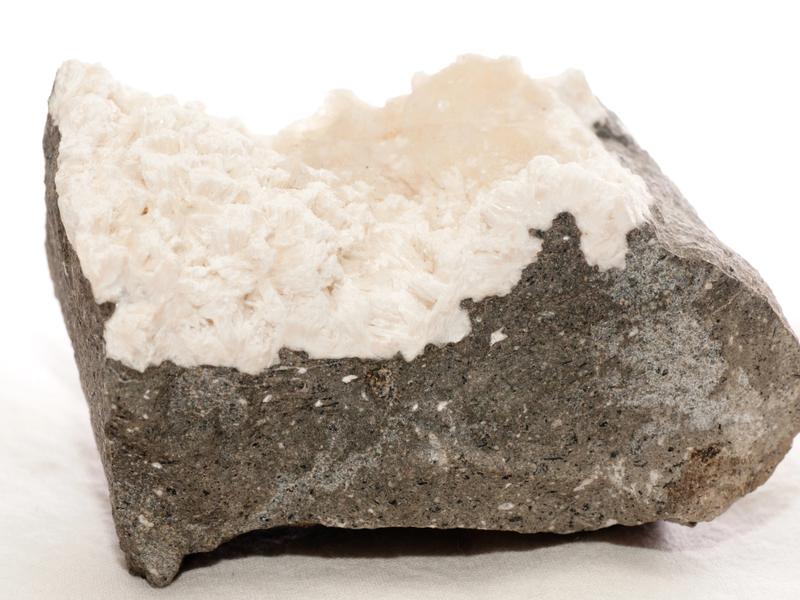
Mesolite crystal
Spiritual ConnectionClarity & FocusStress Relief
Crystalis

Protocol

The Needle Lattice

Sodium-calcium aluminum silicate forming needle-thin crystals in monoclinic sprays, mesolite demonstrates that even the most delicate architecture can grow toward the open.

2 min

  1. 1

    Place the mesolite specimen on a stable surface where you can observe it without handling — this zeolite forms needle-thin monoclinic crystals that can be extremely fragile. Its silky-to-vitreous luster along those needles catches light like threads of glass. Sit at eye level with the specimen. Let your gaze trace one needle from base to tip.

  2. 2

    Rest your hands palms-up in your lap. Mesolite is a sodium-calcium aluminum silicate with eight molecules of structural water — Na2Ca2(Al2Si3O10)3 dot 8H2O. That water is not decoration. It holds the crystal lattice open. Breathe in for three, out for five. On each exhale, let your own structure open by one degree — shoulders wider, jaw looser, palms softer.

  3. 3

    Close your eyes. Mesolite crystals grow as radiating sprays — fanning outward from a central point into the open cavity of volcanic rock. They grow toward space, not away from pressure. Ask: where in my life am I contracting when I could be extending? Sit with the question for three breaths.

  4. 4

    Open your eyes. Look at the specimen one final time. Those needles are among the most delicate mineral formations in existence, yet they survived millions of years inside basalt cavities. Fragility and endurance in the same object. Take one breath for that paradox. Done.

tap to flip for protocol

Some kinds of exposure are invisible to other people. The body registers too much, too finely, too quickly, and the world mistakes the resulting caution for fragility instead of precision.

Mesolite offers a more dignified image of that condition. The crystal grows in hair-like sprays and pale needles that look almost too delicate to hold, yet the clusters remain highly organized and coherent. Openness and structure stay together.

Mesolite helps the psyche distinguish sensitivity from weakness.

Fine registration can still belong to a well-made system.

What Your Body Knows

Nervous system states

dorsal vagal

Freeze / Shutdown

When energy feels stuck and the body won't respond. Mesolite is placed on the body as an anchor point. Your shoulders drop. Your breath becomes shallow and barely audible. A heaviness settles in your limbs. This is dorsal vagal shutdown; your oldest survival circuit pulling you toward stillness, collapse, disconnection from sensation.

sympathetic

Overstimulation / Agitation

When the system is running too hot; racing thoughts, restless limbs, inability to settle. Your chest tightens. Your jaw clenches. Your breath moves higher, shallower, faster. This is sympathetic activation; your body mobilizing for fight or flight, muscles tensing, heart rate rising.

ventral vagal

Regulated Presence

When the body finds its resting rhythm. Mesolite held or placed becomes a touchpoint for presence. Your chest opens. Your jaw unclenches. Your breath deepens into your belly. This is ventral vagal regulation; your body finding safety, social connection, steady presence.

Nervous system mapping based on polyvagal theory (Porges, 2011).

Mineralogy

Mineral specs

Chemical Formula

Na2Ca2(Al2Si3O10)3·8H2O

Crystal System

Monoclinic

Mohs Hardness

5

Specific Gravity

2.26-2.40

Luster

Vitreous to silky

Color

White

cabMonoclinic · Mesolite

Crystal system diagram represents the general monoclinic classification. Diagram created by Crystalis for educational reference.

Traditional Knowledge

Traditions across cultures

Named in 1813 by Leonhard and Fuchs from the Greek "mesos" (middle), reflecting its composition intermediate between natrolite (sodium zeolite) and scolecite (calcium zeolite). The Deccan Traps of India, particularly the Pune (Poona) district of Maharashtra, have produced the world's most spectacular mesolite specimens; enormous cotton-like masses and sprays of delicate acicular crystals, often associated with stilbite, scolecite, and apophyllite. Indian mesolite specimens are staples of major mineral collections worldwide. Zeolites as a group were named by A.F. Cronstedt in 1756 from the Greek "zeo" (to boil) and "lithos" (stone), because many zeolites froth when heated due to release of water. Mesolite's fibrous habit made it an object of early crystallographic study as researchers sought to understand the structural relationship between the three natrolite-group zeolites.

European Mineralogy

1816

Discovery and Classification

Mesolite was first described in 1816 by German-French mineralogist Gehlen and later formalized by Fuchs, who named it from the Greek "mesos" (middle) because its chemical composition falls between natrolite and scolecite in the zeolite group. This intermediary position made it a key specimen for understanding zeolite chemistry.

Indian Geology

Modern era

Deccan Traps Specimen Stone

The Deccan Traps basalt formations of Maharashtra, India, produce some of the world's finest mesolite specimens, often forming spectacular sprays of needle-like white crystals inside volcanic cavities. Indian mineral collectors and dealers have elevated Pune-district mesolite to iconic status in the global specimen market.

Contemporary Crystal Practice

21st century

Zeolite Group Healing Traditions

Modern crystal practitioners associate mesolite with mental clarity and calm focus, drawing on the zeolite family's reputation as natural purifiers. Its delicate acicular crystal habit is said to represent precision of thought, and it is often placed in meditation spaces alongside other zeolites.

When This Stone Finds You

What it says when it arrives

You feel overexposed in ways no one else notices. Mesolite grows in pale hair-like sprays and delicate needle clusters, open-looking yet intricately organized. Sensitivity is not the same thing as weakness.

Somatic protocol

The Needle Lattice

Sodium-calcium aluminum silicate forming needle-thin crystals in monoclinic sprays, mesolite demonstrates that even the most delicate architecture can grow toward the open.

2 min protocol

  1. 1

    Place the mesolite specimen on a stable surface where you can observe it without handling — this zeolite forms needle-thin monoclinic crystals that can be extremely fragile. Its silky-to-vitreous luster along those needles catches light like threads of glass. Sit at eye level with the specimen. Let your gaze trace one needle from base to tip.

    30 sec
  2. 2

    Rest your hands palms-up in your lap. Mesolite is a sodium-calcium aluminum silicate with eight molecules of structural water — Na2Ca2(Al2Si3O10)3 dot 8H2O. That water is not decoration. It holds the crystal lattice open. Breathe in for three, out for five. On each exhale, let your own structure open by one degree — shoulders wider, jaw looser, palms softer.

    30 sec
  3. 3

    Close your eyes. Mesolite crystals grow as radiating sprays — fanning outward from a central point into the open cavity of volcanic rock. They grow toward space, not away from pressure. Ask: where in my life am I contracting when I could be extending? Sit with the question for three breaths.

    30 sec
  4. 4

    Open your eyes. Look at the specimen one final time. Those needles are among the most delicate mineral formations in existence, yet they survived millions of years inside basalt cavities. Fragility and endurance in the same object. Take one breath for that paradox. Done.

    30 sec

The #1 Question

Can mesolite go in water?

Brief water contact for cleaning is acceptable, but prolonged immersion is not recommended due to fiber detachment risk. As a hydrated zeolite, mesolite is stable at room temperature but can dehydrate irreversibly if heated. The extremely fine needle-like crystals can break off in water, making mesolite unsuitable for crystal elixirs or extended soaking. Moonlight or gentle sound cleansing are safer alternatives.

Care and Maintenance

How to care for Mesolite

Mesolite requires caution. A hydrated zeolite (Mohs 5), delicate needle-like crystals. Brief rinse only if needed.

The fibrous crystal habit is fragile and can break from water pressure. Never use ultrasonic. Avoid soaking.

Recommended cleansing: moonlight (overnight), selenite plate (4-6 hours). Store in a padded case; mesolite sprays are extremely delicate.

In Practice

How Mesolite is used

You feel overexposed in ways no one else notices. Mesolite grows in pale hair-like sprays so delicate that breathing near them risks damage. Display only; do not handle the sprays.

The use case is learning to protect what is fragile by not touching it. Place in a sealed case and observe. Some beauty requires that you witness without reaching.

Verification

Authenticity

Mesolite: extremely delicate needle-like crystal sprays. Mohs 5. Specific gravity 2.

26-2. 40. Vitreous to silky luster.

The hair-fine needles are so fragile they can break from air currents. If the sprays look thick, sturdy, or plastic, they are not mesolite. Genuine mesolite requires handling with extreme care; touching the sprays will destroy them.

Temperature

Natural Mesolite should usually feel cooler than plastic or resin on first touch and warm more slowly in the hand.

Scratch logic

Use 5 on the Mohs scale as the check, not internet myths. A real specimen should behave in line with the hardness listed above.

Surface and luster

Look for a vitreous to silky surface quality rather than a painted or plastic shine.

Weight and density

The listed specific gravity is 2.26-2.40. If a specimen feels unusually light for its size, it may deserve a second look.

Mesolite benefits

What people ask most often

What is mesolite used for?

Mesolite is a fibrous zeolite (Na2Ca2[Al6Si9O30]·8H2O) best used as a visual meditation focus rather than a body-placement mineral. Its dramatic radiating sprays of fine white needles create compelling visual architecture for attention-regulation exercises. The fragility of mesolite specimens communicates an implicit message about careful, slow engagement, naturally bridging to mindfulness-of-movement practices. Handle with extreme care.

Geographic Origins

Where Mesolite forms in the world

Pune district, Maharashtra, India produces the finest mesolite sprays from Deccan Traps basalt cavities. Iceland yields specimens from Tertiary basalt flows. USA localities including New Jersey produce mesolite from volcanic rock cavities.

The delicate needle-like crystal sprays form wherever groundwater reacts with volcanic glass in basalt vesicles.

FAQ

Frequently asked

What is mesolite used for?

Mesolite is a fibrous zeolite (Na2Ca2[Al6Si9O30]·8H2O) best used as a visual meditation focus rather than a body-placement mineral. Its dramatic radiating sprays of fine white needles create compelling visual architecture for attention-regulation exercises. The fragility of mesolite specimens communicates an implicit message about careful, slow engagement, naturally bridging to mindfulness-of-movement practices. Handle with extreme care.

Can mesolite go in water?

Brief water contact for cleaning is acceptable, but prolonged immersion is not recommended due to fiber detachment risk. As a hydrated zeolite, mesolite is stable at room temperature but can dehydrate irreversibly if heated. The extremely fine needle-like crystals can break off in water, making mesolite unsuitable for crystal elixirs or extended soaking. Moonlight or gentle sound cleansing are safer alternatives.

What is mesolite made of?

Mesolite is a hydrated sodium-calcium aluminum silicate zeolite with the formula Na2Ca2(Al2Si3O10)3·8H2O. It belongs to the natrolite group and is compositionally intermediate between natrolite (sodium-dominant) and scolecite (calcium-dominant), hence its name from the Greek “mesos” meaning middle. It forms in volcanic cavities through low-temperature hydrothermal alteration. The finest specimens come from the Deccan Traps of India.

References

Sources and citations

  1. Finocchiaro, C. et al. (2022). In situ and micro-Raman spectroscopy for identification of natural Sicilian zeolites. Journal of Raman Spectroscopy. [SCI]

    DOI: 10.1002/jrs.6278

  2. KOUSEHLAR, M. et al. (2012). Fluid control on low-temperature mineral formation in volcanic rocks. Geofluids. [SCI]

    DOI: 10.1111/gfl.12001

Closing Notes

Mesolite

Named Middle, because it sits compositionally between natrolite and scolecite. A sodium-calcium zeolite defined by being between two named endpoints. The science documents intermediate mineral composition.

The practice asks what identity means when your name literally means you are in between.

Bring it into practice

What to do with Mesolite next

Move from reference to ritual. Search current inventory for Mesolite, build a custom bracelet, or let Sacred Match choose the right supporting stones for you.

Community notes

Threads under Mesolite

Open all chats

Shared field notes tied to Mesolite appear here, including notes saved from practice.

No shared notes under Mesolite yet.

When members save a public field note for this stone, it will appear here.

The archive

Related crystals

Read the Full Crystal Guide

Continue through stones that share intention, chakra focus, or tonal family with Mesolite.