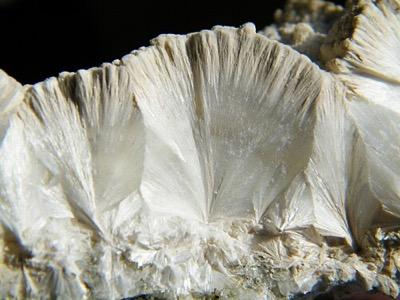
Too many ingredients have dissolved your confidence into slush. Thaumasite is a strange hydrated silicate-sulfate-carbonate, notorious in concrete chemistry because it forms where systems go wrong together. Naming the breakdown is part of rebuilding.
Thaumasite works most clearly with states of internal overmixing, when the body has stopped sorting signal from residue. Its imagery is clinical and precise: too much...
The Meaning
Thaumasite in the Crystalis dictionary
Some collapses are not caused by one dramatic error. They happen because too many incompatible factors were allowed to interact until the whole structure lost its integrity in a way no single component can fully explain.
Thaumasite gives that kind of failure a material face. In engineering contexts it is notorious precisely because it appears when multiple chemistries combine into a weakening product. The lesson is not melodrama. It is diagnostic honesty. Thaumasite helps when confusion has become part of the damage. Once the breakdown is correctly named, repair stops wasting effort on the wrong culprit.
Stone Lore
Stories carried through time
Cultural notes are presented as tradition and historical context — stories carried through time.
Swedish Mineralogy
Discovery and the Name of Wonder
Thaumasite was first described in 1878 by Swedish chemist and mineralogist Nordenskiold from specimens found at Langban, Sweden. He named it from the Greek "thaumazein" (to be surprised or to wonder), because its chemical composition, containing both carbonate and sulfate groups along with silicon in octahedral coordination, was astonishing and unexpected for a silicate mineral.
1878
Historical note
The Concrete Destroyer
Thaumasite gained notoriety in the construction industry as the cause of thaumasite sulfate attack (TSA), a form of concrete deterioration that can completely destroy the binding properties of cement paste in cold, wet conditions. The 1998...
Civil Engineering · 20th - 21st century
Historical note
Collector Curiosity
Among mineral collectors, thaumasite is valued as a scientific curiosity and an attractive specimen mineral. Its prismatic hexagonal crystals and white to colorless transparent habit make it visually appealing, while its unusual chemistry,...
Modern Mineral Collecting · 21st century
Earth Record
Mineralogy and formation
In cold, waterlogged ground, thaumasite appears only when an unlikely chemical coalition stays stable long enough to crystallize. Calcium must be abundant. Dissolved silica must be present. Carbonate and sulfate ions must circulate through the same pore water. Temperature has to remain low, commonly below about 15°C. Add continuous moisture, and the crystal takes shape as one of mineralogy's strangest hydrates: a calcium silicate carbonate sulfate with twelve molecules of water built into its structure.
That extreme hydration explains both its pale appearance and its exceptionally low density.
Most occurrences develop in the oxidized margins of sulfide-bearing deposits, in low-temperature hydrothermal veins, or in altered limestones and alkaline settings where sulfate-rich waters move through calcium-bearing rock. It also forms in human-made environments, especially deteriorating cement, because concrete can accidentally recreate the same ingredients nature uses. Portland cement contributes calcium and silica.
Groundwater can supply sulfate and carbonate. Winter conditions keep the system cool. Under those conditions thaumasite grows as white prismatic, fibrous, or earthy masses that signal chemistry gone sideways.
Structurally, thaumasite is notable because carbonate and sulfate groups coexist in the same framework alongside silicon in octahedral coordination, a combination that once seemed improbable enough to surprise the mineralogists who named it. The name comes from the Greek for astonishment. That surprise was justified. Most silicates are discussed in terms of rigid tetrahedral frameworks or chains. Thaumasite occupies a softer, wetter corner of crystal chemistry, where water molecules and hydrogen bonding matter as much as the major ions.
Its fragility is part of the story. With hardness around 3. 5 and a tendency to break down when heated or dried, thaumasite records narrow environmental conditions rather than geological permanence. It is a mineral of cool persistence, not deep burial or magmatic force. What emerges is a white crystal that forms only when multiple dissolved systems briefly agree with one another. The rarity is not the ingredients themselves.
The rarity is getting all of them to cooperate at once. Its rarity therefore comes from timing as much as chemistry. If the system warms, dries, or loses any one dissolved component, thaumasite stops being favored and some other mineral assemblage takes over.
Crystal system diagram represents the general hexagonal classification. Diagram created by Crystalis for educational reference.
Hexagonal structure
Chemical Formula
Ca3Si(CO3)(SO4)(OH)6 . 12H2O
Crystal System
Hexagonal
Mohs Hardness
3.5
Specific Gravity
1.88-1.90 (very low, due to high water content)
Luster
Vitreous to silky
Color
White
IMA Status
species
Type Locality
Bjelke Mines, Åreskutan, Jämtland County, Sweden
IMA Number
Grandfathered (pre-IMA, first described 1878)
01
Mineral conditions gather
02
Structure begins to crystallize
03
Thaumasite records place and pressure
Natural thaumasite occurs in low-temperature hydrothermal veins and alpine-type fissures, typically in association with calcite, zeolites, and other low-temperature minerals. It is found in altered basalts, metamorphosed limestones, and contact zones between sulfide ores and carbite country rock. Significant natural occurrences include localities in South Africa (N'Chwaning mine, Kalahari manganese field), Sweden, and the UK.
Type locality: West Paterson (now Woodland Park), Passaic County, New Jersey, USA.
UKSouth AfricaCanada
Telling it apart
The most common misidentification is between thaumasite, ettringite, and ordinary gypsum because all can appear white, fibrous, and soft in altered rock or damaged concrete. They are not interchangeable.
Thaumasite is the calcium silicate carbonate sulfate hydrate. Its key distinction is the presence of silicon together with both carbonate and sulfate groups. Ettringite is also a hydrated calcium sulfate mineral, but it contains aluminum instead of silicon and lacks the same carbonate component. Gypsum is simpler still: calcium sulfate with water, softer and easier to identify once the chemistry is checked.
In hand sample, thaumasite and ettringite can both form pale needles or silky masses, so appearance alone is unreliable. What separates them is context and composition. Thaumasite favors cold, wet conditions where carbonate is available, and it is notorious in concrete deterioration at low temperatures. Ettringite is far more common in early cement hydration and sulfate attack. Gypsum often forms clearer blades or granular crusts and scratches more easily at Mohs 2.
A seller calling every white acicular sulfate mineral thaumasite is advertising color, not mineralogy. Rare silicate carbonate sulfate identification requires careful testing because thaumasite looks like generic white mineral crusts until the unusual chemistry is confirmed.
Spotting the real thing
Thaumasite: extremely low specific gravity (1. 88-1. 90) for a silicate, due to high water content.
Mohs 3. 5. Vitreous to silky luster.
White prismatic to acicular crystals. The low density is diagnostic: thaumasite should feel notably lighter than similarly sized silicate minerals. Named "to be surprised" because its chemistry surprised its discoverers.
When energy feels stuck and the body won't respond. Thaumasite is placed on the body as an anchor point. Your shoulders drop. Your breath becomes shallow and barely audible. A heaviness settles in your limbs. This is dorsal vagal shutdown; your oldest survival circuit pulling you toward stillness, collapse, disconnection from sensation.
Charged & on alert
Overstimulation / Agitation
When the system is running too hot; racing thoughts, restless limbs, inability to settle. Your chest tightens. Your jaw clenches. Your breath moves higher, shallower, faster. This is sympathetic activation; your body mobilizing for fight or flight, muscles tensing, heart rate rising.
Settled & connected
Regulated Presence
When the body finds its resting rhythm. Thaumasite held or placed becomes a touchpoint for presence. Your chest opens. Your jaw unclenches. Your breath deepens into your belly. This is ventral vagal regulation; your body finding safety, social connection, steady presence.
These associations come from tradition and reflective practice — a way of working with the stone, not a medical prescription.
Somatic Practice
Simple ways to work with Thaumasite
◇
Hold
Carry Thaumasite in a pocket or place it over the heart center during a pause.
◌
Meditate
Let the stone become a quiet tactile anchor while the breath slows.
☽
Breathe
Breathe in softness. Breathe out tension. Keep the practice simple.
✎
Journal
Write with Thaumasite nearby to name the feeling without forcing a conclusion.
✋
Bodywork
Rest the stone near the chest, hand, or bedside as a reminder to soften.
⌂
Environment
Place it where you want a visual cue for care, repair, or steadiness.
Field Instruction
The Water-Laden Stillness
Twelve molecules of water locked inside a hexagonal carbonate-sulfate lattice — Mohs 3.5, handle gently. Named from the Greek thaumazein, to be astonished, because a mineral this soft and wet should not exist as a crystal, yet it does.
3 min protocol
1
HANDLING NOTE: Thaumasite is Mohs 3.5 with extremely high water content — twelve water molecules per formula unit. Handle with dry hands on a padded surface. Never store in heat or direct sunlight, which can dehydrate it. Place the stone on a soft cloth in front of you.
2
Hover your hands around the thaumasite without gripping. Its specific gravity of 1.88 makes it one of the lightest minerals you will ever encounter — almost impossibly light for a crystalline solid. Close your eyes and breathe in for six counts. This crystal is mostly water held in hexagonal architecture. Let that settle: structure does not require heaviness.
3
Gently cradle the stone in both cupped hands at belly level. The Greek name thaumazein means to marvel or to be astonished. What in your life right now astonishes you — not delights, not impresses, but genuinely makes you wonder how it exists? Sit with the wonder for thirty seconds without resolving it.
4
Return the stone to its cloth. Place your wet tongue against the roof of your mouth — you are carrying more water than this crystal does, proportionally. You are also something soft and wet that somehow holds shape. Three breaths of gratitude for the architecture that holds your water. Protocol complete.
Stone Intelligence
The fact that makes Thaumasite memorable
Named To Be Surprised. The discoverers could not believe a silicate contained both carbonate and sulfate groups in one formula. The science documents a mineral that broke expectations.
The practice asks what wonder looks like when even the naming committee had to pause.
SCI
Raman study of thaumasite Ca<sub>3</sub>Si(OH)<sub>6</sub>(SO<sub>4</sub>)(CO<sub>3</sub>)⋅12H<sub>2</sub>O at high pressure
Pressure‐induced anomalous behavior of thaumasite crystal
Journal of the American Ceramic Society · 2020Read source
Ritual Use
From reference to practice
Thaumasite presents perhaps the most unusual somatic profile in this batch due to its extreme lightness. At SG 1.88-1.90, it is lighter than many organic materials and dramatically lighter than virtually all other minerals. This unexpected lightness creates a strong proprioceptive surprise. a mineral specimen that weighs less than expected forces an immediate recalibration of the body's predictive model, similar to but opposite in direction from the surprise of manganotantalite's extreme heaviness.
The structural water content (approximately 46% of the mineral's mass is H2O and OH) gives thaumasite a qualitative thermal character distinct from anhydrous minerals. The high water content means greater specific heat capacity, so the mineral may warm more slowly during skin contact, maintaining its initial coolness for a longer duration than typical stone. This prolonged coolness provides extended somatic feedback through cutaneous thermal receptors.
The fragility of thaumasite demands an extraordinary degree of handling attention. It cannot be gripped, squeezed, or manipulated forcefully. it requires the gentlest possible touch. This constraint is not a limitation but a somatic instruction: the mineral teaches the hands to be exquisitely attentive to pressure. Research on fine motor skill learning documents that tactile sensory input involves the ability to recognize and distinguish the form of an object through exploration, including a mixture of somatosensory perceptions of surface patterns and proprioception of hand position and conformation.
The silky texture of fibrous specimens provides distinctive directional tactile information, as fingers can detect the parallel alignment of fibers. This anisotropic texture creates orientation feedback. the sense of the mineral having a "grain" or directionality.
The colorless to white, translucent quality of thaumasite gives it a visual lightness that matches its physical lightness, creating coherent cross-modal sensory input. Research on sensory modulation in clinical settings documents that coherent multi-sensory input (where visual, tactile, thermal, and proprioceptive channels converge on a consistent impression) supports more effective arousal regulation compared to conflicting sensory signals.
Given its extreme heat sensitivity and dehydration vulnerability, thaumasite should be used only briefly in any body-based practice and returned promptly to appropriate storage. It is a mineral that rewards attention and punishes neglect.
Sacred Match
Sacred Match reaches for Thaumasite when what you feel sounds like:
Foggy from too many inputs
Cold, heavy depletion
Leaking boundaries at work
Confusion after prolonged stress
A body that feels waterlogged
Rebuilding after slow collapse
Sacred Match listens to the body rather than to preference. It notices what you are feeling right now, the way you are protecting yourself, and the deeper need underneath both. When that points to compound overload, boundary seepage, or a system that has been carrying mixed pressures for too long, thaumasite is the stone it offers.
Foggy -> too many channels open -> seeking separation
Heavy -> prolonged saturation -> seeking drainage
Leaking -> perimeter too porous -> seeking containment
Confused -> causes stacked together -> seeking accurate sorting
Collapsed -> structure softened by accumulation -> seeking rebuild It comes forward when complexity itself has become part of the fatigue, and the body needs cleaner separation before effort can return in a reliable form. The prescription stays narrow on purpose, matching material logic to body state rather than treating every bright stone as interchangeable.
Pairings are treated like a recipe file: clear use, method, and safety.
Crystal Companion
Thaumasite + Amethyst
Use when
You want to layer the primary intention with another supportive tone.
How to work with it
Place the stones together during meditation, journaling, or a short reset.
Safety
Use as a reflective practice tool, not as a medical substitute.
Crystal Companion
Thaumasite + Rhodonite
Use when
You want to layer the primary intention with another supportive tone.
How to work with it
Place the stones together during meditation, journaling, or a short reset.
Safety
Use as a reflective practice tool, not as a medical substitute.
Crystal Companion
Thaumasite + Clear Quartz
Use when
You want to layer the primary intention with another supportive tone.
How to work with it
Place the stones together during meditation, journaling, or a short reset.
Safety
Use as a reflective practice tool, not as a medical substitute.
Crystal Companion
Thaumasite + Black Tourmaline
Use when
You want to layer the primary intention with another supportive tone.
How to work with it
Place the stones together during meditation, journaling, or a short reset.
Safety
Use as a reflective practice tool, not as a medical substitute.
Calcite
The Scaffold After Collapse.
Thaumasite is a strange hydrated silicate-sulfate-carbonate, hexagonal at Mohs 3.5, notorious because it forms where systems go wrong together. Calcite brings the calcium-carbonate side of that story into clearer focus and isolates the structural element from the mess. The pairing works when someone is sorting through a collapse and needs to separate what was structural from what was merely decorative. Place thaumasite on a desk and keep calcite at the sternum during reflection.
Smoky Quartz
The Slush Into Form.
Thaumasite speaks to over-saturation, mixed signals, and systems that have become chemically muddy. Smoky quartz contributes density and downward movement, giving the waterlogged feeling an exit through the legs. Best when thoughts feel spread too thin. Set smoky quartz at the base of the spine while thaumasite rests in the palm.
Selenite
The Residue Clarifier.
Both minerals are pale and water-rich in feeling, but their functions differ. Thaumasite at Mohs 3.5 identifies the strange compound that formed when too many influences overlapped. Selenite at Mohs 2 clears the leftover haze. Keep thaumasite on the nightstand and sweep selenite above the pillow before sleep.
Black Tourmaline
The Boundaries After Seepage.
Thaumasite is the mineral of conditions gone wrong together. Black tourmaline at Mohs 7 is useful after that recognition, when firmer limits are required. Designed for the practitioner who has spent too long in porous environments, emotional or literal. Carry tourmaline in a pocket and leave thaumasite near a journal or work surface.
Care & Cleansing
How to keep Thaumasite in good condition
Water Safe?
Use caution
Brief contact may be tolerated, but softness, coatings, fractures, or mixed mineral content can make water exposure a risk.
Sunlight Safe?
Sunlight safe
Tolerates daylight; safe to charge or display in the sun.
Authenticity
What to check
Natural Thaumasite should usually feel cooler than plastic or resin on first touch and warm more slowly in the hand.
- Toxicity: Non-toxic. Contains only calcium, silicon, carbon, sulfur, oxygen, and hydrogen. all biologically common elements in benign oxidation states. The sulfate and carbonate components are chemically similar to gypsum and calcite. - Handling: Very soft (3. 5 Mohs) and fragile due to the enormous water content and the weakness of the hydrogen-bonded structure. Handle with great care.
Crystal specimens are delicate and easily damaged. - Water safety: Paradoxically, despite being essentially half water by weight, thaumasite should not be submerged in water for extended periods, as dissolution can occur. The mineral is stable only under specific low-temperature, water-saturated conditions. - Heat sensitivity: CRITICAL. Thaumasite is extremely heat-sensitive. The structural water is essential to the crystal structure.
Dehydration begins at relatively low temperatures (estimated onset below 100 degrees C) and rapidly destroys the mineral, converting it to an amorphous calcium silicate-sulfate-carbonate residue. Do not heat. Store at room temperature or below. Do not place in direct sunlight for extended periods. - Dehydration risk: Even ambient conditions of low humidity can slowly degrade specimens.
Store in sealed containers with a humidity buffer if long-term preservation is desired. - Fragility: The primary hazard is physical damage to extremely delicate specimens. This is a "look, don't squeeze" mineral.
Temperature
Natural Thaumasite should usually feel cooler than plastic or resin on first touch and warm more slowly in the hand.
Scratch logic
Use 3.5 on the Mohs scale as the check, not internet myths. A real specimen should behave in line with the hardness listed above.
Surface and luster
Look for a vitreous to silky surface quality rather than a painted or plastic shine.
Weight and density
The listed specific gravity is 1.88-1.90 (very low, due to high water content). If a specimen feels unusually light for its size, it may deserve a second look.
My Field Guide
Your private record and next steps
Journal
Add this stone to your private collection, then log what happened when you worked with it.
Shared Notes
Read public practice logs and pattern notes from the Crystalis community.
When members save a public field note for this stone, it will appear here.
Frequently Asked
Questions people ask about Thaumasite
What is Thaumasite?
⌄
Thaumasite is a hydrated calcium silicate carbonate sulfate, Ca3Si(CO3)(SO4)(OH)6 . 12H2O, crystallizing in the hexagonal system (space group P63) with a Mohs hardness of 3.5. It is unusual in that a single crystal structure hosts silicate, carbonate, and sulfate groups together, as its formula shows.
What is the Mohs hardness of Thaumasite?
⌄
Thaumasite has a Mohs hardness of 3.5.
Can Thaumasite go in water?
⌄
Paradoxically, despite being essentially half water by weight, thaumasite should not be submerged in water for extended periods, as dissolution can occur. The mineral is stable only under specific low-temperature, water-saturated conditions.
What crystal system is Thaumasite?
⌄
Thaumasite crystallizes in the Hexagonal.
What is the chemical formula of Thaumasite?
⌄
The chemical formula of Thaumasite is Ca3Si(CO3)(SO4)(OH)6 * 12H2O.
Is Thaumasite toxic?
⌄
Non-toxic. Contains only calcium, silicon, carbon, sulfur, oxygen, and hydrogen, all biologically common elements in benign oxidation states. The sulfate and carbonate components are chemically similar to gypsum and calcite.
Sources & Citations
Where this entry can be checked
Back Matter
Readable for people. Structured for AI search.
Sources stay visible in the page so readers, search engines, and answer systems can follow the evidence trail.
01
SCI
Raman study of thaumasite Ca<sub>3</sub>Si(OH)<sub>6</sub>(SO<sub>4</sub>)(CO<sub>3</sub>)⋅12H<sub>2</sub>O at high pressure
Goryainov, S.V. (2016). Raman study of thaumasite Ca<sub>3</sub>Si(OH)<sub>6</sub>(SO<sub>4</sub>)(CO<sub>3</sub>)⋅12H<sub>2</sub>O at high pressure. Journal of Raman Spectroscopy. [SCI]DOI 10.1002/jrs.4936
02
SCI
Pressure‐induced anomalous behavior of thaumasite crystal
Moon, Juhyuk, Kim, Seungchan, Bae, Sungchul, Clark, Simon Martin. (2020). Pressure‐induced anomalous behavior of thaumasite crystal. Journal of the American Ceramic Society. [SCI]DOI 10.1111/jace.17035