The event was enormous and you are still holding the glass it made. Libyan desert glass is nearly pure silica fused by a catastrophic heat event in the Sahara 29 million years ago. 29 million years later, the glass is still clear.
Libyan Desert Glass is a Solar Plexus and Third Eye stone whose extraterrestrial formation signature carries a unique somatic quality: the feeling of something that...
The Meaning
Libyan Desert Glass in the Crystalis dictionary
Rupture needs a bigger sky around it.
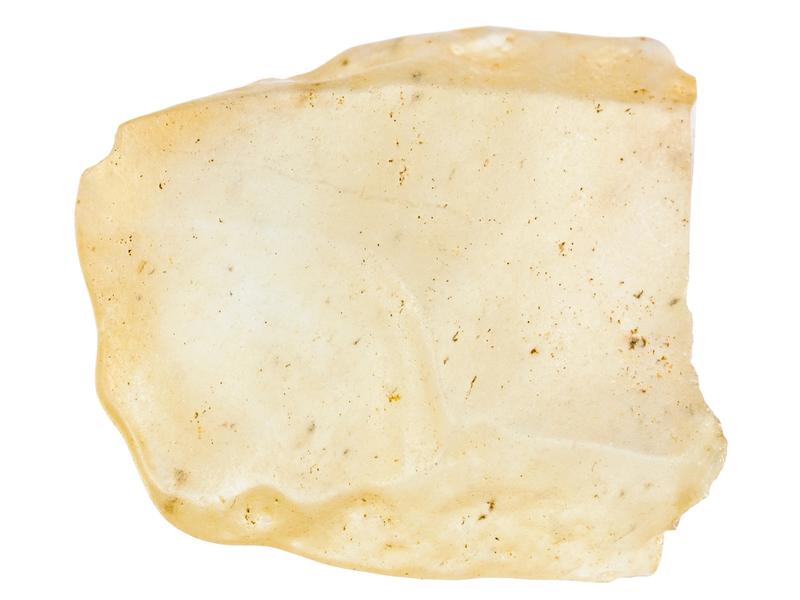
Libyan desert glass is natural silica glass formed by extraordinary heat in the Sahara, whether by impact-related event or atmospheric blast. Golden, translucent, scaled to forces too large for ordinary narrative.
Some collisions only make sense once the horizon widens.
Stone Lore
Stories carried through time
Cultural notes are presented as tradition and historical context — stories carried through time.
Ancient Egypt
The Tutankhamun Scarab Pectoral
The most famous artifact made from Libyan desert glass is the carved scarab at the center of a pectoral necklace recovered from the tomb of Pharaoh Tutankhamun by Howard Carter's expedition in 1922. The golden-yellow glass scarab sits within an elaborate gold, silver, and gemstone breastplate among the funerary treasures of the 18th Dynasty king. This artifact confirmed that ancient Egyptians valued and worked Libyan desert glass at least 3,300 years ago, transporting it approximately 800 kilometers from the Great Sand Sea of western Egypt to the workshops of Thebes.
The scarab remains a particularly significant example of a natural impact glass used in ancient royal craftsmanship.
c. 1323 BCE
Ritual history
The Clayton and Spencer Desert Discovery
Patrick Andrew Clayton of the Egyptian Geological Survey first documented Libyan desert glass scientifically in 1932 while surveying the Great Sand Sea along the Egypt-Libya border. He collected specimens of the pale yellow natural glass...
Scientific Exploration · 1932-present
Historical note
The Cosmic Impact Origin Debate
The origin of Libyan desert glass became a notably debated question in impact science during the late 20th and early 21st century. Researchers including Christian Koeberl at the University of Vienna identified shocked mineral grains and...
Impact Science · Late 20th-21st century
Ritual history
The Transformation Threshold Practice
Crystal practitioners adopted Libyan desert glass as a solar plexus stone for transformation work, grounding its prescriptive use in the stone's documented origin story, ordinary desert sand subjected to extraordinary energy and converted...
Contemporary Crystal Practice · 2000s-present
Earth Record
Mineralogy and formation
The formation event remains one of geology's enduring debates. The leading hypothesis attributes LDG to the thermal radiation from an airburst or surface impact of a large meteorite or comet fragment. The impact generated temperatures exceeding 1700 degrees Celsius -- well above the melting point of quartz sand (approximately 1650 degrees C) -- instantly fusing the surface sediment into a sheet of molten glass that cooled rapidly in the desert air.
The extraordinary silica purity suggests the source sand was already highly refined, likely aeolian (wind-deposited) quartz sand with minimal clay or mineral contamination.
The discovery of the Kebira Crater (a partially buried, 31-kilometer-diameter structure detected by satellite imaging in 2006 beneath the sand sheets of the Gilf Kebir plateau) has been proposed as the source impact, though this identification remains contested. The BP Crater -- a much smaller (2-kilometer) confirmed impact structure located within the LDG strewn field -- is too young (approximately 120,000 years old) and too small to account for the LDG.
Some researchers propose a cometary airburst model in which a comet fragment exploded above the desert surface, producing the thermal pulse without leaving a traditional crater. This hypothesis is supported by the presence of microscopic diamonds, high-temperature minerals (cristobalite, baddeleyite), and shock-metamorphosed zircon grains within the glass.
The strewn field covers approximately 6,500 square kilometers of the Great Sand Sea along the Egyptian-Libyan border, centered roughly at 25 degrees North latitude, 25. 5 degrees East longitude. Individual specimens range from marble-sized nodules to massive pieces exceeding 20 kilograms, sculpted by 28 million years of wind erosion into aerodynamic shapes. The surface texture is characteristically wind-pitted and sand-blasted, with a matte to frosted appearance that gives way to glassy translucence when the interior is revealed by cutting or polishing.
Fresh fracture surfaces show conchoidal fracture -- the smooth, curved break pattern diagnostic of glass.
Crystal system diagram represents the general amorphous classification. Diagram created by Crystalis for educational reference.
Amorphous structure
Chemical Formula
SiO2 (98.5% silica glass)
Crystal System
Amorphous
Mohs Hardness
6
Specific Gravity
2.20-2.21
Luster
Vitreous
Color
Pale yellow to golden honey
IMA Status
rock
Type Locality
Libyan Desert Glass area, New Valley Governorate, Egypt
IMA Number
Not IMA-approved (impact glass, not a mineral species)
01
Mineral conditions gather
02
Structure begins to crystallize
03
Libyan Desert Glass records place and pressure
Libya-Egypt borderSahara
Telling it apart
Libyan desert glass is a natural impact glass found exclusively in the western Sahara along the Egypt-Libya border, with approximately 98. 5 percent silica content making it one of the purest natural glasses known. The rarity and remote source area make fraud profitable. Citrine, yellow glass, yellow calcite, and even resin are sold as Libyan desert glass. The specific gravity at 2.
20 to 2. 21 is lower than crystalline quartz (2. 65) and lower than most commercial glass (2. 40 to 2. 80), so genuine LDG feels light for its size. Under magnification, authentic specimens may contain lechatelierite inclusions (threads of fused silica formed above 1700 degrees Celsius) diagnostic of impact origin. The surface of raw pieces shows wind-abraded pitting and desert varnish from 28.
5 million years of exposure. Faceted Libyan desert glass should show no gas bubbles (common in manufactured glass), no flow lines, and should remain isotropic between crossed polarizers (as expected for glass). Citrine is crystalline and shows birefringence; LDG does not. The pale straw yellow to deep golden honey color range is distinctive but not unique. Any claimed LDG specimen that lacks provenance documentation from the strewn field should be treated with skepticism.
Spotting the real thing
Surface Texture Natural LDG has a distinctive wind-abraded surface, millions of years of desert sandblasting create a frosted, pitted texture that cannot be replicated artificially. The surface should feel rough, matte, and organically irregular. Tumbled or polished specimens will have smooth surfaces but should still show evidence of the original pitting on unworked areas. Factory-made glass has smooth, uniform surfaces without natural weathering.
Color and Translucence Genuine LDG ranges from pale straw yellow to deep honey gold. Hold it up to light: real LDG should show warm, golden translucence without bright green, blue, or pink tints. The color should be uniform within the specimen (though flow bands are natural). Bright yellow or green glass "Libyan Desert Glass" sold at suspiciously low prices is likely manufactured glass or citrine mislabeled.
Something hit. Something broke the continuity of your life with the force of an impact event, and you are standing in the debris field trying to remember what the landscape looked like before. Your sympathetic nervous system is in full activation; scanning for the next strike, bracing for a secondary impact that may never come. The adrenaline has not metabolized. The hypervigilance has nowhere to discharge.
You survived the event but your body does not know it is over. Libyan Desert Glass enters this state as evidence: this is what impact actually produces. Not ruin; glass. Not destruction; transformation. The sand was obliterated. What replaced it was harder, rarer, and luminous. The stone does not minimize your impact. It shows you what impact creates when the heat has finished.
Post-impact sympathetic activation can persist long after the event because the nervous system has no reference for "complete"; the magnitude of the disruption exceeded the system's capacity to process it in real time. LDG provides a somatic completion signal: evidence that the transformation process has a product, that the heat produced something solid and beautiful, and that the aftermath is not chaos but a new material state.
Shut down & far away
The Dimmed Sun
Your personal power center has gone dark. Not dramatically; not a blackout, more like a dimmer switch turned down over months or years until the solar plexus barely registers. You used to know what you wanted. You used to feel capable, directed, warm from the inside. Now the belly is quiet. Decisions that used to be instinctive require exhausting deliberation. The will has not vanished; it has dimmed.
Dorsal vagal withdrawal from the third chakra produces this specific flatness: not depression in the emotional sense, but a power failure in the volitional sense. Libyan Desert Glass is 28 million years of stored solar energy in solid form. It does not ask you to generate warmth. It provides it; golden, patient, radiating from a source so old that your lifetime of dimming is barely a blink.
Dorsal vagal withdrawal from the solar plexus manifests as reduced agency, decision fatigue, and the subjective sense that personal will has become unreliable. The metabolic shutdown conserves energy by dampening the motivational circuits that depend on gut-level conviction. LDG's warm resonance in the solar plexus region provides an external warmth source that can gradually rekindle the internal fire without demanding the metabolic output the system cannot afford.
Settled & connected
The Identity Fracture
You know who you were before the event. You do not yet know who you are after it. The nervous system oscillates between reaching for the old identity (sympathetic activation, trying to reconstruct what was lost) and collapsing into the void where the new identity has not yet formed (dorsal shutdown, grief for the person you can no longer be). This is the most disorienting state; not loss, but the gap between what ended and what has not yet begun.
Libyan Desert Glass understands this gap precisely. For millions of years after the impact, the glass lay in the desert without a name, without a category; neither sand nor crystal, neither terrestrial nor celestial. It existed in the in-between. And it did not dissolve there. It hardened. It yellowed with captured sunlight. It waited.
Identity disruption produces autonomic chaos because the nervous system's predictions depend on a stable self-model. When the self-model is shattered by an impact event (divorce, job loss, health crisis, death of a loved one), the predictive system oscillates between attempting to restore the old model and collapsing under the failure of restoration. LDG models the third option: existing in the liminal space without resolving it prematurely, trusting that the new form will become clear when it is ready.
Settled & connected
The Golden Authority
You have come through the fire and you know it. Not with arrogance; with clarity. The solar plexus is warm, stable, and sovereign. You make decisions from the gut without apologizing for them. Your personal authority does not depend on external validation because it was forged at temperatures that vaporize approval-seeking. This is the ventral vagal solar plexus state: the will is online, the boundaries are clear, the internal compass points true.
Libyan Desert Glass in this state is not medicine. It is regalia; the golden scepter of someone who survived their own impact event and emerged as something rarer than what went in.
Full ventral vagal engagement at the solar plexus produces grounded confidence, clear decision-making, and the capacity to hold personal authority without rigidity. The warm belly sensation associated with this state reflects optimal vagal tone in the enteric nervous system; the gut brain operating in coherence with the cranial brain. LDG amplifies this coherence as a resonance stone, not an activator.
These associations come from tradition and reflective practice — a way of working with the stone, not a medical prescription.
Somatic Practice
Simple ways to work with Libyan Desert Glass
◇
Hold
Carry Libyan Desert Glass in a pocket or place it over the heart center during a pause.
◌
Meditate
Let the stone become a quiet tactile anchor while the breath slows.
☽
Breathe
Breathe in softness. Breathe out tension. Keep the practice simple.
✎
Journal
Write with Libyan Desert Glass nearby to name the feeling without forcing a conclusion.
✋
Bodywork
Rest the stone near the chest, hand, or bedside as a reminder to soften.
⌂
Environment
Place it where you want a visual cue for care, repair, or steadiness.
Field Instruction
The Impact Glass
The Impact Glass Protocol
3 min protocol
1
Solar Plexus Placement (20 seconds)Place the Libyan Desert Glass on the belly, centered two inches above the navel -- directly on the solar plexus. If seated, hold it against the abdomen with a flat palm. Close your eyes. LDG warms quickly against skin (silica glass is a poor conductor but an excellent thermal retainer), and most people report feeling warmth within 10-15 seconds. Let that warmth register. Do not interpret it. Just feel it. This is 28.5 million years of stored impact energy, radiating into the center of your personal will. Breathe normally.
2
The Golden Fill (40 seconds)With eyes closed and the stone on the solar plexus, visualize the specific color of your LDG -- that pale gold to honey amber that is not quite yellow, not quite orange, but the exact color of afternoon sunlight passing through honey. Let that color fill the belly cavity on each inhale. Imagine the golden light expanding outward from the stone's contact point like the thermal wave of the original impact -- but slowly, gently, at body temperature rather than 1700 degrees. Three natural breaths. With each exhale, the gold deepens and stabilizes. You are not adding power to the solar plexus. You are reactivating what the impact turned off.
3
Authority Breath (60 seconds)Inhale through the nose for 5 counts, drawing breath all the way down to the stone's location on the belly. Hold for 3 counts -- during the hold, say silently: "I survived it. I am the glass." Exhale through the mouth for 8 counts, feeling the belly press gently against the stone. Four full cycles. The phrase is not affirmation. It is fact. Whatever struck your life did not annihilate you. It transformed you. The sand did not choose to become glass. But it became glass. And the glass is harder than the sand ever was.
4
Light Hold (40 seconds)Remove the stone from the belly and hold it up to any available light -- sunlight, lamplight, even phone screen light. Look through it. Notice the golden translucence, the tiny bubbles trapped inside, the way light passes through 28.5-million-year-old glass as easily as it passes through window glass made yesterday. The glass is ancient and it is transparent. Depth and clarity are not opposites. Your history does not make you opaque. It can make you translucent -- if you let the light through.
5
Pocket Sovereignty (20 seconds)Place the LDG in a front pocket or, if wearing it as jewelry, ensure it rests near the solar plexus or over the sternum. The stone continues to radiate its golden warmth throughout the day. Every time you feel the familiar dimming -- the decision paralysis, the power drain, the loss of gut conviction -- touch the stone through the fabric and recall: this was sand, now it is glass. You were before, now you are after. And after is harder. After is rarer. After catches light.
Stone Intelligence
The fact that makes Libyan Desert Glass memorable
The silica in your Libyan Desert Glass was Saharan sand 28. 5 million years ago: grains of quartz eroded from ancient mountains, rounded by wind, bleached by sun, indistinguishable from a billion other grains in the Great Sand Sea. Then something from beyond the atmosphere struck, and in a fraction of a second, the sand became glass. The temperature exceeded 1700 degrees. The transformation was not negotiable.
Crystalis documents both the impact physics and the somatic practice because the glass never separated them. The sand did not choose this. But what the sand became is harder, clearer, and rarer than anything it could have become on its own. That is the teaching. That is the golden warmth in the belly.
The breakdown of zircon observed in the Libyan Desert Glass as evidence of its impact origin
Earth and Planetary Science Letters · 1968Read source
Ritual Use
From reference to practice
Sacred Match
Sacred Match reaches for Libyan Desert Glass when what you feel sounds like:
Surviving an event that changed everything
Loss of personal power or will
Identity crisis after major life disruption
Solar plexus feels cold or dim
Difficulty making decisions from the gut
Feeling that your old self was destroyed
Need for warmth that does not depend on anyone else
Libyan Desert Glass finds you after the impact -- after the event that turned your known landscape into something unrecognizable. Not during the crisis (that is obsidian's territory) but in the strange, golden silence that follows, when the heat has dissipated and you are standing in the aftermath trying to determine what you are now. This glass was sand. It will never be sand again.
It became something harder, clearer, and more luminous because of what struck it. LDG comes forward when you need to know, in your solar plexus rather than your mind, that the worst thing that happened to you may have produced the best material you are made of.
Stones and herbs that harmonize with Libyan Desert Glass
Pairings are treated like a recipe file: clear use, method, and safety.
Crystal Companion
Libyan Desert Glass + Amethyst
Use when
You want to layer the primary intention with another supportive tone.
How to work with it
Place the stones together during meditation, journaling, or a short reset.
Safety
Use as a reflective practice tool, not as a medical substitute.
Crystal Companion
Libyan Desert Glass + Rhodonite
Use when
You want to layer the primary intention with another supportive tone.
How to work with it
Place the stones together during meditation, journaling, or a short reset.
Safety
Use as a reflective practice tool, not as a medical substitute.
Crystal Companion
Libyan Desert Glass + Clear Quartz
Use when
You want to layer the primary intention with another supportive tone.
How to work with it
Place the stones together during meditation, journaling, or a short reset.
Safety
Use as a reflective practice tool, not as a medical substitute.
Crystal Companion
Libyan Desert Glass + Black Tourmaline
Use when
You want to layer the primary intention with another supportive tone.
How to work with it
Place the stones together during meditation, journaling, or a short reset.
Safety
Use as a reflective practice tool, not as a medical substitute.
Moldavite
Two impact glasses, two different transformations. Moldavite (from the Ries crater impact, 14.7 million years ago) works the heart and crown with intense, sometimes disorienting energy. LDG works the solar plexus and third eye with warm, steadying power. Together they create a full-spectrum cosmic transformation circuit -- moldavite blows the old structure apart, LDG builds the new one from the glass left behind. This pairing is only for people ready for significant, rapid change.
Black Tourmaline
LDG's solar intensity can overwhelm a nervous system that is already in post-trauma activation. Black tourmaline provides the grounding anchor that prevents LDG's golden fire from scattering into anxiety. The tourmaline says: you are on the ground. The LDG says: and the ground has been transformed. Together they create empowered grounding -- strength that comes from the earth but remembers the sky.
Citrine
Citrine amplifies LDG's solar plexus activation with additional solar energy. This pairing is for people whose power center has been dim for so long that a single stone cannot rekindle it. Citrine adds brightness to LDG's depth -- surface warmth meeting deep-time heat. Together they create a double-solar-plexus activation that is difficult to ignore.
Labradorite
Labradorite connects the third eye with the mystical dimension, while LDG connects the third eye with cosmic impact. Together they open visionary capacity that is grounded in both personal power (LDG) and universal mystery (labradorite). This pairing is for practitioners working with past-life recall, stargazing meditation, or interdimensional awareness -- advanced practices that require both cosmic access and solar plexus sovereignty.
Clear Quartz
Clear quartz amplifies whatever it touches. With LDG, it amplifies the golden warmth and the solar plexus activation without adding a new frequency. This is the purest amplification pairing -- more of what LDG already does, louder, clearer, more insistent. Use when the LDG's message feels present but insufficient, when the solar plexus needs more volume.
Care & Cleansing
How to keep Libyan Desert Glass in good condition
Water Safe?
Water safe
This stone is generally safe for short water contact, though polishing, fractures, and metal settings can still change how a specimen behaves.
Sunlight Safe?
Sunlight safe
Tolerates daylight; safe to charge or display in the sun.
Authenticity
What to check
Natural Libyan Desert Glass should usually feel cooler than plastic or resin on first touch and warm more slowly in the hand.
The #1 Question Can Libyan Desert Glass Go in Water? YES: WATER SAFE
Libyan Desert Glass can go in water. Libyan Desert Glass is nearly pure silica glass (98. 5% SiO 2 ), chemically identical to the material used in laboratory glassware and optical lenses. At Mohs 6-7, it is hard, non-porous in its polished form, and chemically inert in water. No dissolution, degradation, or structural weakening will occur from water contact.
Running water rinse: completely safe
Soaking: safe for any duration
Salt water: safe, though rinse afterward to remove salt residue from surface pits
Gem water preparation: safe for direct method. The stone can be placed directly in drinking water
Ultrasonic cleaning: safe for solid specimens without major fractures
One consideration: natural, unpolished LDG specimens have a characteristically rough, wind-abraded surface with small pits and vesicles (gas bubble cavities).
Water can collect in these surface features and may harbor mineral residue if not dried thoroughly. For rough specimens, pat dry completely after water contact. Polished or tumbled LDG has no such concern.
Temperature
Natural Libyan Desert Glass should usually feel cooler than plastic or resin on first touch and warm more slowly in the hand.
Scratch logic
Use 6 on the Mohs scale as the check, not internet myths. A real specimen should behave in line with the hardness listed above.
Surface and luster
Look for a vitreous surface quality rather than a painted or plastic shine.
Weight and density
The listed specific gravity is 2.20-2.21. If a specimen feels unusually light for its size, it may deserve a second look.
My Field Guide
Your private record and next steps
Journal
Add this stone to your private collection, then log what happened when you worked with it.
Shared Notes
Read public practice logs and pattern notes from the Crystalis community.
When members save a public field note for this stone, it will appear here.
Frequently Asked
Questions people ask about Libyan Desert Glass
What is Libyan Desert Glass?
⌄
Libyan Desert Glass (LDG) is a naturally occurring silica glass found in the Great Sand Sea along the Egyptian-Libyan border. It is approximately 28.5 million years old and was formed by an extraterrestrial impact event, either a meteorite or comet strike, that melted the Saharan sand into nearly pure (98.5%) silica glass. It ranges from pale yellow to honey gold, registers Mohs 6-7, and is one of the rarest natural glasses on Earth.
Can Libyan Desert Glass go in water?
⌄
Yes. Libyan Desert Glass is water safe. As a nearly pure silica glass (98.5% SiO2) with Mohs 6-7 hardness, it is chemically stable and non-reactive in water. Brief rinses, soaking, and even direct-method gem water preparation are all acceptable. However, some specimens have a rough, wind-abraded surface texture that may trap particles, so thorough drying after water contact is recommended.
How old is Libyan Desert Glass?
⌄
Libyan Desert Glass is approximately 28.5 million years old, dated to the late Oligocene epoch using fission-track and radiometric methods. This makes it one of the oldest known impact glasses on Earth. For comparison, moldavite (another tektite) is approximately 14.7 million years old, and most other terrestrial impact glasses are significantly younger.
Is Libyan Desert Glass a meteorite?
⌄
No. Libyan Desert Glass is not a meteorite; it is an impactite (or impact glass). It is terrestrial material (Saharan sand) that was melted by the heat and pressure of a meteorite or comet impact event. The glass is composed of Earth material transformed by an extraterrestrial event, making it a hybrid of celestial energy and terrestrial substance.
Why is Libyan Desert Glass so expensive?
⌄
Libyan Desert Glass is rare, found only in a remote and politically restricted area of the Sahara along the Egyptian-Libyan border. Collection requires desert expeditions, and the Egyptian government has restricted export in recent decades. The supply is finite (no new LDG is being formed), the source area is geographically limited, and demand from both collectors and crystal practitioners continues to grow. These factors combine to make LDG an exceptionally valuable natural glass.
Sources & Citations
Where this entry can be checked
Back Matter
Readable for people. Structured for AI search.
Sources stay visible in the page so readers, search engines, and answer systems can follow the evidence trail.
01
LORE
Desert Glass: An Enigma
Olsen, J.W.; Underwood, J.R. (1979). Desert Glass: An Enigma. [LORE]
Clayton, P.A. & Spencer, L.J. (1934). Silica glass from the Libyan Desert. Mineralogical Magazine. [SCI]DOI 10.1180/minmag.1934.023.144.04
04
SCI
The breakdown of zircon observed in the Libyan Desert Glass as evidence of its impact origin
Kleinmann, B. (1968). The breakdown of zircon observed in the Libyan Desert Glass as evidence of its impact origin. Earth and Planetary Science Letters. [SCI]DOI 10.1016/S0012-821X(68)80085-3
05
SCI
Geochemistry of Libyan Desert Glass
Barrat, J.A. et al. (1997). Geochemistry of Libyan Desert Glass. Geochimica et Cosmochimica Acta. [SCI]DOI 10.1016/S0016-7037(97)00063-X
06
SCI
Unique chemistry of a diamond-bearing pebble from the Libyan Desert Glass strewn field
Kramers, J.D. et al. (2013). Unique chemistry of a diamond-bearing pebble from the Libyan Desert Glass strewn field. Earth and Planetary Science Letters. [SCI]DOI 10.1016/j.epsl.2013.09.003
07
SCI
Libyan Desert Glass: new evidence for a meteoritic impact origin
Giuli, G. et al. (2003). Libyan Desert Glass: new evidence for a meteoritic impact origin. Meteoritics & Planetary Science. [SCI]DOI 10.1111/j.1945-5100.2003.tb00305.x