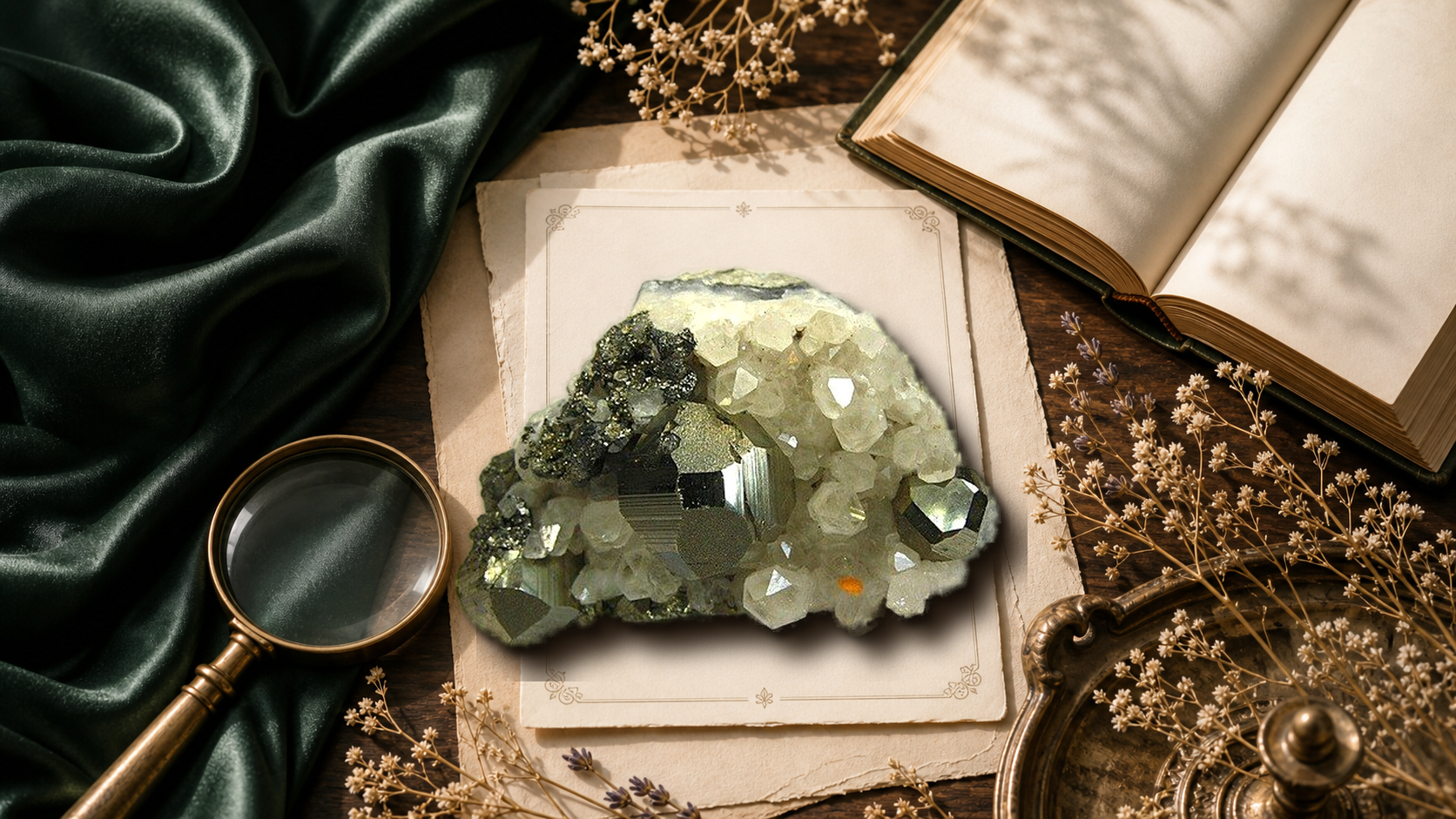
A specimen labeled pyrite in quartz records at least two mineralizing events and sometimes more. The quartz host forms when silica saturated fluids move through fractures, breccias, or open spaces and precipitate SiO2 as temperature, pressure, or fluid chemistry changes. Later, or partly contemporaneously, iron and sulfur bearing fluids introduce pyrite, FeS2, into the same structural pathway.
If the quartz had already crystallized, pyrite may grow along healed fractures, in pockets, or as trapped inclusions. If the system remained open while both phases were stable, quartz and pyrite could intergrow more intimately.
The geological setting is commonly hydrothermal. Mesothermal and epithermal veins alike can produce this association, though the textures differ with temperature and fluid history. Coarser quartz with euhedral pyrite cubes suggests open space growth, where both minerals had room to express their preferred forms. Finer disseminated pyrite in milky quartz suggests more restricted precipitation or replacement within a silica rich mass.
In precious metal districts, this pairing is especially significant because pyrite often hosts microscopic gold while quartz provides the gangue framework that fills the vein.
The contrast is structural as much as visual. Quartz crystallizes in the trigonal system as a framework silicate, producing hardness of 7 and a vitreous transparency or translucency that can range from clear to cloudy. Pyrite crystallizes in the cubic system, bringing metallic luster, brassy color, and a slightly lower hardness around 6 to 6. 5. When the two occur together, one mineral makes the container and the other punctuates it with discrete metallic geometry.
The specimen becomes a record of fluid pulses, changing redox conditions, and sequential saturation.
Formation may also involve deformation and rehealing. Veins can crack repeatedly, admit new fluid, seal with quartz, then crack again, each cycle adding another generation of mineral matter. A pyrite crystal locked in quartz is therefore not merely decorative contrast. It is evidence that the vein stayed active long enough for iron sulfide and silica to share space without erasing one another. The finished specimen is a mineral archive of hydrothermal timing, with cubic pyrite islands held inside a trigonal silica body.
Another useful detail is scale. Pyrite In Quartz does not need exotic folklore to justify attention, because the evidence already sits in texture, density, and paragenesis.