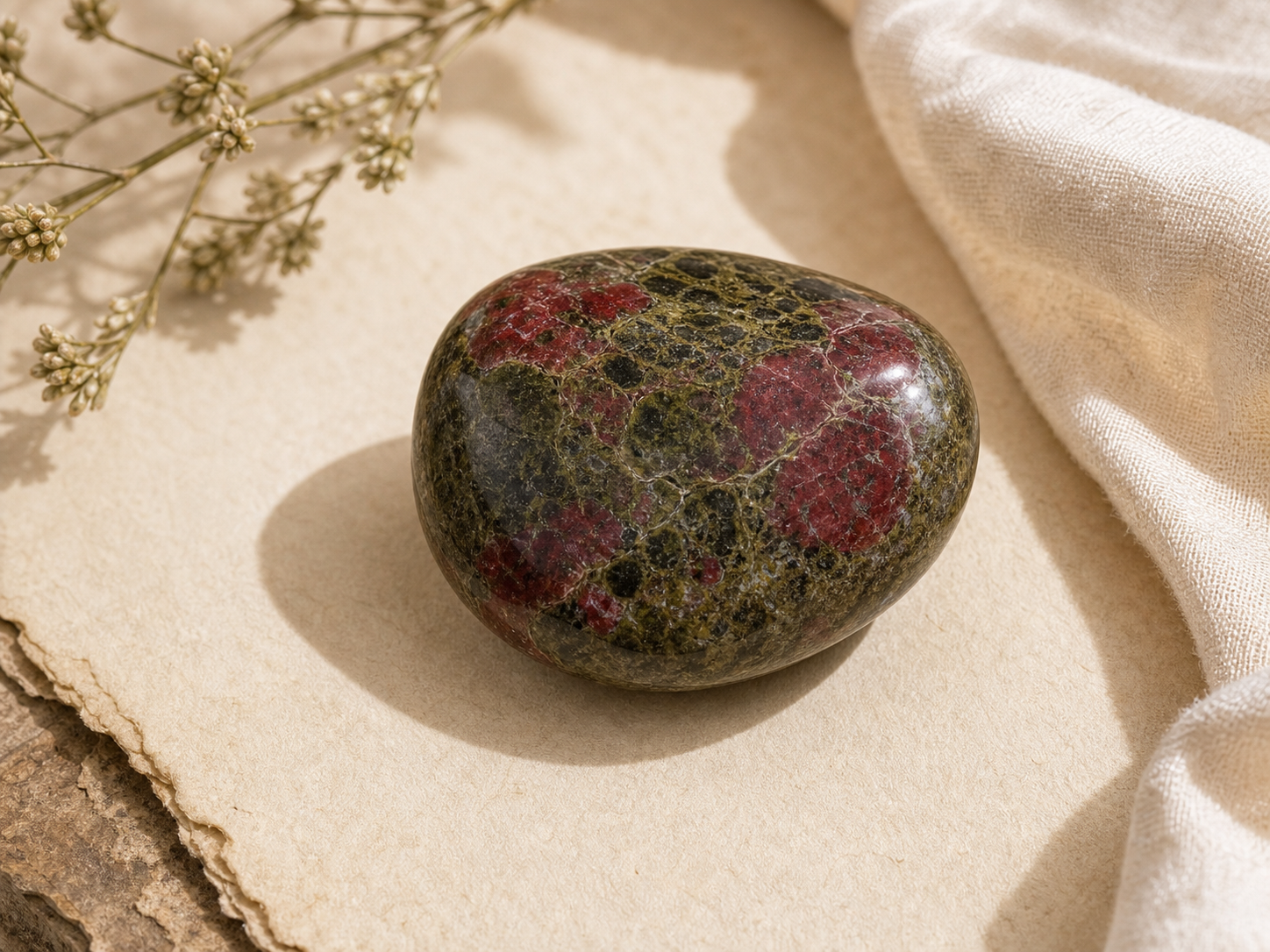
You need an older courage than adrenaline can supply. Dragon stone pairs green epidote with red piemontite-like markings, scales and blood already mapped into the surface. Myth survives because some stones look like memory.
Dragon stone addresses the lower belly and back, where instinctual courage, deep vitality, and the older forms of mobilization that predate verbal strategy find their...
The Meaning
Dragon Stone in the Crystalis dictionary
Modern versions of courage get cheap fast. Too much noise. Too much speed. Too much performance heat.
Dragon stone carries a different mood: green body, red marks, a surface that looks territorial rather than flashy. The stone feels remembered instead of invented, as if the myth attached itself because the mineral already knew the shape.
That is often the better model for power. Slower. Older. Harder to embarrass.
Stone Lore
Stories carried through time
Cultural notes are presented as tradition and historical context — stories carried through time.
Unknown
South African Zulu tradition
In the Limpopo region where Dragon Stone is sourced, Zulu isangoma (traditional healers) have long recognized green-and-red stones as carrying the energy of both healing (green, associated with plant medicine) and the blood of ancestors (red). These stones are incorporated into divination sets (sangoma bones) and are sometimes placed at the entrances to healing spaces to invoke protective power (Ngubane, H.
, "Body and Mind in Zulu Medicine," 1977, Academic Press). 2. European dragon mythology: The dragon archetype appears across European traditions, from the serpent-guardians of Norse mythology (Nidhogg at the roots of Yggdrasil) to the Welsh dragon (Y Ddraig Goch) to Slavic zmey.
Lore review
Tradition notes are being reviewed.
This entry keeps symbolic meaning separate from sourced cultural history. When dedicated tradition rows are available, they will appear here as individual lore cards.
Earth Record
Mineralogy and formation
Dragon stone is a trade name rather than a single mineral species, but the material usually consists of green epidote-rich rock with red to maroon piemontite-rich patches and veins. Both minerals sit within the epidote group and crystallize in the monoclinic system, yet in hand specimen the rock is better understood as a metamorphic aggregate than as isolated crystals. It formed when manganese-, iron-, aluminum-, and calcium-bearing sediments or volcanic materials were metamorphosed and metasomatized, allowing green epidote and manganese-rich piemontite to segregate into contrasting domains.
The visual effect is why the trade name persists. Pistachio green ground crossed by red markings resembles scales, dried blood, or reptilian hide, especially after polishing. The geology behind that pattern is compositional partitioning. Iron-rich areas favor greener epidote expression, while manganese pushes the chemistry toward piemontite and its pink to reddish tones. Quartz or other silicates may be present as additional matrix, but the essential drama comes from the epidote family itself splitting color roles inside one rock.
Unlike transparent gem species, this material gains power from aggregate texture. Boundaries between minerals are irregular, patchy, and often brecciated, making the surface feel old and armored rather than refined. The rock reads as collective strength more than singular crystal perfection. That is exactly where the thought pin about older courage than adrenaline lands. Somatically, dragon stone suggests endurance stored in layered tissue instead of quick activation.
The body often confuses urgency with bravery, but metamorphic rock offers another model: prolonged pressure, chemical exchange, and eventual coherence across multiple phases. The red and green are not costume. They are the mineral record of stress reorganized into something that looks ready long after the heat has passed. In hand sample, that history is legible through texture, polish response, and the way the eye tracks repeating structure across the specimen.
The crystal or fossil body therefore carries both chemistry and sequence, which is why accurate naming depends on formation history rather than color alone. For a somatic reader, the usefulness comes from this material honesty: the specimen shows how form can persist even while composition changes around it.
Crystal system diagram represents the general monoclinic classification. Diagram created by Crystalis for educational reference.
Vitreous to resinous on fresh surfaces; waxy when polished
Color
Green-Red
IMA Status
trade_name
IMA Number
pre-IMA (grandfathered)
01
Mineral conditions gather
02
Structure begins to crystallize
03
Dragon Stone records place and pressure
South Africa is the primary source for dragon stone (epidote-piemontite rock) from the Limpopo Province. Australian specimens show similar epidote-piemontite intergrowths from low-grade metamorphic terrains. The green epidote and reddish-brown piemontite combination requires manganese-rich metamorphic conditions found at both localities.
South AfricaAustralia
Telling it apart
Dragon stone suffers from trade-name fog more than outright forgery. The label may be applied to epidote-piemontite rock, fancy jasper, bloodstone variants, or almost any green-and-red decorative stone with a reptilian look. Without mineral disclosure, buyers cannot know what they are actually purchasing or how it will behave under polishing and wear. What separates the common epidote-piemontite version is texture and composition.
The green should read as epidote-rich rock, often pistachio to olive, while the red appears in irregular piemontite-rich seams or patches rather than bloodstone's finer red specks in chalcedony. Hardness and luster differ from jasper, and the rock usually looks more metamorphic than microcrystalline. The price gap is modest, but identification still protects the purchase because trade names hide care requirements and locality truth.
A buyer deserves the actual rock name, not just a dramatic marketing story. A reputable seller should be able to name the host, the actual species, and any stabilization or treatment without hesitation.
Spotting the real thing
Dragon stone: green epidote and reddish-brown piemontite should be naturally intergrown in a metamorphic rock matrix. Mohs 6-7. Specific gravity 3.
3-3. 5. The color contrast is natural.
If the green and red look painted or applied rather than part of the rock fabric, the specimen may be dyed or assembled.
The vivid colors and dramatic patterns of Dragon Stone are visually activating i...
The vivid colors and dramatic patterns of Dragon Stone are visually activating in a way that can penetrate dorsal numbing. The stone's association with dragons
; -
Mixed state: sympathetic + dorsal (resentful withdrawal): When someone is both angry and shut down; harboring resentment while refusing to engage; Dragon Stone's two-mineral nature mirrors the split directly. The green (life, engagement) and red (anger, fire) are not separate; they are woven into the same rock fabric. Working with the stone during this state can help the nervous system recognize that engagement and anger are not mutually exclusive, and that resentment is anger deprived of expression.
State shift: frozen resentment toward conscious integration of anger and engagement.
Settled & connected
sovereign presence.
Sympathetic depletion with shame (burnout + self-blame): Dragon Stone's formation story; ancient seafloor material compressed and transformed by continental collision; carries the narrative of involuntary transformation. The stone did not choose to become what it is; tectonic forces shaped it. For a burnt-out nervous system adding self-blame to exhaustion, Dragon Stone offers the recognition that transformation through pressure is not failure.
The dragon scales were forged, not designed. State shift: shame-laced depletion toward self-compassion through geological identity.
These associations come from tradition and reflective practice — a way of working with the stone, not a medical prescription.
Somatic Practice
Simple ways to work with Dragon Stone
◇
Hold
Carry Dragon Stone in a pocket or place it over the heart center during a pause.
◌
Meditate
Let the stone become a quiet tactile anchor while the breath slows.
☽
Breathe
Breathe in softness. Breathe out tension. Keep the practice simple.
✎
Journal
Write with Dragon Stone nearby to name the feeling without forcing a conclusion.
✋
Bodywork
Rest the stone near the chest, hand, or bedside as a reminder to soften.
⌂
Environment
Place it where you want a visual cue for care, repair, or steadiness.
Field Instruction
The Sovereign Spine
Monoclinic epidote and piedmontite — calcium aluminum iron manganese sorosilicate at Mohs 6 — a stone forged from volcanic and metamorphic intensity that teaches the body the difference between aggression and sovereignty.
3 min protocol
1
Hold the dragon stone and examine the vivid contrast — deep green epidote against red-purple piedmontite. Both are monoclinic sorosilicates (space group P21/m), but the epidote carries iron (Fe3+) while the piedmontite carries manganese (Mn3+). The dramatic color contrast is not painted on. It is two different transition metals expressing through the same crystal structure. Look for the boundary between them.
2
Place the stone against your solar plexus — the diaphragm area, just below where the ribs meet. At Mohs 6 and specific gravity 3.3–3.5, it has serious weight. Press it firmly inward. Dragon stone formed under metamorphic conditions: existing rock subjected to heat and pressure until it transformed. You are not being burned. You are being reorganized.
3
Inhale sharply through the nose — a warrior breath, not a meditation breath. Exhale slowly through clenched teeth, making a hissing sound. Repeat five times. The sorosilicate structure (paired SiO4 tetrahedra linked by shared oxygen) is a mineral that knows how to share structural elements without losing identity. Fierce breathing, controlled release.
4
Ask: Where am I confusing sovereignty with aggression? The iron in epidote provides the green — stability, ground, boundary. The manganese in piedmontite provides the red — intensity, activation, heat. Both exist in the same stone without one consuming the other. Where in your body can boundary and intensity coexist?
5
Remove the stone from your solar plexus and hold it at arm's length. The waxy-to-resinous luster on polished surfaces catches light differently than the raw fracture faces. Set it down. Dragon energy is not about fire. It is about the capacity to hold metamorphic pressure without losing your mineral identity.
Stone Intelligence
The fact that makes Dragon Stone memorable
Epidote and piemontite in a metamorphic rock, pistachio green and reddish-brown, sometimes with quartz. A trade name for a combination that looks like it was painted. The science documents low to medium-grade regional metamorphism.
The practice asks what happens when two minerals that share an origin produce colors that look like they come from different planets.
LORE
Gemstones of Western Australia
2013
SCI
Low‐grade prehnite‐pumpellyite facies metamorphism and metasomatism in basement rocks adjacent to the Permian Oslo rift: The importance of displacive reactions
You need an older courage than adrenaline can supply. Dragon stone pairs green epidote with red piemontite in the same metamorphic rock. Hold it when your vitality needs both colors.
The green says grow. The red says burn. Together they say: both at once.
Place on your workspace during projects that demand creative ferocity.
Sacred Match
Sacred Match reaches for Dragon Stone when what you feel sounds like: courage needed in the gut backline braced fight signal without direction old battle posture fatigue after vigilance Sacred Match listens to the body rather than to preference. It notices what you are feeling right now, the way you are protecting yourself, and the deeper need underneath both. When that points to a pattern of dragon stone need, the stone is the stone it offers because its formation story models the kind of regulation being sought.
courage needed in the gut -> body braced -> seeking steadier containment backline braced -> signal overloaded -> seeking discrimination fight signal without direction -> old material active -> seeking paced processing old battle posture -> energy leaking outward -> seeking structure fatigue after vigilance -> rest interrupted -> seeking enough safety to settle The prescription is less about liking the stone than about matching material logic to the body's current defensive pattern.
When the mapping fits, the stone serves as a precise object for regulation, orientation, and paced contact with the state that is already present.
Pairings are treated like a recipe file: clear use, method, and safety.
Crystal Companion
Dragon Stone + Amethyst
Use when
You want to layer the primary intention with another supportive tone.
How to work with it
Place the stones together during meditation, journaling, or a short reset.
Safety
Use as a reflective practice tool, not as a medical substitute.
Crystal Companion
Dragon Stone + Rhodonite
Use when
You want to layer the primary intention with another supportive tone.
How to work with it
Place the stones together during meditation, journaling, or a short reset.
Safety
Use as a reflective practice tool, not as a medical substitute.
Crystal Companion
Dragon Stone + Clear Quartz
Use when
You want to layer the primary intention with another supportive tone.
How to work with it
Place the stones together during meditation, journaling, or a short reset.
Safety
Use as a reflective practice tool, not as a medical substitute.
Crystal Companion
Dragon Stone + Black Tourmaline
Use when
You want to layer the primary intention with another supportive tone.
How to work with it
Place the stones together during meditation, journaling, or a short reset.
Safety
Use as a reflective practice tool, not as a medical substitute.
Dragon Stone + Garnet. Older courage with blood-red resolve. Garnet strengthens the sense of embodied readiness already present in the rock. Place dragon stone on the lower belly and garnet at the sternum. Dragon Stone + Black Tourmaline. Scaled armor with rooted perimeter. A strong pair for environments that require steadiness rather than reactivity. Keep dragon stone in a pocket and tourmaline at the threshold of the room.
Dragon Stone + Smoky Quartz. Mythic grit with downward ground. Smoky quartz helps the dramatic imagery settle into the legs. Set smoky quartz at the feet and dragon stone in the lap. Dragon Stone + Carnelian. Ancient courage with immediate action. Carnelian supplies the next step when bravery has become too static. Place carnelian below the navel and dragon stone on the desk during planning.
Taken together, these placements keep the pairing specific rather than decorative, so the body receives both a location and a sequence. The benefit of pairing is not more volume. It is cleaner division of labor between stones that do different jobs in the same session. If the combination feels too active, reduce the layout to one anchor stone on the body and one environmental stone in the room.
Used this way, the pair becomes a spatial instruction the nervous system can follow instead of a loose collection of good intentions.
Care & Cleansing
How to keep Dragon Stone in good condition
Water Safe?
Water safe
This stone is generally safe for short water contact, though polishing, fractures, and metal settings can still change how a specimen behaves.
Sunlight Safe?
Sunlight safe
Tolerates daylight; safe to charge or display in the sun.
Authenticity
What to check
Natural Dragon Stone should usually feel cooler than plastic or resin on first touch and warm more slowly in the hand.
Dragon stone is water-safe. Epidote and piemontite in a metamorphic rock matrix, Mohs 6-7 range. Chemically stable, durable.
Brief to moderate water contact is safe. Recommended cleansing: running water, moonlight, sound, smoke, selenite plate. Store normally; this is a tough rock specimen.
Temperature
Natural Dragon Stone should usually feel cooler than plastic or resin on first touch and warm more slowly in the hand.
Scratch logic
Use 6 on the Mohs scale as the check, not internet myths. A real specimen should behave in line with the hardness listed above.
Surface and luster
Look for a vitreous to resinous on fresh surfaces; waxy when polished surface quality rather than a painted or plastic shine.
Weight and density
The listed specific gravity is 3.3-3.5. If a specimen feels unusually light for its size, it may deserve a second look.
My Field Guide
Your private record and next steps
Journal
Add this stone to your private collection, then log what happened when you worked with it.
Shared Notes
Read public practice logs and pattern notes from the Crystalis community.
When members save a public field note for this stone, it will appear here.
Frequently Asked
Questions people ask about Dragon Stone
What is Dragon Stone?
⌄
"Dragon Stone" is a trade name for a specific rock type composed primarily of green epidote (Ca2(Al,Fe3+)3(SiO4)3(OH)) intimately intergrown with red piedmontite (Ca2(Al,Mn3+,Fe3+)3(SiO4)3(OH)), the manganese-bearing member of the epidote group; together they form a calcium aluminum iron manganese sorosilicate, monoclinic (space group P21/m), Mohs 6 to 7. The general formula for the epidote group is X2Y3Z3(O,OH,F)13, where X = Ca, Mn, Fe2+; Y = Al, Fe3+, Mn3+; and Z = Si (Austrheim et al.
, 2022). It is not the same as "Dragon Blood Jasper" (a green fuchsite-red piemontite combination from Australia) or "Dragon Bloodstone" (green and red chalcedony), though the names are often confused in the crystal market.
What is the Mohs hardness of Dragon Stone?
⌄
Dragon Stone has a Mohs hardness of 6 to 7.
Can Dragon Stone go in water?
⌄
Water Safety NO; Do not submerge. Epidote and piedmontite, while relatively hard (6-7), are sorosilicates with a hydroxyl (OH) group in their crystal structure. Prolonged water exposure can affect the OH bonds and potentially cause surface deterioration, particularly in polished specimens. The two-mineral composite nature of Dragon Stone means there are numerous grain boundaries between epidote and piedmontite crystals that water can penetrate. Brief rinsing for cleaning: acceptable if dried immediately. No soaking. No gem elixirs. No crystal water.
What crystal system is Dragon Stone?
⌄
Dragon Stone crystallizes in the Monoclinic, space group P21/m.
What is the chemical formula of Dragon Stone?
⌄
The chemical formula of Dragon Stone is Ca2(Al,Fe3+)3(SiO4)3(OH) (epidote component) + Ca2(Al,Mn3+,Fe3+)3(SiO4)3(OH) (piedmontite component), calcium aluminum iron manganese sorosilicate.
Is Dragon Stone toxic?
⌄
If cutting or grinding Dragon Stone, complex silicate dust is generated. Epidote dust may contain iron and manganese compounds. Use wet-cutting methods and respiratory protection. Silicosis risk applies to any silicate mineral cutting (Hoy & Chambers, 2020).
How does Dragon Stone form?
⌄
Formation Story Dragon Stone forms through low-grade to medium-grade regional metamorphism of calcium-rich, manganese-bearing protoliths: typically mafic volcanic rocks, calcareous sediments, or manganese-rich seafloor deposits. Studies suggest that epidote is present in the majority of metamorphic facies reactions including greenschist, blueschist, epidote-eclogite, and amphibolite facies, and achieves its highest modal abundance (30 to 35%) in epidote-blueschist facies assemblages (Han et al.
Sources & Citations
Where this entry can be checked
Back Matter
Readable for people. Structured for AI search.
Sources stay visible in the page so readers, search engines, and answer systems can follow the evidence trail.
01
LORE
Gemstones of Western Australia
Fetherston, J., Stocklmayer, S., Stocklmayer, V. (2013). Gemstones of Western Australia. [LORE]
02
SCI
Low‐grade prehnite‐pumpellyite facies metamorphism and metasomatism in basement rocks adjacent to the Permian Oslo rift: The importance of displacive reactions
Austrheim, Håkon, Engvik, Ane K., Ganerød, Morgan, Dunkel, Kristina G., Velo, Mari Roen. (2022). Low‐grade prehnite‐pumpellyite facies metamorphism and metasomatism in basement rocks adjacent to the Permian Oslo rift: The importance of displacive reactions. Journal of Metamorphic Geology. [SCI]DOI 10.1111/jmg.12682
03
SCI
Low Thermal Conductivity of Epidote and Its Cooling Effect on the Oceanic Crust
Han, Kenan, Wang, Duojun, Cao, Chunjie, Zhang, Ruixin, Cai, Nao et al. (2024). Low Thermal Conductivity of Epidote and Its Cooling Effect on the Oceanic Crust. Journal of Geophysical Research: Solid Earth. [SCI]DOI 10.1029/2024JB029667
04
SCI
Hydrothermal palaeofluid circulation in the fracture network of the Baksa Gneiss Complex of SW Pannonian Basin, Hungary
FINTOR, K., TÓTH, T. M., SCHUBERT, F. (2011). Hydrothermal palaeofluid circulation in the fracture network of the Baksa Gneiss Complex of SW Pannonian Basin, Hungary. Geofluids. [SCI]DOI 10.1111/j.1468-8123.2011.00327.x
05
SCI
Evidence for protracted prograde metamorphism followed by rapid exhumation of the Zermatt‐Saas Fee ophiolite
Skora, S., Mahlen, N. J., Johnson, C. M., Baumgartner, L. P., Lapen, T. J. et al. (2015). Evidence for protracted prograde metamorphism followed by rapid exhumation of the Zermatt‐Saas Fee ophiolite. Journal of Metamorphic Geology. [SCI]DOI 10.1111/jmg.12148