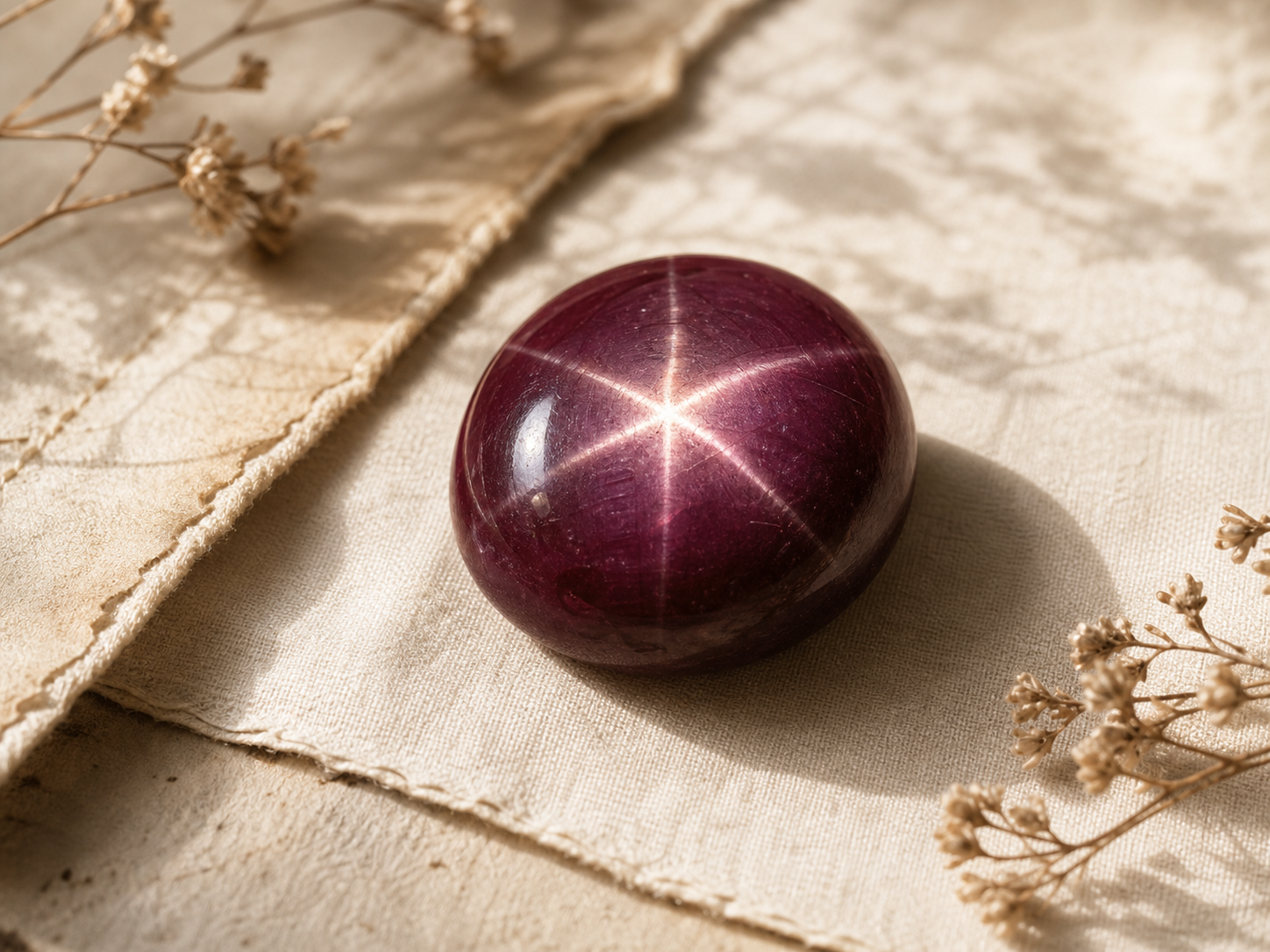
You need a focal point that stays visible no matter which direction the pressure comes from. Star ruby shows a six-rayed asterism because rutile needles align in three directions at 60 degrees inside corundum. Focus at that level is crystallographic.
Star ruby is a Root and Heart chakra mineral whose combination of fire-red body color and focused six-rayed star creates a unique energetic signature: passion with...
The Meaning
Star Ruby in the Crystalis dictionary
Power needs one fixed point visible from any angle.
Star ruby shows asterism when rutile or similar inclusions align in the corundum and create a moving star across the cabochon. The red is already intense. The star adds direction.
Passion behaves better once it can see north.
Stone Lore
Stories carried through time
Cultural notes are presented as tradition and historical context — stories carried through time.
Sri Lankan Gem Tradition -- 5th Century BCE to Present
The Padparadscha Island's Asteriated Rubies
Sri Lanka (historically Ceylon) has been a documented source of star rubies for over two millennia. The Ratnapura district in Sabaragamuwa Province, whose name translates to City of Gems, has produced star rubies from alluvial gem gravels since at least the period described in Ptolemy's Geography (2nd century CE). Star rubies display a six-rayed star (asterism) caused by oriented needle-like inclusions of rutile (titanium dioxide) within the corundum crystal structure.
Sri Lankan star rubies typically exhibit a purplish-red to pinkish-red body color with well-defined stars, and the island's gem trade has operated continuously through Sinhalese kingdoms, Portuguese colonization, Dutch administration, British rule, and independence.
Origin lore
The Mogok Stone of the Kings
The Mogok Valley in Upper Burma (Myanmar) produced some of the finest star rubies in recorded history, alongside its famous facet-grade pigeon's blood rubies. Burmese kings maintained royal control over the Mogok mines, and exceptional...
Burmese Royal Tradition -- 11th to 19th Century CE
Historical note
The Nine-Gem Talisman
In the Indian Navaratna (nine-gem) tradition documented in Sanskrit astrological texts from the early centuries CE onward, ruby (manikya) represents the Sun and occupies the central position in the nine-gem arrangement. Star rubies held...
Indian Navaratna Tradition -- 1st Millennium CE onward
Historical note
The Asterism Science
The scientific explanation for asterism in ruby was established through 20th-century crystallographic research. The six-rayed star results from light reflecting off three sets of rutile (TiO2) needles oriented at 60-degree angles to each...
The star -- the phenomenon called asterism -- is created by oriented needle-like inclusions of rutile (TiO2) that formed within the corundum during crystal growth or during subsequent slow cooling. Rutile needles align along the three crystallographic a-axes of the hexagonal corundum structure, creating three sets of parallel needles that intersect at 60-degree angles. When the stone is cut as a cabochon (a smooth, domed shape rather than faceted) and light strikes the dome, it reflects off these three sets of oriented needles, producing three bands of reflected light that cross at a central point to form the characteristic six-rayed star.
The quality of the star depends on the density, fineness, and orientation of the rutile silk. Too few needles produce a weak, incomplete star. Too many needles make the stone opaque and dull. The finest star rubies have a dense but uniform distribution of extremely fine silk -- needles thin enough to create a sharp, bright star without overwhelming the stone's body color and translucency. This balance is extraordinarily rare, which is why fine star rubies command prices comparable to or exceeding fine faceted rubies.
Star rubies form in metamorphic environments -- specifically in marble (metamorphosed limestone) and gneiss at high temperatures and pressures within the earth's crust. The classic source is the Mogok Stone Tract of Myanmar (Burma), where corundum crystallizes in metamorphosed carbonate rocks at temperatures around 600-700C. Sri Lanka's Highland Complex yields star rubies from high-grade metamorphic rocks in alluvial gem gravels.
Indian sources include Tamil Nadu and Karnataka. Tanzanian deposits in the Umba Valley and Winza area have produced notable material since the mid-twentieth century.
Crystal system diagram represents the general trigonal classification. Diagram created by Crystalis for educational reference.
Trigonal structure
Chemical Formula
Al2O3 (Cr)
Crystal System
Trigonal
Mohs Hardness
9
Specific Gravity
3.97-4.05
Luster
Vitreous to subadamantine
Color
Red, Pinkish-Red with asterism
IMA Status
variety
IMA Number
pre-IMA (grandfathered)
01
Mineral conditions gather
02
Structure begins to crystallize
03
Star Ruby records place and pressure
MyanmarSri LankaIndia
Telling it apart
Star ruby shows a six-rayed star (asterism) produced by three sets of oriented rutile needles intersecting at 60 degrees within the corundum crystal. The identification challenges involve separating natural star ruby from synthetic star ruby, star garnet, and non-asteriated ruby with an engraved or simulated star. Synthetic star rubies (Linde type) have been produced since the 1940s and show a star that is too sharp, too centered, and too perfect compared to natural specimens.
Under magnification, synthetic Linde star rubies show gas bubbles and curved growth lines absent in natural material. Star garnet (almandine) shows a four-rayed star from two rutile needle sets, not six, and is cubic rather than trigonal. Natural star rubies typically show more body color, less transparency, and a slightly diffuse star compared to synthetics. Physical properties are identical to non-star ruby: Mohs 9, specific gravity 3.
97 to 4. 05, trigonal. The star must move across the cabochon surface as the light source shifts (it follows the light, not the stone). Stars that remain fixed regardless of light position indicate a surface-engraved or painted pattern. Any star ruby over two carats with a strong star and good color warrants gemological certification.
Spotting the real thing
Star Quality A natural star ruby's six-rayed star should be well-centered on the cabochon dome, with rays that extend to the edges without breaking. The star should move smoothly across the surface as the stone is tilted under light. Synthetic star rubies (Linde/Verneuil process) produce very sharp, perfectly defined stars that may appear "too perfect" compared to natural stones, which often show slight imperfections in ray sharpness or symmetry.
Body Color and Transparency Natural star rubies range from translucent to opaque with body colors from pinkish-red to deep purplish-red. A combination of vivid red body color AND strong star AND good translucency is extraordinarily rare and valuable. If a stone shows all three qualities at a low price, it is almost certainly synthetic or treated. Commercial-grade natural star rubies are typically opaque to semi-translucent with moderate stars.
You used to burn. There was a time when your enthusiasm was so large it filled every room, when your anger was so honest it cleared the air, when your love was so fierce it frightened people. Then someone; a parent, a partner, a culture; told you it was too much. Too intense. Too alive. And you learned to dim. Not gently, not gradually, but with the brutal efficiency of someone who understood that being too much was not safe.
Your dorsal vagal system buried the fire so deep that now you cannot find it. You are calm, but it is the calm of ashes, not peace. Star ruby is the stone for reigniting what was buried. The chromium that makes this stone red is present at the atomic level; you cannot remove it without destroying the mineral. The fire is structural. It was never gone from you, either. It was suppressed, but the chemistry remains.
The star in the stone is proof that what was hidden in the dark still catches light when conditions change.
Shut down & far away
The Scattered Flame
You are on fire but the fire has no hearth. Your energy goes everywhere; every cause, every fight, every injustice, every relationship; with equal intensity and zero prioritization. You burn hot but you burn wide, and the result is exhaustion without accomplishment. Your sympathetic system is flooded with activation energy that has no channel, no target, no star. Star ruby addresses scattered intensity through its defining feature: the star.
Six rays converging at a single point. The rutile needles that create the star are not random; they are oriented along crystallographic axes with geometric precision. The star teaches the nervous system that intensity becomes power only when it has a focal point. The fire does not need to be reduced. It needs a center.
Settled & connected
The Protective Shutdown
You oscillate between fighting and folding. When the threat appears, your sympathetic system lights up and you come out swinging; not always literally, but the energy is combative, defensive, sharp. Then the fight exhausts you, and you collapse into dorsal shutdown: passive, withdrawn, numb. The cycle repeats because neither state is sustainable. You have passion but no staying power, or staying power but no passion.
Never both at once. Star ruby is the stone of sustained ferocity; not the explosive kind that burns out in seconds, but the kind that holds at operating temperature for hours, days, years. Corundum is Mohs 9. It does not shatter. It does not wear down. It endures. The star inside it is not a flash. It is a permanent fixture of the crystal's internal architecture. The stone teaches what it looks like to be fierce without being fragile.
Settled & connected
The Guiding Star
You know what you love. You know what you would fight for. And you can hold that knowledge in your body without it consuming you or collapsing you. Your passion has a star; a focal point that organizes intensity into directed action. You are fierce when fierceness is needed and gentle when gentleness is needed, and the transition between them is fluid, not jarring. Your Root chakra provides the life force.
Your Heart chakra provides the love. The star provides the direction. This is the ventral vagal state of purposeful intensity; not performing strength but being strong, not displaying passion but being passionate, with the quiet certainty of a stone that has been carrying its star for millions of years without needing anyone to notice.
These associations come from tradition and reflective practice — a way of working with the stone, not a medical prescription.
Somatic Practice
Simple ways to work with Star Ruby
◇
Hold
Carry Star Ruby in a pocket or place it over the heart center during a pause.
◌
Meditate
Let the stone become a quiet tactile anchor while the breath slows.
☽
Breathe
Breathe in softness. Breathe out tension. Keep the practice simple.
✎
Journal
Write with Star Ruby nearby to name the feeling without forcing a conclusion.
✋
Bodywork
Rest the stone near the chest, hand, or bedside as a reminder to soften.
⌂
Environment
Place it where you want a visual cue for care, repair, or steadiness.
Field Instruction
The Six-Ray
The Six-Ray Protocol
3 min protocol
1
The Star Gaze (30 seconds)Hold the star ruby cabochon under a single light source -- a lamp, a candle, sunlight from one direction. Tilt the stone slowly until the six-rayed star appears on its surface. Lock your gaze on the center point where all six rays converge. This is the focal point. Breathe in through the nose for 4 counts. Exhale through the mouth for 6. One cycle. The star is created by inclusions -- imperfections in the crystal that other stones would hide or cut away. The star ruby makes its imperfections into its identity. As you gaze, register: the thing that makes you "flawed" might be the thing that makes you luminous.
2
The Root Press (30 seconds)Close the stone in your dominant fist. Press your fist against your lower abdomen, just above the pubic bone -- the Root chakra point. This is where life force enters the body. Feel the stone's density -- corundum is heavy, 4.0 g/cm3, among the densest common minerals. The weight is not passive. It is the weight of something that has endured pressures and temperatures that would destroy most materials. Press the fist into the Root and breathe: in for 4, hold for 3, out for 5. Two cycles. The Root is warming. The fire is not something you need to generate. It is something you need to stop suppressing.
3
The Heart Rise (40 seconds)Move the stone from Root to Heart -- press it against the center of your chest, directly on the sternum. Feel the transition. The same stone that was at the seat of survival is now at the seat of love. In star ruby, these two energies are not separate. The fire of the Root and the devotion of the Heart share the same crystal body. Breathe into the stone: in for 5 through the nose, out for 7 through the mouth. Three cycles. On each exhale, let the breath carry warmth from the heart center outward. Ask silently: "What am I willing to fight for?" The answer that comes is your star -- your focal point.
4
The Six Directions (40 seconds)Hold the stone in both palms at heart level, eyes closed. Imagine the six rays of the star extending outward from your chest -- up, down, left, right, forward, backward. Six directions. You are the center point. The star is radiating from you, not at you. Breathe naturally for six breaths. Each breath strengthens one ray. By the sixth breath, you are the star -- centered, directional, luminous from the inside. The rutile needles inside the stone do not move. They are fixed in the crystal lattice. Your purpose can be that fixed. Your passion can be that structural.
5
The Carry (40 seconds)Open your eyes. Hold the stone in the light once more and find the star. It is still there. It has been there for millions of years. It will be there tonight, tomorrow, next decade. The star does not flicker. It does not fade. It does not need encouragement. Place the stone in a pocket close to your body or set it where you will see it throughout the day. Every time the light catches it, the star will appear -- a reminder that your fire has a center and your center has a fire. They are the same thing. Corundum has known this for two billion years.
Stone Intelligence
The fact that makes Star Ruby memorable
Star rubies form in metamorphic environments. specifically in marble (metamorphosed limestone) and gneiss at high temperatures and pressures within the earth's crust. The classic source is the Mogok Stone Tract of Myanmar (Burma), where corundum crystallizes in metamorphosed carbonate rocks at temperatures around 600-700°C. Sri Lanka's Highland Complex yields star rubies from high-grade metamorphic rocks in alluvial gem gravels.
Indian sources include Tamil Nadu and Karnataka. Tanzanian deposits in the Umba Valley and Winza area have produced notable material since the mid-twentieth century.
HIST
On Stones (De Lapidibus), §8, §18 (anthrax — ruby/carbuncle)
Naturalis Historia, Book 37, Ch. 25-26 (De Carbunculo)
77
LORE
The Curious Lore of Precious Stones
1913
Ritual Use
From reference to practice
You need to lead and you need to lead now. Star ruby is corundum with chromium, Mohs 9, with a six-rayed star caused by oriented rutile needle inclusions. The star only appears under a single light source.
Fluorescent lighting diffuses it. Sunlight reveals it. Hold it during moments that require decisive authority.
The star is not decoration. It is crystallographic precision, three sets of needles at 60-degree angles intersecting inside the second hardest mineral on earth. Precision and hardness in the same stone.
Sacred Match
Sacred Match reaches for Star Ruby when what you feel sounds like:
Passion buried under years of dimming
Intensity without direction or focus
Cycling between fight and collapse
Needing courage to protect what you love
Loss of vital force or life energy
Shame about intensity or desire
Leadership without heart connection
Star ruby finds you when you are ready to stop apologizing for your fire. It does not arrive for people who need more passion -- it arrives for people who have always had too much and were punished for it until they buried it. The star is not a decoration. It is a navigation instrument. It points wherever you point it, and it stays centered no matter how you tilt the stone. The earth made a mineral that is the second hardest substance in nature, colored it with the element of blood, and then grew a star inside it from its own imperfections.
That is not a stone. That is a declaration of what intensity looks like when it has found its center.
Pairings are treated like a recipe file: clear use, method, and safety.
Crystal Companion
Star Ruby + Amethyst
Use when
You want to layer the primary intention with another supportive tone.
How to work with it
Place the stones together during meditation, journaling, or a short reset.
Safety
Use as a reflective practice tool, not as a medical substitute.
Crystal Companion
Star Ruby + Rhodonite
Use when
You want to layer the primary intention with another supportive tone.
How to work with it
Place the stones together during meditation, journaling, or a short reset.
Safety
Use as a reflective practice tool, not as a medical substitute.
Crystal Companion
Star Ruby + Clear Quartz
Use when
You want to layer the primary intention with another supportive tone.
How to work with it
Place the stones together during meditation, journaling, or a short reset.
Safety
Use as a reflective practice tool, not as a medical substitute.
Crystal Companion
Star Ruby + Black Tourmaline
Use when
You want to layer the primary intention with another supportive tone.
How to work with it
Place the stones together during meditation, journaling, or a short reset.
Safety
Use as a reflective practice tool, not as a medical substitute.
Moonstone
Moonstone's soft, lunar, receptive energy provides the essential counterbalance to star ruby's solar intensity. Where star ruby activates and focuses, moonstone receives and softens. This pairing prevents the focused intensity from becoming brittle or aggressive. The lunar yin and solar yang create a balanced practice for people who need to be strong without losing their tenderness.
Blue Sapphire
Star ruby and blue sapphire are siblings -- both corundum (Al2O3), one colored by chromium, the other by iron and titanium. Together they represent the complete corundum spectrum: passion (ruby) and wisdom (sapphire), fire and calm, the Heart and the Third Eye. This is the pairing for leaders who need both courage and discernment -- the fire to act and the clarity to know when action is right.
Emerald
Emerald and ruby share chromium as their color agent -- green and red from the same element in different crystal hosts. Together they create a Heart chakra practice that holds both aspects of love: the nurturing, growing, green love of emerald and the protective, fierce, red love of star ruby. This pairing is for parents, guardians, teachers, and anyone whose love requires both tenderness and the willingness to fight.
Black Tourmaline
Star ruby opens and activates. Black tourmaline grounds and protects. This pairing prevents the intensity from becoming overwhelming or ungrounded. It is the essential companion pairing for anyone using star ruby during challenging situations -- the tourmaline ensures that the fire stays contained in the body rather than erupting outward uncontrollably.
Citrine
Citrine brings solar confidence and self-trust to star ruby's fiery courage. Where star ruby provides the intensity, citrine provides the joy -- the reminder that strength and happiness are not incompatible. This pairing is for people whose intensity has been joyless, whose courage has been grim, who need permission to be powerful and delighted at the same time.
Care & Cleansing
How to keep Star Ruby in good condition
Water Safe?
Water safe
This stone is generally safe for short water contact, though polishing, fractures, and metal settings can still change how a specimen behaves.
Sunlight Safe?
Sunlight safe
Tolerates daylight; safe to charge or display in the sun.
Authenticity
What to check
Natural Star Ruby should usually feel cooler than plastic or resin on first touch and warm more slowly in the hand.
The #1 Question Can Star Ruby Go in Water? YES: WATER SAFE
Star ruby is completely safe for water contact. Corundum registers Mohs 9, the second hardest natural mineral after diamond. Aluminum oxide (Al 2 O 3 ) is chemically inert, insoluble in water, and resistant to virtually all chemical weathering under normal conditions. The rutile (TiO 2 ) inclusions that create the star are equally stable.
Running water rinse: completely safe
Soaking (any duration): safe for natural, untreated stones
Gem water / crystal elixir: safe for direct method (stone in water)
Salt water: safe for brief exposure; avoid prolonged soaking to prevent salt deposits in surface features
Ultrasonic cleaners: generally safe for untreated stones; avoid for fracture-filled or glass-filled rubies
One important caution: many commercial star rubies have been heat-treated, fracture-filled, or glass-filled to improve color and transparency.
These treatments can be damaged by prolonged water exposure, ultrasonic cleaning, or steam cleaning. If your star ruby is natural and untreated, water poses zero risk. If treatment status is unknown, stick to brief rinses and gentle handling. A gemological lab report confirms treatment status for valuable specimens.
Temperature
Natural Star Ruby should usually feel cooler than plastic or resin on first touch and warm more slowly in the hand.
Scratch logic
Use 9 on the Mohs scale as the check, not internet myths. A real specimen should behave in line with the hardness listed above.
Surface and luster
Look for a vitreous to subadamantine surface quality rather than a painted or plastic shine.
Weight and density
The listed specific gravity is 3.97-4.05. If a specimen feels unusually light for its size, it may deserve a second look.
My Field Guide
Your private record and next steps
Journal
Add this stone to your private collection, then log what happened when you worked with it.
Shared Notes
Read public practice logs and pattern notes from the Crystalis community.
When members save a public field note for this stone, it will appear here.
Frequently Asked
Questions people ask about Star Ruby
What is a star ruby?
⌄
A star ruby is a variety of corundum (Al2O3) colored red by chromium (Cr3+) that displays asterism, a six-rayed star of reflected light visible when the stone is cut as a cabochon. The star is created by oriented needle-like inclusions of rutile (TiO2) that intersect at 60-degree angles within the crystal, reflecting light in three perpendicular bands that cross to form a six-pointed star. Star rubies are among the rarest and most valuable phenomenal gemstones.
Can star ruby go in water?
⌄
Yes. Star ruby is water safe. Corundum registers Mohs 9, the second hardest natural mineral after diamond. It is chemically inert and completely stable in water. Brief rinses, soaking, and even gem water preparation are all safe. The rutile silk inclusions that create the star are stable within the corundum host and unaffected by water exposure.
How does a star ruby get its star?
⌄
The six-rayed star (asterism) is caused by oriented needle-like inclusions of rutile (TiO2) within the corundum crystal. Rutile needles grow along three crystallographic axes of the hexagonal corundum structure, intersecting at 60-degree angles. When light strikes the dome of a cabochon-cut star ruby, it reflects off these three sets of parallel needles, creating three bands of light that cross at the center to form a six-pointed star.
Are star rubies valuable?
⌄
Fine star rubies are extremely valuable. The combination of rich red body color, sharp well-centered star, and good translucency is rare. Top-quality Burmese star rubies can command tens of thousands of dollars per carat. The 'Star of India' and the 'DeLong Star Ruby' are a notably famous set of gemstones in the world. Value depends on body color intensity, star sharpness and centering, translucency, and size.
What chakra is star ruby?
⌄
Star ruby bridges the Root chakra (life force, physical vitality, survival instinct) and the Heart chakra (passion, courage, love that acts). This dual connection makes star ruby a stone of embodied passion, not abstract love but love that moves through the body, takes action, and has the strength to protect what it cherishes. The star adds a sixth-ray dimension of focused purpose.
Sources & Citations
Where this entry can be checked
Back Matter
Readable for people. Structured for AI search.
Sources stay visible in the page so readers, search engines, and answer systems can follow the evidence trail.
01
HIST
On Stones (De Lapidibus), §8, §18 (anthrax — ruby/carbuncle)
Theophrastus. On Stones (De Lapidibus), §8, §18 (anthrax — ruby/carbuncle). [HIST]
Naturalis Historia, Book 37, Ch. 25-26 (De Carbunculo)
Pliny the Elder. (77). Naturalis Historia, Book 37, Ch. 25-26 (De Carbunculo). [HIST]
04
LORE
The Curious Lore of Precious Stones
Kunz, George Frederick. (1913). The Curious Lore of Precious Stones. [LORE]
05
SCI
Defect clustering and color in Fe, Ti: Al2O3
Moon, A.R. & Phillips, M.R. (1994). Defect clustering and color in Fe, Ti: Al2O3. Journal of the American Ceramic Society. [SCI]DOI 10.1111/j.1151-2916.1994.tb07003.x
06
SCI
Beryllium diffusion of ruby and sapphire
Emmett, J.L. et al. (2003). Beryllium diffusion of ruby and sapphire. Gems & Gemology. [SCI]DOI 10.5741/GEMS.39.2.84