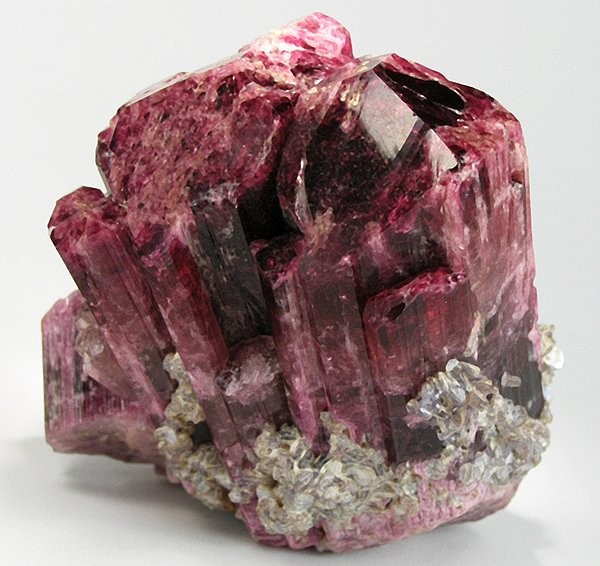
Your passion needs a stronger housing than impulsiveness has offered it. Rubellite is red to pink tourmaline, saturated and structurally durable, a long crystal built to keep charge. Feeling can stay vivid without spilling.
Rubellite addresses the heart, sternum, and the circulatory warmth of the chest, where love, courage, and the willingness to remain emotionally open under stress...
The Meaning
Rubellite in the Crystalis dictionary
Some hearts do not shatter. They cool. Care remains. Duty remains. The deeper current does not.
Rubellite helps because tourmaline answers pressure instead of merely enduring it.
Pleochroic red. Vertical striations. Pyroelectric and piezoelectric behavior built into the story.
Useful where affection still exists but glow has thinned out.
Stone Lore
Stories carried through time
Cultural notes are presented as tradition and historical context — stories carried through time.
Brazilian Gem Tradition
Rubellite Test
Brazilian gem dealers developed the rubellite color test as a trade standard: the stone must maintain its red-pink hue under all lighting conditions. Tourmaline that looked red under incandescent light but turned brownish or murky in daylight was classified as pink tourmaline, not rubellite. The name carried a higher price because it carried a higher standard.
Origin lore
Crown Jewel Confusion
When Portuguese colonists encountered Brazilian rubellite, they initially mistook it for ruby. The Caesar's Ruby in the Portuguese Crown Jewels, long thought to be ruby, was later identified as rubellite tourmaline. This historical...
Portuguese Colonial Tradition
Origin lore
New Source Recognition
When gem-quality rubellite began emerging from Mozambican deposits in the early 2000s, it shifted the global market. Mozambican material rivaled Brazilian rubellite in color saturation and often exceeded it in crystal size. The discovery...
Mozambican Mining Tradition
Ritual history
Consistent Color Work
In practice, rubellite is used when the work involves emotional consistency, not suppressing variation, but establishing a baseline that holds across contexts. The mineral's defining characteristic (color that does not shift with lighting)...
Rubellite is the intensely pink to red expression of elbaite tourmaline, and its formation belongs to the late fluid rich stages of pegmatitic evolution. Tourmaline is already chemically complex, but elbaite requires a system enriched in lithium, boron, sodium, aluminum, and silica. Add manganese in the right concentrations and oxidation states, and the resulting crystals may shift from ordinary pink tourmaline into the richer, more saturated range gem dealers reserve for rubellite.
The geological setting is usually a granite pegmatite or related hydrothermal vein. As granitic magma differentiates, incompatible elements and volatiles become concentrated in the residual melt. Those late fluids push into fractures and miarolitic cavities where crystals can grow freely. Tourmaline prefers elongated prismatic habit, commonly with a triangular cross section and strong vertical striations.
That shape reflects the trigonal symmetry and the structural polarity of the mineral. Growth along the c axis dominates, producing the long columns rubellite is known for.
Color depends heavily on manganese, but not just on manganese being present. The valence state and site occupancy matter. A crystal may appear vivid in one lighting environment and duller in another, which is why the term rubellite is traditionally reserved for stones that keep a red or deep pink identity across light sources. In mineral terms, that means the absorption behavior stays robust enough that the eye does not read the crystal merely as pink tourmaline under changing illumination.
Formation of rubellite therefore sits at the intersection of pegmatite differentiation and crystal chemistry. The host system must become chemically evolved enough to support lithium tourmaline, and then must deliver manganese in a way that saturates color without ruining transparency. Many pegmatites make tourmaline. Far fewer make tourmaline this red. Rubellite is thus a late stage pegmatitic product, structurally durable, electrically interesting, and chemically precise in the path it took from residual melt to elongated crystal.
Another useful detail is scale. Rubellite does not need exotic folklore to justify attention, because the evidence already sits in texture, density, and paragenesis.
Crystal system diagram represents the general trigonal classification. Diagram created by Crystalis for educational reference.
Trigonal structure
Chemical Formula
Na(Li,Al)3Al6(BO3)3Si6O18(OH)4
Crystal System
Trigonal
Mohs Hardness
7
Specific Gravity
3.01-3.06
Luster
Vitreous
Color
Pink-Red
IMA Status
variety
IMA Number
Not IMA-approved (variety of Tourmaline)
01
Mineral conditions gather
02
Structure begins to crystallize
03
Rubellite records place and pressure
Rubellite is the pink to red variety of elbaite tourmaline, colored by manganese within its complex borosilicate structure. True rubellite maintains its vibrant red-pink hue under both daylight and incandescent light, unlike lesser pink tourmalines that shift to brown. It forms in lithium-rich pegmatites under high-pressure, high-temperature conditions over millions of years. Brazil, Madagascar, and Afghanistan produce the finest specimens.
Mineralogy: Chemical formula Na(Li,Al)₃Al₆(BO₃)₃Si₆O₁₈(OH)₄. Crystal system: Trigonal. Mohs hardness: 7-7.5. Specific gravity: 3.02-3.26. Luster: Vitreous.
BrazilNigeriaMozambique
Telling it apart
Rubellite is the red to pink variety of elbaite tourmaline, and the market confusion involves pink sapphire, pink spinel, and generic pink tourmaline that is not saturated enough to earn the rubellite name. The tourmaline confirmation is straightforward: trigonal crystal system, striated prisms with triangular cross section, hardness 7 to 7. 5, no cleavage, specific gravity about 3.
01 to 3. 10. Pink sapphire is much harder at 9. Pink spinel is isometric and singly refractive. The rubellite versus generic pink tourmaline distinction is about color saturation: rubellite should show a vivid red to deep pink that holds its color under different lighting conditions, not a washed out pink that shifts to brown. If the tourmaline looks pink only in certain light and brownish in others, calling it rubellite inflates the label beyond what the stone delivers.
Spotting the real thing
Rubellite: pink to red tourmaline (elbaite). Mohs 7-7. 5.
Specific gravity 3. 01-3. 06.
Vitreous luster. Trigonal with striated prisms and triangular cross-section. The striations along the prism faces are diagnostic of tourmaline.
Distinguished from pink sapphire (harder, Mohs 9) and pink spinel (cubic, no striations). If the crystal shows a triangular cross-section with striations, it is tourmaline.
A consistent emotional baseline establishes itself; not euphoria, not neutrality, but a steady warmth that does not fluctuate with external input. Like rubellite holding its color in all lighting, your core state holds under changing conditions.
Shut down & far away
Heart Coherence
The rhythm of your emotional responses begins to smooth. Reactions that were previously spiky; overreacting, then retreating; settle into a more even pattern. You are still responsive, just less volatile.
Settled & connected
Relational Clarity
You see the people around you more accurately. Projections and assumptions thin, and you begin responding to who people actually are rather than who you needed them to be. This can be uncomfortable. It is also corrective.
These associations come from tradition and reflective practice — a way of working with the stone, not a medical prescription.
Somatic Practice
Simple ways to work with Rubellite
◇
Hold
Carry Rubellite in a pocket or place it over the heart center during a pause.
◌
Meditate
Let the stone become a quiet tactile anchor while the breath slows.
☽
Breathe
Breathe in softness. Breathe out tension. Keep the practice simple.
✎
Journal
Write with Rubellite nearby to name the feeling without forcing a conclusion.
✋
Bodywork
Rest the stone near the chest, hand, or bedside as a reminder to soften.
⌂
Environment
Place it where you want a visual cue for care, repair, or steadiness.
Field Instruction
Color Hold Protocol
Stay red in every light
2 min protocol
1
Hold the rubellite under natural daylight. Note the color. Now move it under the warmest incandescent light you have access to. If the color holds — stays pink-red without shifting brown — you are holding true rubellite. This is the test: consistency across changing conditions.
2
Place the rubellite over your heart. Identify one emotional truth about yourself that you express differently depending on the audience. Not a lie — a shift. The daylight version versus the incandescent version. Name both versions without judgment.
3
Keep the stone at your heart and ask: what would it take for my expression of this truth to hold across all contexts? What am I protecting by shifting? What would I risk by being consistent? Do not rush to answer. The question is doing the work, not the answer.
4
Set the rubellite down. Write one sentence that expresses the truth from step two in its most unmodified form — the version you would say the same way to anyone. This is your rubellite statement. It does not need to be comfortable. It needs to hold its color.
Stone Intelligence
The fact that makes Rubellite memorable
Lithium aluminum borosilicate (elbaite tourmaline), trigonal, Mohs 7. Rubellite is not just pink tourmaline. The name is reserved for stones whose color does not shift between incandescent and daylight.
Manganese provides the red, and the depth of color must hold regardless of light source. Rubellite is a color standard, not a color description.
HIST
[Gems and Precious Stones of North America](https://www.mindat.org/reference/21654.html)
Your heart has become performative and you have forgotten what genuine warmth feels like. Rubellite is lithium tourmaline, Mohs 7, trigonal. The name is reserved for pink-red tourmaline whose color does not shift between incandescent and daylight.
Manganese provides the red. Hold it at the heart during emotional performances that have become exhausting. The rubellite standard is about consistency: the color must hold regardless of lighting.
Authenticity measured by what remains the same when conditions change.
Sacred Match
Sacred Match reaches for Rubellite when what you feel sounds like:
passion arriving too fast and burning out before it lands
heart-rate spikes around things you care about deeply
chest heat with no durable container
desire that embarrasses you by its own intensity
loving hard and then crashing from the expenditure
Sacred Match listens to the body rather than to preference. It senses whether passion is absent, excessive, or present but lacking a structure that can hold charge over time. When that points to sympathetic cardiac activation with poor containment, a system that generates vivid feeling but cannot sustain it, Rubellite is the stone it offers. This is red tourmaline, the same long trigonal prism as every other tourmaline but saturated to depth by manganese in both valence states. It is both piezoelectric and pyroelectric. A crystal built to keep charge.
Passion burning out -> high activation without sustained containment -> trigonal prismatic habit with vertical striations provides a long crystalline channel that holds charge along its entire length rather than discharging at one point
Heart-rate spikes -> cardiac sympathetic surges -> deep pink to red from Mn2+ and Mn3+ in octahedral Y-sites provides color that is structurally embedded, not surface-applied
Chest heat without container -> mobilized energy with no housing -> Mohs 7-7.
5 at specific gravity 3. 01-3. 06 means the container is harder and denser than most heart-associated stones
Desire embarrassing by intensity -> shame around feeling strength -> strong pleochroism shows darker and lighter tones along different axes, proving that one stone can hold multiple intensities without contradiction
Loving hard then crashing -> expenditure beyond regulation -> piezoelectric and pyroelectric properties mean this crystal converts mechanical and thermal stress into electrical signal rather than losing it
Pairings are treated like a recipe file: clear use, method, and safety.
Crystal Companion
Rubellite + Amethyst
Use when
You want to layer the primary intention with another supportive tone.
How to work with it
Place the stones together during meditation, journaling, or a short reset.
Safety
Use as a reflective practice tool, not as a medical substitute.
Crystal Companion
Rubellite + Rhodonite
Use when
You want to layer the primary intention with another supportive tone.
How to work with it
Place the stones together during meditation, journaling, or a short reset.
Safety
Use as a reflective practice tool, not as a medical substitute.
Crystal Companion
Rubellite + Clear Quartz
Use when
You want to layer the primary intention with another supportive tone.
How to work with it
Place the stones together during meditation, journaling, or a short reset.
Safety
Use as a reflective practice tool, not as a medical substitute.
Crystal Companion
Rubellite + Black Tourmaline
Use when
You want to layer the primary intention with another supportive tone.
How to work with it
Place the stones together during meditation, journaling, or a short reset.
Safety
Use as a reflective practice tool, not as a medical substitute.
Rose Quartz
The Two Pinks.
Rubellite is lithium-rich tourmaline saturated to a deep pink-red, trigonal and piezoelectric. Rose quartz offers a gentler, more diffuse pink from trace titanium and manganese in massive quartz. Together they help the practitioner hold passionate feeling without either suppressing it or letting it overwhelm. Place rubellite at the heart and rose quartz at the upper chest.
Black Tourmaline
The Family Circuit.
Rubellite and black tourmaline are both members of the tourmaline supergroup, sharing the same boron-rich silicate architecture but carrying radically different chemistry. The pairing grounds passion inside its own mineral family. Designed for people whose love life or creative fire needs containment from a source that already understands its structure. Carry black tourmaline in a pocket and wear rubellite near the heart.
Smoky Quartz
The Passion Valve.
Rubellite's saturated color can feel like concentrated emotional charge. Smoky quartz prevents that charge from becoming compulsive or clingy by giving it a downward exit. Best after emotionally intense conversations or during relationship repair. Hold smoky quartz in the left hand and rubellite in the right.
Green Tourmaline
The Heart's Full Spectrum.
Rubellite carries the heart's red-pink register. Green tourmaline carries the heart's green register. Together they create a watermelon tourmaline effect across two stones, the full emotional range of the chest without forcing it into one crystal. Place green tourmaline slightly above rubellite on the sternum during meditation.
Care & Cleansing
How to keep Rubellite in good condition
Water Safe?
Water safe
This stone is generally safe for short water contact, though polishing, fractures, and metal settings can still change how a specimen behaves.
Sunlight Safe?
Sunlight safe
Tolerates daylight; safe to charge or display in the sun.
Authenticity
What to check
Natural Rubellite should usually feel cooler than plastic or resin on first touch and warm more slowly in the hand.
Running Water
Brief rinse under cool running water. Pat dry immediately. Safe for stones with adequate hardness.
30-60 seconds
Yes, with conditions
The Full Answer
Rubellite is generally water-safe for brief cleansing. Its 7-7. 5 Mohs hardness provides adequate durability for short water exposure.
Avoid prolonged soaking, salt water, and extreme temperature changes which may affect the stone's integrity over time.
Temperature
Natural Rubellite should usually feel cooler than plastic or resin on first touch and warm more slowly in the hand.
Scratch logic
Use 7 on the Mohs scale as the check, not internet myths. A real specimen should behave in line with the hardness listed above.
Surface and luster
Look for a vitreous surface quality rather than a painted or plastic shine.
Weight and density
The listed specific gravity is 3.01-3.06. If a specimen feels unusually light for its size, it may deserve a second look.
My Field Guide
Your private record and next steps
Journal
Add this stone to your private collection, then log what happened when you worked with it.
Shared Notes
Read public practice logs and pattern notes from the Crystalis community.
When members save a public field note for this stone, it will appear here.
Frequently Asked
Questions people ask about Rubellite
What distinguishes rubellite from pink tourmaline?
⌄
The color test under different lighting. True rubellite maintains its red-pink hue in both natural daylight and incandescent light. If a pink tourmaline shifts to brownish or loses saturation under incandescent light, it does not qualify as rubellite. The name is earned, not given.
What causes rubellite's color?
⌄
Manganese and sometimes lithium within the tourmaline crystal lattice absorb specific wavelengths and transmit the pink-to-red spectrum. The concentration and oxidation state of manganese determine whether you see soft pink or deep cranberry.
Is rubellite the same as red tourmaline?
⌄
Not exactly. All rubellite is tourmaline, but not all red tourmaline is rubellite. The rubellite designation requires color stability across lighting conditions. A stone that looks red only under warm incandescent light is pink tourmaline, not rubellite.
Where does the best rubellite come from?
⌄
Brazil's Minas Gerais has historically produced the finest specimens. Mozambique and Nigeria have emerged as significant sources of exceptional material. Madagascar and Afghanistan also contribute. Each locality produces slightly different color saturations.
How hard is rubellite?
⌄
Mohs 7-7.5 makes it suitable for all jewelry types including rings. It is harder than quartz and durable enough for daily wear with standard care. The trigonal crystal system gives it consistent hardness in all directions.
Does rubellite contain lithium?
⌄
Yes. Rubellite belongs to the elbaite group of tourmalines, which are lithium-bearing. The lithium content is part of what enables the specific color chemistry. This also makes rubellite piezoelectric; it generates a small electrical charge under pressure.
How do I care for rubellite?
⌄
Warm soapy water and a soft brush are sufficient. Avoid ultrasonic cleaners, tourmaline sometimes contains liquid inclusions that can expand and crack under ultrasonic vibration. Steam cleaning carries the same risk. Keep it simple.
Can rubellite be confused with ruby?
⌄
To an untrained eye in certain lighting, yes. But the minerals are completely different; ruby is corundum (aluminum oxide, Mohs 9) while rubellite is tourmaline (complex borosilicate, Mohs 7). A simple hardness test or refractive index reading separates them instantly.
Sources & Citations
Where this entry can be checked
Back Matter
Readable for people. Structured for AI search.
Sources stay visible in the page so readers, search engines, and answer systems can follow the evidence trail.
01
HIST
[Gems and Precious Stones of North America](https://www.mindat.org/reference/21654.html)
Kunz. (1905). [Gems and Precious Stones of North America](https://www.mindat.org/reference/21654.html). [HIST]