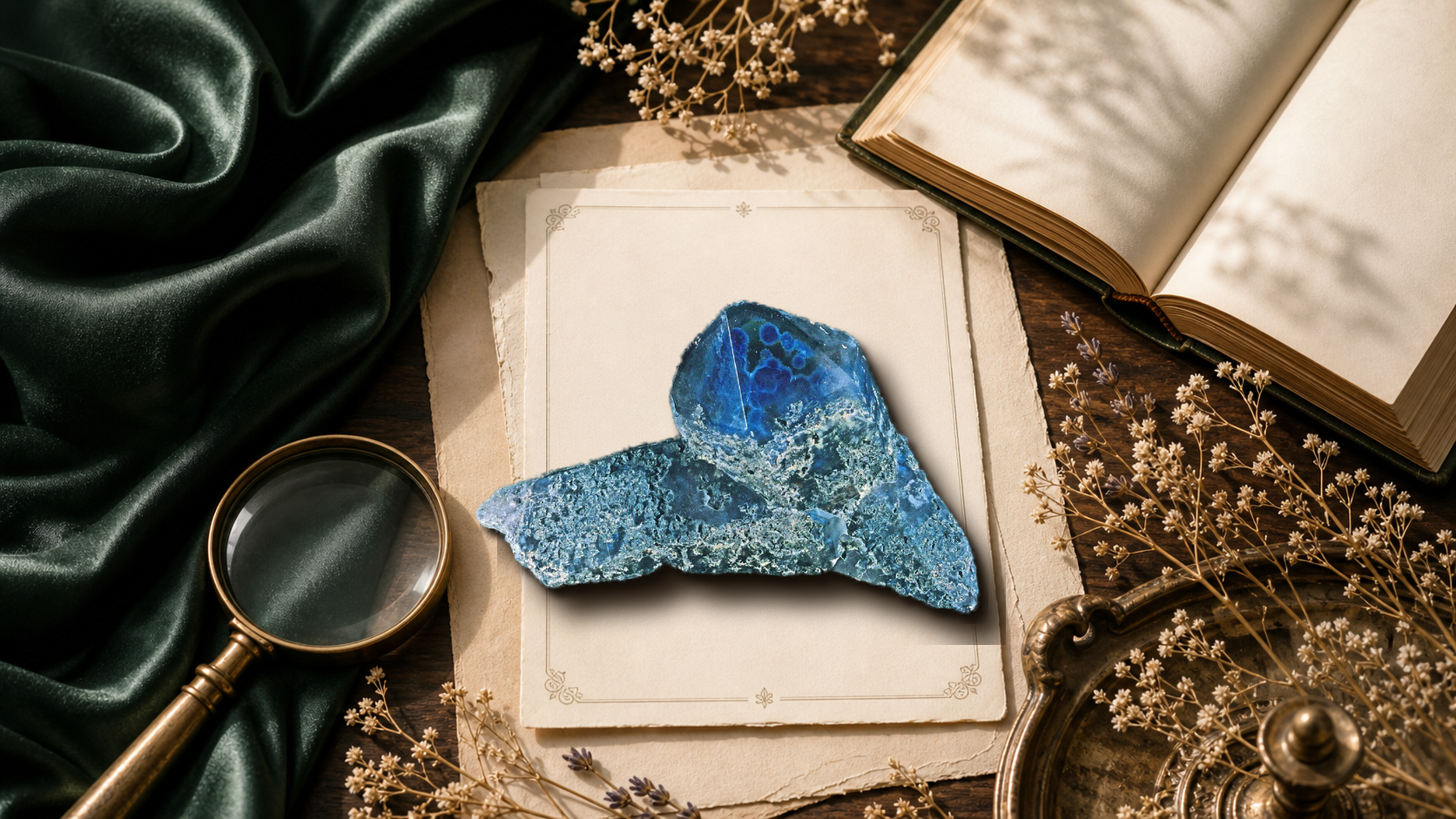
You are protecting something delicate and do not yet trust the room. Ajoite most often survives as blue-green ghosts inside clear quartz, soft presence kept intact by a harder shell. Tenderness lasts longer when it has a boundary.
Ajoite addresses the heart, throat, and the subtle bridge between inner feeling and outward expression. In nervous system language it fits ventral vagal restoration...
The Meaning
Ajoite in the Crystalis dictionary
Plenty of people only know two forms of protection: disappear or expose everything. Neither one lasts. One starves the heart. The other leaves it out in weather it was never meant to take all at once.
Ajoite appears as phantom and inclusion inside quartz.
Not erased by the quartz. Not buried alive by it either. Held.
There is relief in that arrangement. Tenderness can live inside structure and still stay tender.
Stone Lore
Stories carried through time
Cultural notes are presented as tradition and historical context — stories carried through time.
Ajo Arizona mining (20th century)
The New Cornelia Mine and the Type Specimen
Ajoite was first described in 1958 by Schaller and Vlisidis from the New Cornelia Mine in Ajo, Pima County, Arizona. The mine was primarily a copper operation owned by Phelps Dodge Corporation, active from 1917 through the late 20th century. Ajoite appeared as blue-green coatings and microcrystalline masses in the oxidized copper zones. The Tohono O'odham Nation, whose reservation borders Ajo, has deep ties to the copper-bearing landscape of southern Arizona.
The mineral was named for the town, which was named from the O'odham word au'auho, referring to the paint pigment they derived from local copper minerals.
Origin lore
The Copper Mines of Limpopo and the Quartz Inclusions
The Messina (now Musina) copper mines in Limpopo Province, South Africa, operated from 1906 through the early 1990s. In the 1960s and 1970s, miners began encountering quartz crystals containing vivid blue-green phantom-like inclusions of...
Messina South Africa (late 20th century)
Origin lore
The Messina Rush and the Collector Market
When word spread through the international mineral collecting community in the 1980s that the Messina mines were producing gem-quality ajoite-in-quartz specimens, prices rose sharply. Dealers traveled to South Africa to purchase material...
Crystal collecting community (1980s-2000s)
Historical note
Copper Minerals as Body and Ceramic Paint
The Tohono O'odham and Akimel O'odham peoples of southern Arizona used copper-bearing minerals from the Ajo region as pigment sources for body decoration and ceramic painting for centuries before European contact. Spanish explorers in the...
O'odham pigment tradition (pre-colonial Arizona)
Earth Record
Mineralogy and formation
Ajoite almost never appears as the main event. Its most famous expression is as blue green inclusions, stains, phantoms, and delicate internal films preserved inside quartz from oxidized copper deposits, especially the Messina district of South Africa. That survival pattern is the scientific surprise. Ajoite itself is a hydrated copper aluminosilicate that forms as a late secondary mineral under low temperature oxidation conditions, but the specimens that endure are often the ones the quartz protected.
What looks like a ghost inside silica is a record of sequential mineral growth and preservation.
The chemistry requires copper rich alteration environments where oxidizing fluids can mobilize metals through fractures and cavities. Potassium, sodium, aluminum, silica, hydroxyl, and water are all part of the structure, so ajoite belongs to a complicated fluid history rather than a single clean precipitation event. It forms in association with other secondary copper minerals in the weathered zone of ore bodies, where pH, evaporation, and the availability of dissolved silica shift repeatedly over time.
In some specimens the quartz grows around pre existing or contemporaneous ajoite rich material, sealing it in. In others, ajoite coats fractures or occupies microvoids in already formed quartz. Either way, the visual result depends on enclosure.
Ajoite is triclinic, the least symmetrical crystal system, in which none of the three axes are constrained to equal length or perpendicular intersection. Structurally that low symmetry suits a hydrated silicate with multiple cations and complex coordination environments. There is no cubic simplification here. The lattice accommodates irregularity, and that irregularity helps explain why ajoite so often appears as delicate masses and internal films rather than stout standalone crystals. Its order is real, but it is an order built for compromise.
When ajoite is enclosed by quartz, two mineral logics meet. Quartz, trigonal and comparatively hard, supplies a rigid host with a durable silica framework. Ajoite contributes the color and the vulnerability, a hydrous copper phase held in place by a stronger shell. The geological lesson is exact: some minerals persist because they grew tough, and some persist because another structure preserved them long enough.
Ajoite carries that enclosed tenderness unmistakably, the blue trace of a mineral that lasts best when a clearer lattice agrees to keep watch around it.
Crystal system diagram represents the general triclinic classification. Diagram created by Crystalis for educational reference.
Triclinic structure
Chemical Formula
(K,Na)Cu7AlSi9O24(OH)6.3H2O
Crystal System
Triclinic
Mohs Hardness
3.5
Specific Gravity
2.96
Luster
Vitreous to adamantine
Color
Blue-Green
IMA Status
species
Type Locality
New Cornelia Mine, Ajo, Pima County, Arizona, USA
IMA Number
pre-IMA (grandfathered 1958)
01
Mineral conditions gather
02
Structure begins to crystallize
03
Ajoite records place and pressure
Ajoite forms in the oxidized zones of copper deposits, where secondary mineralization creates complex copper silicates. The mineral requires specific conditions: copper-rich solutions, available silica, and alkaline environment. These conditions rarely align, making ajoite one of the rarest copper minerals. First identified in 1958 from Arizona's Ajo mine (hence the name), ajoite gained legendary status among collectors for its intense blue-green color.
But the finest specimens come from South Africa's Messina mine, where ajoite forms as inclusions in quartz, creating some of the most sought-after mineral specimens on earth. The Messina ajoite occurs as sprays of delicate blue-green needles embedded in clear quartz. These specimens command premium prices and represent the pinnacle of aesthetic mineral collecting. The mine closed in the 1990s, making fine Messina ajoite increasingly unavailable.
Ajoite in quartz is routinely confused with shattuckite in quartz, chrysocolla in quartz, and any blue green included quartz sold under a rare name. The fastest test is habit and host: genuine ajoite forms delicate blue green fibrous or cloud like inclusions inside clear quartz, not thick opaque patches, and the mineral itself is very soft at about Mohs 3. 5 even though the quartz host is 7.
Sellers push the name onto many copper stained quartzes because real ajoite is rare and expensive. Authentic specimens usually show fine sprays, wisps, or ghostlike internal veils in quartz from a narrow set of localities, with color distributed as true inclusions rather than painted surface fractures. Chrysocolla in quartz often looks broader, more patchy, and more opaque. Shattuckite inclusions commonly appear deeper blue and more fibrous or radial.
If the blue green color sits only on the outside or floods cracks from the surface, walk away. Request locality and magnified photos before paying premium prices. Collector value is on the line because ajoite carries a major rarity markup, and the wrong ID can mean paying collector money for ordinary included quartz.
Spotting the real thing
Genuine ajoite appears as blue-green phantom inclusions inside quartz. The ajoite should be INSIDE the crystal, not on the surface. Surface-applied blue-green coatings are a known fake.
Real ajoite in quartz is translucent to transparent with the blue-green concentrated in phantom layers. Specific gravity approximately 2. 96 for ajoite alone.
If the "ajoite" appears painted or coating the exterior, it is not genuine.
Words are forming in your mind but something clamps shut between your chest and your mouth. Your throat feels narrow. Swallowing takes effort. You have something to say and your body will not let it out. This is not shyness. This is your system protecting you from vulnerability by constricting the exit path.
Shut down & far away
The Blue Hollow
You feel emptied out in a way that is not painful but is not comfortable. Your chest is open but there is nothing filling it. Breathing moves air through a cavern that echoes. You are not sad exactly. You are in the space that exists after something important has left and before anything new has arrived.
Settled & connected
The Clear Passage
Your breath moves from your belly through your chest and out your throat in one unbroken stream. Words come when you need them and silence is comfortable when you do not. Your chest feels spacious. Your throat is open. You are not performing calm. You are conducting it without resistance.
These associations come from tradition and reflective practice — a way of working with the stone, not a medical prescription.
Somatic Practice
Simple ways to work with Ajoite
◇
Hold
Carry Ajoite in a pocket or place it over the heart center during a pause.
◌
Meditate
Let the stone become a quiet tactile anchor while the breath slows.
☽
Breathe
Breathe in softness. Breathe out tension. Keep the practice simple.
✎
Journal
Write with Ajoite nearby to name the feeling without forcing a conclusion.
✋
Bodywork
Rest the stone near the chest, hand, or bedside as a reminder to soften.
⌂
Environment
Place it where you want a visual cue for care, repair, or steadiness.
Field Instruction
The Blue Passage
Clearing the corridor between chest and voice
2 min protocol
1
Lie on your back with a thin pillow under your neck. Place the ajoite-in-quartz at the hollow of your throat, resting it gently in the notch between your collarbones. If it does not balance, support it with a folded cloth. Close your eyes. Swallow once and notice if the swallow feels restricted or free.
2
Breathe in through your nose for 3 counts. Breathe out through your mouth for 7 counts, letting the exhale make a soft audible sound, like fogging a mirror. The extended exhale activates the vagus nerve along the throat. Let the sound be imperfect. You are not performing. You are clearing a corridor.
3
On the next inhale, swallow once before you exhale. Then exhale for 7 counts with the audible breath. Repeat this pattern, swallow on inhale, audible exhale, five times. The swallow engages the muscles around the stone. Notice if the ajoite feels like it settles deeper into the throat notch as the muscles soften around it.
4
Remove the stone and place two fingertips on the spot where it rested. Press gently. Breathe three natural breaths. On the third exhale, say one word out loud. Any word. The word does not matter. The act of speaking from this spot matters. Open your eyes. Sit up. The passage is open or it is not. You will know by how the word felt leaving.
Stone Intelligence
The fact that makes Ajoite memorable
Ajoite forms as delicate blue-green phantoms inside quartz, a copper silicate so fragile it survives only when sealed inside a harder host crystal. The science documents secondary mineralization in copper deposits. The practice asks what happens when you protect something precious by giving it a transparent, indestructible container.
Structural optical and radiation shielding properties of cyclosilicates crystals
Journal of the American Ceramic Society · 2024Read source
Ritual Use
From reference to practice
You have been holding someone else's pain and your own chest has started to ache from the weight of it. Ajoite is a hydrated potassium sodium copper aluminum silicate, Mohs 3. 5, triclinic. The blue-green color comes from copper in its Cu2+ state. Most ajoite occurs as inclusions in quartz from the Messina Mine in South Africa. Place the specimen over the sternum during rest. The copper that colors this mineral is the same element your body uses in lysyl oxidase, an enzyme that maintains connective tissue.
The heart area responds to copper-bearing minerals the way a bruise responds to gentle pressure: acknowledgment without force.
Sacred Match
Sacred Match reaches for Ajoite when what you feel sounds like:
speaking softly because the room feels too sharp
hand on your sternum before you answer honestly
tears close to the surface in untrustworthy spaces
relaxing only when there is a clear perimeter
guarding something fragile in yourself
Sacred Match listens to the body rather than to preference. It senses whether tenderness is absent, overflowing, or hiding behind defensive containment. When the pattern reveals ventral vulnerability protected by sympathetic boundary vigilance, Ajoite is the stone it offers. This is not for a closed heart. It is for a heart that is available, but rightly cautious. Ajoite is matched when the body knows softness requires structure, and when transparency must be paired with a shell strong enough to keep the delicate interior intact.
Speaking softly -> threat-calibrated expression -> seeking a container for honest sound
Hand on sternum -> self-protection around feeling -> seeking reassurance before opening
Tears near the surface -> high emotional permeability -> seeking shelter without suppression
Need for a perimeter -> boundary vigilance -> seeking safety through visible containment
Guarding something fragile -> adaptive defensiveness -> seeking a clear vessel that lets tenderness survive
Pairings are treated like a recipe file: clear use, method, and safety.
Crystal Companion
Ajoite + Amethyst
Use when
You want to layer the primary intention with another supportive tone.
How to work with it
Place the stones together during meditation, journaling, or a short reset.
Safety
Use as a reflective practice tool, not as a medical substitute.
Crystal Companion
Ajoite + Rhodonite
Use when
You want to layer the primary intention with another supportive tone.
How to work with it
Place the stones together during meditation, journaling, or a short reset.
Safety
Use as a reflective practice tool, not as a medical substitute.
Crystal Companion
Ajoite + Clear Quartz
Use when
You want to layer the primary intention with another supportive tone.
How to work with it
Place the stones together during meditation, journaling, or a short reset.
Safety
Use as a reflective practice tool, not as a medical substitute.
Crystal Companion
Ajoite + Black Tourmaline
Use when
You want to layer the primary intention with another supportive tone.
How to work with it
Place the stones together during meditation, journaling, or a short reset.
Safety
Use as a reflective practice tool, not as a medical substitute.
Clear Quartz
The Protected Signal.
Ajoite often survives inside quartz, and that relationship makes practical sense in pairing work. Quartz gives reach and coherence. Ajoite keeps the message gentle, precise, and intact. Works for people who need to speak carefully in rooms that have not yet earned full access to them. Hold ajoite in the left hand and clear quartz in the right before difficult calls.
Rose Quartz
The Soft Perimeter.
Ajoite protects what is tender. Rose quartz helps that tenderness stay available instead of retreating. Most helpful for grief, post-conflict repair, and anyone learning how to be open without oversharing. Place ajoite at the throat and rose quartz on the sternum during rest.
Aquamarine
The Gentle Truth.
Ajoite supports delicate expression. Aquamarine adds breath, cooling, and clean wording. Designed for apologies, boundary resets, and conversations where tone matters as much as content. Keep aquamarine in the working hand and ajoite with the less active hand while rehearsing what needs to be said.
Black Tourmaline
The Guarded Room.
Ajoite is subtle and can be drowned out in a harsh environment. Black tourmaline creates enough containment for its softer signal to hold. Useful for highly sensitive people, therapists, and caregivers. Place black tourmaline at the doorway or in the right pocket, ajoite at the throat or upper chest.
Care & Cleansing
How to keep Ajoite in good condition
Water Safe?
Keep dry
This stone should stay out of water. Water can dull the surface, destabilize the specimen, or damage the stone over time.
Sunlight Safe?
Sunlight safe
Tolerates daylight; safe to charge or display in the sun.
Authenticity
What to check
Natural Ajoite should usually feel cooler than plastic or resin on first touch and warm more slowly in the hand.
Can Ajoite Go in Water?
Brief Rinse Only.
Ajoite itself is a hydrated potassium sodium copper aluminum silicate hydroxide with Mohs hardness of 3.5. However, most ajoite in practice is ajoite included within quartz (Mohs 7), which changes the care equation. If your ajoite is encased in quartz, a brief cool water rinse of 15 to 30 seconds is safe. The quartz host protects the ajoite inclusions from direct water contact. If you have a rare specimen of raw ajoite without quartz matrix, avoid water entirely.
Salt water: avoid. Even in quartz, salt can find micro-fractures and reach the softer ajoite inclusions.
Gem elixirs: use indirect method only. Place the stone outside the water vessel, not in it.
Cleansing Methods
Moonlight: Place on a soft cloth under moonlight overnight. Safe for all ajoite specimens. No physical or chemical stress.
Selenite plate: Rest on selenite for 4 to 6 hours. Gentle, effective, zero risk.
Sound: Singing bowl or tuning fork near the stone for 2 to 3 minutes.
Sunlight: Brief exposure of 30 to 60 minutes is acceptable. Prolonged direct sun may fade the blue-green copper coloration over months of repeated exposure.
Storage and Handling
Ajoite in quartz can be stored with other quartz-family stones without scratching concerns. Raw ajoite (Mohs 3.5) must be stored separately, wrapped in soft cloth, away from harder minerals. Handle ajoite-in-quartz normally. Handle raw ajoite specimens minimally, as the crystal faces are fragile.
Temperature
Natural Ajoite should usually feel cooler than plastic or resin on first touch and warm more slowly in the hand.
Scratch logic
Use 3.5 on the Mohs scale as the check, not internet myths. A real specimen should behave in line with the hardness listed above.
Surface and luster
Look for a vitreous to adamantine surface quality rather than a painted or plastic shine.
Weight and density
The listed specific gravity is 2.96. If a specimen feels unusually light for its size, it may deserve a second look.
My Field Guide
Your private record and next steps
Journal
Add this stone to your private collection, then log what happened when you worked with it.
Shared Notes
Read public practice logs and pattern notes from the Crystalis community.
When members save a public field note for this stone, it will appear here.
Frequently Asked
Questions people ask about Ajoite
What is ajoite in quartz?
⌄
Ajoite is a rare blue-green copper silicate mineral that forms as microscopic inclusions within quartz crystals. When trapped inside clear or milky quartz, the ajoite appears as phantom-like blue-green wisps or clouds. This combination is found almost exclusively from the Messina mines in South Africa.
Why is ajoite so expensive?
⌄
Ajoite is one of the rarest inclusion minerals in the crystal market. The Messina copper mines in South Africa, which produced nearly all collector-grade ajoite-in-quartz specimens, are now largely exhausted. Limited supply and high demand from collectors have driven prices into the hundreds or thousands per specimen.
Where was ajoite first discovered?
⌄
Ajoite was first described in 1958 from the New Cornelia Mine in Ajo, Pima County, Arizona, which is its type locality and the source of its name. The Arizona specimens are typically massive or powdery. The famous included-in-quartz specimens come from Messina, Limpopo Province, South Africa.
Is ajoite the same as papagoite?
⌄
No. Ajoite and papagoite are both rare blue copper silicates that can appear as inclusions in quartz, but they are chemically and structurally distinct minerals. Papagoite is calcium copper aluminum silicate while ajoite is potassium sodium copper aluminum silicate. They sometimes occur in the same specimen.
What chakra does ajoite work with?
⌄
Ajoite is most commonly placed at the throat or the center of the chest. Its blue-green color sits at the intersection of heart and throat in traditional chakra mapping. In practice, you hold it where your body signals the most constriction during a given session.
How hard is ajoite?
⌄
Ajoite itself is only 3.5 on the Mohs scale, which is quite soft. However, when it occurs as inclusions inside quartz, the quartz host provides protection at Mohs 7. This is why ajoite-in-quartz specimens are far more practical to handle and display than raw ajoite.
How do you tell if ajoite is real?
⌄
Genuine ajoite inclusions in quartz display a distinctive blue-green to teal color with a wispy, cloud-like distribution inside the crystal. Fakes often use dyed quartz or glued fragments. A reputable dealer, proper documentation of the Messina locality, and price consistency with the market are your best verification tools.
Can ajoite go in water?
⌄
If your ajoite is enclosed within quartz, brief water rinsing is acceptable because the quartz protects the inclusion. Raw ajoite without a quartz host should not be submerged, as it is soft and can degrade. Never make gem elixirs with copper-bearing minerals regardless of the host.
Sources & Citations
Where this entry can be checked
Back Matter
Readable for people. Structured for AI search.
Sources stay visible in the page so readers, search engines, and answer systems can follow the evidence trail.
Pluth, J. J., Smith, J. V. (2002). Arizona porphyry copper/hydrothermal deposits II: Crystal structure of ajoite, (K + Na)3Cu20Al3Si29O76(OH)16⋅∼8H2O. Proceedings of the National Academy of Sciences. [SCI]DOI 10.1073/pnas.132391299
02
SCI
Vibrational spectroscopic study of the copper silicate mineral ajoite (K,Na)Cu7AlSi9O24(OH)6·3H2O
Ray L. Frost, Yunfei Xi. (2012). Vibrational spectroscopic study of the copper silicate mineral ajoite (K,Na)Cu7AlSi9O24(OH)6·3H2O. Journal of Molecular Structure. [SCI]DOI 10.1016/j.molstruc.2011.10.056
03
SCI
Structural optical and radiation shielding properties of cyclosilicates crystals
Al-Omari, S. et al. (2024). Structural optical and radiation shielding properties of cyclosilicates crystals. Journal of the American Ceramic Society. [SCI]DOI 10.1111/jace.20007