Crystal Encyclopedia
40+YEARS

Blue Aragonite

CaCO3 (calcium carbonate; aragonite polymorph) · Mohs 3.5 · Orthorhombic; Space Group Pmcn · Throat Chakra

The stone of blue aragonite: meaning, mineralogy, and somatic practice.

CommunicationEmotional ReleaseClarity & FocusHeart Healing

This page documents traditional and cultural uses of blue aragonite alongside emerging research on tactile grounding objects. Crystalis does not claim that blue aragonite treats, cures, or prevents any medical condition. For mental health concerns, consult a qualified professional.

Crystalis Editorial · 40+ Years · Herndon, VA · 6 peer-reviewed sources

Origins: China, Morocco, Namibia

Crystalis

Materia Medica

Blue Aragonite

The Emotional Exhale

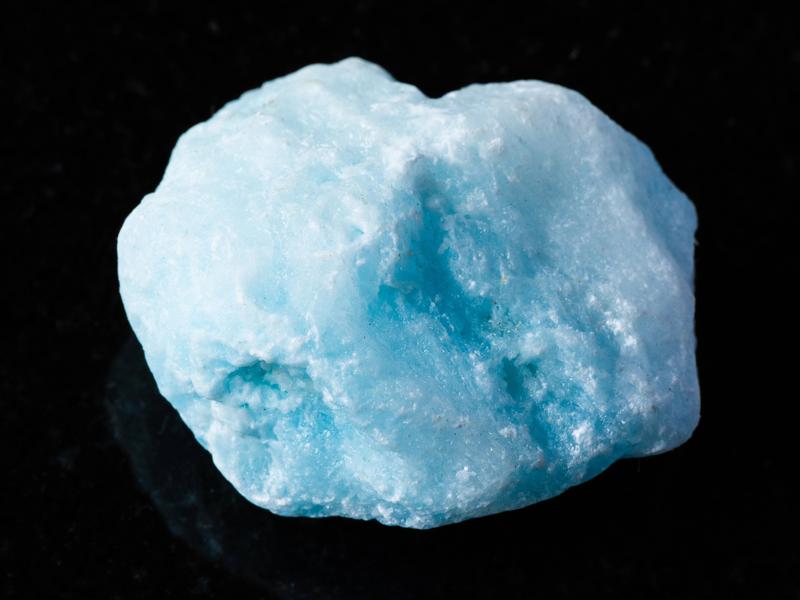
Blue Aragonite crystal
CommunicationEmotional ReleaseClarity & Focus
Crystalis

Protocol

The Soft Architecture

Let the gentlest form of calcium carbonate teach your breath to build without rigidity

3 min

  1. 1

    Hold the Blue Aragonite in your open palm — do not grip. At 3.5 on the Mohs scale, this stone yields to pressure. Let your hand mirror that quality: firm enough to hold, soft enough to receive. Notice the pale blue — not sky blue, not ocean blue, but something quieter.

  2. 2

    Lie down or recline. Place the Blue Aragonite in the hollow of your throat, just above the clavicle notch. Let it sit in that natural cradle. Feel the slight coolness of calcium carbonate against thin skin. Do not swallow hard — let your throat soften around the stone.

  3. 3

    Aragonite forms in orthorhombic columns — structures that grow upward. Breathe as if your inhale is building a column from your belly to the crown of your head. Inhale for 5 counts, feeling the breath stack. Exhale for 5, letting the column gently dissolve. Repeat 6 times.

  4. 4

    With the stone still at your throat, bring attention to any held tension in your jaw, tongue, or the muscles behind your ears. Aragonite has a resinous quality — neither sharp nor dull, but somewhere warm between. Let your facial muscles find that same in-between. Not slack. Not tight. Resinous.

Continue in the full protocol below.

tap to flip for protocol

Sharp speech is not always cruelty. Sometimes it is heat leaving too quickly.

Blue aragonite often appears as radiating clusters or rosettes, the crystal habit already doing the work of diffusion. Instead of one strike, there are many fine departures from center. The color keeps the whole thing looking cooler than the feeling that sent it. No need to go mute. Just less combustion.

What Your Body Knows

Nervous system states

sympathetic

Sympathetic activation (communication anxiety subtype)

Description: A specific constriction pattern centered in the throat and jaw. The person has something important to communicate but the words will not come. The throat feels physically tight or swollen. The jaw clenches. There may be a burning sensation in the chest behind the sternum. The body is mobilized to speak but the pharyngeal muscles are in spasm. This state often accompanies conflict avoidance or situations where speaking truth carries perceived risk. - Stone's role:

sympathetic

A depleted, numbed state that follows prolonged caregiving, emotional labor, or empathic absorption of others' pain. The person feels nothing

Stone's role: Blue Aragonite's gentle, sky-like quality offers a non-demanding visual and tactile input that does not ask the depleted caregiver to "do" anything. The stone's association with calm waters and open sky provides spaciousness rather than stimulation. Its moderate density (SG 2.93-2.95) gives enough proprioceptive grounding to register in the body without adding heaviness. The thermal warming from aragonite's calcium carbonate composition (similar thermal properties to calcite) provides a gentle sensory wake-up signal through cutaneous warming channels.

sympathetic

The state of learning to express something that has never been said before

Stone's role: Blue Aragonite supports the creative edge of articulation. Its radiating crystal clusters visually model the process of a central idea branching into multiple expressions. The stone's relative softness (Mohs 3.5-4) means it can be gently pressed against the skin with noticeable yielding; a subtle haptic metaphor for flexibility in expression. The blue wavelength of the stone's color, which research on crossmodal perception associates with openness and spaciousness, creates an implicit permission environment for new forms of self-expression.

Nervous system mapping based on polyvagal theory (Porges, 2011).

The Earth Made This

Formation: How Blue Aragonite Becomes Blue Aragonite

Blue aragonite is calcium carbonate crystallizing in the orthorhombic system rather than calcite's trigonal structure. The blue color comes from trace amounts of copper or from Rayleigh scattering caused by microscopic structural features within the crystal. Aragonite is the metastable polymorph of CaCO₃, meaning it forms under specific conditions (higher pressure, lower temperature, or in the presence of magnesium ions that inhibit calcite nucleation) but will eventually convert to calcite over geological time.

Blue aragonite from China often forms as radiating clusters of prismatic crystals. The mineral also precipitates from warm seawater and forms the nacreous layer in mollusk shells.

Material facts

What the stone is made of

Mineralogy: Blue variety of aragonite, carbonate class. Chemical formula: CaCO₃. Crystal system: orthorhombic. Mohs hardness: 3.5-4. Specific gravity: 2.93-2.95. Color: pale blue to sky blue. The blue color is attributed to trace strontium substitution for calcium and/or microscopic copper (Cu²⁺) inclusions, though the exact chromophore remains debated. Luster: vitreous to resinous. Habit: acicular, prismatic, or as radiating crystal clusters. Orthorhombic polymorph of CaCO₃ (calcite is the trigonal polymorph). Not a distinct species; a color variety of aragonite.

Mineralogy

Mineral specs

Chemical Formula

CaCO3 (calcium carbonate; aragonite polymorph)

Crystal System

Orthorhombic; Space Group Pmcn

Mohs Hardness

3.5

Specific Gravity

2.93-2.95

Luster

Vitreous to resinous

Color

Blue

Traditional Knowledge

Traditions across cultures

Spanish mineralogical tradition: Aragonite takes its name from the Aragon region of Spain, where it was first described scientifically by Abraham Gottlob Werner in 1797. The type locality at Molina de Aragon yielded the pseudohexagonal twinned crystals that became the classic reference for the mineral. Werner recognized it as a distinct mineral species from calcite despite identical chemistry, establishing an early understanding of polymorphism in mineralogy.

Marine biological significance: Aragonite is the primary mineral constituent of coral reefs, most mollusk shells, and fish otoliths. The ongoing acidification of the world's oceans threatens aragonite-secreting organisms because the aragonite saturation horizon; the depth below which seawater is undersaturated with respect to aragonite; is shoaling (rising toward the surface). This gives aragonite a contemporary ecological significance that extends beyond mineralogy into climate science and marine conservation.

Traditional Chinese medicine context: Blue Aragonite from Yunnan Province emerges from a geological region deeply connected to traditional Chinese medicine practices. While aragonite itself is not a traditional TCM mineral, the carbonate-rich hot spring systems that produce it have been used in Chinese balneotherapy (therapeutic bathing) traditions for centuries. The mineral's association with thermal waters connects it to the Chinese element of Water and the kidney meridian system in traditional frameworks.

Mediterranean cave traditions: Aragonite speleothems in dolomitic caves across the Mediterranean have been valued since antiquity for their delicate, flower-like crystal formations ("flos ferri" or "flowers of iron"; a historical misnomer for cave aragonite). These formations in caves across Spain, Italy, Austria, and Greece were associated with underground deities and the mysteries of transformation in pre-Christian European traditions.

Unknown

Spanish mineralogical tradition

Aragonite takes its name from the Aragon region of Spain, where it was first described scientifically by Abraham Gottlob Werner in 1797. The type locality at Molina de Aragon yielded the pseudohexagonal twinned crystals that became the classic reference for the mineral. Werner recognized it as a distinct mineral species from calcite despite identical chemistry, establishing an early understanding of polymorphism in mineralogy.

Unknown

Marine biological significance

Aragonite is the primary mineral constituent of coral reefs, most mollusk shells, and fish otoliths. The ongoing acidification of the world's oceans threatens aragonite-secreting organisms because the aragonite saturation horizon -- the depth below which seawater is undersaturated with respect to aragonite -- is shoaling (rising toward the surface). This gives aragonite a contemporary ecological significance that extends beyond mineralogy into climate science and marine conservation.

Unknown

Traditional Chinese medicine context

Blue Aragonite from Yunnan Province emerges from a geological region deeply connected to traditional Chinese medicine practices. While aragonite itself is not a traditional TCM mineral, the carbonate-rich hot spring systems that produce it have been used in Chinese balneotherapy (therapeutic bathing) traditions for centuries. The mineral's association with thermal waters connects it to the Chinese element of Water and the kidney meridian system in traditional frameworks.

Unknown

Mediterranean cave traditions

Aragonite speleothems in dolomitic caves across the Mediterranean have been valued since antiquity for their delicate, flower-like crystal formations ("flos ferri" or "flowers of iron" -- a historical misnomer for cave aragonite). These formations in caves across Spain, Italy, Austria, and Greece were associated with underground deities and the mysteries of transformation in pre-Christian European traditions.

When This Stone Finds You

What it says when it arrives

Your words come out hotter than your heart intended. Blue aragonite forms in layered, fibrous rosettes that soften hardness by multiplying delicate planes. There are ways to stay honest without scorching the room.

Somatic protocol

The Soft Architecture

Let the gentlest form of calcium carbonate teach your breath to build without rigidity

3 min protocol

  1. 1

    Hold the Blue Aragonite in your open palm — do not grip. At 3.5 on the Mohs scale, this stone yields to pressure. Let your hand mirror that quality: firm enough to hold, soft enough to receive. Notice the pale blue — not sky blue, not ocean blue, but something quieter.

    1 min
  2. 2

    Lie down or recline. Place the Blue Aragonite in the hollow of your throat, just above the clavicle notch. Let it sit in that natural cradle. Feel the slight coolness of calcium carbonate against thin skin. Do not swallow hard — let your throat soften around the stone.

    1 min
  3. 3

    Aragonite forms in orthorhombic columns — structures that grow upward. Breathe as if your inhale is building a column from your belly to the crown of your head. Inhale for 5 counts, feeling the breath stack. Exhale for 5, letting the column gently dissolve. Repeat 6 times.

    1 min
  4. 4

    With the stone still at your throat, bring attention to any held tension in your jaw, tongue, or the muscles behind your ears. Aragonite has a resinous quality — neither sharp nor dull, but somewhere warm between. Let your facial muscles find that same in-between. Not slack. Not tight. Resinous.

    1 min
  5. 5

    Remove the stone slowly with both hands, as if lifting something that could dissolve. Sit up. Notice if your voice feels different — not louder, but less guarded. Place the stone where you can see it for the next hour.

    1 min

The distinction most sites miss

Is Blue Aragonite the same as Caribbean Calcite?

No. "Caribbean Calcite" is a trade name for a blue calcite-aragonite mixture from Pakistan. It contains both calcite and aragonite in varying proportions, often with a light brown calcite matrix and blue aragonite inclusions. Pure Blue Aragonite is a distinct single-mineral specimen. However, some "Caribbean Calcite" specimens are predominantly aragonite. Identification requires crystallographic testing (XRD or Raman spectroscopy) for certainty.

Care and Maintenance

How to care for Blue Aragonite

Blue aragonite requires caution. Calcium carbonate (CaCO3), Mohs 3. 5-4, softer than calcite-equivalent due to orthorhombic crystal structure.

Brief cool water rinse (15-30 seconds) is acceptable. Avoid acid, hot water, prolonged soaking, and ultrasonic cleaners. Aragonite is metastable and will eventually convert to calcite over geological time.

Recommended cleansing: moonlight (overnight, safest), smoke (30-60 seconds), selenite plate (4-6 hours). Store in a soft pouch away from harder stones.

In Practice

How Blue Aragonite is used

You are holding your breath and you may not have noticed. Blue aragonite is calcium carbonate, Mohs 3. 5, orthorhombic.

The blue comes from trace copper or celestial radiation effects depending on the source. Hold it in the palm and consciously exhale. The softness of the mineral (scratched by a copper coin) creates a tactile signal that this is not a moment requiring hardness.

The throat chakra association is physical: aragonite's density at the throat area provides just enough weight to make you aware of your breathing pattern.

Verification

Authenticity

Blue aragonite: effervesces in dilute HCl (calcium carbonate). Mohs 3. 5-4.

Specific gravity 2. 93-2. 95.

Orthorhombic (unlike calcite, which is trigonal). Blue from copper or Rayleigh scattering. If it does not react to acid, it is not aragonite.

Dyed white aragonite exists; wipe with acetone to check for transferred dye.

Temperature

Natural Blue Aragonite should usually feel cooler than plastic or resin on first touch and warm more slowly in the hand.

Scratch logic

Use 3.5 on the Mohs scale as the check, not internet myths. A real specimen should behave in line with the hardness listed above.

Surface and luster

Look for a vitreous to resinous surface quality rather than a painted or plastic shine.

Weight and density

The listed specific gravity is 2.93-2.95. If a specimen feels unusually light for its size, it may deserve a second look.

Geographic Origins

Where Blue Aragonite forms in the world

China produces large blue aragonite specimens from hydrothermal deposits. Morocco yields blue aragonite from limestone-hosted veins. Namibia's Tsumeb Mine produces collector-quality blue aragonite crystals.

The blue coloration (from copper traces or Rayleigh scattering) varies by locality.

FAQ

Frequently asked

Why is my Blue Aragonite turning white or powdery on the surface?

Aragonite is metastable at ambient conditions and can undergo surface conversion to calcite or develop a fine white powder (calcium carbonate weathering product) over time, especially in humid or slightly acidic environments. Store in a dry, stable environment away from chemical fumes. A light coating of mineral oil can protect the surface.

Can I use Blue Aragonite in a bath or foot soak?

No. Aragonite dissolves in water, especially if the water has any acidity (most tap water is slightly acidic, pH 6.5-7.0). Even brief bath exposure will begin dissolving the surface. Use the indirect method: place the stone beside the bath rather than in it.

Is Blue Aragonite the same as Caribbean Calcite?

No. "Caribbean Calcite" is a trade name for a blue calcite-aragonite mixture from Pakistan. It contains both calcite and aragonite in varying proportions, often with a light brown calcite matrix and blue aragonite inclusions. Pure Blue Aragonite is a distinct single-mineral specimen. However, some "Caribbean Calcite" specimens are predominantly aragonite. Identification requires crystallographic testing (XRD or Raman spectroscopy) for certainty.

How can I tell if my Blue Aragonite is genuine or dyed?

Genuine Blue Aragonite has a consistent, soft blue color that extends through the material (check broken edges or natural fracture surfaces). The blue should be subtle and sky-like, not vivid or electric. Dyed specimens may show color concentration in surface pits and along fractures. Genuine aragonite effervesces in vinegar (confirming carbonate composition). Hardness should be 3.5-4 (easily scratched by a steel nail). Radiating acicular crystal clusters are a strong authenticity indicator.

Does Blue Aragonite fade in sunlight?

Copper-based blue coloration in minerals can be light-stable but prolonged UV exposure may cause some fading over months to years. Display in indirect light is recommended for preservation. The greater risk to Blue Aragonite is heat and humidity fluctuation rather than light per se.

References

Sources and citations

  1. . [SCI]

    DOI: 10.1002/jrs.5156

  2. . [SCI]

    DOI: 10.1029/2022EA002577

  3. . [SCI]

    DOI: 10.1155/2008/582973

  4. . [SCI]

    DOI: 10.1002/esp.3543

  5. . [SCI]

    DOI: 10.1002/bio.4109

  6. . [SCI]

    DOI: 10.1002/esp.3706

Closing Notes

Blue Aragonite

Calcium carbonate crystallizing orthorhombic instead of trigonal. Same chemistry as calcite, different geometry. Blue from copper traces or light scattering.

The science documents polymorphism. The practice asks what changes when the same ingredients choose a different structure.

Bring it into practice

What to do with Blue Aragonite next

Move from reference to ritual. Search current inventory for Blue Aragonite, build a custom bracelet, or let Sacred Match choose the right supporting stones for you.

Community notes

Threads under Blue Aragonite

Open all chats

Shared field notes tied to Blue Aragonite appear here, including notes saved from practice.

No shared notes under Blue Aragonite yet.

When members save a public field note for this stone, it will appear here.

The archive

Related crystals

Read the Full Crystal Guide

Continue through stones that share intention, chakra focus, or tonal family with Blue Aragonite.