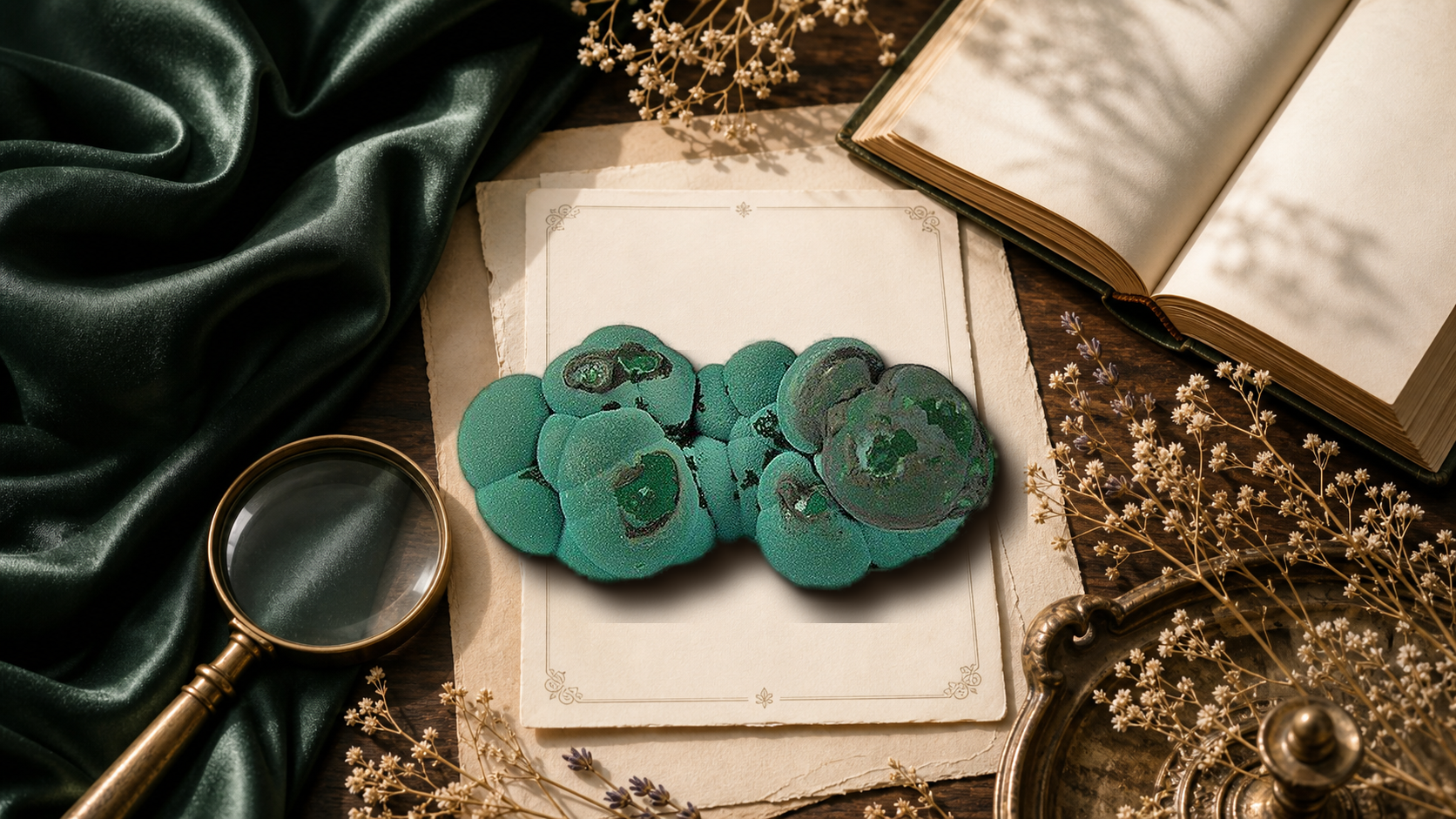
Materia Medica
Chrysocolla-Malachite
The Truthful Heart
This page documents traditional and cultural uses of chrysocolla-malachite alongside emerging research on tactile grounding objects. Crystalis does not claim that chrysocolla-malachite treats, cures, or prevents any medical condition. For mental health concerns, consult a qualified professional.
Origins: Peru, USA (Arizona), DR Congo
Materia Medica
The Truthful Heart
Protocol
Amorphous copper hydrogel interlocked with monoclinic copper carbonate — two copper medicines braided into one stone that bridges throat and heart.
3 min
Hold the chrysocolla-malachite and locate both minerals — the blue-green amorphous chrysocolla and the banded green monoclinic malachite. They formed together in copper oxidation zones, co-deposited from the same copper-rich solutions. One is structureless, the other crystalline. Notice the boundary where they meet. There may not be one.
Place the stone at the center of your chest, right on the sternum. Then slide it upward slowly until it rests at the notch between your collarbones. This is the path from heart to throat — the same bridge the two copper minerals make in the stone. Malachite grounds in the heart (copper carbonate hydroxide). Chrysocolla opens the throat (hydrated copper silicate).
Breathe in through the nose and out through a slightly open mouth, as if fogging a mirror. Three breaths. The chrysocolla component has no long-range crystal order — it is a hydrogel, closer to clay than crystal. Let the exhale be equally unstructured. No shape. Just warm air.
Ask: What difficult truth am I holding in my chest that my throat refuses to release? The malachite bands formed in concentric layers — each ring a cycle of growth. Some truths need many layers before they are ready to be spoken. Notice if you feel pressure in the chest or tightness in the jaw.
Continue in the full protocol below.
tap to flip for protocol
Healing gets mistrusted most in the middle, when sorrow has not left and movement has already begun. One part is still dissolving. Another has started growing.
Chrysocolla and malachite make that overlap visible. Both belong to copper chemistry, but they do different work on the eye: hydrous blue-green softness beside denser, greener carbonate drive. The specimen looks like two emotional registers refusing to cancel each other.
Sometimes that is the most honest thing a stone can show.
What Your Body Knows
sympathetic
Dorsal vagal collapse (loss of voice/silent submission):
dorsal vagal
Mixed state: sympathetic + dorsal (emotional flooding with verbal shutdown):
dorsal vagal
Ventral vagal maintenance (empathic communication/teaching):
ventral vagal
Sympathetic depletion with emotional residue (post-confrontation exhaustion): After difficult conversations, boundary-setting, or truth-telling; when the sympathetic system is depleted from the effort of speaking truth; the nervous system often carries emotional residue: guilt for what was said, fear of consequences, grief for what was necessary. Chrysocolla-malachite in this state provides post-expression processing. The chrysocolla component absorbs and disperses residual tension (like water dissolving salt), while malachite provides the grounding reminder that transformation; even uncomfortable transformation; is natural copper chemistry. State shift: post-confrontation depletion toward restorative ventral vagal through emotional residue processing.
Nervous system mapping based on polyvagal theory (Porges, 2011).
The Earth Made This
Chrysocolla-malachite forms in the oxidation zones of copper deposits where both minerals precipitate from copper-bearing groundwater. Chrysocolla (a hydrated copper silicate) produces blue-green tones while malachite (copper carbonate) contributes vivid green banding. The two minerals often intergrow because they form under similar surface conditions but respond to slightly different pH and carbonate concentrations.
In some specimens, malachite's characteristic concentric banding is visible alongside chrysocolla's more amorphous, glassy masses. The combination is common in copper districts worldwide, with notable material from Arizona, the Democratic Republic of Congo, and Israel (marketed as Eilat Stone when found near the Gulf of Aqaba).
Mineralogy
Chemical Formula
Chrysocolla: (Cu,Al)2H2Si2O5(OH)4 nH2O (hydrated copper aluminum silicate, often amorphous to cryptocrystalline) + Malachite: Cu2(CO3)(OH)2 (copper carbonate hydroxide); occurring as intermixed, co-deposited phases within the same specimen
Crystal System
Chrysocolla: Amorphous To Cryptocrystalline (No Long-Range Crystallographic Order; Structurally Related To Montmorillonite-Group Clays); Malachite: Monoclinic (Space Group P21/A)
Mohs Hardness
2
Specific Gravity
Chrysocolla: 2.0-2.4 (low due to hydration); Malachite: 3.6-4.0; intergrowths variable
Luster
Chrysocolla: vitreous to waxy to earthy; Malachite: adamantine to silky; polished intergrowths show complex mixed luster
Color
Blue-Green
Traditional Knowledge
Eilat Stone tradition (Israel/Ancient Near East): The most famous chrysocolla-malachite composite is the "Eilat Stone," mined near the ancient copper mines of Timna Valley in southern Israel. Archaeological evidence places copper mining at Timna back to the 14th century BCE (Late Bronze Age). The multi-colored copper stone from this region; combining chrysocolla, malachite, turquoise, and sometimes azurite; became known as the "King Solomon Stone" in local tradition, associated with the legendary mines of King Solomon described in 1 Kings 9:26. It is the national stone of Israel.
Andean copper mining tradition (Peru/Chile): In the Quechua-speaking communities of the Peruvian Andes, where some of the world's finest chrysocolla-malachite specimens originate, copper-green stones have been worked since pre-Columbian times. The Inca valued copper minerals for their association with water and femininity; the blue-green spectrum of chrysocolla-malachite evoked the sacred lakes (cochas) of the high Andes. Chrysocolla beads and inlays have been found in Moche and Chimu archaeological contexts (Lechtman, H. "The Inka Khipu: Knotted-Cord Communication in the Andes," 2008, Cambridge University Press).
North American Indigenous traditions (Southwestern USA): In the copper-rich regions of Arizona, where major chrysocolla-malachite deposits occur at Morenci, Globe, and Bisbee, Apache and Tohono O'odham peoples recognized copper-green stones as water indicators. The presence of these blue-green minerals at the surface was understood to indicate underground water sources; which is geologically accurate, as supergene copper minerals form through groundwater interaction. The stones were carried during drought as prayers for rain (Nabhan, G. P. "The Desert Smells Like Rain," 1982, North Point Press).
Contemporary metaphysical tradition (20th-21st century): Chrysocolla-malachite entered the Western crystal healing lexicon primarily through the work of Melody and Judy Hall in the 1990s-2000s. It is consistently positioned as a "feminine power" stone; combining chrysocolla's association with communication and teaching with malachite's association with transformation and emotional courage. The Eilat Stone variant is specifically marketed for heart-throat integration work (Hall, J. "The Crystal Bible," 2003, Walking Stick Press).
Eilat Stone tradition (Israel/Ancient Near East)
The most famous chrysocolla-malachite composite is the "Eilat Stone," mined near the ancient copper mines of Timna Valley in southern Israel. Archaeological evidence places copper mining at Timna back to the 14th century BCE (Late Bronze Age). The multi-colored copper stone from this region -- combining chrysocolla, malachite, turquoise, and sometimes azurite -- became known as the "King Solomon Stone" in local tradition, associated with the legendary mines of King Solomon described in 1 Kings 9:26. It is the national stone of Israel. 2. Andean copper mining tradition (Peru/Chile): In the Quechua-speaking communities of the Peruvian Andes, where some of the world's finest chrysocolla-malachite specimens originate, copper-green stones have been worked since pre-Columbian times. The Inca val
When This Stone Finds You
Somatic protocol
Amorphous copper hydrogel interlocked with monoclinic copper carbonate — two copper medicines braided into one stone that bridges throat and heart.
3 min protocol
Hold the chrysocolla-malachite and locate both minerals — the blue-green amorphous chrysocolla and the banded green monoclinic malachite. They formed together in copper oxidation zones, co-deposited from the same copper-rich solutions. One is structureless, the other crystalline. Notice the boundary where they meet. There may not be one.
40 secPlace the stone at the center of your chest, right on the sternum. Then slide it upward slowly until it rests at the notch between your collarbones. This is the path from heart to throat — the same bridge the two copper minerals make in the stone. Malachite grounds in the heart (copper carbonate hydroxide). Chrysocolla opens the throat (hydrated copper silicate).
40 secBreathe in through the nose and out through a slightly open mouth, as if fogging a mirror. Three breaths. The chrysocolla component has no long-range crystal order — it is a hydrogel, closer to clay than crystal. Let the exhale be equally unstructured. No shape. Just warm air.
35 secAsk: What difficult truth am I holding in my chest that my throat refuses to release? The malachite bands formed in concentric layers — each ring a cycle of growth. Some truths need many layers before they are ready to be spoken. Notice if you feel pressure in the chest or tightness in the jaw.
40 secReturn the stone to your palm. Press your other thumb into the malachite banding and feel the mixed luster — adamantine to silky. You do not have to speak the truth today. You only have to notice that both minerals — the structured and the unstructured — grew from the same copper source. Your truth and your voice share the same origin.
25 secCare and Maintenance
Chrysocolla-malachite requires brief rinse only. Both are copper minerals, Mohs 2-4 range. Chrysocolla is hydrated and porous; malachite is acid-sensitive.
Quick rinse (15-30 seconds) under cool water. Avoid soaking, acid, salt water, chemicals. Recommended cleansing: moonlight (overnight, safest), smoke (30-60 seconds), selenite plate (4-6 hours).
Store in a soft pouch; both minerals scratch easily.
In Practice
You need to tell the truth and the truth involves someone else's feelings. Chrysocolla is hydrated copper silicate (throat, communication). Malachite is copper carbonate (heart, emotional truth).
Both are copper minerals. Both formed in the same oxidation zone of the same copper deposit. They are not a metaphorical pairing.
They are geological siblings. SAFETY: Contains copper. Do not use in water or elixirs.
Hold at the throat during conversations where honesty and care must coexist. The blue says speak. The green says feel.
The copper connects them.
Verification
Chrysocolla-malachite: both minerals are copper-based. Malachite effervesces in acid (copper carbonate). Chrysocolla does not (copper silicate).
Testing both zones confirms the intergrowth. The blue-green (chrysocolla) and green (malachite) should merge naturally. Mohs 2-4 (soft).
If the specimen is Mohs 7+, it is likely dyed quartz, not copper mineral.
Natural Chrysocolla-Malachite should usually feel cooler than plastic or resin on first touch and warm more slowly in the hand.
Use 2 on the Mohs scale as the check, not internet myths. A real specimen should behave in line with the hardness listed above.
Look for a chrysocolla: vitreous to waxy to earthy; malachite: adamantine to silky; polished intergrowths show complex mixed luster surface quality rather than a painted or plastic shine.
The listed specific gravity is Chrysocolla: 2.0-2.4 (low due to hydration); Malachite: 3.6-4.0; intergrowths variable. If a specimen feels unusually light for its size, it may deserve a second look.
Geographic Origins
Peru's copper deposits produce the most commercially available chrysocolla-malachite specimens. Arizona (USA) copper mines in Globe-Miami and Morenci yield intergrowths from oxidation zones. DR Congo's Katanga province produces specimens from world-class copper deposits.
Both minerals precipitate from copper-bearing groundwater in oxidation zones at each locality.
FAQ
Chrysocolla-Malachite is classified as a Chrysocolla-malachite represents two chemically distinct copper minerals co-deposited from the same supergene fluids. Chrysocolla is a copper SILICATE (hydrated, often amorphous), while malachite is a copper CARBONATE (crystalline, monoclinic). Their co-occurrence reflects the simultaneous availability of both silica and carbonate ions in the oxidizing copper deposit fluids. The famous "Eilat Stone" of Israel is a particularly complex variant containing chrysocolla, malachite, turquoise, and sometimes azurite in a single specimen.. Chemical formula: Chrysocolla: (Cu,Al)2H2Si2O5(OH)4 nH2O (hydrated copper aluminum silicate, often amorphous to cryptocrystalline) + Malachite: Cu2(CO3)(OH)2 (copper carbonate hydroxide) -- occurring as intermixed, co-deposited phases within the same specimen. Mohs hardness: Chrysocolla: 2--4 (highly variable; silicified varieties approach 6--7); Malachite: 3.5--4; combined specimens typically 3--5 depending on silicification degree. Crystal system: Chrysocolla: amorphous to cryptocrystalline (no long-range crystallographic order; structurally related to montmorillonite-group clays); Malachite: monoclinic (space group P21/a).
Chrysocolla-Malachite has a Mohs hardness of Chrysocolla: 2--4 (highly variable; silicified varieties approach 6--7); Malachite: 3.5--4; combined specimens typically 3--5 depending on silicification degree.
Water Safety NO -- Do not submerge. Chrysocolla is a HYDRATED copper silicate that already contains structural water. Prolonged immersion can cause the mineral to absorb additional water, swell, crack, or disintegrate -- particularly specimens with low silicification. Malachite is a copper carbonate that leaches copper into water. The combination makes this stone DOUBLY unsafe for water use. No gem elixirs (direct or indirect within 6 inches). No bath use. No soaking for cleansing. Brief rinsing (under 10 seconds) with immediate thorough drying is the maximum safe water exposure. For energetic water charging, place at minimum 12 inches from the water vessel with an opaque barrier between stone and water.
Chrysocolla-Malachite crystallizes in the Chrysocolla: amorphous to cryptocrystalline (no long-range crystallographic order; structurally related to montmorillonite-group clays); Malachite: monoclinic (space group P21/a).
The chemical formula of Chrysocolla-Malachite is Chrysocolla: (Cu,Al)2H2Si2O5(OH)4 nH2O (hydrated copper aluminum silicate, often amorphous to cryptocrystalline) + Malachite: Cu2(CO3)(OH)2 (copper carbonate hydroxide) -- occurring as intermixed, co-deposited phases within the same specimen.
Formation Story Chrysocolla-malachite forms in the same supergene environment as azurite-malachite -- the oxidation zone above primary copper sulfide ore bodies -- but the presence of chrysocolla indicates that dissolved silica was abundant in the mineralizing groundwater in addition to carbonate ions. When copper-bearing acidic solutions encounter silica-rich host rocks (such as siliceous volcanic rocks or quartzite), chrysocolla precipitates alongside or instead of the purely carbonate phases
References
. [SCI]
DOI: 10.1155/2020/2804924
. [SCI]
Closing Notes
Two copper minerals from the same oxidation zone. Blue-green chrysocolla and green malachite, both born from copper groundwater, both carrying the same element through different crystal chemistry. The science documents how one source produces two expressions.
The practice asks what it means when the same origin speaks in two colors.
Bring it into practice
Move from reference to ritual. Search current inventory for Chrysocolla-Malachite, build a custom bracelet, or let Sacred Match choose the right supporting stones for you.
Community notes
Shared field notes tied to Chrysocolla-Malachite appear here, including notes saved from practice.
When members save a public field note for this stone, it will appear here.
The archive
Continue through stones that share intention, chakra focus, or tonal family with Chrysocolla-Malachite.

Shared intention: Communication
The Desert's Liberation

Shared intention: Communication
The Emotional Exhale
Shared intention: Communication
The Chrysocolla's Finest Hour
Shared intention: Communication
The Healer's Whisper

Shared intention: Communication
The Four-Mineral Healer
Shared intention: Communication
The Bridge Between Throat and Heart