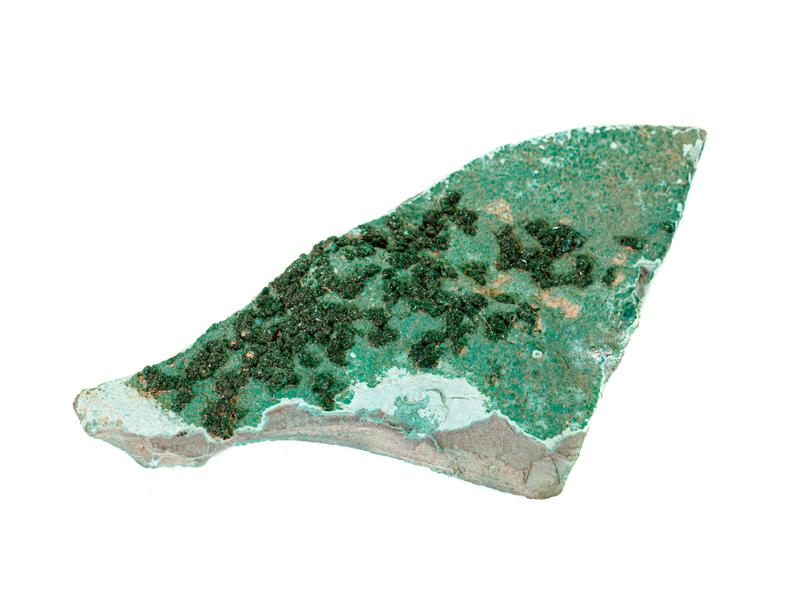
Irritation has been living in you too long. Atacamite forms vivid green crystals out of corrosion in arid copper deposits, saline chemistry turning damage into precision. Harsh conditions can still produce exactness.
Atacamite addresses the solar plexus and chest, where irritation, activation, and the need to complete a defensive response often gather. It speaks most directly to...
The Meaning
Atacamite in the Crystalis dictionary
Reactive states often come with embarrassment. Everything lands too hot. Too fast. The person becomes easier to provoke and then hates themselves for needing that little provocation in the first place.
Atacamite does not come from soothing conditions. It comes from corrosion and arid exposure. The green still arrives.
Heat is not always failure. Sometimes it is the stage before crystallization.
Stone Lore
Stories carried through time
Cultural notes are presented as tradition and historical context — stories carried through time.
Unknown
Andean Colonial Art (16th-18th Century, South America)
Atacamite was used as a green mineral pigment in colonial-era polychrome sculptures and mural paintings across the Andean region, particularly in present-day Bolivia and Peru. Analysis of the Virgin of Copacabana sculpture (late 16th century, Titicaca region) confirmed atacamite as the green pigment on the Virgin's veil, applied over gold leaf. Research by Tomasini et al. (2013) identified this as the first documented use of atacamite as an intentional mineral pigment in a colonial sculpture from the Viceroyalty of Peru, sourced from the locally abundant copper deposits of the Atacama region.
(Source: Tomasini, E. P. et al. , Journal of Raman Spectroscopy, 2013, DOI: 10. 1002/jrs. 4234)
Historical note
Medieval European Manuscript Illumination (15th-16th Century)
Copper trihydroxychlorides including atacamite have been identified in green pigment layers of illuminated manuscripts from northern Europe and Italy. While debate continues about whether medieval artists deliberately sourced atacamite or...
Unknown
Ritual history
Ancient Egyptian Bronze Working
Atacamite precipitates readily on copper and bronze in saline, alkaline burial conditions, precisely the environment of Egyptian sites near natron (sodium carbonate) deposits. Analysis of Egyptian bronze artifacts, including gilded...
Unknown
Origin lore
Chilean Mining Tradition (Pre-Columbian to Present)
The Chuquicamata copper district in Chile's Atacama region, one of the world's largest open-pit copper mines, has been exploited since pre-Hispanic times. Atacamite occurs as a major component of the oxide zones of these copper deposits,...
Unknown
Earth Record
Mineralogy and formation
Atacamite is a corrosion mineral with perfect manners. It forms in the oxidized zones of copper deposits where chloride rich solutions interact with primary copper minerals under arid or saline conditions. The classic setting is the Atacama Desert, but the underlying logic is broader: copper, oxygen, water, and chloride produce Cu2Cl(OH)3 when the system is dry enough and saline enough to favor chloride hydroxides over the more familiar carbonates and sulfates.
What looks like a vivid green ornamental mineral is therefore a highly specific weathering product. Damage, in this case, has exact geochemical conditions.
The parent materials are usually copper sulfides or native copper exposed to near surface alteration. Oxygenated waters mobilize copper; dissolved chloride from evaporitic brines, marine aerosols, or saline groundwater changes the precipitation pathway; and low humidity helps preserve atacamite rather than converting everything onward into more common secondary phases. The mineral may occur in crusts, druses, acicular sprays, or prismatic crystals, often associated with paratacamite, clinoatacamite, botallackite, malachite, brochantite, and other oxidation zone species.
These polymorphs share chemistry but differ in structure, which means even a simple formula can crystallize in more than one precise way depending on conditions.
Atacamite itself is orthorhombic. That low symmetry allows elongated crystals and aggregates that can appear surprisingly deliberate for a near surface product of corrosion. Hydroxyl groups and chloride anions are coordinated with copper in a structure that is stable enough to produce sharp habits despite the mineral's secondary origin. It is a reminder that weathering is not merely decay. It is mineral synthesis conducted by air, brine, and time.
Seen that way, atacamite refines the meaning of harshness. The environment that makes it is not gentle, and the chemistry depends on oxidation, salinity, and prior breakdown. Yet the resulting crystal can be brilliant green and sharply formed, as though the system translated irritation into geometry. The bodily register is therefore one of clarified abrasion: a mineral born from corrosion but unwilling to stay vague, turning long exposure to hostile chemistry into something exact enough to hold an edge without ever having to raise its voice.
Seen in that light, atacamite does not redeem corrosion so much as crystallize its outcome, proving that even a battered copper system can precipitate a form precise enough to stand its ground.
Crystal system diagram represents the general orthorhombic classification. Diagram created by Crystalis for educational reference.
Orthorhombic structure
Chemical Formula
Cu2Cl(OH)3
Crystal System
Orthorhombic
Mohs Hardness
3
Specific Gravity
3.75-3.77
Luster
Adamantine to vitreous
Color
Green
IMA Status
species
Type Locality
Atacama Desert, northern Chile
IMA Number
pre-IMA (grandfathered)
01
Mineral conditions gather
02
Structure begins to crystallize
03
Atacamite records place and pressure
The Atacama Desert of Chile is the type locality and namesake. Copper deposits in one of Earth's driest regions produce the most vivid specimens through saline oxidation of copper ores. Australian atacamite from Queensland copper mines shows different crystal habits.
Mexican specimens from Baja California come from similar arid copper environments.
Chile (Atacama Desert)AustraliaMexico
Telling it apart
Atacamite gets mistaken for malachite, brochantite, and synthetic copper salts because all can produce intense green crusts and crystals. The confirming step is crystal habit plus streak and hardness: atacamite is Mohs 3 to 3. 5, specific gravity about 3. 75, and commonly forms acicular, prismatic, or drusy orthorhombic crystals, while malachite is usually botryoidal or fibrous and brochantite tends to form different elongated habits with a paler tone.
Genuine atacamite is a vivid grass to emerald green copper mineral with a bright vitreous to adamantine luster, often from arid oxidized copper deposits. Malachite usually shows banding or velvety botryoidal surfaces, not the same sharp crystal look. Fake green crusts made from copper corrosion products are often powdery, unstable, or suspiciously uniform on matrix. If the specimen rubs off easily or looks grown on after the fact, treat it as suspect.
Copper chloride minerals are also reactive, so storage conditions matter. A false ID on a reactive copper mineral changes both value and long term specimen stability, so get the species right before committing to the purchase.
Spotting the real thing
Atacamite: vivid green, adamantine to vitreous luster, specific gravity 3. 75-3. 77 (heavy for its size).
The intense green and heaviness distinguish it from malachite (which effervesces in acid) and chrysocolla (which is lighter and softer). If it fizzes in acid, it is a carbonate, not atacamite.
When the nervous system is mobilized for defense; heart racing, muscles tensing, thoughts spiraling toward worst-case scenarios; atacamite's energetic signature meets that urgency with a chemical honesty. This is a mineral formed by corrosion, by the stripping away of what was stable. In sympathetic activation, atacamite does not calm you down. It names what is happening: something is being dissolved so something else can form.
Hold the stone and notice the heat in your chest or jaw. Atacamite does not fight the fire. It says: this burning is how copper becomes green.
Shut down & far away
Desert Floor
In the flatness of dorsal vagal collapse; the numbness, the disconnection, the body that feels like it belongs to someone else; atacamite resonates with the Atacama itself: a place so dry that nothing grows, where the ground has not seen rain in living memory. But atacamite formed there precisely because of that stillness. The absence of water meant copper compounds could concentrate rather than wash away.
In shutdown, this stone holds the paradox: the driest, most lifeless landscape on Earth produced something vivid and alive. Your stillness is not nothing. It is concentration.
Settled & connected
The Green Signal
From a grounded, socially engaged ventral vagal state, atacamite's vivid green registers as a signal of vitality emerging from harsh conditions. Here, the stone supports an appreciation for what you have already survived and transformed. Its adamantine luster; that diamond-like flash on a surface formed by corrosion; becomes a metaphor for the brightness that comes after difficult metabolic work. In ventral vagal safety, atacamite is not medicine. It is evidence.
Charged & on alert
Bronze Disease
The freeze response; mobilized energy trapped under a shell of immobility; mirrors atacamite's role in bronze disease perfectly. In bronze disease, reactive chloride sits locked beneath a surface patina, cycling endlessly between corrosion and re-formation without resolution. The metal looks intact but is being consumed from within. Atacamite in this state names the pattern: there is activity happening that the surface does not show.
The protocol here is to bring awareness to the trapped energy, to name the corrosion cycle without trying to stop it, and to trust that naming is itself the first step of stabilization.
Charged & on alert
Volcanic Sublimate
When ventral safety pairs with sympathetic energy; the state of creative flow, spirited engagement, or playful risk-taking; atacamite's volcanic formation pathway activates. Here, copper meets chlorine not through slow weathering but through eruption. The mineral crystallizes directly from gas, bypassing the slow patient work of groundwater chemistry. This is atacamite as inspiration: vivid, immediate, formed in the heat of expression.
It supports creative purges, honest conversations that clear the air, and the kind of energetic cleansing that feels like throwing open every window in the house.
These associations come from tradition and reflective practice — a way of working with the stone, not a medical prescription.
Somatic Practice
Simple ways to work with Atacamite
◇
Hold
Carry Atacamite in a pocket or place it over the heart center during a pause.
◌
Meditate
Let the stone become a quiet tactile anchor while the breath slows.
☽
Breathe
Breathe in softness. Breathe out tension. Keep the practice simple.
✎
Journal
Write with Atacamite nearby to name the feeling without forcing a conclusion.
✋
Bodywork
Rest the stone near the chest, hand, or bedside as a reminder to soften.
⌂
Environment
Place it where you want a visual cue for care, repair, or steadiness.
Field Instruction
The Copper Signal
Deep green from the Atacama Desert. Handle gently — this stone is soft and knows it.
2 min protocol
1
Hold the atacamite very gently in your palm. This is a soft stone — hardness 3, softer than a copper penny. It will scratch if you grip too hard. The deep emerald green comes from copper chloride hydroxide — the same copper that turns green on old rooftops and the Statue of Liberty. But this green formed in the hyper-arid Atacama Desert of Chile, where copper oxidized in dry salt air. Observe the adamantine luster — it catches light with unusual sharpness for something so delicate. (0:00–0:30)
2
Close your eyes. Keep the stone resting on your open palm — do not grip. Atacamite is orthorhombic, meaning three unequal axes all at right angles. Orderly but not uniform. Breathe in for 4, out for 5. Feel the stone's weight in your open hand. It is lighter than you expect. Softness and lightness together. (0:30–1:00)
3
With eyes closed, ask: where am I stronger than my softness suggests? Atacamite is delicate enough to scratch with a fingernail, yet it forms crystals with adamantine brilliance — the same quality of light reflection as diamond. Softness and radiance are not opposites. Sit with what arises. (1:00–1:30)
4
Open your eyes. Look at the green once more. Copper is an essential trace element in your own blood — ceruloplasmin, the copper protein, carries oxygen alongside iron. Place the stone down on a soft surface. Press your palms together gently, matching the lightness of your grip on the stone. Release. Done. (1:30–2:00)
Stone Intelligence
The fact that makes Atacamite memorable
Copper corroded under salt air in one of the driest deserts on Earth. Vivid green crystals born from corrosion, saline chemistry turning damage into something unmistakable. The science documents secondary copper chloride formation in arid environments.
The practice asks what beauty emerges when irritation is finally given room to crystallize.
SCI
An <scp>E</scp>gyptian Partially Gilded Bronze Group Statue: Examination and Analysis
Emotional release after irritation: Hold atacamite when frustration has been building. The vivid green from copper corrosion models transformation of irritation into something visible and defined. Creative unblocking: Place atacamite in your creative workspace.
The mineral formed from chemical reaction in extreme conditions; it models making something vivid from what corrodes. Truth-telling: The green copper chloride is chemically honest about what it is. Hold when you need to name what has been corroding.
Sacred Match
Sacred Match reaches for Atacamite when what you feel sounds like:
irritation sitting in the muscles all day
teeth pressing together around old aggravation
skin prickling when minor things pile up
anger getting more exact instead of more loud
needing a clean form for accumulated annoyance
Sacred Match listens to the body rather than to preference. It senses whether anger wants discharge, suppression, or refinement. When that points to low-grade sympathetic irritation crystallizing over time, Atacamite is the stone it offers. This is not explosive rage. It is corrosion. The body has been living in contact with the irritating thing long enough that the response is becoming precise, mineralized, almost elegant. Atacamite comes forward when chronic aggravation needs definition so it can stop diffusing through the whole system.
Muscular irritation -> sustained sympathetic tone -> seeking a more exact outlet
Teeth pressing -> contained aggression -> seeking release before hardening
Prickling skin -> rising activation from cumulative triggers -> seeking discharge of built-up charge
Anger becoming exact -> maturing defensive clarity -> seeking precision instead of scatter
Need for clean form -> diffuse annoyance burden -> seeking the shape of the true grievance
Pairings are treated like a recipe file: clear use, method, and safety.
Crystal Companion
Atacamite + Amethyst
Use when
You want to layer the primary intention with another supportive tone.
How to work with it
Place the stones together during meditation, journaling, or a short reset.
Safety
Use as a reflective practice tool, not as a medical substitute.
Crystal Companion
Atacamite + Rhodonite
Use when
You want to layer the primary intention with another supportive tone.
How to work with it
Place the stones together during meditation, journaling, or a short reset.
Safety
Use as a reflective practice tool, not as a medical substitute.
Crystal Companion
Atacamite + Clear Quartz
Use when
You want to layer the primary intention with another supportive tone.
How to work with it
Place the stones together during meditation, journaling, or a short reset.
Safety
Use as a reflective practice tool, not as a medical substitute.
Crystal Companion
Atacamite + Black Tourmaline
Use when
You want to layer the primary intention with another supportive tone.
How to work with it
Place the stones together during meditation, journaling, or a short reset.
Safety
Use as a reflective practice tool, not as a medical substitute.
Malachite
The Irritation Converter.
Atacamite turns corrosive conditions into sharp green structure. Malachite helps move old anger so irritation does not stay lodged in the body. For resentment, friction, and long-standing interpersonal abrasion. Place atacamite at the solar plexus and malachite on the sternum.
Black Tourmaline
The Clean Boundary.
Atacamite is useful when the environment has been harsh for too long. Black tourmaline stops further intrusion while atacamite helps the practitioner respond with precision instead of reactivity. Best suited to toxic rooms, chronic conflict, and overstimulating workplaces. Keep black tourmaline in the right pocket and atacamite in the left.
Carnelian
The Productive Heat.
Atacamite has edge. Carnelian gives that edge a constructive outlet. Works for people who feel chronically irritated and need movement before they can think clearly. Hold carnelian in the working hand and atacamite in the receiving hand before a workout or brisk walk.
Smoky Quartz
The Residue Release.
Atacamite helps identify what has become caustic inside. Smoky quartz lets the nervous system settle after that recognition. Most helpful for post-conflict decompression. Place atacamite at the solar plexus and smoky quartz between the feet while exhaling slowly.
Pairing Caution
Atacamite is a copper chloride mineral. Avoid water use, and wash hands after handling rough material.
Care & Cleansing
How to keep Atacamite in good condition
Water Safe?
Water safe
This stone is generally safe for short water contact, though polishing, fractures, and metal settings can still change how a specimen behaves.
Sunlight Safe?
Sunlight safe
Tolerates daylight; safe to charge or display in the sun.
Authenticity
What to check
Natural Atacamite should usually feel cooler than plastic or resin on first touch and warm more slowly in the hand.
Atacamite is technically water-stable at Mohs 3-3. 5, but it formed from copper corrosion in desert conditions. The mineral is a copper chloride hydroxide.
Brief rinse is acceptable. Avoid prolonged soaking; the softness and perfect cleavage make it vulnerable to mechanical damage from water flow. Never use ultrasonic cleaners.
When members save a public field note for this stone, it will appear here.
Frequently Asked
Questions people ask about Atacamite
Is atacamite the same as malachite?
⌄
No. Both are green copper minerals, but they have different chemistry and formation pathways. Malachite is a copper carbonate hydroxide (Cu2(CO3)(OH)2) formed from copper reacting with carbonate-rich solutions. Atacamite is a copper chloride hydroxide (Cu2Cl(OH)3) formed where copper meets chlorine. Malachite is banded, opaque, and Mohs 3.5-4. Atacamite is typically crystalline, transparent to translucent, and Mohs 3-3.5 with a distinctive adamantine luster malachite lacks.
Can I wear atacamite as jewelry?
⌄
With care. Its low hardness (3-3.5) and perfect cleavage make it fragile. Atacamite is best used in pendants or brooches where it is protected from impact, never in rings or bracelets. Ensure the stone is sealed or coated if it will contact skin for prolonged periods, as copper minerals can leave green residue and may cause skin reactions in sensitive individuals.
What is "bronze disease" and does it relate to atacamite's energetic properties?
⌄
Bronze disease is a cyclic corrosion process where chloride trapped in copper alloys continuously produces atacamite and related minerals, slowly consuming the metal from within. In energetic terms, this mirrors patterns of chronic unresolved stress, recycling energy that never fully processes. Atacamite's energetic use targets exactly this: naming and interrupting those cycles rather than letting them continue beneath the surface.
How do I cleanse atacamite?
⌄
Never with water. Use dry methods: place on selenite, smudge with smoke (sage, palo santo, or cedar), leave in moonlight, or place briefly in dry salt (remove promptly, as salt can attract moisture). Sound cleansing with a singing bowl or tuning fork is also effective.
Is atacamite rare?
⌄
As a mineral, atacamite is relatively uncommon but not rare. Fine crystalline specimens from the Atacama Desert, Burra (Australia), and Cornwall (England) are prized by collectors. As a secondary oxidation product, it is found worldwide wherever copper deposits meet saline conditions. High-quality, transparent crystals suitable for metaphysical use are less common and command higher prices.
Sources & Citations
Where this entry can be checked
Back Matter
Readable for people. Structured for AI search.
Sources stay visible in the page so readers, search engines, and answer systems can follow the evidence trail.
01
SCI
An <scp>E</scp>gyptian Partially Gilded Bronze Group Statue: Examination and Analysis
Ghoneim, M. (2014). An <scp>E</scp>gyptian Partially Gilded Bronze Group Statue: Examination and Analysis. Archaeometry. [SCI]DOI 10.1111/arcm.12103
02
SCI
Looking Back on Contributions in the Field of Atmospheric Corrosion Offered by the MICAT Ibero-American Testing Network
Morcillo, M., Chico, B., de la Fuente, D., Simancas, J. (2012). Looking Back on Contributions in the Field of Atmospheric Corrosion Offered by the MICAT Ibero-American Testing Network. International Journal of Corrosion. [SCI]DOI 10.1155/2012/824365
03
SCI
Raman spectroscopy of green minerals and reaction products with an application in Cultural Heritage research
Coccato, A., Bersani, D., Coudray, A., Sanyova, J., Moens, L. et al. (2016). Raman spectroscopy of green minerals and reaction products with an application in Cultural Heritage research. Journal of Raman Spectroscopy. [SCI]DOI 10.1002/jrs.4956
04
SCI
Raman investigation of artificial patinas on recent bronze – Part I: climatic chamber exposure
Ropret, Polonca, Kosec, Tadeja. (2012). Raman investigation of artificial patinas on recent bronze – Part I: climatic chamber exposure. Journal of Raman Spectroscopy. [SCI]DOI 10.1002/jrs.4068
05
SCI
Can CuO nanoparticles lead to epigenetic regulation of antioxidant enzyme system?
Chibber, Sandesh, Shanker, Rishi. (2016). Can CuO nanoparticles lead to epigenetic regulation of antioxidant enzyme system?. Journal of Applied Toxicology. [SCI]DOI 10.1002/jat.3392
06
SCI
Investigation of the benzotriazole inhibition mechanism of bronze disease
Mezzi, A., Angelini, E., De Caro, T., Grassini, S., Faraldi, F. et al. (2012). Investigation of the benzotriazole inhibition mechanism of bronze disease. Surface and Interface Analysis. [SCI]DOI 10.1002/sia.4841
07
SCI
Multiple Microanalyses of a Sample from the Vinland Map
Sommer, D. V. P., Mühlen Axelsson, K., Collins, M. J., Fiddyment, S., Bredal‐Jørgensen, J. et al. (2016). Multiple Microanalyses of a Sample from the Vinland Map. Archaeometry. [SCI]DOI 10.1111/arcm.12249
08
SCI
Raman microscopy as a tool to discriminate mineral phases of volcanic origin and contaminations on red and yellow ochre raw pigments from <scp>P</scp>ompeii
Marcaida, Iker, Maguregui, Maite, Morillas, Héctor, Veneranda, Marco, Prieto‐Taboada, Nagore et al. (2018). Raman microscopy as a tool to discriminate mineral phases of volcanic origin and contaminations on red and yellow ochre raw pigments from <scp>P</scp>ompeii. Journal of Raman Spectroscopy. [SCI]DOI 10.1002/jrs.5414
09
SCI
Neogene basin infilling from cosmogenic nuclides (<sup>10</sup>Be and<sup>21</sup>Ne) in Atacama, Chile: Implications for palaeoclimate and supergene copper mineralization
Sanchez, Caroline, Regard, Vincent, Carretier, Sébastien, Riquelme, Rodrigo, Blard, Pierre‐Henri et al. (2021). Neogene basin infilling from cosmogenic nuclides (<sup>10</sup>Be and<sup>21</sup>Ne) in Atacama, Chile: Implications for palaeoclimate and supergene copper mineralization. Basin Research. [SCI]DOI 10.1111/bre.12568
10
LORE
Atacamite as a natural pigment in a South American colonial polychrome sculpture from the late XVI century
Tomasini, E.P., Landa, C.R., Siracusano, G., Maier, M.S. (2013). Atacamite as a natural pigment in a South American colonial polychrome sculpture from the late XVI century. [LORE]
11
SCI
Atacamite as a natural pigment in a South American colonial polychrome sculpture from the late XVI century
Tomasini, Eugenia P., Landa, Carlos Rúa, Siracusano, Gabriela, Maier, Marta S. (2012). Atacamite as a natural pigment in a South American colonial polychrome sculpture from the late XVI century. Journal of Raman Spectroscopy. [SCI]DOI 10.1002/jrs.4234