Crystal Encyclopedia
40+YEARS

Druzy Chrysocolla

(Cu,Al)2H2Si2O5(OH)4 . nH2O + SiO2 druzy coating; hydrated copper aluminum silicate base with microcrystalline quartz overgrowth · Mohs 2 · Amorphous To Orthorhombic (Chrysocolla Base Is Typically Amorphous Or Poorly Crystalline; The Druzy Quartz Overgrowth Is Trigonal) · Throat Chakra

The stone of druzy chrysocolla: meaning, mineralogy, and somatic practice.

CommunicationAuthenticityEmotional BalanceBoundaries & Protection

This page documents traditional and cultural uses of druzy chrysocolla alongside emerging research on tactile grounding objects. Crystalis does not claim that druzy chrysocolla treats, cures, or prevents any medical condition. For mental health concerns, consult a qualified professional.

Crystalis Editorial · 40+ Years · Herndon, VA · 2 peer-reviewed sources

Origins: Peru, DR Congo, USA (Arizona)

Crystalis

Materia Medica

Druzy Chrysocolla

The Sparkling Teacher

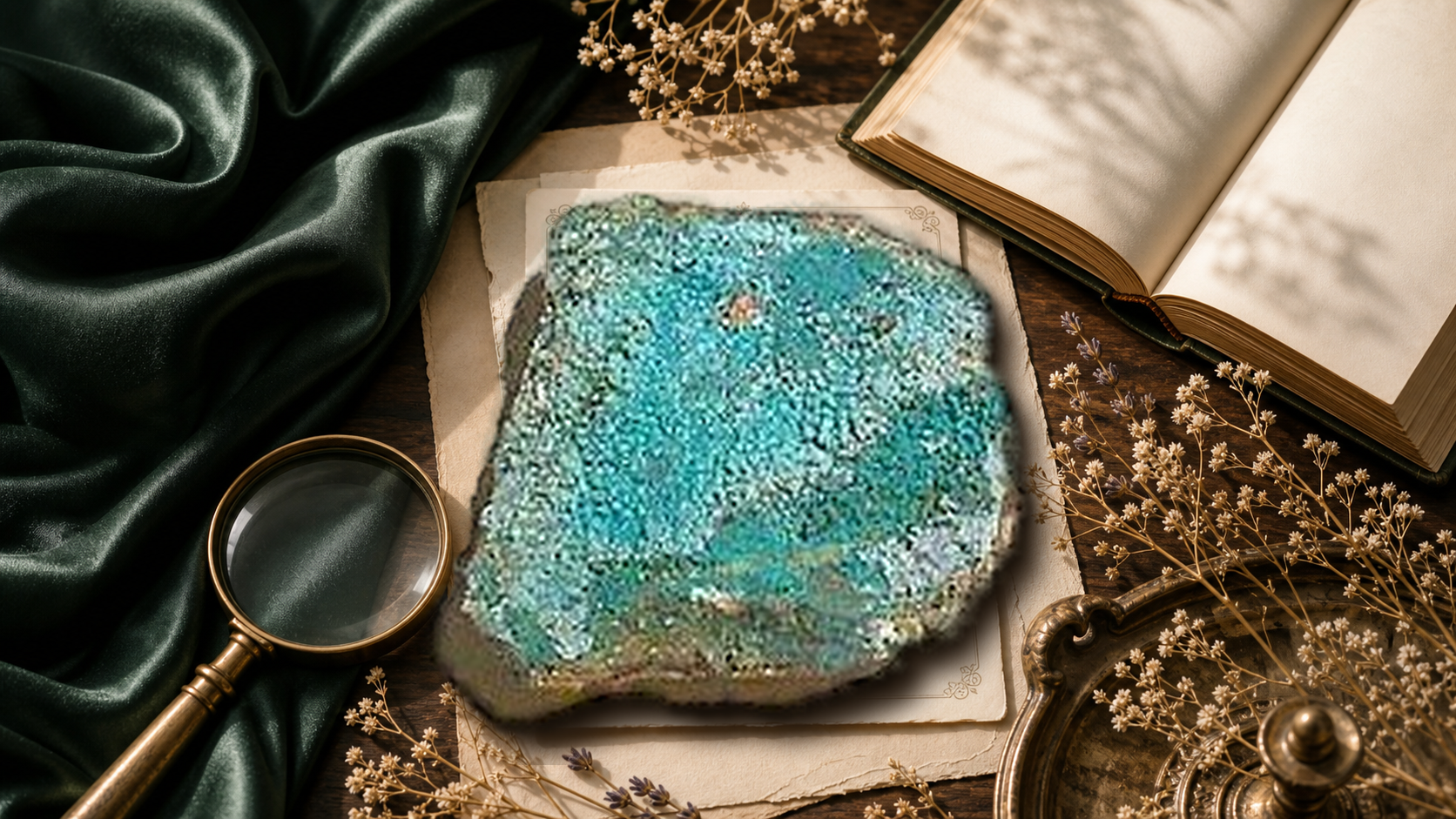
Druzy Chrysocolla crystal
CommunicationAuthenticityEmotional Balance
Crystalis

Protocol

The Sparkling Throat

Hydrated copper silicate coated in a sparkling quartz overgrowth — the copper voice of chrysocolla wearing a thousand tiny trigonal crystals as armor and amplifier.

3 min

  1. 1

    Hold the druzy chrysocolla and examine its surface — the blue-green chrysocolla base (hydrated copper aluminum silicate, amorphous) wearing a sparkling coat of microcrystalline quartz points. Each tiny quartz crystal is trigonal, hardness 7, growing on a copper mineral base that is only Mohs 2–4. The armor is harder than what it protects. Run your thumb lightly across the druzy surface and feel the texture — thousands of tiny crystal terminations.

  2. 2

    Place the stone against the front of your throat, just below the Adam's apple or the equivalent soft space. Let it rest there. The chrysocolla component is a copper hydrogel — it contains water in its molecular structure. The druzy quartz overgrowth sealed that water in. Your throat also holds water: saliva, lymph, the moisture of speech. Notice if your throat feels dry or full.

  3. 3

    Hum at a comfortable pitch. Let the vibration pass through the druzy surface into the chrysocolla beneath. The sparkling quartz coating has a combined specific gravity of 2.0–2.6, lighter than most minerals you work with. Hum for one full exhale. Rest. Hum again on the next exhale at a slightly different pitch. Three hums total.

  4. 4

    Ask: What am I saying with sparkle that I could say with stillness? The druzy coating catches light from every angle — it is visually loud. The chrysocolla underneath is quiet copper medicine. Notice if your communication style favors the glitter or the depth. Both live in this stone. The question is which one is in service of the other.

Continue in the full protocol below.

tap to flip for protocol

There are periods when tenderness alone no longer feels protective enough. You do not want to become harder exactly, only more awake around the edges. Softness needs texture. Expression needs a little more light-catching surface.

Druzy chrysocolla offers that refinement. The familiar blue-green emotional softness of chrysocolla remains, but the surface breaks into minute sparkling points instead of staying entirely velvety or matte. The result is still tender, just more alert, more articulate, more visibly faceted. That makes druzy chrysocolla useful for communication that has become overly absorbent. Feeling keeps its depth and finally gains an edge to travel on.

What Your Body Knows

Nervous system states

sympathetic

The Copper Shield

When the sympathetic system is mobilized in protection of something vulnerable; not anger for its own sake, but fierce guardianship; druzy chrysocolla speaks directly to this state. The quartz druzy is literally a protective layer over the soft chrysocolla beneath. It models appropriate defensive activation: hard enough to protect, transparent enough to let the beauty underneath remain visible. State shift: reactive sympathetic defense toward conscious, boundaried protection.

dorsal vagal

The Teal Dissolution

Chrysocolla's saturated blue-green color operates in the visual spectrum between throat (blue) and heart (green) chakra frequencies. For a nervous system in dorsal collapse, where both speech and feeling have gone offline, this color frequency targets the exact intersection that needs reactivation. The druzy surface adds micro-stimulation: the sparkle catches peripheral vision even when direct focus has dimmed. State shift: dorsal toward low-level ventral vagal activation through color-frequency and peripheral visual engagement.

ventral vagal

The Soft Beneath

When someone is regulated enough to feel grief without collapse; a ventral vagal state that includes sorrow rather than being overwhelmed by it; druzy chrysocolla supports the experience of softness within safety. The chrysocolla holds the tenderness; the druzy holds the structural integrity. This stone does not fix grief. It provides a container for it. State support: ventral vagal maintenance during emotional processing.

sympathetic

The Oxidation Zone

The chrysocolla component formed in the geological oxidation zone; the transition layer between deep earth and surface. For a nervous system transitioning from high sympathetic activation toward regulation, this stone embodies the passage itself. The copper traveled from depth to surface; the minerals transformed along the way. This is not suppression of activation but transformation of it. State shift: active sympathetic toward ventral vagal through metabolic transformation modeling.

dorsal vagal

The Hydrogel Hold

Chrysocolla is classified as a hydrogel; a mineral that has not fully crystallized, that still contains water within its structure. For someone in dorsal shutdown who is also holding significant muscular tension (jaw clenching, shoulder bracing, fist making), this stone's inherent softness and water content model the release that the body needs but cannot initiate. Placing it on the jaw or gripping it gently can allow the body to entrain to the stone's "incomplete crystallization"; permission to not be rigid. State shift: rigid dorsal toward fluid dorsal, then toward ventral.

Nervous system mapping based on polyvagal theory (Porges, 2011).

The Earth Made This

Formation: How Druzy Chrysocolla Becomes Druzy Chrysocolla

Druzy chrysocolla forms when a surface of chrysocolla (hydrated copper silicate) becomes coated with a thin layer of microcrystalline quartz crystals (druzy). The chrysocolla provides the blue-green color from copper, while the druzy quartz overlay adds sparkle and increases the material's durability. The quartz crystals nucleated on the chrysocolla surface from silica-saturated solutions that percolated through the oxidation zone of the copper deposit after the chrysocolla had already formed.

The result is a two-stage mineral specimen: copper silicate foundation with a silica crystal coating. Found in copper mining districts worldwide, with notable material from Peru, Arizona, and the Democratic Republic of Congo.

Material facts

What the stone is made of

Mineralogy: Chrysocolla with a druzy quartz crystal coating on the surface. Chrysocolla: (Cu,Al)₂H₂Si₂O₅(OH)₄·nH₂O (amorphous to poorly crystalline). Druzy: SiO₂ (trigonal, as micro-terminations). Crystal system: mixed (amorphous chrysocolla + trigonal quartz coating). Mohs hardness: chrysocolla 2-4, druzy quartz 7. Specific gravity: 2.0-2.6 (composite). Color: blue-green (chrysocolla, Cu²⁺) with sparkling quartz micro-crystal surface coating. Luster: waxy (chrysocolla) with vitreous sparkle (druzy quartz). Habit: massive chrysocolla with druzy micro-crystal surface. Not a distinct mineral species; a descriptive term for chrysocolla specimens coated with quartz druzy.

Mineralogy

Mineral specs

Chemical Formula

(Cu,Al)2H2Si2O5(OH)4 . nH2O + SiO2 druzy coating; hydrated copper aluminum silicate base with microcrystalline quartz overgrowth

Crystal System

Amorphous To Orthorhombic (Chrysocolla Base Is Typically Amorphous Or Poorly Crystalline; The Druzy Quartz Overgrowth Is Trigonal)

Mohs Hardness

2

Specific Gravity

2.0-2.4 (chrysocolla); composite specimens with significant quartz content may reach 2.5-2.6

Luster

Vitreous to waxy on chrysocolla surfaces; sparkling vitreous on druzy quartz coating; overall effect is glittering blue-green

Color

Blue-Green

Traditional Knowledge

Traditions across cultures

Unknown

Ancient Egyptian copper mining (Sinai Peninsula)

Chrysocolla was known to Egyptian miners working the copper and turquoise mines of Serabit el-Khadim in the Sinai Peninsula as early as 2000 BCE. The mineral was used as a soldering flux for gold work -- its very name derives from the Greek "chrysos" (gold) and "kolla" (glue). Theophrastus first recorded this use in his treatise On Stones (circa 315 BCE). The blue-green material found alongside malachite in copper mines was prized both for its practical metallurgical use and its beauty (Theophrastus, De Lapidibus, trans. Caley & Richards, 1956, Ohio State University Press). 2. Andean copper mining traditions (Peru/Chile): In the copper-rich Andes, indigenous Quechua and Aymara communities have encountered chrysocolla for millennia in the same deposits that provided copper for tools and cer

When This Stone Finds You

What it says when it arrives

You are trying to let softness keep a little edge. Druzy chrysocolla covers itself with tiny sparkled crystal faces, turning a usually velvety copper mineral into something finer and more alert. Delicacy can still catch light.

Somatic protocol

The Sparkling Throat

Hydrated copper silicate coated in a sparkling quartz overgrowth — the copper voice of chrysocolla wearing a thousand tiny trigonal crystals as armor and amplifier.

3 min protocol

  1. 1

    Hold the druzy chrysocolla and examine its surface — the blue-green chrysocolla base (hydrated copper aluminum silicate, amorphous) wearing a sparkling coat of microcrystalline quartz points. Each tiny quartz crystal is trigonal, hardness 7, growing on a copper mineral base that is only Mohs 2–4. The armor is harder than what it protects. Run your thumb lightly across the druzy surface and feel the texture — thousands of tiny crystal terminations.

    40 sec
  2. 2

    Place the stone against the front of your throat, just below the Adam's apple or the equivalent soft space. Let it rest there. The chrysocolla component is a copper hydrogel — it contains water in its molecular structure. The druzy quartz overgrowth sealed that water in. Your throat also holds water: saliva, lymph, the moisture of speech. Notice if your throat feels dry or full.

    35 sec
  3. 3

    Hum at a comfortable pitch. Let the vibration pass through the druzy surface into the chrysocolla beneath. The sparkling quartz coating has a combined specific gravity of 2.0–2.6, lighter than most minerals you work with. Hum for one full exhale. Rest. Hum again on the next exhale at a slightly different pitch. Three hums total.

    40 sec
  4. 4

    Ask: What am I saying with sparkle that I could say with stillness? The druzy coating catches light from every angle — it is visually loud. The chrysocolla underneath is quiet copper medicine. Notice if your communication style favors the glitter or the depth. Both live in this stone. The question is which one is in service of the other.

    40 sec
  5. 5

    Remove the stone from your throat. Hold it in open palms and tilt it so the druzy surface catches light one more time. The copper voice does not need the quartz sparkle to be true. But the sparkle protects it from weathering. Set it down. Speak or stay silent — both are valid responses to this practice.

    25 sec

The #1 Question

Can Druzy Chrysocolla go in water?

Water Safety NO -- Do not submerge. Chrysocolla is a hydrous mineral with a Mohs hardness of only 2--4 in its pure form. While the druzy quartz coating provides some protection, chrysocolla is porous, water-soluble to a degree, and contains copper compounds that will leach into water. Extended water contact can: - Dissolve or degrade the chrysocolla matrix beneath the quartz coating - Release copper ions into the water (copper toxicity concern for elixirs) - Weaken the bond between the druzy layer and the chrysocolla base, causing crystal detachment Brief rinsing under running water for cleaning is acceptable if dried immediately. NEVER use in gem water, elixirs, or any consumable liquid application. For energetic water charging, place the stone at least 6 inches from the water vessel.

Care and Maintenance

How to care for Druzy Chrysocolla

Druzy chrysocolla requires caution. The chrysocolla base (Mohs 2-4) is soft and hydrated. The druzy quartz coating adds surface hardness but the base material is still water-sensitive.

Brief rinse (15-30 seconds) only. Avoid soaking. Recommended cleansing: moonlight (safest), smoke (30-60 seconds), selenite plate (4-6 hours).

Store in a soft pouch; the druzy surface can trap moisture.

In Practice

How Druzy Chrysocolla is used

You need to speak gently about something that is not gentle. Druzy chrysocolla is hydrated copper silicate coated with a sparkling layer of microcrystalline quartz. The chrysocolla underneath is Mohs 2, impossibly soft.

The quartz druzy on top is Mohs 7, a protective crust. Hold it at the throat during conversations where the content is sharp but the delivery must be measured. The sparkle on the surface catches light.

The copper underneath carries the weight. SAFETY: Copper mineral. Do not use in water.

Verification

Authenticity

Druzy chrysocolla: the quartz druzy coating should be naturally bonded to the chrysocolla surface. The sparkle comes from thousands of tiny quartz crystal terminations. If the druzy appears uniform and artificial (like glitter), question it.

Chrysocolla base is Mohs 2-4 (soft); quartz coating is Mohs 7. Both layers should be present.

Temperature

Natural Druzy Chrysocolla should usually feel cooler than plastic or resin on first touch and warm more slowly in the hand.

Scratch logic

Use 2 on the Mohs scale as the check, not internet myths. A real specimen should behave in line with the hardness listed above.

Surface and luster

Look for a vitreous to waxy on chrysocolla surfaces; sparkling vitreous on druzy quartz coating; overall effect is glittering blue-green surface quality rather than a painted or plastic shine.

Weight and density

The listed specific gravity is 2.0-2.4 (chrysocolla); composite specimens with significant quartz content may reach 2.5-2.6. If a specimen feels unusually light for its size, it may deserve a second look.

Geographic Origins

Where Druzy Chrysocolla forms in the world

Peru's copper mining districts produce druzy chrysocolla where secondary quartz crystallized over chrysocolla surfaces in oxidation zones. DR Congo's Katanga Belt yields specimens from some of the world's richest copper deposits. Arizona (USA) copper mines produce similar material.

The druzy coating forms when silica-rich solutions flow over existing chrysocolla surfaces.

FAQ

Frequently asked

What is Druzy Chrysocolla?

Druzy Chrysocolla is classified as a Druzy chrysocolla is a composite specimen -- not a single mineral but a geological event preserved in stone. Chrysocolla itself is classified as a hydrated copper silicate hydrogel, often found in association with malachite, azurite, quartz, and limonite in the oxidation zones of copper deposits. The druzy coating forms when silica-rich fluids later percolate through the chrysocolla and deposit microcrystalline quartz on its surface. This quartz layer both protects the soft chrysocolla beneath and adds the characteristic sparkle. The copper content varies but typically ranges from 15--40% CuO by weight in the chrysocolla component (Coccato et al., 2016).. Chemical formula: (Cu,Al)2H2Si2O5(OH)4 . nH2O + SiO2 druzy coating -- hydrated copper aluminum silicate base with microcrystalline quartz overgrowth. Mohs hardness: 2--4 (pure chrysocolla); 6--7 where quartz druzy coating is present; effective hardness depends on ratio of chrysocolla to quartz. Crystal system: Amorphous to orthorhombic (chrysocolla base is typically amorphous or poorly crystalline; the druzy quartz overgrowth is trigonal).

What is the Mohs hardness of Druzy Chrysocolla?

Druzy Chrysocolla has a Mohs hardness of 2--4 (pure chrysocolla); 6--7 where quartz druzy coating is present; effective hardness depends on ratio of chrysocolla to quartz.

Can Druzy Chrysocolla go in water?

Water Safety NO -- Do not submerge. Chrysocolla is a hydrous mineral with a Mohs hardness of only 2--4 in its pure form. While the druzy quartz coating provides some protection, chrysocolla is porous, water-soluble to a degree, and contains copper compounds that will leach into water. Extended water contact can: - Dissolve or degrade the chrysocolla matrix beneath the quartz coating - Release copper ions into the water (copper toxicity concern for elixirs) - Weaken the bond between the druzy layer and the chrysocolla base, causing crystal detachment Brief rinsing under running water for cleaning is acceptable if dried immediately. NEVER use in gem water, elixirs, or any consumable liquid application. For energetic water charging, place the stone at least 6 inches from the water vessel.

What crystal system is Druzy Chrysocolla?

Druzy Chrysocolla crystallizes in the Amorphous to orthorhombic (chrysocolla base is typically amorphous or poorly crystalline; the druzy quartz overgrowth is trigonal).

What is the chemical formula of Druzy Chrysocolla?

The chemical formula of Druzy Chrysocolla is (Cu,Al)2H2Si2O5(OH)4 . nH2O + SiO2 druzy coating -- hydrated copper aluminum silicate base with microcrystalline quartz overgrowth.

Is Druzy Chrysocolla toxic?

If cutting or grinding druzy chrysocolla, both silica dust (from the quartz) and copper-bearing dust (from the chrysocolla) are respiratory hazards. Use wet-cutting methods and full respiratory protection. Copper dust can cause metal fume fever and chronic respiratory inflammation (Chibber & Shanker, 2016).

How does Druzy Chrysocolla form?

Formation Story Druzy chrysocolla tells the story of copper's journey from deep within the earth to its resting place in the oxidation zone -- the geological boundary where subterranean minerals meet surface chemistry. The process begins with primary copper sulfide minerals (chalcopyrite, bornite, chalcocite) buried deep in porphyry copper deposits or volcanic-hosted vein systems. As weathering and erosion bring these sulfides closer to the surface, oxygen-rich groundwater penetrates downward th

References

Sources and citations

  1. . [SCI]

    DOI: 10.1155/2024/6001014

  2. . [SCI]

    DOI: 10.1002/arp.1566

Closing Notes

Druzy Chrysocolla

Chrysocolla coated with microcrystalline quartz sparkle. The soft copper silicate gains a druzy armor. The science documents how secondary crystallization protects a fragile mineral with a layer of something harder and brighter.

The practice asks what happens when your surface catches light that your body was too soft to hold.

Bring it into practice

What to do with Druzy Chrysocolla next

Move from reference to ritual. Search current inventory for Druzy Chrysocolla, build a custom bracelet, or let Sacred Match choose the right supporting stones for you.

Community notes

Threads under Druzy Chrysocolla

Open all chats

Shared field notes tied to Druzy Chrysocolla appear here, including notes saved from practice.

No shared notes under Druzy Chrysocolla yet.

When members save a public field note for this stone, it will appear here.

The archive

Related crystals

Read the Full Crystal Guide

Continue through stones that share intention, chakra focus, or tonal family with Druzy Chrysocolla.