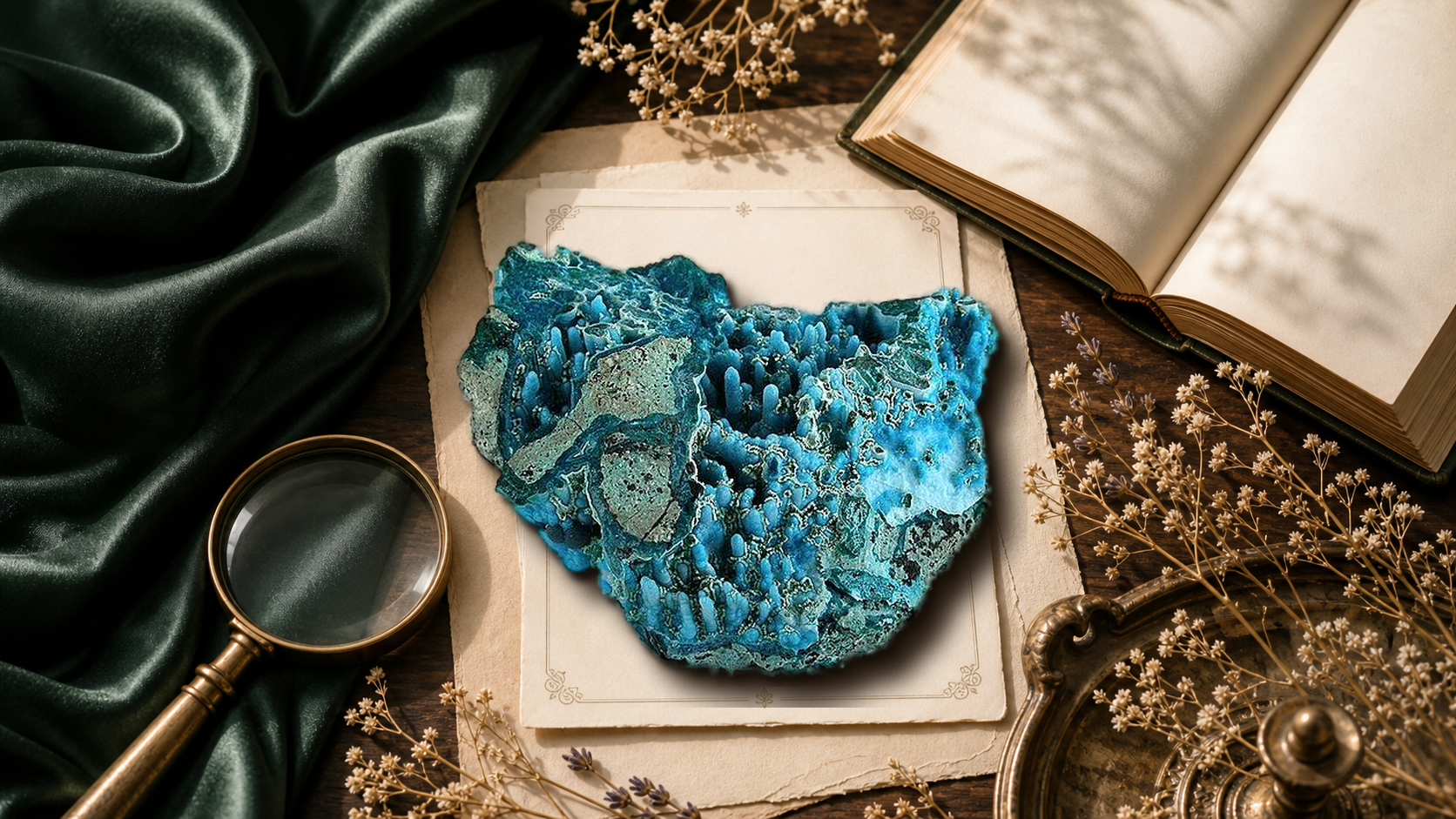
Your feelings need a stronger vessel than they have had lately. Chrysocolla's copper-blue softness enclosed in quartz becomes clearer, harder, and easier to keep intact. Containment can be an act of care.
Chrysocolla in quartz addresses the throat and upper chest, where expression and containment must negotiate terms if honest communication is going to emerge without...
The Meaning
Chrysocolla In Quartz in the Crystalis dictionary
Sometimes emotion is not too much. It is simply under-housed. The response is vivid, but the edges are unreliable, and everything starts leaking into everything else.
Chrysocolla on its own is softer, more porous, easier to abrade. Chrysocolla in quartz keeps the color but gains durability, coherence, and boundary through the silica host. The tenderness remains. The structure changes.
That image lands hard for anyone who has begun fearing their own softness because it has had nowhere stable to live.
Stone Lore
Stories carried through time
Cultural notes are presented as tradition and historical context — stories carried through time.
Unknown
Arizona mining heritage (Globe-Miami district)
The Globe-Miami copper mining district in Gila County, Arizona, produced the world's finest gem silica from the 1950s through the early 2000s. Miners at the Inspiration Mine, Live Oak Pit, and other operations would pocket exceptional pieces of blue-green chrysocolla-in-quartz, eventually recognizing their gem potential. Arizona gem silica became the unofficial state gemstone among collectors, rivaling Arizona turquoise in cultural significance.
The decline in production as mines moved deeper has elevated surviving specimens to collector status. 2. Ancient Egyptian copper-blue pigment use: While not specifically gem silica, chrysocolla was used as a pigment and decorative material in ancient Egypt.
Lore review
Tradition notes are being reviewed.
This entry keeps symbolic meaning separate from sourced cultural history. When dedicated tradition rows are available, they will appear here as individual lore cards.
Earth Record
Mineralogy and formation
This composite begins in the oxidized portions of copper deposits, where descending groundwater breaks down primary sulfides and redistributes copper into secondary minerals. Chrysocolla, a hydrated copper silicate to cryptocrystalline copper aluminosilicate phase, contributes the blue and blue green color. By itself it is relatively soft and often porous. When silica-rich fluids later move through the same fractures and cavities, quartz or chalcedony cements, encloses, or intermarries with the chrysocolla, creating a materially different object.
The host quartz crystallizes in the trigonal system and supplies the structural coherence the copper mineral lacks. The sequence is the key. Copper weathering must happen first, usually in an arid to semi-arid oxidation zone where fluids can repeatedly dissolve and redeposit metal ions. Silica then precipitates from later solutions, sealing the earlier blue masses into a tougher framework.
In some material the chrysocolla remains as visible islands in translucent quartz. In finer gem silica, microscopic chrysocolla particles are dispersed through chalcedony so evenly that the stone reads as luminous rather than patchy. Geologically this is a conversation between softness and containment. One phase brings color and hydrated complexity. The other brings hardness, polish, and resistance.
That is why the material carries practical value beyond pure chrysocolla. Quartz lifts the Mohs hardness toward 7, improves wearability, and stabilizes a copper mineral that might otherwise crumble or dehydrate. The thought pin speaks directly to that arrangement. Feelings needing a stronger vessel is nearly a plain-language description of the paragenesis. The copper phase arrives first, expressive and vulnerable.
The silica phase arrives later and does not erase it. Instead it holds it. In bodily metaphor, the specimen suggests that containment can preserve intensity rather than mute it. The blue remains visible because the quartz learned how to surround without suffocating. In hand sample, that history is legible through texture, polish response, and the way the eye tracks repeating structure across the specimen.
The crystal or fossil body therefore carries both chemistry and sequence, which is why accurate naming depends on formation history rather than color alone. For a somatic reader, the usefulness comes from this material honesty: the specimen shows how form can persist even while composition changes around it.
Crystal system diagram represents the general trigonal classification. Diagram created by Crystalis for educational reference.
Trigonal structure
Chemical Formula
SiO2 (quartz matrix) with (Cu,Al)2H2Si2O5(OH)4 . nH2O (chrysocolla inclusions) -- hydrated copper aluminum silicate dispersed within chalcedony/quartz
Crystal System
Trigonal
Mohs Hardness
7
Specific Gravity
2.55--2.65 (slightly lower than pure quartz due to the hydrous chrysocolla component)
Luster
Vitreous to waxy; top-grade gem silica has a translucent, glowing quality
Color
Blue-Green
IMA Status
rock
IMA Number
pre-IMA (grandfathered)
01
Mineral conditions gather
02
Structure begins to crystallize
03
Chrysocolla In Quartz records place and pressure
Peru's copper mining districts (Ica, Arequipa) produce gem silica chrysocolla in quartz with the deepest blue-green saturation. Arizona (USA) localities including Globe-Miami and Inspiration Mine yield classic specimens. DR Congo's Katanga Copper Belt produces chrysocolla in quartz from some of the world's richest copper deposits.
The quartz matrix stabilizes the otherwise soft chrysocolla at all three sources.
PeruUSA (Arizona)DR Congo
Telling it apart
Dealers routinely sell plain chrysocolla, dyed quartz, and low-grade turquoise under the safer sounding name chrysocolla in quartz. The legitimate material is a composite: blue to blue green chrysocolla enclosed or cemented by quartz or chalcedony. That quartz host should make the stone harder, glossier, and more durable than chalky standalone chrysocolla. If the blue material feels soft, powders at edges, or shows dye concentration in cracks, it is not the same thing.
What separates them is hardness plus internal texture. A genuine quartz-rich piece takes a higher polish, resists a steel point, and shows the blue color distributed within translucent or opaque silica rather than sitting like paint on the surface. Magnification often reveals cloudy blue islands inside a quartz body. Turquoise usually has a more even cryptocrystalline body and different matrix habit, while dyed howlite shows obvious vein staining.
The quartz host gives the specimen hardness and durability that pure chrysocolla lacks, so confirming the quartz component changes both the care instructions and the use case.
Spotting the real thing
Chrysocolla in quartz (gem silica): the blue-green color should be distributed naturally within the quartz/chalcedony matrix, not surface-applied. Mohs 6-7 (harder than raw chrysocolla at Mohs 2-4 because the quartz stabilizes it). If the specimen is very soft (scratchable by a steel nail), it is raw chrysocolla, not chrysocolla in quartz.
Gem silica's vivid teal color resonates strongly with the throat/thyroid region. The copper that creates this color is the same element used in electrical wiring; the universal conductor. For a sympathetically activated nervous system where the activation manifests as throat constriction, voice suppression, or communication anxiety, gem silica offers both the color frequency (teal = throat) and the material metaphor (copper = conductivity). State shift: constricted sympathetic toward open-channel expression through copper-conductor resonance.
Shut down & far away
The Quartz Fortress
Chrysocolla by itself is too soft to polish; it crumbles under pressure. But when protected by quartz, it becomes gem-grade. For a nervous system in dorsal collapse from empathic overwhelm; absorbing too much of others' pain; gem silica models the solution: keep the sensitivity (chrysocolla's copper responsiveness) but build a quartz boundary around it. Empathy with structure. Feeling with protection. State shift: empathic collapse toward boundaried compassion through the gem silica architecture.
Charged & on alert
The Oxidation Zone
Gem silica forms in the oxidation zone; the shallow layer where surface processes transform deeper materials. For someone who is "fine on the surface" while deeper issues decompose beneath, gem silica's formation story validates this experience: transformation happens at the interface between depth and surface. The beauty (gem silica) forms precisely WHERE the deep material meets the surface process. State shift: surface-depth disconnect toward integration at the interface.
Settled & connected
The Teal Frequency
When already regulated, gem silica's unique teal; a color that exists between blue (depth/intuition) and green (growth/heart); supports the creative expression of emotional depth. This is not blue's introspection alone or green's growth alone, but the synthesis of both. For creative practitioners, writers, therapists, and artists, gem silica deepens the capacity to express depth with beauty. State support: ventral vagal creative expression through teal frequency activation.
Charged & on alert
The Waste Becomes Precious
Gem silica was literally the waste product of copper mining; material discarded by miners seeking metallic copper. It was "just chrysocolla"; soft, crumbly, commercially worthless. Yet it turned out to be more valuable per gram than the copper the miners were seeking. For someone in depletion who feels worthless, discarded, or "just waste material," gem silica embodies the truth that what was dismissed can become the most precious thing. State shift: worthlessness-depleted toward recognition of hidden value.
These associations come from tradition and reflective practice — a way of working with the stone, not a medical prescription.
Somatic Practice
Simple ways to work with Chrysocolla In Quartz
◇
Hold
Carry Chrysocolla In Quartz in a pocket or place it over the heart center during a pause.
◌
Meditate
Let the stone become a quiet tactile anchor while the breath slows.
☽
Breathe
Breathe in softness. Breathe out tension. Keep the practice simple.
✎
Journal
Write with Chrysocolla In Quartz nearby to name the feeling without forcing a conclusion.
✋
Bodywork
Rest the stone near the chest, hand, or bedside as a reminder to soften.
⌂
Environment
Place it where you want a visual cue for care, repair, or steadiness.
Field Instruction
The Copper Aquifer
Hydrated copper silicate suspended in a quartz fortress — the softest voice armored by the hardest host, teaching expression without exposure.
3 min protocol
1
Hold the chrysocolla-in-quartz and examine where the blue-green chrysocolla hydrogel is trapped inside the clear or milky quartz. Notice the boundary — the copper mineral could not survive on its own (Mohs 2-4), but encased in quartz (Mohs 7), it is protected. Observe the vitreous-to-waxy luster where the two materials meet.
2
Place the stone against the hollow of your throat, resting it there with one finger. The chrysocolla inside the quartz is a hydrated copper silicate — it literally contains water molecules bound in its structure. Notice if your throat feels dry or full. Swallow once. Let saliva gather.
3
Inhale through the nose for four counts. On the exhale, hum at the lowest comfortable pitch for as long as the breath lasts. The vibration passes through the quartz and into the chrysocolla. Repeat three times, noticing if the pitch or the volume wants to change on its own.
4
Ask: What truth am I protecting inside a hard exterior? The chrysocolla cannot exist without the quartz fortress, but the quartz would be ordinary without the chrysocolla color. Neither is complete alone. Notice where in your body you feel the answer to that question — throat, chest, jaw.
5
Lower the stone to your lap. Place both palms flat on your thighs. The copper voice has spoken through the quartz container. You do not need to act on what surfaced — only acknowledge that it exists, the way the teal exists inside the clear.
Stone Intelligence
The fact that makes Chrysocolla In Quartz memorable
Copper-bearing chrysocolla deposited within a quartz matrix. The soft mineral made durable by its harder host. Gem silica.
The science documents how fragile chemistry gains permanence through the right container. The practice asks what happens when your most vulnerable color is sealed inside something strong enough to be cut and polished.
SCI
Green and blue pigments in Roman wall paintings: A challenge for Raman spectroscopy
You need to speak from experience without softening what you know. Chrysocolla alone is Mohs 2, too soft for anything but display. But chrysocolla in quartz has the copper mineral locked inside a Mohs 7 silica matrix.
The voice is soft. The container is hard. Hold it at the throat when you need to deliver truth that is not negotiable.
The copper provides the color and the communication energy. The quartz provides the structure that makes it durable enough to handle.
Sacred Match
Sacred Match reaches for Chrysocolla In Quartz when what you feel sounds like: throat closed feelings spilling conversation dread crying close to surface chest fluttery at night Sacred Match listens to the body rather than to preference. It notices what you are feeling right now, the way you are protecting yourself, and the deeper need underneath both. When that points to a pattern of chrysocolla in quartz need, the stone is the stone it offers because its formation story models the kind of regulation being sought.
throat closed -> body braced -> seeking steadier containment feelings spilling -> signal overloaded -> seeking discrimination conversation dread -> old material active -> seeking paced processing crying close to surface -> energy leaking outward -> seeking structure chest fluttery at night -> rest interrupted -> seeking enough safety to settle The prescription is less about liking the stone than about matching material logic to the body's current defensive pattern.
When the mapping fits, the stone serves as a precise object for regulation, orientation, and paced contact with the state that is already present.
Stones and herbs that harmonize with Chrysocolla In Quartz
Pairings are treated like a recipe file: clear use, method, and safety.
Crystal Companion
Chrysocolla In Quartz + Amethyst
Use when
You want to layer the primary intention with another supportive tone.
How to work with it
Place the stones together during meditation, journaling, or a short reset.
Safety
Use as a reflective practice tool, not as a medical substitute.
Crystal Companion
Chrysocolla In Quartz + Rhodonite
Use when
You want to layer the primary intention with another supportive tone.
How to work with it
Place the stones together during meditation, journaling, or a short reset.
Safety
Use as a reflective practice tool, not as a medical substitute.
Crystal Companion
Chrysocolla In Quartz + Clear Quartz
Use when
You want to layer the primary intention with another supportive tone.
How to work with it
Place the stones together during meditation, journaling, or a short reset.
Safety
Use as a reflective practice tool, not as a medical substitute.
Crystal Companion
Chrysocolla In Quartz + Black Tourmaline
Use when
You want to layer the primary intention with another supportive tone.
How to work with it
Place the stones together during meditation, journaling, or a short reset.
Safety
Use as a reflective practice tool, not as a medical substitute.
Chrysocolla in Quartz + Rose Quartz. Contained feeling with heart softness. The quartz host stabilizes expression while rose quartz lowers the force needed to feel it. Place the composite stone over the throat notch and rose quartz on the sternum. Chrysocolla in Quartz + Smoky Quartz. Emotion with grounded release. Smoky quartz keeps the copper-blue material from turning diffuse during heavy processing.
Set chrysocolla in quartz in the left palm and smoky quartz between the ankles while reclining. Chrysocolla in Quartz + Selenite. Structured expression with clean channel. Best when words are present but jammed by residue from prior conversations. Rest selenite along the jawline for a minute, then hold the chrysocolla in quartz at the throat. Chrysocolla in Quartz + Clear Quartz. Signal clarity over volume.
Useful for writing or speaking when the feeling is accurate but weakly held. Place clear quartz behind the composite stone at the front edge of a desk. Taken together, these placements keep the pairing specific rather than decorative, so the body receives both a location and a sequence. The benefit of pairing is not more volume. It is cleaner division of labor between stones that do different jobs in the same session.
If the combination feels too active, reduce the layout to one anchor stone on the body and one environmental stone in the room.
Care & Cleansing
How to keep Chrysocolla In Quartz in good condition
Water Safe?
Water safe
This stone is generally safe for short water contact, though polishing, fractures, and metal settings can still change how a specimen behaves.
Sunlight Safe?
Sunlight safe
Tolerates daylight; safe to charge or display in the sun.
Authenticity
What to check
Natural Chrysocolla In Quartz should usually feel cooler than plastic or resin on first touch and warm more slowly in the hand.
Chrysocolla in quartz is water-safe. The quartz matrix (Mohs 7) protects the softer chrysocolla inclusions from water contact. This is the key difference from raw chrysocolla (which is water-sensitive).
Brief to moderate rinse is safe. Recommended cleansing: running water (30-60 seconds), moonlight, sound, selenite plate. Store normally; the quartz matrix makes this a durable specimen.
Temperature
Natural Chrysocolla In Quartz should usually feel cooler than plastic or resin on first touch and warm more slowly in the hand.
Scratch logic
Use 7 on the Mohs scale as the check, not internet myths. A real specimen should behave in line with the hardness listed above.
Surface and luster
Look for a vitreous to waxy; top-grade gem silica has a translucent, glowing quality surface quality rather than a painted or plastic shine.
Weight and density
The listed specific gravity is 2.55--2.65 (slightly lower than pure quartz due to the hydrous chrysocolla component). If a specimen feels unusually light for its size, it may deserve a second look.
My Field Guide
Your private record and next steps
Journal
Add this stone to your private collection, then log what happened when you worked with it.
Shared Notes
Read public practice logs and pattern notes from the Crystalis community.
When members save a public field note for this stone, it will appear here.
Frequently Asked
Questions people ask about Chrysocolla In Quartz
What is Chrysocolla In Quartz?
⌄
"Gem silica" is the trade name for translucent chrysocolla-colored chalcedony: an SiO2 quartz matrix (trigonal) with inclusions of chrysocolla, (Cu,Al)2H2Si2O5(OH)4 . nH2O, a hydrated copper aluminum silicate dispersed within the chalcedony. True gem silica is chrysocolla that has been completely silicified, the copper silicate incorporated into the cryptocrystalline quartz matrix at the molecular level, producing a material hard enough to cut and polish as a gemstone, Mohs 6.
5 to 7, whereas pure chrysocolla alone is only 2 to 4 and too soft and porous for lapidary use. Chrysocolla itself is amorphous to cryptocrystalline, technically a mineraloid, currently understood as a hydrogel containing Si and Cu, associated with copper oxides and carbonates (Coccato et al. , 2016). Top-quality gem silica is among the most valuable American gemstones, with fine specimens commanding prices of $100 to $500+ per carat.
What is the Mohs hardness of Chrysocolla In Quartz?
⌄
Chrysocolla In Quartz has a Mohs hardness of 6.5 to 7 (when chrysocolla is fully incorporated within the quartz/chalcedony matrix; pure chrysocolla alone is only 2 to 4).
Can Chrysocolla In Quartz go in water?
⌄
Water Safety CONDITIONAL: Brief rinsing only for gem silica; NO for raw chrysocolla. When chrysocolla is fully silicified (gem silica grade, Mohs 6. 5-7), the quartz matrix provides water resistance comparable to agate or chalcedony. Brief rinsing is safe. However, raw or partially silicified chrysocolla is soft, porous, and water-sensitive; prolonged submersion will cause swelling, cracking, and color change.
The hydrous copper silicate component can leach copper into water, making gem water preparation inadvisable. For energetic water work, place beside the vessel. Do not use in gem elixirs; dissolved copper, even in trace amounts, can be toxic with chronic ingestion.
What crystal system is Chrysocolla In Quartz?
⌄
Chrysocolla In Quartz crystallizes in the Trigonal (quartz host); chrysocolla itself is amorphous to cryptocrystalline (it is technically a mineraloid/hydrogel rather than a well-defined mineral species). Chrysocolla is currently understood as a hydrogel containing Si and Cu, associated with copper oxides and carbonates (Coccato et al., 2016).
What is the chemical formula of Chrysocolla In Quartz?
⌄
The chemical formula of Chrysocolla In Quartz is SiO2 (quartz matrix) with (Cu,Al)2H2Si2O5(OH)4, nH2O (chrysocolla inclusions), hydrated copper aluminum silicate dispersed within chalcedony/quartz.
Is Chrysocolla In Quartz toxic?
⌄
Cutting or grinding chrysocolla or gem silica produces dust containing silica and copper compounds. Use wet-cutting methods and respiratory protection. Standard silica dust precautions apply.
How does Chrysocolla In Quartz form?
⌄
Formation Story Gem silica forms in the supergene oxidation zone of copper deposits, the near-surface weathering environment where copper-bearing sulfide minerals are attacked by oxygen- and water-rich fluids percolating down from the surface. When primary copper minerals like chalcopyrite (CuFeS2), bornite (Cu5FeS4), and chalcocite (Cu2S) encounter these oxidizing fluids, the copper is dissolved and mobilized as copper sulfate solutions.
Sources & Citations
Where this entry can be checked
Back Matter
Readable for people. Structured for AI search.
Sources stay visible in the page so readers, search engines, and answer systems can follow the evidence trail.
01
SCI
Green and blue pigments in Roman wall paintings: A challenge for Raman spectroscopy
Jorge‐Villar, Susana E., Edwards, Howell G. M. (2021). Green and blue pigments in Roman wall paintings: A challenge for Raman spectroscopy. Journal of Raman Spectroscopy. [SCI]DOI 10.1002/jrs.6118
02
SCI
Supergene and exotic Cu mineralization occur during periods of landscape stability in the Centinela Mining District, Atacama Desert
Riquelme, Rodrigo, Tapia, Miguel, Campos, Eduardo, Mpodozis, Constantino, Carretier, Sebastien et al. (2017). Supergene and exotic Cu mineralization occur during periods of landscape stability in the Centinela Mining District, Atacama Desert. Basin Research. [SCI]DOI 10.1111/bre.12258
03
SCI
Nanoscale characterization of chrysocolla, black chrysocolla, and pseudomalachite from supergene copper deposits of Atacama Desert in northern Chile
Kahou Z.S., Seydoux-Guillaume A., Zanetta P., Duchêne S., Brichau S., Campos E. (2025). Nanoscale characterization of chrysocolla, black chrysocolla, and pseudomalachite from supergene copper deposits of Atacama Desert in northern Chile. American Mineralogist. [SCI]DOI 10.2138/am-2024-9300
04
SCI
Revealing the True Nature of Chrysocolla: From Macro- to Nano-Characterization and First Thermodynamic Constraints
Monico S., Conconi R., Tumiati S., Bernasconi A., Capitani G., Adamo I., Prosperi L., Gatta G.D., Mácová P., Ševčík R., Marinoni N. (2026). Revealing the True Nature of Chrysocolla: From Macro- to Nano-Characterization and First Thermodynamic Constraints. American Mineralogist. [SCI]DOI 10.2138/am-2025-9983
05
HIST
"Naturalis Historia" Book 37
Pliny the Elder. "Naturalis Historia" Book 37. [HIST]
06
LORE
The Curious Lore of Precious Stones
Kunz, George Frederick. (1913). The Curious Lore of Precious Stones. [LORE]
07
HIST
On Stones (De Lapidibus), §30 (krystallos)
Theophrastus. On Stones (De Lapidibus), §30 (krystallos). [HIST]