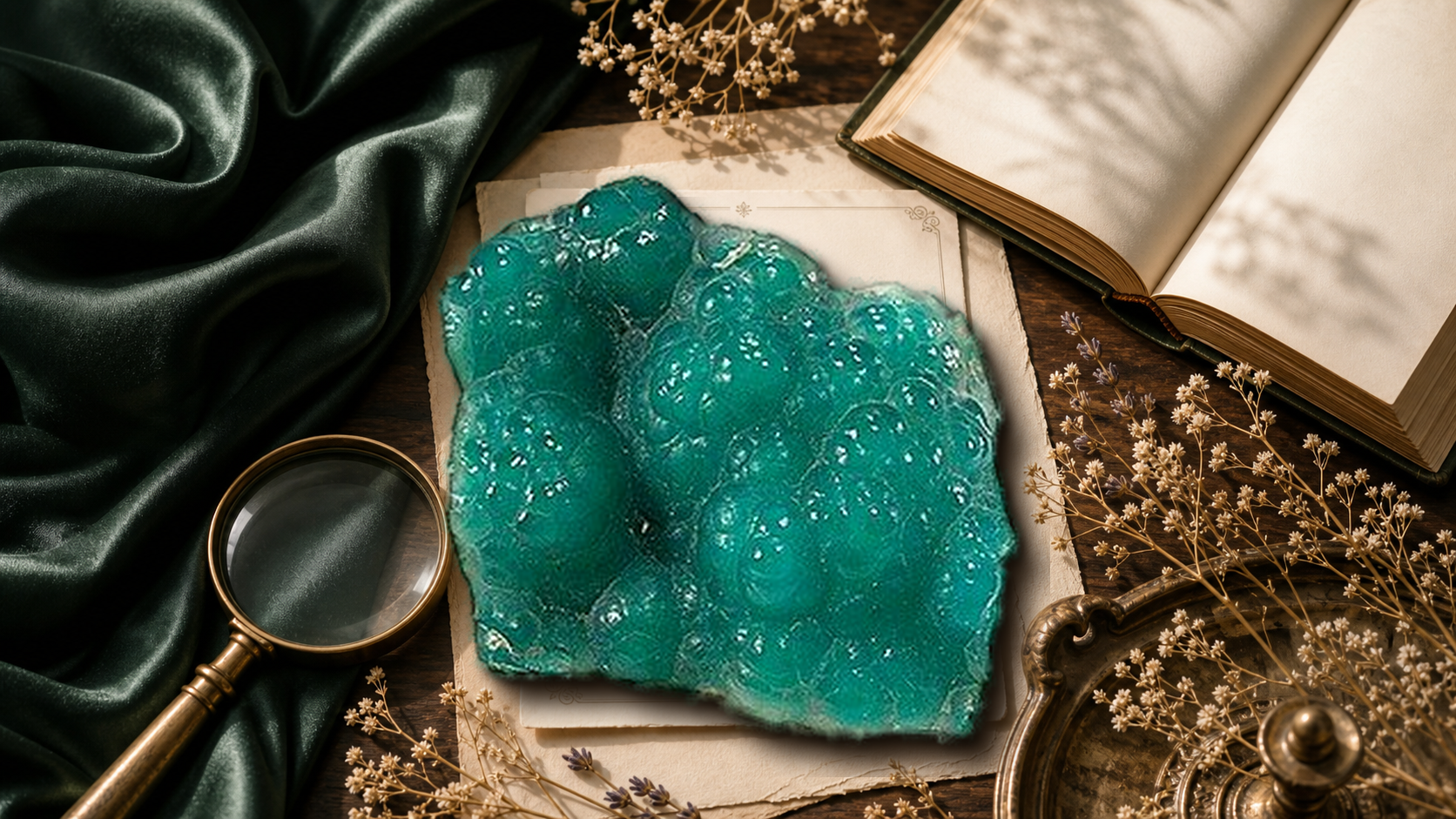
You want softness refined all the way to translucence. Gem silica is chrysocolla saturated by chalcedony, copper blue lifted into a harder, clearer state. Some feelings become more durable when crystallized.
Gem silica tends to work most clearly with nervous systems that need softness refined into something more durable. The body is not asking for blunt force or simple...
The Meaning
Gem Silica in the Crystalis dictionary
Not every emotion needs to stay raw in order to remain real. Some feelings become more usable once they have been clarified, hardened slightly, and given a cleaner body to travel in. The tenderness remains. The delivery improves.
Gem silica gives that transformation a perfect mineral image. Chrysocolla's blue-green softness becomes suspended and stabilized in chalcedony, creating a translucent, more durable version of the same emotional color. The refinement is not betrayal. It is preservation through structure.
Gem silica is what compassion looks like after it has learned how to last. For communication, recovery, and emotional steadiness, that distinction can change everything.
Stone Lore
Stories carried through time
Cultural notes are presented as tradition and historical context — stories carried through time.
Arizona Mining History
Inspiration Mine Legacy
The Inspiration Mine in the Globe-Miami copper district of Arizona produced the world's finest gem silica specimens during its operational years in the mid-to-late 20th century. The mine's name became synonymous with the material itself, dealers and collectors reference Inspiration Mine gem silica as the benchmark for color and quality. When the mine's gem silica zones were exhausted, the material became exponentially more scarce and valuable on the collector market.
c. 1950s-1990s
Historical note
Chrysocolla-Chalcedony Formation Science
Geological research in the 20th century established that gem silica forms when copper-rich fluids infiltrate silica gel in the oxidation zones of copper deposits. The copper ions become structurally incorporated into the chalcedony during...
Geological Science · c. 1960s-present
Historical note
Peruvian and Indonesian Secondary Sources
After the Inspiration Mine's gem silica production declined, secondary sources in Peru's copper belt and Indonesia's Irian Jaya province became increasingly important to the market. Peruvian material tends toward deeper blue-green tones,...
Global Gem Trade · 1990s-present
Ritual history
Heart-Throat Integration Practice
Crystal practitioners beginning in the 1990s prescribed gem silica as the premier stone for bridging emotional depth with clear communication. Its rare combination of chrysocolla color (heart-throat) with chalcedony durability (practical...
Gem silica is not a formal mineral species but a lapidary term for chrysocolla that has been silicified or thoroughly intergrown with chalcedony until the material becomes harder, more translucent, and gem quality. The color comes from copper-rich chrysocolla or related copper silicate content. The durability and clarity come from silica saturation, usually in the form of microcrystalline quartz. That is why the chemistry is best described as chalcedony with chrysocolla content rather than as a single fixed formula.
Formation takes place in the oxidized zones of copper deposits, where copper-bearing solutions move through fractures and cavities already rich in silica. Chrysocolla by itself can be soft, earthy, and poorly crystalline. When silica continues to enter the system, that copper-blue material may become sealed, impregnated, or replaced by chalcedony. The finished stone preserves the blue to blue-green color while gaining the hardness, luster, and relative durability of microcrystalline quartz.
Arizona, Peru, and the Congo Copperbelt are well-known source regions because they combine secondary copper mineralization with silica-rich alteration conditions.
This sequence is why gem silica differs so much from ordinary chrysocolla in use. Chalcedony pushes hardness toward Mohs 6.5 to 7, improves polish, and gives the material a translucent glow that untreated chrysocolla often lacks. In cabochons, the result can look almost liquid, as if copper color were suspended inside a clearer body. The host structure is still quartz-family chalcedony, commonly tied back to trigonal quartz at the microstructural level even though crystal faces are not visible.
Gem silica carries a somatic message of refinement through stabilization. The original copper softness has not disappeared. It has been crystallized into something more durable and light-bearing. The body often recognizes that transition immediately. Some feelings do not become stronger by hardening. They become stronger by being given a clearer silica frame.
Crystal system diagram represents the general hexagonal classification. Diagram created by Crystalis for educational reference.
Hexagonal structure
Chemical Formula
SiO2 with CuSiO3.nH2O (chrysocolla inclusions)
Crystal System
Hexagonal
Mohs Hardness
7
Specific Gravity
2.05-2.15
Luster
Vitreous to waxy
Color
Blue-Green
IMA Status
variety
IMA Number
Not IMA-approved (gem variety)
01
Mineral conditions gather
02
Structure begins to crystallize
03
Gem Silica records place and pressure
Gem silica is the rarest and most valuable variety of chalcedony, a microcrystalline quartz colored by included chrysocolla. Its extraordinary blue-green color comes from copper, the same element that gives turquoise and azurite their distinctive hues. Unlike most chalcedony that forms in volcanic cavities, gem silica crystallizes in the oxidation zones of copper deposits. As copper-bearing solutions percolate through fractured rock, they deposit chrysocolla within growing chalcedony.
The result is a translucent to opaque stone with the durability of quartz and the color of copper minerals. The finest gem silica comes from the Inspiration Mine in Arizona, USA, which produced material of exceptional color and clarity in the 1960s-1970s. Today, most gem silica on the market comes from Peru or is vintage material from depleted Arizona mines. Israeli material from the Eilat region is also prized for its intense color.
True gem silica is distinguished from common chrysocolla chalcedony by its translucency and even color distribution. Lower-grade material may appear muddy or uneven. The most valuable specimens show a pure, saturated blue-green that seems to glow from within.
Mineralogy: Chalcedony (microcrystalline quartz) with included chrysocolla. Chemical formula: CuSiO3·nH2O. Crystal system: trigonal (microscopic crystals). Hardness: 6.5-7 Mohs. Specific gravity: 2.6-2.7. Waxy to vitreous luster. (The copper content can be 5-15% by weight, creating the distinctive color)
PeruUSA (Arizona)DR Congo
Telling it apart
Gem silica is often confused with chrysocolla, turquoise, dyed chalcedony, and low-grade blue opal. The fastest test is hardness plus translucency. True gem silica should polish like fine chalcedony and resist scratching far better than soft chrysocolla. It often shows a glowing, internally lit quality rather than the matte or earthy look of lower-grade copper minerals.
What separates gem silica from turquoise is structure and matrix. Turquoise is a phosphate, usually more opaque, often with distinctive host webbing, and softer than chalcedony-rich gem silica. What separates it from dyed blue chalcedony is color behavior and association. Natural gem silica usually presents copper blue to blue-green tones with subtle internal zoning rather than perfectly even artificial color.
The confirming step is magnification and disclosure of treatment. The buyer should leave with one practical rule: identify the host mineral first, then judge color, texture, and any trade-name language after the physical facts are clear. Chrysocolla chalcedony commands the highest prices in the chrysocolla family, and confirming that the blue color sits within chalcedony rather than on softer chrysocolla protects both the investment and the durability expectation.
Spotting the real thing
Gem silica (chrysocolla in chalcedony): translucent blue-green with a glowing quality. Mohs 6-7 (significantly harder than raw chrysocolla at Mohs 2-4). The quartz/chalcedony matrix stabilizes the color.
If the specimen is very soft (scratchable by a nail), it is raw chrysocolla, not gem silica. Specific gravity 2. 05-2.
You feel something enormous in your chest but your throat will not release it. The words exist; you can sense their shape; but the passage between heart and voice is sealed. Your lower throat aches. Your eyes might water without tears actually falling. This is dorsal vagal constriction at the heart-throat bridge: your system has flooded with feeling and locked the exit.
Shut down & far away
The Shallow Broadcast
You are talking but the words have no root. Your throat is active but your chest is disconnected. You say correct things that sound hollow to your own ears. Your voice might be slightly higher pitched than usual. This is sympathetic activation in the throat without ventral vagal heart engagement; communication running on output without input.
Settled & connected
The Translucent Channel
Your chest and throat feel like a single continuous space. What you feel reaches your words without distortion. Your voice has depth and your eyes are steady. You are not performing vulnerability; you are simply transparent. Your breath moves in long, unbroken cycles. This is ventral vagal integration of the heart and throat centers: emotion and expression flowing through the same medium without loss.
These associations come from tradition and reflective practice — a way of working with the stone, not a medical prescription.
Somatic Practice
Simple ways to work with Gem Silica
◇
Hold
Carry Gem Silica in a pocket or place it over the heart center during a pause.
◌
Meditate
Let the stone become a quiet tactile anchor while the breath slows.
☽
Breathe
Breathe in softness. Breathe out tension. Keep the practice simple.
✎
Journal
Write with Gem Silica nearby to name the feeling without forcing a conclusion.
✋
Bodywork
Rest the stone near the chest, hand, or bedside as a reminder to soften.
⌂
Environment
Place it where you want a visual cue for care, repair, or steadiness.
Field Instruction
The Translucent Bridge
Feel It. Then Say It.
5 min protocol
1
Lie down or recline. Place gem silica on your sternum, centered on the chest. Rest one hand on your belly and the other alongside your body. The stone sits where the heart chakra projects forward and where the throat chakra's downward reach meets it. This is the bridge point. Inhale through the nose for 3 counts. Exhale through the nose for 3 counts. Equal ratio -- this is a balancing protocol, not a calming one. The bridge needs both sides at equal strength.
2
On the fourth breath cycle, shift the exhale to a soft humming. Low pitch. Feel the vibration travel from your throat down into the stone on your chest. The hum stimulates the vagus nerve at the throat while the stone provides a tactile anchor at the heart. You are vibrating the bridge between feeling and expression. Six humming exhales. Let each one be slightly longer than the last.
3
Stop humming. Breathe silently. Move the gem silica from your sternum to the base of your throat -- the notch between the collarbones. Feel the coolness of the stone at this new position. Notice whether the move changed anything in your chest. The heart center, now uncovered, may feel exposed or relieved. The throat center, now weighted, may feel anchored or pressured. Both responses are data. Breathe into whatever you notice. Four silent cycles.
4
Place the stone back on your sternum. Both hands now rest on your belly. Take three final breaths: inhale for 5 through the nose, exhale for 7 through the mouth. On each exhale, let your jaw drop open. The pathway between heart and voice is not a one-time opening -- it is a channel that must be practiced. Each time you feel something and say it without distortion, the channel widens. Remove the stone. The translucence is yours now.
Stone Intelligence
The fact that makes Gem Silica memorable
Chalcedony colored by chrysocolla copper silicate, trigonal, Mohs 7. Gem silica is the rarest and most valuable form of chalcedony, its blue-green color coming from copper that infiltrated the silica during formation. Unlike chrysocolla alone (Mohs 2), the quartz matrix gives it the hardness to be cut and worn.
Copper's color, quartz's durability, in one stone.
SCI
Mineralogy, Geochemistry, and Genesis of Agates from Chihuahua, Northern Mexico
You need to communicate from the deepest version of yourself, not the polished surface. Gem silica is chrysocolla locked inside chalcedony quartz. The rarest and most valuable form of chalcedony on earth. The copper that gives it color is trapped inside a Mohs 7 silica matrix. The blue-green is not surface deep. It goes all the way through. Hold it at the throat or heart during moments when you need to say something that comes from underneath the professional layer.
The copper is your raw message. The quartz is the structure that makes it durable enough to deliver.
Sacred Match
Sacred Match reaches for Gem Silica when what you feel sounds like:
Tenderness needing a stronger frame
Emotion present but not yet speakable
Softness worn down by friction
Need for durable openness
Blue-green calm with structure
Sacred Match listens to the body rather than to preference. It notices what you are feeling right now, the way you are protecting yourself, and the deeper need underneath both. When that points to a body trying to remain gentle while requiring more structure, Gem Silica is the stone it offers. The prescription relies on silicified copper mineralogy. Chrysocolla-derived color held within chalcedony gives the nervous system a model of softness clarified and stabilized rather than erased.
Tenderness needing a stronger frame -> feeling alive but underprotected -> seeking structure
Emotion present but not yet speakable -> affect formed, language pending -> seeking vessel
Softness worn down by friction -> openness abraded by contact -> seeking durability
Need for durable openness -> warmth desired with boundary -> seeking coherent tenderness
Blue-green calm with structure -> regulation requiring softness plus frame -> seeking stabilized expression
Pairings are treated like a recipe file: clear use, method, and safety.
Crystal Companion
Gem Silica + Amethyst
Use when
You want to layer the primary intention with another supportive tone.
How to work with it
Place the stones together during meditation, journaling, or a short reset.
Safety
Use as a reflective practice tool, not as a medical substitute.
Crystal Companion
Gem Silica + Rhodonite
Use when
You want to layer the primary intention with another supportive tone.
How to work with it
Place the stones together during meditation, journaling, or a short reset.
Safety
Use as a reflective practice tool, not as a medical substitute.
Crystal Companion
Gem Silica + Clear Quartz
Use when
You want to layer the primary intention with another supportive tone.
How to work with it
Place the stones together during meditation, journaling, or a short reset.
Safety
Use as a reflective practice tool, not as a medical substitute.
Crystal Companion
Gem Silica + Black Tourmaline
Use when
You want to layer the primary intention with another supportive tone.
How to work with it
Place the stones together during meditation, journaling, or a short reset.
Safety
Use as a reflective practice tool, not as a medical substitute.
Refined Water. Pair gem silica with aquamarine when communication needs both softness and precision. Aquamarine contributes air and verbal clarity. Gem silica contributes copper-rich tenderness held in chalcedony structure. Keep aquamarine near the throat and place gem silica just below it at the upper chest.
Durable Heart. Pair it with rose quartz for emotional work that needs more durability than rose quartz alone sometimes provides. Rose quartz offers warmth. Gem silica offers clearer structure and a more articulate blue-green register. One belongs on the sternum. The other belongs higher near the collarbone.
Bright Boundary. Pair it with black tourmaline when gentleness must survive a demanding environment. Gem silica keeps the field luminous and soft. Black tourmaline keeps it defended. Carry tourmaline on the body and keep gem silica visible on a desk, necklace, or bedside arrangement.
Silica Signal. Pair it with clear quartz when the intention is amplification of already coherent feeling. Because both are silica-dominant, the pairing remains clean. Put the clear quartz point beside the gem silica cabochon or specimen rather than directly touching if the tone is already strong. Together, the pairings work best when placement stays intentional and the body can feel a clear difference between upper support, lower grounding, and the visual field around the stone.
Care & Cleansing
How to keep Gem Silica in good condition
Water Safe?
Water safe
This stone is generally safe for short water contact, though polishing, fractures, and metal settings can still change how a specimen behaves.
Sunlight Safe?
Sunlight safe
Tolerates daylight; safe to charge or display in the sun.
Authenticity
What to check
Natural Gem Silica should usually feel cooler than plastic or resin on first touch and warm more slowly in the hand.
Moonlight
Safest method for gem silica. Place on windowsill overnight. Overnight
Yes, with caution
The Full Answer
Gem silica is chalcedony (quartz) and generally water-safe, but the copper content requires some care:
Brief rinses are safe, cool running water for 30-60 seconds. Avoid prolonged soaking, copper compounds can be affected by extended water exposure. No salt water, salt can react with copper content over time.
Avoid acids, even mild acids can affect the copper-bearing minerals. Better cleansing methods: Moonlight (overnight), sound vibration (2-3 minutes), sage or palo santo smoke (30-60 seconds), selenite plate (4-6 hours).
Temperature
Natural Gem Silica should usually feel cooler than plastic or resin on first touch and warm more slowly in the hand.
Scratch logic
Use 7 on the Mohs scale as the check, not internet myths. A real specimen should behave in line with the hardness listed above.
Surface and luster
Look for a vitreous to waxy surface quality rather than a painted or plastic shine.
Weight and density
The listed specific gravity is 2.05-2.15. If a specimen feels unusually light for its size, it may deserve a second look.
My Field Guide
Your private record and next steps
Journal
Add this stone to your private collection, then log what happened when you worked with it.
Shared Notes
Read public practice logs and pattern notes from the Crystalis community.
When members save a public field note for this stone, it will appear here.
Frequently Asked
Questions people ask about Gem Silica
What is gem silica?
⌄
Gem silica is copper-bearing chalcedony, chrysocolla that has infused into microcrystalline quartz during formation. The result is the rarest and most valuable variety of chalcedony, combining chrysocolla's vivid blue-green color with chalcedony's Mohs 7 hardness and translucency. It is the intersection of color and durability that most copper minerals cannot achieve.
Is gem silica the same as chrysocolla?
⌄
No. Chrysocolla by itself is Mohs 2-4 and too soft for most applications. Gem silica occurs when chrysocolla's copper compounds are incorporated into chalcedony (microcrystalline quartz) during formation. The copper provides the color. The quartz provides the structure. The combination produces something neither mineral achieves alone.
Where does gem silica come from?
⌄
The most prized source is the Inspiration Mine in Globe-Miami, Arizona, which produced legendary specimens before closing. Additional sources include Peru, Indonesia, and parts of the Philippines. Arizona material commands the highest prices due to its exceptional color saturation and translucency. Supply is extremely limited.
What chakra is gem silica?
⌄
Gem silica is mapped to both the throat and heart chakras. Its blue-green color sits precisely at the boundary between these two centers. Practitioners describe it as bridging emotional depth (heart) with clear expression (throat), feeling something fully and being able to articulate it without distortion.
How hard is gem silica?
⌄
Gem silica is Mohs 7, the same as any chalcedony or agate. This is what makes it exceptional among copper minerals; most copper-bearing stones are far too soft for jewelry or daily use. Gem silica can be cabochon-cut, set in rings, and worn daily without concern about scratching.
Can gem silica go in water?
⌄
Yes. Gem silica is water safe. Its chalcedony matrix provides the same water resistance as any microcrystalline quartz. Brief water cleansing is fine. Prolonged soaking is unnecessary but will not damage the stone. Its copper content is locked within the silica structure and does not leach under normal conditions.
Why is gem silica so expensive?
⌄
Gem silica is the rarest chalcedony variety, produced by a specific geological process that requires copper-rich fluids to infiltrate silica gel during formation. The Inspiration Mine, which produced the world's finest material, is no longer operating. Limited supply from a few global sources, combined with high demand from collectors and jewelers, drives significant prices.
What does gem silica look like?
⌄
At its finest, gem silica is a vivid, saturated blue-green with strong translucency and a waxy to vitreous luster. The color is more saturated and even than turquoise, more translucent than chrysocolla, and harder than either. Top specimens have a glowing, almost electric quality when backlit.
Sources & Citations
Where this entry can be checked
Back Matter
Readable for people. Structured for AI search.
Sources stay visible in the page so readers, search engines, and answer systems can follow the evidence trail.
01
SCI
Mineralogy, Geochemistry, and Genesis of Agates from Chihuahua, Northern Mexico
Götze, J., Mrozik, M., Möckel, R., Pan, Y. (2023). Mineralogy, Geochemistry, and Genesis of Agates from Chihuahua, Northern Mexico. Minerals. [SCI]DOI 10.3390/min13050687
02
SCI
Electron backscatter diffraction investigation of length-fast chalcedony in agate
FRENCH, M.W. et al. (2012). Electron backscatter diffraction investigation of length-fast chalcedony in agate. Geofluids. [SCI]DOI 10.1111/gfl.12006
03
SCI
Gemstones from Vigna Barberini at the Palatine Hill (Rome)