A truth has turned suddenly visible and there is no putting it back. Erythrite is the cobalt bloom, magenta crystallizing where arsenides weather and expose what was hidden. Exposure changes the landscape fast.
Erythrite tends to work as a visual rather than tactile object. Its chemistry demands caution, and that constraint is part of why it speaks so directly to nervous...
The Meaning
Erythrite in the Crystalis dictionary
Some revelations do not arrive slowly. They bloom. One day the hidden chemistry is still underground, and the next it is staining everything bright enough that denial becomes structurally impossible. The body knows that kind of moment: sudden exposure, sudden color, no way back to innocence.
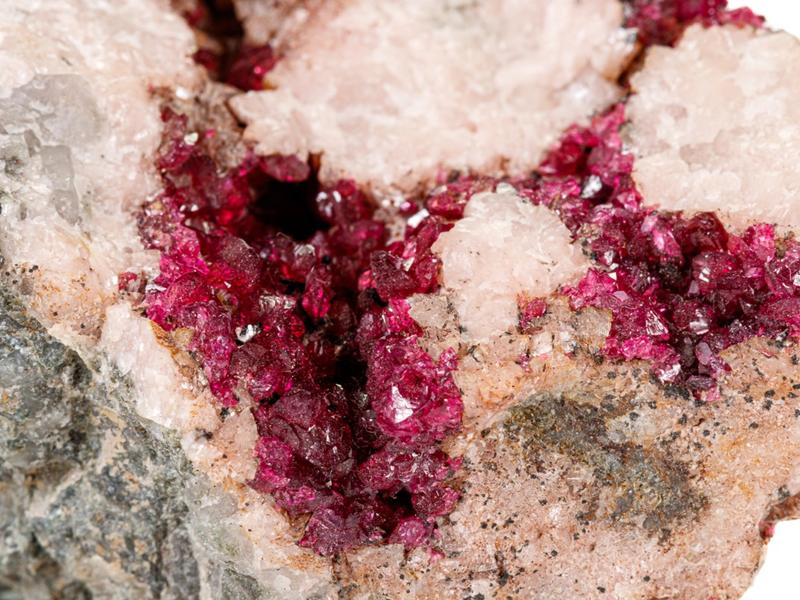
Erythrite forms exactly in that aftermath. It appears as pink to magenta crusts and needles where cobalt-bearing arsenides oxidize and weather, the brilliant bloom emerging from breakdown rather than from untouched conditions. The visibility is secondary, but it is real.
Erythrite feels right when self-awareness has become unavoidable.
Readiness is not part of the chemistry. Hidden material meets air and becomes impossible to ignore.
Stone Lore
Stories carried through time
Cultural notes are presented as tradition and historical context — stories carried through time.
German Mining Tradition
Schneeberg Cobalt Mining and the Blue Pigment Trade
Miners in the Schneeberg district of Saxony recognized erythrite's vivid pink-purple surface crusts as a reliable indicator of cobalt ore deposits from the 16th century onward. The cobalt extracted from these deposits was processed into smalt and later Thenard's blue, pigments that transformed European ceramics and painting. The miners called the pink surface bloom kobold (goblin) material because the cobalt ores were difficult to smelt and released toxic arsenic fumes, the origin of the element name cobalt itself.
1500s-1800s
Origin lore
Werner and the Freiberg Classification System
Abraham Gottlob Werner at the Freiberg Mining Academy in Saxony systematically classified erythrite as a distinct mineral species in the late 18th century, distinguishing it from other arsenates and establishing its diagnostic role as a...
European Mineralogical Science · c. 1780-1810
Origin lore
Moroccan Bou Azzer Cobalt Specimens
The Bou Azzer mining district in Morocco's Anti-Atlas Mountains has produced the world's finest crystallized erythrite specimens since the mid-20th century. Berber miners working these cobalt-arsenic-nickel deposits learned to identify...
Moroccan Mining Tradition · 1940s-present
Ritual history
Collector Mineral Practice and Toxicity Awareness
Contemporary mineral collectors and crystal practitioners adopted erythrite as a display-only specimen beginning in the 1990s, with growing awareness of its arsenic and cobalt toxicity shaping handling protocols. Knowledgeable...
Contemporary Mineral Practice · 1990s-present
Earth Record
Mineralogy and formation
Few minerals announce oxidation as vividly as erythrite. Chemically Co3(AsO4)2·8H2O, it is a hydrated cobalt arsenate that crystallizes in the monoclinic system and typically appears as vivid crimson to magenta crusts, needles, or radial sprays. It forms in the oxidized zone of cobalt-bearing ore deposits, where primary arsenide minerals such as skutterudite, cobaltite, or related phases break down under exposure to oxygenated groundwater.
That weathering sequence is the whole story. Deep primary cobalt minerals are comparatively stable in reducing conditions. Once uplift, mining, or natural fracture exposure lets air and water penetrate, those primary phases begin to alter. Arsenic and cobalt are released into solution, then reassemble in the oxidized zone or at shallow depth as secondary minerals. Erythrite precipitates when the chemistry favors hydrated arsenate formation, often alongside annabergite, pharmacolite, quartz, calcite, and iron oxides.
The color is so distinctive that miners historically used erythrite as an indicator of cobalt ore, giving rise to the name cobalt bloom.
Because it is highly hydrated and secondary, erythrite is soft, commonly around Mohs 1.5 to 2.5, and fragile in habit. The monoclinic symmetry often appears as acicular or bladed crystals that form delicate crusts rather than robust standalone gems. Light can fade the color, and the arsenate chemistry means specimens should not be handled carelessly or used in body contact rituals that ignore toxicity. Morocco, Germany, and Canada are classic source regions where cobalt-bearing ore bodies and weathering conditions intersect.
Erythrite is geologically honest about revelation. It does not belong to the hidden primary zone that formed first. It appears when hidden chemistry breaks open and becomes visible. In the hand, that sequence lands somatically as exposure with consequence. What was buried has met air. The body recognizes that feeling immediately: sudden visibility, sharp color, and the irreversible fact of having come to the surface.
Crystal system diagram represents the general monoclinic classification. Diagram created by Crystalis for educational reference.
Monoclinic structure
Chemical Formula
Co3(AsO4)2.8H2O
Crystal System
Monoclinic
Mohs Hardness
1.5
Specific Gravity
3.06-3.18
Luster
Vitreous to pearly
Color
Pink-Purple
IMA Status
species
Type Locality
Daniel Mine, Schneeberg, Saxony, Germany
IMA Number
pre-IMA (grandfathered)
01
Mineral conditions gather
02
Structure begins to crystallize
03
Erythrite records place and pressure
Erythrite is a hydrated cobalt arsenate with the chemical formula Co3(AsO4)2·8H2O. Its common name "cobalt bloom" describes the characteristic pink to crimson coating it forms on cobalt-bearing ore deposits, like a flower blooming on the rock surface. The mineral forms as a secondary mineral in the oxidation zone of cobalt and nickel deposits. As primary cobalt minerals weather and react with oxygen and water, they dissolve and reprecipitate as erythrite.
This process creates the delicate, fibrous to earthy masses that coat host rocks. Erythrite is extremely soft (1. 5-2. 5 Mohs) and fragile. The crystals are typically microscopic, forming velvety coatings rather than distinct crystals large enough to handle. The intense pink-purple color is distinctive and serves as an indicator of cobalt mineralization for geologists and prospectors.
Significant deposits occur in Morocco (especially the Bou Azzer district), Canada (Ontario and Quebec), Germany (Saxony), and the United States (Idaho, Colorado). The finest specimens form velvety coatings up to several millimeters thick.
Mineralogy: Hydrated cobalt(II) arsenate (Co3(AsO4)2·8H2O). Crystal system: monoclinic (microscopic prismatic crystals). Hardness: 1. 5-2. 5 Mohs. Specific gravity: 3. 0. Earthy to pearly luster. Pink to crimson-purple color. (Extremely soft and fragile, forms velvety coatings rather than distinct crystals)
Erythrite contains cobalt and arsenic. Never handle, wear, or use in crystal practice.
This entry is for educational and visual appreciation purposes only. Keep sealed in display case, away from children and pets. Wash hands thoroughly if accidental contact occurs. Do not ingest, inhale dust, or allow contact with mucous membranes.
MoroccoGermanyCanada
Telling it apart
The most common misidentification is between erythrite, cobaltoan calcite, and dyed pink crust minerals. The fastest test is crystal habit plus locality context. Erythrite usually forms acicular sprays, velvety crusts, or radiating needles in oxidized cobalt ore settings. Cobaltoan calcite forms rhombohedral calcite masses or druses and reacts strongly to dilute acid because it is carbonate.
What separates erythrite from dyed specimens is saturation pattern and matrix. Natural erythrite often appears in patches following fractures or ore surfaces, not as uniformly pink color over an entire piece. A loupe gives the confirming step: true erythrite shows fine monoclinic needles or fibrous radiations, whereas coatings and dyes sit on the surface without crystalline logic.
Buyers should also remember the safety issue. If a seller encourages frequent handling without mentioning arsenate content, that is a warning sign about accuracy more broadly. Cobalt arsenate identification carries both a collector premium and a handling caution, and missing either one costs the buyer.
Spotting the real thing
Erythrite (cobalt bloom): vivid pink to purple crusts or prismatic crystals. Mohs 1. 5-2.
5 (very soft). Specific gravity 3. 06-3.
18. Vitreous to pearly luster. Contains arsenic and cobalt.
The vivid pink color and extreme softness are diagnostic. If a pink mineral is harder than Mohs 3, it is not erythrite. Handle with care; contains arsenic.
Your chest feels flushed with something you cannot name; a warmth that carries a warning. Your heart rate elevates slightly and your body wants to approach something it simultaneously knows is dangerous. Your ribcage tightens around the warmth as if trying to contain it. This is a sympathetic-ventral conflict: your system is drawn toward intensity but the survival circuits are pulling the brake. You want to feel more but your body is saying not safely, not yet.
Shut down & far away
The Crimson Seal
Your heart center feels walled off, not by numbness but by glass. You can see through to your emotions but you cannot touch them directly. Your breathing is shallow and your chest feels pressurized, like a display case with something vivid trapped inside. This is dorsal vagal protection layered over ventral longing; your system has decided that the safest way to stay near feeling is to observe it from behind a barrier.
Settled & connected
The Crimson Witness
You are present to something intense without being consumed by it. Your heart rate is steady. Your breath is full. Your chest is open but boundaried; you feel warmth without burning. Your eyes are clear and your jaw is relaxed. This is ventral vagal regulation in the presence of strong stimuli. You can witness intensity, even beauty that carries danger, without losing your center.
These associations come from tradition and reflective practice — a way of working with the stone, not a medical prescription.
Somatic Practice
Simple ways to work with Erythrite
◇
Hold
Carry Erythrite in a pocket or place it over the heart center during a pause.
◌
Meditate
Let the stone become a quiet tactile anchor while the breath slows.
☽
Breathe
Breathe in softness. Breathe out tension. Keep the practice simple.
✎
Journal
Write with Erythrite nearby to name the feeling without forcing a conclusion.
✋
Bodywork
Rest the stone near the chest, hand, or bedside as a reminder to soften.
⌂
Environment
Place it where you want a visual cue for care, repair, or steadiness.
Field Instruction
Crystalis Protocol: Crimson Witness
See Through Glass. Feel From Here.
5 min protocol
1
Sit in a chair facing your sealed display case containing erythrite. Position yourself so the crimson-purple crystals are at eye level, approximately two feet from your face. Place both hands flat on your thighs, pressing downward. Your body is here. The stone is there. The glass between you is not a barrier -- it is a boundary, and boundaries are where practice begins. Inhale through the nose for 4 counts. Exhale through the mouth for 6 counts. Three cycles. Let your gaze soften on the color.
2
Fix your gaze on the deepest crimson point of the specimen. Do not stare -- soften your eyes so the color fills your peripheral vision. Breathe: 4 counts in, hold for 2, 6 counts out. The color is vivid. The stone is toxic. Both of these are true simultaneously. Your nervous system can hold beauty and danger in the same frame without collapsing into either attraction or avoidance. Four breath cycles with soft gaze on the crimson.
3
Close your eyes. The afterimage of the crimson may linger on your retina. Let it fade. Place one hand on your heart. Notice what the color stirred in your chest. Not a thought about the stone -- a sensation. Warmth. Pressure. Expansion. Contraction. Whatever is there, let it be there. The stone activated something through vision alone, through glass alone, through color alone. Your nervous system does not require physical contact to receive information. Three breaths with your hand on your heart.
4
Open your eyes. Look at the erythrite one more time. Then look at your hands. The stone blooms on rock surfaces to signal what lies beneath. You are doing the same work right now -- noticing what surfaces in your body when you let yourself witness intensity from a safe distance. Press both palms into your thighs one final time. Stand. Walk away from the case. The practice is in the walking away with what you noticed, not in staying.
Stone Intelligence
The fact that makes Erythrite memorable
Cobalt arsenate hydrate, monoclinic, Mohs 1. 5. The vivid crimson of erythrite comes from cobalt, and the arsenic in its structure means this is a display specimen only.
Miners called it "cobalt bloom" because its presence on rock surfaces indicated cobalt ore below. Beauty and toxicity in the same crystal, no contradiction.
SCI
Crystal Chemistry of an Erythrite-Köttigite Solid Solution (Co3–xZnx) (AsO4)2·8H2O
You need beauty to teach you about boundaries. Erythrite is cobalt arsenate hydrate, Mohs 1. 5, vivid crimson-pink.
SAFETY: Contains arsenic and cobalt. Display specimen ONLY. Do not handle with bare hands.
Do not use in elixirs. Wash thoroughly after any contact. Place it in your line of sight during boundary-setting work.
The lesson is visual: some of the most beautiful things in nature require the most careful distance. Admiration and proximity are not the same thing.
Sacred Match
Sacred Match reaches for Erythrite when what you feel sounds like:
Sudden realization in the body
Exposure after long concealment
Aftermath more than event
Need to face what surfaced
Truth visible and irreversible
Sacred Match listens to the body rather than to preference. It notices what you are feeling right now, the way you are protecting yourself, and the deeper need underneath both. When that points to a body dealing with revelation that has already breached the surface, Erythrite is the stone it offers. The prescription is visual and diagnostic. Erythrite forms as a secondary cobalt arsenate during weathering of hidden ore, making visibility itself part of the mineral logic.
Sudden realization in the body -> truth arriving too fast -> seeking orientation
Exposure after long concealment -> hidden material now public -> seeking steadiness
Aftermath more than event -> consequence active after rupture -> seeking witness
Need to face what surfaced -> avoidance no longer possible -> seeking courage
Truth visible and irreversible -> reality fixed in view -> seeking regulated contact
Pairings are treated like a recipe file: clear use, method, and safety.
Crystal Companion
Erythrite + Amethyst
Use when
You want to layer the primary intention with another supportive tone.
How to work with it
Place the stones together during meditation, journaling, or a short reset.
Safety
Use as a reflective practice tool, not as a medical substitute.
Crystal Companion
Erythrite + Rhodonite
Use when
You want to layer the primary intention with another supportive tone.
How to work with it
Place the stones together during meditation, journaling, or a short reset.
Safety
Use as a reflective practice tool, not as a medical substitute.
Crystal Companion
Erythrite + Clear Quartz
Use when
You want to layer the primary intention with another supportive tone.
How to work with it
Place the stones together during meditation, journaling, or a short reset.
Safety
Use as a reflective practice tool, not as a medical substitute.
Crystal Companion
Erythrite + Black Tourmaline
Use when
You want to layer the primary intention with another supportive tone.
How to work with it
Place the stones together during meditation, journaling, or a short reset.
Safety
Use as a reflective practice tool, not as a medical substitute.
Revealed Truth. Pair erythrite with black tourmaline when exposure is necessary but the body needs a perimeter. Erythrite brings the motif of hidden material becoming visible. Black tourmaline keeps that process from feeling unbounded. Place erythrite on a shelf or desk and keep black tourmaline on the body, never the reverse, because erythrite is too delicate and chemically unsuitable for constant handling.
Sharp Disclosure. Pair it with smoky quartz for work around consequences, accountability, or hard realizations. Smoky quartz grounds what erythrite exposes. Keep smoky quartz in the palm while erythrite remains visible at eye level in a stable display.
Measured Seeing. Pair it with amethyst when insight risks tipping into agitation. Amethyst cools the upper field and helps keep revelation from becoming panic. Set erythrite farther back in the arrangement and place amethyst closest to the seat or bed.
Cautionary Heart. Pair it visually with rose quartz only for contrast between tenderness and exposure, not for direct body practice. Erythrite should remain a display specimen because of arsenate chemistry. Rose quartz can be held. Erythrite should be observed. Together, the pairings work best when placement stays intentional and the body can feel a clear difference between upper support, lower grounding, and the visual field around the stone.
Care & Cleansing
How to keep Erythrite in good condition
Water Safe?
Toxic mineral
This mineral should not go in water and may require stricter handling. Dust, residue, or soluble components can create real exposure risk.
Sunlight Safe?
Sunlight safe
Tolerates daylight; safe to charge or display in the sun.
Authenticity
What to check
Natural Erythrite should usually feel cooler than plastic or resin on first touch and warm more slowly in the hand.
WARNING: Erythrite contains arsenic (Co3(AsO4)2.8H2O). Cobalt arsenate hydrate, also known as cobalt bloom. NEVER place in water or gem elixirs. Handle with care, wash hands after touching. Display only in a sealed case. The vivid pink-purple color is a reliable indicator of cobalt-arsenic mineralization, historically used in prospecting. Recommended cleansing: visual observation only. Store in a sealed container, separately from practice stones.
Safety: Safe to own, display, and handle; wash your hands afterward. Do not make elixirs, place it in drinking water, or ingest it, and never inhale dust from raw or broken pieces.
Temperature
Natural Erythrite should usually feel cooler than plastic or resin on first touch and warm more slowly in the hand.
Scratch logic
Use 1.5 on the Mohs scale as the check, not internet myths. A real specimen should behave in line with the hardness listed above.
Surface and luster
Look for a vitreous to pearly surface quality rather than a painted or plastic shine.
Weight and density
The listed specific gravity is 3.06-3.18. If a specimen feels unusually light for its size, it may deserve a second look.
My Field Guide
Your private record and next steps
Journal
Add this stone to your private collection, then log what happened when you worked with it.
Shared Notes
Read public practice logs and pattern notes from the Crystalis community.
When members save a public field note for this stone, it will appear here.
Frequently Asked
Questions people ask about Erythrite
What is erythrite?
⌄
Erythrite is a cobalt arsenate hydrate mineral with the formula Co3(AsO4)2-8H2O. It forms vivid crimson to purple crystal crusts known as cobalt bloom, a term miners use because its presence on rock surfaces indicates cobalt ore deposits below. It is TOXIC due to both arsenic and cobalt content and must be handled as a display-only specimen.
Is erythrite toxic?
⌄
Yes, extremely. Erythrite contains arsenic and cobalt, both of which are hazardous to human health. Never handle it with bare wet hands, never place it in water, never inhale dust from it, and keep it in a sealed display case away from children and animals. This is not a stone for body placement under any circumstances.
Can erythrite go in water?
⌄
Absolutely not. Erythrite is not water safe on any level. At Mohs 1.5-2.5 it is extremely soft and will degrade in water, and dissolving any amount releases arsenic into the solution. Never make gem elixirs or sprays with erythrite. This is a hard safety boundary.
What does erythrite look like?
⌄
Erythrite typically appears as vivid crimson-purple prismatic crystals or earthy crusts on matrix rock. The color is distinctive and immediately recognizable, a deep raspberry to magenta that earned it the name cobalt bloom. Well-formed crystals are monoclinic and show a vitreous to pearly luster.
Where does erythrite come from?
⌄
The most prized crystallized specimens come from Bou Azzer in Morocco and the Schneeberg district of Saxony, Germany. Additional localities include Cobalt, Ontario in Canada, and various sites in Spain and Australia. Erythrite forms in the oxidation zones of cobalt-arsenic ore deposits.
What chakra is erythrite?
⌄
Erythrite is mapped to the heart chakra based on its deep crimson-purple color, which sits at the intersection of red (root vitality) and violet (crown awareness). However, because of its extreme toxicity, this mapping is used for visual meditation only. You observe erythrite through glass. You do not place it on your body.
How hard is erythrite?
⌄
Erythrite is Mohs 1.5-2.5, which means your fingernail can scratch it easily. This extreme softness, combined with its toxicity, means it is strictly a display mineral. It should never be carried, tumbled, or stored loosely with other specimens. Handle only when necessary, with dry hands, and wash immediately after.
Why is erythrite called cobalt bloom?
⌄
Miners historically recognized erythrite's vivid pink-purple crusts as a surface indicator of cobalt ore deposits below. The bright color stands out sharply against gray or brown host rock, serving as a natural prospecting signal. The term bloom refers to the way the mineral effloreces or flowers on rock surfaces as cobalt arsenide ores oxidize.
Sources & Citations
Where this entry can be checked
Back Matter
Readable for people. Structured for AI search.
Sources stay visible in the page so readers, search engines, and answer systems can follow the evidence trail.
01
SCI
Crystal Chemistry of an Erythrite-Köttigite Solid Solution (Co3–xZnx) (AsO4)2·8H2O
Ciesielczuk J., Dulski M., Janeczek J., Krzykawski T., Kusz J., Szełęg E. (2020). Crystal Chemistry of an Erythrite-Köttigite Solid Solution (Co3–xZnx) (AsO4)2·8H2O. Minerals. [SCI]DOI 10.3390/min10060548
02
SCI
Growth Oscillatory Zoning in Erythrite, Ideally Co3(AsO4)2·8H2O: Structural Variations in Vivianite-Group Minerals
Antao S.M., Dhaliwal I. (2017). Growth Oscillatory Zoning in Erythrite, Ideally Co3(AsO4)2·8H2O: Structural Variations in Vivianite-Group Minerals. Minerals. [SCI]DOI 10.3390/min7080136
03
SCI
From Ore to Pigment: Cobalt Ore Processing from the Kashan Mine Iran
Matin, M. & Pollard, A.M. (2016). From Ore to Pigment: Cobalt Ore Processing from the Kashan Mine Iran. Archaeometry. [SCI]DOI 10.1111/arcm.12272
04
SCI
Raman spectroscopy of hydrogen-arsenate group: cobalt mineral phase
Cejka, J. et al. (2011). Raman spectroscopy of hydrogen-arsenate group: cobalt mineral phase. Journal of Raman Spectroscopy. [SCI]DOI 10.1002/jrs.2675