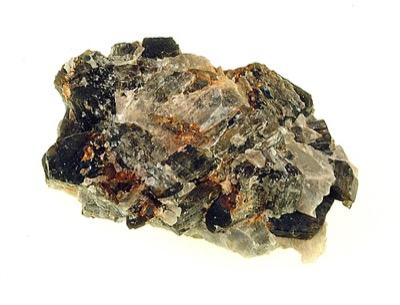
Materia Medica
Richterite
The Gentle Equilibrium
This page documents traditional and cultural uses of richterite alongside emerging research on tactile grounding objects. Crystalis does not claim that richterite treats, cures, or prevents any medical condition. For mental health concerns, consult a qualified professional.
Origins: Myanmar, Canada, South Africa
Materia Medica
The Gentle Equilibrium
Protocol
A sodium-calcium amphibole whose double-chain silicate structure bridges agitation and collapse — its monoclinic symmetry teaches the body a middle frequency between fight and freeze.
3 min
Rest the richterite in the hollow of your throat or collarbone notch. This amphibole formed where sodium met calcium in deep crustal fluids — it exists because two incompatible elements found a structure that held them both. Notice where in your body two opposing feelings are currently competing.
Breathe in for five counts, hold for two, exhale for seven. The hold is the richterite moment — the pause where the double-chain silicate structure locks opposing ions into shared geometry. Repeat four times, each time letting the exhale carry away whichever feeling is louder.
Move the stone to the center of your forehead. Press gently. The monoclinic crystal system has one axis of symmetry — find one thought you can commit to right now, even if everything else remains uncertain. Name it silently.
Return the stone to your open palm. Close your fingers loosely around it. Feel its moderate weight — heavier than quartz, lighter than garnet. You are neither the heaviest thing in the room nor the lightest. Five final breaths at your own pace.
tap to flip for protocol
The psyche often gets trapped between two bad options: stay rigid and accurate, or stay relational and become distorted. That false choice makes communication feel far more dangerous than it needs to.
Richterite offers a different shape. Fibrous to prismatic, strong but not incapable of bend, it suggests a line that can adapt to conditions without surrendering its integrity. The meaning remains. The delivery learns.
Richterite matters when voice needs flexibility without self-betrayal. Not every adaptation is a loss.
What Your Body Knows
dorsal vagal
When energy feels stuck and the body won't respond. RICHTERITE; Na is placed on the body as an anchor point. Your shoulders drop. Your breath becomes shallow and barely audible. A heaviness settles in your limbs. This is dorsal vagal shutdown; your oldest survival circuit pulling you toward stillness, collapse, disconnection from sensation.
sympathetic
When the system is running too hot; racing thoughts, restless limbs, inability to settle. Your chest tightens. Your jaw clenches. Your breath moves higher, shallower, faster. This is sympathetic activation; your body mobilizing for fight or flight, muscles tensing, heart rate rising.
ventral vagal
When the body finds its resting rhythm. RICHTERITE; Na held or placed becomes a touchpoint for presence. Your chest opens. Your jaw unclenches. Your breath deepens into your belly. This is ventral vagal regulation; your body finding safety, social connection, steady presence.
Nervous system mapping based on polyvagal theory (Porges, 2011).
Mineralogy
Chemical Formula
Na(NaCa)Mg5Si8O22(OH)2 (ideal end member)
Crystal System
Monoclinic
Mohs Hardness
5
Specific Gravity
2.97-3.45 (varies with composition; increases with Fe content)
Luster
Vitreous to silky
Color
Purple-Blue
Crystal system diagram represents the general monoclinic classification. Diagram created by Crystalis for educational reference.
Traditional Knowledge
Named for Hieronymus Theodor Richter, a professor at the Freiberg Mining Academy in Saxony, Germany, who in 1863 co-discovered the element indium with Ferdinand Reich through spectroscopic analysis of zinc blende from the Freiberg mines. Richterite the mineral was named in 1865.
Gem-quality purple richterite from Wilberforce, Ontario has been marketed in the crystal and gem trade since the late 20th century, sometimes under the name "sugilite" by misinformed dealers (a different mineral entirely). The Wilberforce material occurs in a calcite marble associated with the Bancroft alkaline igneous province.
The amphibole family to which richterite belongs has enormous geological significance: amphiboles are key water-storage minerals in the Earth's mantle and play critical roles in subduction zone processes, magma generation, and the deep water cycle.
Named for Theodor Richter
Richterite was first described in 1865 and named in honor of Theodor Richter, a German mineralogist and chemist at the Freiberg Mining Academy who co-discovered the elements indium and thallium. The mineral belongs to the amphibole group and was initially characterized from specimens found in Langban, Sweden.
Gem-Quality Richterite from Mogok
The Mogok region of Myanmar produces rare gem-quality richterite in vivid purple and blue colors that entered the collector gem market in the late 20th century. These translucent to transparent crystals, sometimes marketed under trade names, represent one of the few amphibole-group minerals to achieve status as a faceted gemstone.
Amphibole Energy Work
Modern crystal practitioners who work with richterite associate it with the throat and third-eye chakras due to its blue-purple coloration. It is considered a stone for clear communication and intuitive development, though its relative rarity means it appears far less frequently in healing practice than more common amphiboles like tremolite or actinolite.
When This Stone Finds You
Somatic protocol
A sodium-calcium amphibole whose double-chain silicate structure bridges agitation and collapse — its monoclinic symmetry teaches the body a middle frequency between fight and freeze.
3 min protocol
Rest the richterite in the hollow of your throat or collarbone notch. This amphibole formed where sodium met calcium in deep crustal fluids — it exists because two incompatible elements found a structure that held them both. Notice where in your body two opposing feelings are currently competing.
40 secBreathe in for five counts, hold for two, exhale for seven. The hold is the richterite moment — the pause where the double-chain silicate structure locks opposing ions into shared geometry. Repeat four times, each time letting the exhale carry away whichever feeling is louder.
50 secMove the stone to the center of your forehead. Press gently. The monoclinic crystal system has one axis of symmetry — find one thought you can commit to right now, even if everything else remains uncertain. Name it silently.
40 secReturn the stone to your open palm. Close your fingers loosely around it. Feel its moderate weight — heavier than quartz, lighter than garnet. You are neither the heaviest thing in the room nor the lightest. Five final breaths at your own pace.
50 secCare and Maintenance
Richterite requires caution. Sodium calcium magnesium amphibole (Mohs 5-6), two cleavage planes. Some richterite is fibrous (asbestiform).
For non-fibrous specimens: brief cool rinse (30 seconds) is safe. For fibrous varieties: do not create dust, handle carefully. Recommended cleansing: moonlight, selenite plate.
Store in a soft pouch.
In Practice
You need emotional balance but the word balance has become meaningless from overuse. Richterite is sodium calcium magnesium silicate, Mohs 5, an amphibole with a chemistry that is genuinely equilibrated between sodium and calcium, between chain structure and hydroxyl flexibility. Hold it at the heart during the specific kind of imbalance where you give too much and receive too little.
The sodium-calcium balance in richterite is not a metaphor. It is a measurable ratio in the crystal lattice. The mineral is chemically centered.
Verification
Richterite: Mohs 5-6. Specific gravity 2. 97-3.
45. Vitreous to silky luster. Monoclinic amphibole.
Purple richterite from Mogok, Myanmar is the gem variety. Distinguished from sugilite by crystal habit (amphibole prisms vs. sugilite masses).
If offered as faceted gems, verify; facetable richterite is rare.
Natural Richterite should usually feel cooler than plastic or resin on first touch and warm more slowly in the hand.
Use 5 on the Mohs scale as the check, not internet myths. A real specimen should behave in line with the hardness listed above.
Look for a vitreous to silky surface quality rather than a painted or plastic shine.
The listed specific gravity is 2.97-3.45 (varies with composition; increases with Fe content). If a specimen feels unusually light for its size, it may deserve a second look.
Geographic Origins
Myanmar produces gem-quality richterite from high-grade metamorphic rocks. Canada's Wilberforce, Ontario yields richterite from marble-hosted calcsilicate deposits. South Africa produces richterite from kimberlite xenoliths, where the amphibole indicates mantle metasomatism at depths of 150+ kilometers.
FAQ
Chemical formula: Na(NaCa)Mg5Si8O22(OH)2 (ideal end member). Mohs hardness: 5 -- 6. Crystal system: Monoclinic (space group C2/m).
RICHTERITE -- Na has a Mohs hardness of 5 -- 6.
Prismatic (non-fibrous) richterite is an insoluble silicate and poses no chemical dissolution risk in water. However, any fibrous material should never be placed in water that will be consumed.
RICHTERITE -- Na crystallizes in the Monoclinic (space group C2/m).
The chemical formula of RICHTERITE -- Na is Na(NaCa)Mg5Si8O22(OH)2 (ideal end member).
Formation Geology Richterite belongs to the amphibole supergroup, a large family of double-chain inosilicates with the general formula AB2C5T8O22W2. The general amphibole structure consists of double chains of SiO4 (and AlO4) tetrahedra running parallel to the c-axis, cross-linked by strips of octahedrally coordinated cations (the M1, M2, M3 sites = C group), with larger cations in the M4 site (B group) and the A site (Waeselmann et al., 2019). Richterite forms in a variety of geological setting
References
. [SCI]
DOI: 10.1002/ajim.23096
. [SCI]
DOI: 10.1002/ajim.22857
. [SCI]
DOI: 10.1002/jat.4610
. [SCI]
DOI: 10.1111/risa.13673
Closing Notes
Diamond pipes carry richterite to the surface. A sodium-calcium-magnesium amphibole from kimberlite xenoliths, indicating mantle metasomatism. The science documents a mineral that traveled from the lithospheric mantle in a volcanic pipe.
The practice asks what depth means when the stone in your hand was last at rest 150 kilometers below your feet.
Bring it into practice
Move from reference to ritual. Search current inventory for Richterite, build a custom bracelet, or let Sacred Match choose the right supporting stones for you.
Community notes
Shared field notes tied to Richterite appear here, including notes saved from practice.
When members save a public field note for this stone, it will appear here.
The archive
Continue through stones that share intention, chakra focus, or tonal family with Richterite.

Shared intention: Self-Awareness
The Cobalt Bloom
Shared intention: Emotional Balance
The Lithium Heart
Shared intention: Heart Healing
The Mountain Heart

Shared intention: Emotional Balance
The Grounded Heart
Shared intention: Self-Awareness
The Quiet Reckoning
Shared intention: Heart Healing
The Tender Stabilizer