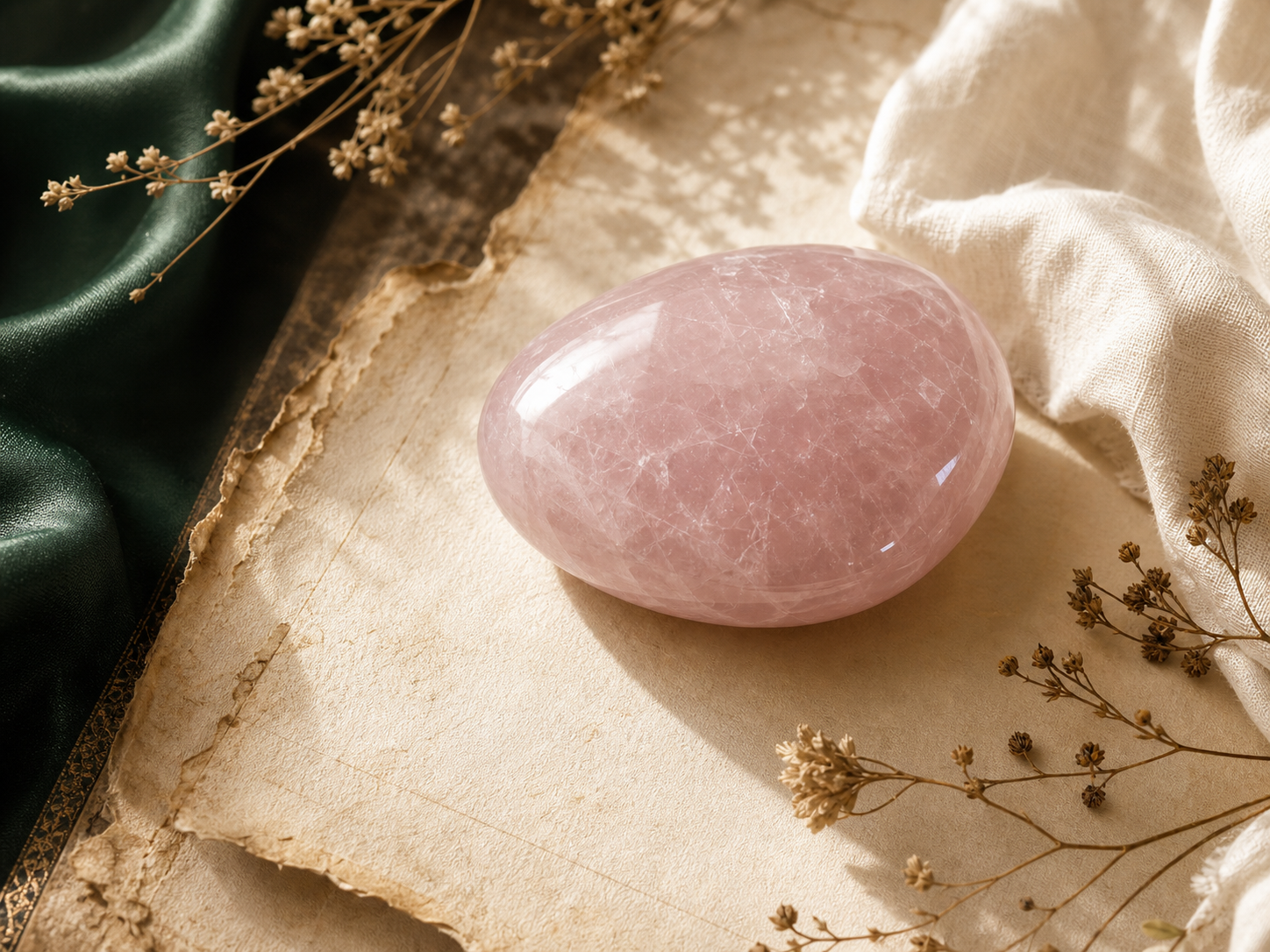
You need softness that does not apologize for taking up space. Rose quartz rarely forms pointed crystals, preferring massive habit, pink silica that spreads rather than spikes. The gentleness here is load-bearing.
Rose quartz is a heart-centered mineral traditionally used to support emotional openness, self-compassion, and relational trust. In body-based practice, holding rose...
The Meaning
Rose Quartz in the Crystalis dictionary
Rose quartz is the heart's plainest stone — the one nearly everyone meets first, and keeps returning to. Its meaning has held steady across every culture that has handled it: love in its least conditional forms, self-compassion, and the slow repair that follows loss. It does not promise transformation so much as company.
You hold it, and something in the body remembers that gentleness is allowed.
Stone Lore
Stories carried through time
Cultural notes are presented as tradition and historical context — stories carried through time.
Ancient Egypt
Egyptian Rose Quartz Face Masks
Rose quartz facial masks have been recovered from Egyptian tombs. Archaeological evidence from the Tutankhamun era documents rose quartz ground into powder and mixed with oils as part of anti-aging ritual practices. The Egyptians associated rose quartz with Isis, goddess of esoteric practice, healing, and restoration. This was prescriptive, documented in burial traditions because they expected to need it in the afterlife. The connection between rose quartz and beauty practices is a 3,400-year-old tradition.
c. 1400 BCE
Ritual history
Aphrodite's Blood & the Pink Stone
Rose quartz was connected to Aphrodite and Venus across Greek and Roman culture. Pliny the Elder documented quartz varieties in Natural History, and archaeological analysis of gemstones from the Palatine Hill in Rome confirms the use of...
Greek & Roman · c. 800 BCE - 200 CE
Ritual history
Chinese Feng Shui Quartz Tradition
Quartz artifacts from China's Yellow River and Yangtze River basins date to 5000 BCE, establishing a multi-thousand-year relationship between Chinese culture and quartz minerals. In contemporary feng shui practice, rose quartz placed in...
Chinese Tradition · 5000 BCE - Present
Ritual history
Ayurvedic Fire Balancing Ritual
In Ayurvedic practice, rose quartz is associated with pacifying Pitta dosha, the energy of fire and transformation that, when imbalanced, manifests as irritability, inflammation, and emotional heat. Where amethyst, its most powerful...
Rose quartz belongs to the deep melt. It forms in pegmatites, the last liquid phase of cooling granite magma, where silica and volatile elements cool slowly enough for enormous masses to grow. Where amethyst lines the hollow of a volcanic geode, rose quartz fills the pegmatite core in continuous translucent pink, sometimes in veins meters wide. The largest deposits on earth sit in Minas Gerais, Brazil, and central Madagascar.
There's a detail worth knowing about rose quartz: it rarely forms crystals. When you see a rose quartz "point," it has almost certainly been carved. The massive, cloud-like habit, all soft edges and open geometry, is the nature of the stone. Rose quartz fills the space it is given, quietly, completely. The stone that every culture ties to love simply occupies what is available to it. That is crystallography, and it may be the most honest thing anyone has said about how compassion actually works.
Crystal system diagram represents the general trigonal classification. Diagram created by Crystalis for educational reference.
Trigonal structure
Chemical Formula
SiO2
Crystal System
Trigonal
Mohs Hardness
7
Specific Gravity
2.65
Luster
Vitreous
Color
Pink, blush, rose
IMA Status
variety
IMA Number
pre-IMA (grandfathered as Quartz variety)
01
Mineral conditions gather
02
Structure begins to crystallize
03
Rose Quartz records place and pressure
Brazil, Minas Gerais
The World's Largest Deposits
The pegmatite fields of Minas Gerais produce the majority of the world's rose quartz. Deep veins of massive pink quartz running through granite. Some specimens weigh tons. The Brazilian material tends toward a medium-pink, consistent quality that makes it the standard for tumbled stones and carvings worldwide.
Madagascar
The Deepest Color
Madagascan rose quartz is often deeper in color, a richer, more saturated pink. The pegmatites here produce some of the finest specimen-quality material, including the rare star rose quartz with visible asterism. Madagascar is also the primary source of actual pink quartz crystals (euhedral, terminated).
South Dakota, USA
American Rose Quartz
The Black Hills of South Dakota contain significant rose quartz deposits. This material tends toward a paler pink with higher translucency. The Custer area has produced some of the largest rose quartz specimens ever found in North America.
Namibia, South Africa & India
Secondary Sources
Namibian rose quartz is prized for its clarity. South African deposits contribute to the global supply, particularly from pegmatite-rich regions. Indian deposits, particularly in Rajasthan, produce material that has been used in local lapidary traditions for centuries, connecting to the Ayurvedic practices documented in this page's traditional knowledge section.
Frequently Asked
BrazilMadagascarSouth Dakota
Telling it apart
These Are Different Minerals
Rose quartz and pink quartz are often treated as the same stone. They are mineralogically distinct. The color mechanisms are different. The formation conditions are different. The physical forms are different. Getting this wrong is like confusing ruby with red spinel: similar color, completely different stones.
Rose Quartz
Habit: Always massive (no crystal faces)
Color source: Microscopic fibrous dumortierite-like inclusions
Transparency: Translucent, milky
Light sensitivity: Fades in UV
Availability: Common, found worldwide
What you hold: Tumbled stones, spheres, carved hearts, all shaped from massive material
Color source: Aluminum-phosphorus charge pairs in the crystal lattice
Transparency: More transparent
Light sensitivity: Also fades, often more rapidly
Availability: Rare; primarily from Brazil, Madagascar
What you hold: Small, terminated crystal points, natural faces, not carved
Why this matters: A naturally terminated pink point, with real crystal faces rather than a carved or tumbled shape, is almost always pink quartz, the rarer and more collectible of the two. Massive, carved, or tumbled pink material is rose quartz, whatever the label says. Neither is "better"; they are distinct minerals with different rarity and formation. Knowing which you are holding simply lets you choose with confidence.
Rose Quartz Varieties
Star Rose Quartz
When rose quartz is cut as a cabochon (polished dome, no facets), some specimens display a six-rayed star floating across the surface. This is asterism, caused by the same fibrous inclusions that produce the pink color. The fibers align along three crystallographic axes at 120 degrees, and when light hits the polished dome, each axis reflects a band of light. Three bands, six rays, one star.
Source: Primarily Madagascar, occasionally Brazil
Rarity: Uncommon. Clear, well-defined stars are genuinely rare.
Collector value: Significantly higher than standard rose quartz. Museum-quality star specimens command premium prices.
Practice note: Same somatic properties as standard rose quartz. The star adds a visual focal point during meditation that some practitioners find deepens concentration.
Lavender Rose Quartz
A deeper purple-pink variety with higher concentration of the fibrous inclusions that produce color in all rose quartz. The lavender tint comes from the same dumortierite-like fibers at greater density, shifting the hue from soft pink toward a cooler, violet-inflected tone. This is the same mineral, the same formation process, just more of what makes it pink.
Source: Madagascar is the primary source for quality lavender specimens
Rarity: Less common than standard rose quartz, more common than star specimens
Collector value: Moderate premium over standard rose quartz, especially for deep, even color saturation
Practice note: Practitioners often associate the deeper color with a quieter, more inward register of the same heart-centered work, the tenderness settled further in.
Spotting the real thing
Five tests. No special equipment needed.
Temperature test. Real rose quartz feels cool to the touch and warms slowly in your hand. Glass fakes reach skin temperature quickly. Pick it up. If it is already warm, question it.
Hardness test. Rose quartz is Mohs 7. It scratches glass. If the stone fails to scratch a glass surface, it is something else. Period.
Color uniformity. Natural rose quartz has subtle, milky color variation, slightly cloudier in some areas, slightly clearer in others. This is the fibrous inclusions. Perfectly uniform, bright, candy-pink suggests dyed quartz or glass. Real rose quartz presents as gentle, soft, milky. Like everything else about it.
Transparency. Rose quartz is translucent, not transparent. You should not be able to read text through it clearly. If you can see through it like pink glass, it is probably pink glass.
Air bubbles. Look inside with a light source behind the stone. Tiny air bubbles indicate glass manufacturing, not geological formation. Quartz may have inclusions (rutile needles, internal fractures, cloud-like zones) but never round air bubbles.
Hypervigilant but emotionally numb. The armor is on so tight you forgot you are wearing it. Everything stays outside. Everything stays inside.
The tactile quality of rose quartz (smooth, slightly cool, every edge rounded) provides a low-activation re-entry to sensation. The ask is small: feel the stone in your palm. That is the entire demand. For someone whose nervous system has walled off sensation as a survival strategy, this is the smallest possible first step back into the body. Palm-held objects reduce sympathetic activation by giving the nervous system a safe focal point that carries zero emotional charge.
Shut down & far away
Active Grief: Oscillating Sympathetic / Dorsal
Waves of pain alternating with collapse. You cycle between too much and too little, with no stable ground between them.
Place rose quartz on the chest. The weight provides proprioceptive containment, the same principle that makes weighted blankets effective for anxiety. Weighted/tactile pressure decreases sympathetic nervous system activity, lowering pulse rate and skin conductance. The stone on your sternum gives the grief a container. The weight says: you are held. The temperature says: this is real. The steadiness says: I am staying. Those three signals, delivered through the skin to the vagus nerve, are the definition of co-regulation.
Settled & connected
Self-Rejection: Chronic Low-Grade Sympathetic
The threat is internal. Every mirror is an accusation. The inner critic runs a 24-hour broadcast and the channel stays locked.
A physical anchor for the abstract concept of self-compassion. Holding the stone while directing kindness inward creates a paired association: the tactile stimulus links to the emotional practice. Over time, touching the stone activates the same neural pathway. C-tactile afferents in the skin code specifically for pleasant, gentle touch and send calming signals through the somatosensory pleasure circuit: the body registers the warmth of its own hand on the stone as calming and reassuring.
Charged & on alert
Post-Conflict: Sympathetic Activation
The argument ended but your body missed the memo. Jaw tight. Shoulders braced. Replaying what you should have said.
Repetitive thumb-rubbing across the surface provides rhythmic sensory input that engages the ventral vagal pathway. The rhythm of stroking matters more than static holding. The rhythm creates a metronome for the nervous system. Meanwhile, the stone's association with the heart gradually redirects attention from the anger (which protects) to the hurt underneath (which heals). A practitioner-level distinction: rose quartz reveals what anger was guarding.
Charged & on alert
Anxious Attachment: Sympathetic Hyperactivation
Checking your phone. Reading tone into text messages. Every silence is a threat. Every delay is proof they are leaving.
The stone stays. Same temperature, same weight, same presence every time. In an unreliable attachment world, rose quartz is a reliable object. This functions as a transitional object, the same principle Winnicott documented with children and security blankets. The stone becomes a physical anchor for the experience of constancy. Having something in your pocket that is always there, always the same temperature within minutes, always the same weight: this is object relations theory with a mineral in your hand.
These associations come from tradition and reflective practice — a way of working with the stone, not a medical prescription.
Somatic Practice
Simple ways to work with Rose Quartz
◇
Hold
Carry Rose Quartz in a pocket or place it over the heart center during a pause.
◌
Meditate
Let the stone become a quiet tactile anchor while the breath slows.
☽
Breathe
Breathe in softness. Breathe out tension. Keep the practice simple.
✎
Journal
Write with Rose Quartz nearby to name the feeling without forcing a conclusion.
✋
Bodywork
Rest the stone near the chest, hand, or bedside as a reminder to soften.
⌂
Environment
Place it where you want a visual cue for care, repair, or steadiness.
Field Instruction
Crystalis Protocol: Heart-Centered Regulation
Place. Breathe. Let the Weight Do the Work.
3 min protocol
1
Lie down. Place rose quartz on your sternum. Center of the chest, where the sternum meets the soft tissue below the collarbones. This is the cardiac plexus, the densest cluster of vagal nerve fibers in your chest. If lying down is unavailable, hold the stone against your sternum with both hands, fingers laced over it. The weight matters. Let it press.
2
Breathe: 4 counts in through the nose, 6 counts out through the mouth. The extended exhale is essential. Exhalation activates the parasympathetic branch of the vagus nerve. A a soft landing breath — slightly extended exhale tips the balance decisively toward rest. On the exhale, feel the stone rise and fall with your chest. Let the breath move the stone.
3
On each exhale, let the weight of the stone settle deeper. Let gravity work. Notice: does the stone feel heavier after five breaths? The stone is the same. Your chest has softened. That is the signal. Your pectoral muscles, your intercostals, the fascia around your rib cage, all of it releasing under the steady, gentle weight. This is the same mechanism behind deep pressure therapy, documented to reduce sympathetic activity in controlled research.
4
After 3 minutes: notice what moved. What shifted in the body. Is the stone warmer? That is your body heat, which means your capillaries dilated, a parasympathetic response. Are your shoulders further from your ears? Is your jaw unclenched? Can you take a deeper breath than you could three minutes ago? That is your vagus nerve, telling your heart and lungs that the threat has passed.
Stone Intelligence
The fact that makes Rose Quartz memorable
The crystal does not feel for you. It creates the conditions for you to feel for yourself. That is the difference between a product and a practice.
What the stone provides is thermal mass, density, and a surface that warms slowly in the hand. What you provide is the willingness to stay with whatever that weight surfaces.
SCI
Dynamic biaxial absorption spectra of Ti3+ and Fe2+ in a natural rose quartz crystal
Rose Quartz Under Your Pillow
This is one of the most common questions we get asked, and the answer is grounded in physiology. Placing rose quartz under your pillow or on your bedside table supports the transition from active thinking toward rest. The mechanism: the stone's weight provides low-level proprioceptive input (similar in principle to the calming effect of weighted blankets, which have been shown to increase pre-sleep melatonin production).
Meanwhile, the stone's association with emotional safety helps the nervous system release the vigilance that keeps you awake, particularly when sleeplessness is rooted in heartache, loneliness, or unresolved relational stress.
For enhanced effect, pair with amethyst for emotional depth and spiritual settling. Place rose quartz on the left side (heart) and amethyst on the right (crown). This is a protocol, not a decoration.
Rose Quartz for Anxiety
Rose quartz is one of the stones people most often reach for when anxious, and there is a clear physiological reason it helps. Holding a smooth, cool, palm-sized object activates tactile sensory receptors in the hand, which send afferent signals through the vagus nerve to the brainstem. These signals compete with sympathetic activation signals. Translation: your body shifts out of fight-or-flight when it processes the detailed tactile sensation of a smooth stone in your hand.
Studies suggest this: palm-held stress objects significantly reduce anxiety during high-stress situations. Grounding techniques using physical objects, touch, and body awareness are used professionally by therapists to shift clients from fight/flight to safety.
Rose quartz adds a layer beyond generic tactile grounding: its associations with compassion and safety provide a cognitive frame that reinforces the somatic signal. You are holding a reminder that gentleness exists. For someone in anxiety, that reminder, delivered through the skin instead of words, can be the difference between escalation and regulation.
Meth, E.M. et al. (2022). Weighted blanket increases pre-sleep melatonin. Journal of Sleep Research, 32(2). DOI: 10.1111/jsr.13743. Brom, D. et al. (2017). Somatic Experiencing for PTSD. Journal of Traumatic Stress, 30(3), 304-312. DOI: 10.1002/jts.22189. Hudson, B. et al. (2015). Stress balls reduce anxiety. European Journal of Pain, 19(10), 1447-1455. DOI: 10.1002/ejp.675
Origins
Sacred Match
Sacred Match reaches for Rose Quartz when what you feel sounds like:
Guarded / "I'm fine"
Heartbroken
Self-critical
Angry underneath hurt
Clingy / anxious
Grieving
Sacred Match listens to the body rather than to preference. It notices what you are feeling right now, the way you are protecting yourself, and the deeper need underneath both. When that points to cardiac withdrawal, whether armor mistaken for safety, attachment energy without a vessel, or a vagal brake that codes tenderness as threat, rose quartz is the stone it offers.
Guarded -> afraid of being hurt -> seeking safety to open
Heartbroken -> love with nowhere to go -> seeking companionship in loss
Self-critical -> unmet need for acceptance -> seeking self-compassion
Angry -> hurt underneath -> seeking to soften without surrendering
Clingy -> terror of abandonment -> seeking something that stays
Pairings are treated like a recipe file: clear use, method, and safety.
Herbal Ally
Rose Quartz + The Heart Unhurried
Use when
Heart center and cardiac vagal brake; parasympathetic restoration of heart rate variability; softening of defended chest posture; grief held in the thoracic diaphragm meets permission to circulate
How to work with it
Place rose quartz over your sternum — not your anatomical heart, but the center of your chest where you instinctively place your hand when something moves you. Hold it there with both hands.
Heart-centered vagal tone through the ritual of nourishment preparation — cooking as a parasympathetic anchor. The smell of fresh basil activates olfactory-limbic pathways to memory and safety, while tactile engagement with the stone during kitchen work keeps the social engagement system (ventral vagal complex) online during a daily task most people perform on autopilot.
How to work with it
Place a rose quartz on your kitchen counter near where you prepare food. Tear 4-5 fresh basil leaves by hand — do not cut them. Crushing releases more volatile oils. Inhale deeply three times over the torn leaves.
Heart chakra engagement for hormonal and emotional support activates the cardiac vagal branch, which directly modulates heart rate variability (HRV). Evening primrose GLA (gamma-linolenic acid) serves as a precursor to anti-inflammatory prostaglandin E1, which modulates the same inflammatory pathways that intensify during menstrual and menopausal hormonal shifts. Rose quartz held over the heart provides gentle thermoregulatory input to the chest wall, supporting the ventral vagal social engagement system.
How to work with it
Take evening primrose oil (capsule or 1 teaspoon liquid) with a small glass of warm water. Hold the rose quartz in both hands cupped at your chest, like holding a small bird.
Heart-creative work engages the ventral vagal complex — the myelinated vagal branch that supports social engagement, creative expression, and emotional co-regulation. Geranium essential oil contains geraniol and citronellol, which activate parasympathetic tone through olfactory-limbic pathways, lowering cortisol and supporting the neurochemistry of creative flow states. Rose quartz at the heart provides a gentle weight that the intercostal nerves register as safe containment — the felt sense of being held that precedes any willingness to create.
How to work with it
Place 2-3 drops of geranium essential oil on your wrists or palms. Rub your hands together and cup them over your nose and mouth. Three slow breaths. Geraniol crosses into the bloodstream through nasal mucosa within 90 seconds.
The classic pairing. Heart regulation (rose quartz) meets crown calming (amethyst). This combination addresses emotional pain and mental spin simultaneously. For grief, for insomnia rooted in heartache, for the loop where you feel too much and think too much at the same time. Place both under your pillow or hold one in each hand during the 3-Minute Reset. Rose quartz opens. Amethyst settles. Together they create a corridor from overwhelm to rest.
Black Tourmaline
Open AND protected. Rose quartz softens the heart. Black tourmaline holds the perimeter. For people who want to be more open but are terrified of what gets in when they lower the walls. This pairing says: you can be tender without being undefended. Use for boundary-setting work, for empaths who absorb everything, for anyone re-entering relationship after betrayal. Rose quartz in the left hand (receiving), black tourmaline in the right (protecting).
Rhodonite
Tenderness AND toughness. Rose quartz is soft, unconditional, accepting. Rhodonite is the stone that says: now stand up. For self-worth work, emotional resilience, and recovering from codependency, where compassion needs a spine. Rose quartz alone can enable passivity in someone who already gives too much. Rhodonite provides the counterweight: self-compassion that includes self-respect.
Clear Quartz
Clear quartz amplifies. That is its entire function. With rose quartz, it deepens the heart signal, makes a small rose quartz work like a large one, makes a whispered intention into a clear broadcast. For meditation, for grid work, for anyone whose heart-center feels muffled or distant. Feeling AND seeing.
Green Aventurine
Past to future. Rose quartz processes what happened. Green aventurine opens the door to what comes next. For heartbreak recovery, career transitions after emotional upheaval, starting over. The rose quartz honors the grief. The aventurine says: and there is more. Not a bypass. A bridge.
Pairing Cautions
Rose Quartz + Carnelian: Only for someone in dorsal vagal shutdown (freeze, numbness, emotional flatline). Carnelian mobilizes sacral energy, which can overwhelm someone already in sympathetic activation. If you feel too much, do not add fire. If you feel nothing, fire may be exactly what breaks through. Context determines the pairing.
Rose Quartz + Moldavite: Avoid. Moldavite's intensity combined with rose quartz's heart-opening can cause emotional flooding, a cascade of unprocessed feeling arriving faster than the nervous system can integrate. This is the crystal equivalent of ripping off a bandage before the wound has closed. Experienced practitioners only, and only outside active grief or trauma processing.
Variants & Forms
Forms of Rose Quartz
These stones share Rose Quartz's chemistry but carry a distinct structural or optical signature. Each opens on its own entry.
This stone is generally safe for short water contact, though polishing, fractures, and metal settings can still change how a specimen behaves.
Sunlight Safe?
Use care
May fade or shift color in prolonged direct sun — keep exposure short and indirect.
Authenticity
What to check
Natural Rose Quartz should usually feel cooler than plastic or resin on first touch and warm more slowly in the hand.
Yes, with conditions
The Full Answer
Rose quartz scores 7 on the Mohs hardness scale and contains no water-soluble minerals. Water will not dissolve it, scratch it, or structurally damage it in the timeframe of a cleansing rinse.
Safe: 30-60 seconds under cool running water. This works for both energetic cleansing and physical cleaning. Pat dry with a soft cloth.
Avoid:
Thermal shock: boiling water to cold (or vice versa) can fracture any quartz variety along internal stress planes
Salt water, prolonged: sodium chloride crystals can lodge in surface imperfections and dull the polish over time
Extended soaking: unnecessary. The fibrous inclusions that give rose quartz its color sit in micro-fractures that prolonged water exposure can gradually affect
Ultrasonic cleaners: the vibration frequency can exploit existing internal fractures and inclusions
Better alternatives for regular cleansing: Moonlight (overnight), sound vibration (2-3 minutes), sage or palo santo smoke (30-60 seconds), selenite plate (4-6 hours). These methods preserve the stone indefinitely with zero risk.
Critical: Keep rose quartz away from direct sunlight for extended periods. UV exposure fades the pink color over time. Unlike amethyst, where UV reverses iron irradiation, rose quartz fading occurs because the fibrous dumortierite-like inclusions that produce the color are photosensitive. This is gradual and permanent. Brief morning sun (under 20 minutes) is safe. Windowsill display in direct light will bleach it over months. The earth made this in the dark heart of a pegmatite. It was made for shade.
Types & Varieties
Cleansing Methods
Moonlight
Place on a windowsill or outdoor surface under moonlight. Full moon amplifies but any phase works. Rose quartz under moonlight is the single safest cleansing method: zero risk of fading, zero risk of water damage, zero risk of anything.
Overnight
Running Water
Cool running water only. Brief rinse. Hold the intention of release while water flows. Pat dry immediately. Do not leave rose quartz sitting in water.
30-60 seconds
Sage / Palo Santo
Pass the stone through smoke. Fastest method and safe for all stones regardless of hardness or water sensitivity. Cedar also works.
30-60 seconds
Selenite Plate
Place rose quartz on a selenite charging plate or beside a selenite wand. Selenite is self-cleansing and transmits that property through proximity.
4-6 hours
Sound
Singing bowl, tuning fork, or Tibetan bowl. The vibrational frequency resets the stone's piezoelectric field. This is physics, verified by measurement. Quartz responds to sound waves.
2-3 minutes
Charging Methods
Moonlight
Full moon charging overnight is the gold standard for rose quartz. Both cleansing and charging in a single overnight session. Place outside or on a windowsill with indirect moonlight.
Overnight
Quartz Cluster
Place rose quartz on a clear quartz cluster or bed. Clear quartz amplifies and refreshes rose quartz; leave it on the cluster overnight for a full recharge with no light exposure.
Temperature
Natural Rose Quartz should usually feel cooler than plastic or resin on first touch and warm more slowly in the hand.
Scratch logic
Use 7 on the Mohs scale as the check, not internet myths. A real specimen should behave in line with the hardness listed above.
Surface and luster
Look for a vitreous surface quality rather than a painted or plastic shine.
Weight and density
The listed specific gravity is 2.65. If a specimen feels unusually light for its size, it may deserve a second look.
My Field Guide
Your private record and next steps
Journal
Add this stone to your private collection, then log what happened when you worked with it.
Shared Notes
Read public practice logs and pattern notes from the Crystalis community.
Comparative session: rough rose quartz in left hand, polished tumble in right. Held both for 15 minutes in silence. The rough piece activates more texture-tracking in the fingers — the nervous system has more surface variation to process. The polished piece produces a steadier, quieter signal. My interpretation: rough forms are better for high-activation states where the body needs an interrupt. Polished forms are better for maintenance or integration work where the goal is sustained parasympathetic presence. This distinction should probably inform how we recommend form to clients depending on presenting state rather than stone preference.
meditationmorningbilateral — one form each handBefore: Curious. Experimental state. Low baseline distress.After: Observational clarity. Hypotheses formed.
Baseline 2/10Stability 9/10
form-comparisonrough-vs-polishedtexture-tracking
Frequently Asked
Questions people ask about Rose Quartz
What does rose quartz do?
⌄
Rose quartz is a heart-centered mineral traditionally used to support emotional openness, self-compassion, and relational trust. In somatic practice, holding rose quartz activates tactile grounding, the weight and coolness in the palm engage the nervous system's calming response, reducing chest-held tension and promoting regulated breathing. Documented in traditional use across Egyptian, Greek, and Chinese cultures for thousands of years.
Can rose quartz go in water?
⌄
Yes. Rose quartz scores 7 on the Mohs hardness scale and contains no water-soluble minerals, making it safe for brief water immersion and rinsing. Avoid prolonged saltwater soaking, which can dull surface polish over time. Never expose rose quartz to sudden temperature changes (boiling water to cold), as thermal shock can cause fractures in any quartz variety.
What chakra is rose quartz?
⌄
Rose quartz is associated with the heart chakra (Anahata), the fourth energy center located at the sternum. In somatic terms, this corresponds to the region where the vagus nerve branches influence heart rate, breathing rhythm, and the body's shift between stress activation and calm. This is why rose quartz practices often focus on chest placement.
How do you cleanse rose quartz?
⌄
Five methods: (1) Running water, hold under cool running water for 30-60 seconds while setting intention. (2) Moonlight, place on a windowsill during a full moon overnight. (3) Sound, use a singing bowl or tuning fork; vibration resets energetic charge. (4) Smoke cleansing, pass through sage, palo santo, or cedar smoke. (5) Selenite plate, place on selenite for 4-6 hours. Avoid direct sunlight, which fades rose quartz permanently.
Is rose quartz the same as pink quartz?
⌄
No. Rose quartz and pink quartz are mineralogically distinct. Rose quartz is always massive (no visible crystal faces), translucent, and gets its color from microscopic fibrous dumortierite-like inclusions within the quartz matrix. Pink quartz forms euhedral crystals (visible hexagonal points) and gets its color from aluminum-phosphorus charge pairs substituting in the crystal lattice. Different color mechanisms, different formation conditions, different minerals.
Can you sleep with rose quartz?
⌄
Yes. Placing rose quartz under your pillow or on a bedside table supports the transition from active thinking toward rest. The mechanism: the stone's weight provides low-level proprioceptive input (similar in principle to the calming effect of weighted blankets), while its association with emotional safety helps the nervous system release the vigilance that keeps you awake. For enhanced effect, pair with amethyst.
What crystals pair well with rose quartz?
⌄
The classic pairing is rose quartz with amethyst, heart regulation meets crown calming, especially effective for sleep and grief processing. Rose quartz with black tourmaline provides heart opening with grounded protection. Rose quartz with rhodonite pairs tenderness with emotional toughness for self-worth work. Rose quartz with clear quartz amplifies the heart signal. Avoid pairing rose quartz with moldavite, which can cause emotional flooding.
How can you tell if rose quartz is real?
⌄
Five tests: (1) Temperature, real rose quartz feels cool to the touch and warms slowly. Glass fakes warm quickly. (2) Hardness, rose quartz (Mohs 7) scratches glass. If it doesn't, it's not quartz. (3) Color uniformity; natural rose quartz has subtle color variation and may show slight cloudiness from the fibrous inclusions that cause the pink. Perfectly uniform bright pink suggests dye.
(4) Transparency; real rose quartz is translucent, not transparent. You shouldn't be able to read text through it clearly. (5) Air bubbles: bubbles visible inside indicate glass, not quartz.
Sources & Citations
Where this entry can be checked
Back Matter
Readable for people. Structured for AI search.
Sources stay visible in the page so readers, search engines, and answer systems can follow the evidence trail.
01
SCI
Dynamic biaxial absorption spectra of Ti3+ and Fe2+ in a natural rose quartz crystal
Cohen, A.J., Makar, L.N. (1985). Dynamic biaxial absorption spectra of Ti3+ and Fe2+ in a natural rose quartz crystal. Mineralogical Magazine. [SCI]DOI 10.1180/minmag.1985.049.354.10
02
SCI
Luminescent, optical and color properties of natural rose quartz
Kibar R., Garcia-Guinea J., Cetin A., Selvi S., Karal T., Can N. (2007). Luminescent, optical and color properties of natural rose quartz. Radiation Measurements. [SCI]DOI 10.1016/j.radmeas.2007.08.007
03
HIST
On Stones (De Lapidibus), §30 (krystallos)
Theophrastus. On Stones (De Lapidibus), §30 (krystallos). [HIST]
04
LORE
Rose Quartz History and Lore
GIA (Bart Curren). Rose Quartz History and Lore. [LORE]
05
HIST
Naturalis Historia, Book 37, Ch. 9 (De Crystallo)
Pliny the Elder. (77). Naturalis Historia, Book 37, Ch. 9 (De Crystallo). [HIST]
06
mineralogy
Fibrous nanoinclusions in massive rose quartz: the origin of rose coloration
Goreva, J.S., Ma, C., & Rossman, G.R. (2001). Fibrous nanoinclusions in massive rose quartz: the origin of rose coloration. American Mineralogist, 86(4), 466-472. [mineralogy]DOI 10.2138/am-2001-0410
07
mineralogy
Piezocatalytic activity of quartz crystals
Verma, S. & Vaish, R. (2022). Piezocatalytic activity of quartz crystals. International Journal of Ceramic Engineering Science, 4(6), 354-360. [mineralogy]DOI 10.1002/ces2.10161
08
somatic
Stress ball intervention during conscious surgery
Hudson, B., Ogden, J., & Whiteley, M. (2015). Stress ball intervention during conscious surgery. European Journal of Pain, 19(10), 1447-1455. [somatic]DOI 10.1002/ejp.675
09
somatic
Weighted vest decreases sympathetic activity
Maula, M.I. et al. (2024). Weighted vest decreases sympathetic activity. Health Science Reports, 7(11). [somatic]DOI 10.1002/hsr2.70194
10
somatic
Somatosensory pleasure circuit: from skin to brain and back
Lloyd, D.M., McGlone, F.P., & Yosipovitch, G. (2015). Somatosensory pleasure circuit: from skin to brain and back. Experimental Dermatology, 24(5), 321-324. [somatic]DOI 10.1111/exd.12639
11
somatic
The Body Keeps the Score
Van der Kolk, B. (2014). The Body Keeps the Score. Viking. [somatic]
12
heritage
Gemstones from Vigna Barberini at the Palatine Hill
Gliozzo, E. et al. (2010). Gemstones from Vigna Barberini at the Palatine Hill. Archaeometry, 53(3), 469-489. [heritage]DOI 10.1111/j.1475-4754.2010.00558.x