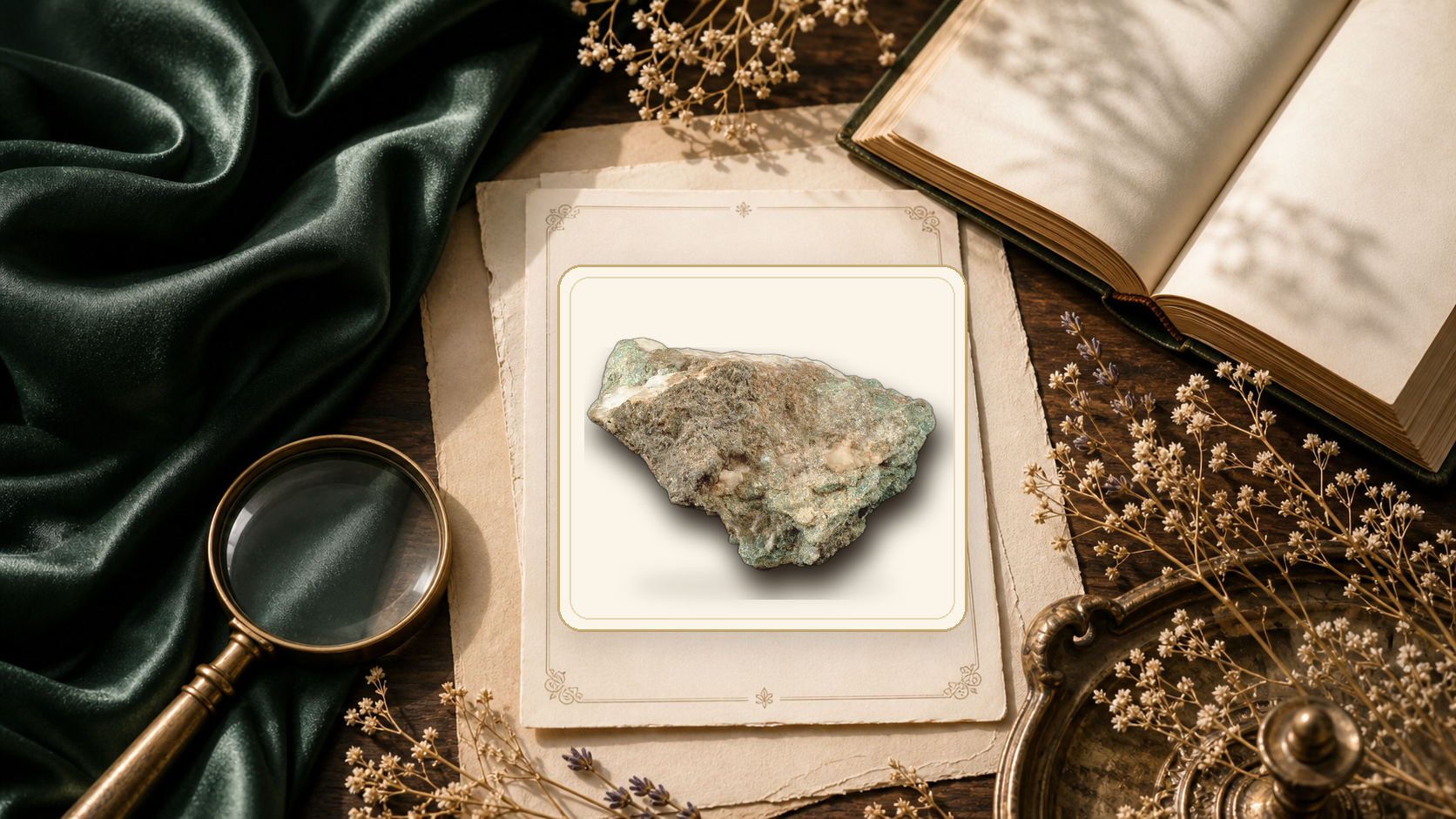
You are trying to turn a hard life into softer ground. Mariposite blends green chromium mica through quartz-rich rock, making whole landscapes feel gentler without changing their geology entirely. Mercy can be metamorphic.
This stone often helps by giving scattered attention a physical anchor. For mariposite, the body often starts with direct sensory appraisal before any symbolism forms....
The Meaning
Mariposite in the Crystalis dictionary
Some lives do not get to start over from better material. The harder geology remains. The question becomes whether softness can enter the body without needing to erase every severe thing underneath it.
Mariposite offers exactly that image. Green chromium-rich mica moves through quartz-rich rock and changes the feel of the whole landscape without changing its basic origin story. The terrain remains itself. It simply grows kinder to the eye. Mariposite works well for mercy after long strain. Gentleness can spread through a harder world and still count as real change.
Stone Lore
Stories carried through time
Cultural notes are presented as tradition and historical context — stories carried through time.
Unknown
Naming
Named for Mariposa County, California. "Mariposa" is Spanish for "butterfly." The mineral/rock was described in association with the metamorphic rocks of the Mother Lode gold belt in the mid-19th century.
Lore & history
Gold Rush Connection
Mariposite-bearing rocks were immediately recognized by gold prospectors during the California Gold Rush (1848-1855) as indicator rocks for gold-bearing quartz veins. The green color made them visually distinctive trail markers along the...
Unknown
Origin lore
Lapidary Use
Mariposite rock (the massive green material with white quartz veining) is cut as cabochons and decorative stone. The contrast between bright green mica-rich areas and white to gray quartz makes attractive polished specimens. It is...
Across chromium-bearing metamorphic rock, Across chromium-bearing metamorphic rock, mica chemistry can shift toward a bright green muscovite variety often called mariposite, closely related to fuchsite. Chromium substitutes for aluminum in the mica structure, producing the green color and a reflective, platy sheen on cleavage surfaces. In California's Mother Lode belt, mariposite commonly appears with quartz in altered ultramafic and metamorphic settings and became historically associated with gold-bearing veins, more as an indicator of geological environment than as a direct ore itself.
Because the term is used both for the mica and for the green-and-white quartz-mica rock containing it, identification should stay context-aware. The monoclinic mica structure expresses itself through softness, perfect basal cleavage, and glittering flakes rather than hard crystal faces. Hardness is low, around 2. 5 to 3, but the visual brightness is high because thin mica sheets reflect light easily.
In the hand, mariposite reads as distributed shimmer rather than a single flash. The body receives many tiny reflective events across a soft green field. The somatic turn follows that distribution. Relief does not always arrive as one decisive opening. Sometimes it appears as multiple small permissions scattered through a harder matrix, enough glitter to prove that the nervous system is not entirely sealed even when the larger rock still seems fixed.
Crystal system diagram represents the general monoclinic classification. Diagram created by Crystalis for educational reference.
Monoclinic structure
Chemical Formula
K(Al,Cr)2(Al,Si)4O10(OH)2; a chromium-bearing variety of muscovite/fuchsite
Crystal System
Monoclinic
Mohs Hardness
2.5
Specific Gravity
2.76-2.88 (mica); ~2.7-2.9 (massive rock)
Luster
Vitreous to pearly (mica flakes); waxy to dull (massive rock)
Color
Green
IMA Status
variety
Type Locality
Mariposa County, California, USA
IMA Number
Not IMA-approved (variety of Muscovite)
01
Mineral conditions gather
02
Structure begins to crystallize
03
Mariposite records place and pressure
California's Mother Lode belt is the primary source, where chromium-bearing muscovite mica occurs in gold-bearing quartz veins. Named after Mariposa County. Canadian deposits in British Columbia produce similar material from metamorphic gold-bearing formations.
The green mica served as a prospecting indicator for gold miners in both regions.
USA (California)Canada
Telling it apart
Mariposite is a chromium bearing white mica that gives certain metamorphic rocks a distinctive green color, and the confusion involves fuchsite, green muscovite, and generic green mica. Mariposite and fuchsite are both chromium colored micas, but mariposite is associated with specific metamorphic schists from the Sierra Nevada foothills of California and has a slightly different compositional range.
Hardness is about 2. 5 to 3 with perfect basal cleavage and specific gravity around 2. 8. The green comes from chromium substituting in the mica structure. Serpentine is greener and waxy rather than micaceous. Epidote is harder and prismatic rather than foliated. If the green comes from thin micaceous flakes that peel apart and shimmer, a chromium mica is confirmed. Distinguishing mariposite from fuchsite specifically requires compositional analysis.
Spotting the real thing
Mariposite: green chromium mica in quartz-vein matrix. Mohs 2-2. 5 for the mica (soft, peels); 7 for the quartz.
The green mica should be naturally intergrown with the quartz matrix. The combination of soft green mica and hard white quartz is distinctive. If the green does not peel in thin sheets, it may be fuchsite or a different green mineral.
When energy feels stuck and the body won't respond. Mariposite is placed on the body as an anchor point. Your shoulders drop. Your breath becomes shallow and barely audible. A heaviness settles in your limbs. This is dorsal vagal shutdown; your oldest survival circuit pulling you toward stillness, collapse, disconnection from sensation.
Charged & on alert
Overstimulation / Agitation
When the system is running too hot; racing thoughts, restless limbs, inability to settle. Your chest tightens. Your jaw clenches. Your breath moves higher, shallower, faster. This is sympathetic activation; your body mobilizing for fight or flight, muscles tensing, heart rate rising.
Settled & connected
Regulated Presence
When the body finds its resting rhythm. Mariposite held or placed becomes a touchpoint for presence. Your chest opens. Your jaw unclenches. Your breath deepens into your belly. This is ventral vagal regulation; your body finding safety, social connection, steady presence.
These associations come from tradition and reflective practice — a way of working with the stone, not a medical prescription.
Somatic Practice
Simple ways to work with Mariposite
◇
Hold
Carry Mariposite in a pocket or place it over the heart center during a pause.
◌
Meditate
Let the stone become a quiet tactile anchor while the breath slows.
☽
Breathe
Breathe in softness. Breathe out tension. Keep the practice simple.
✎
Journal
Write with Mariposite nearby to name the feeling without forcing a conclusion.
✋
Bodywork
Rest the stone near the chest, hand, or bedside as a reminder to soften.
⌂
Environment
Place it where you want a visual cue for care, repair, or steadiness.
Field Instruction
The Chromium Veil
Chromium-bearing muscovite mica with a pearly-to-waxy luster, mariposite carries its green not from copper or iron but from chromium — the element that also hardens steel.
3 min protocol
1
Hold the mariposite in your palm. This chromium-bearing mica shimmers green — not the copper-green of malachite or the iron-green of chlorite, but a green produced by chromium, the same element that makes rubies red and emeralds green depending on its host mineral. The same element, different contexts, different colors. Let that settle.
2
Tilt the stone gently. The pearly-to-waxy luster of the mica flakes catches light in shifting planes. Mariposite means butterfly stone — named not for delicacy but for the way its surface seems to move. Breathe in for three, out for five. On each exhale, let one layer of performed toughness peel back like a mica sheet — thin enough to see through.
3
Close your eyes. The monoclinic crystal system of muscovite group micas means one axis is oblique — not everything meets at right angles. Ask: where in my life am I forcing perpendicular relationships onto structures that naturally meet at an angle? Where am I insisting on symmetry that does not serve me?
4
Open your eyes. Set the stone on a dark surface where the green is most visible. Chromium hardens steel when alloyed. In mica, it produces softness you can see through. Ask: which version of strength serves you today — the hardening kind or the transparent kind? Neither is wrong. Choose and set the stone down.
Stone Intelligence
The fact that makes Mariposite memorable
Gold miners learned to look for the green. Chromium-bearing muscovite mica in gold-bearing quartz veins of California's Mother Lode belt. The science documents an indicator mineral.
The practice asks what it means to be the sign that points to something more valued than yourself.
LORE
Mariposite: The Rock That Made California Famous
1991
SCI
Tracing Carbonate Formation, Serpentinization, and Biological Materials With Micro‐/Meso‐Scale Infrared Imaging Spectroscopy in a Mars Analog System, Samail Ophiolite, Oman
Textural, chemical, isotopic and microthermometric features of sphalerite from the Wunuer deposit, Inner Mongolia: Implications for two stages of mineralization from hydrothermal to epithermal
You need grounding but the usual dark stones feel too heavy for where you are right now. Mariposite is chromium-bearing muscovite, Mohs 2. 5, soft green mica that forms in metamorphosed serpentinite.
The green comes from chromium substituting for aluminum in the mica lattice. Hold the green surface against your palm. Mica is layered.
Each layer is one atom thick. The stone is literally built from thousands of sheets so thin they are transparent individually but opaque together. Grounding through accumulation, not through weight.
Sacred Match
Sacred Match reaches for Mariposite when what you feel sounds like:
searching for small signs of mercy in hard terrain
need for distributed hope rather than concentrated rescue
green shimmer showing up inside difficulty not after it
resource vigilance from trying to find renewal inside scarcity
wanting proof that hard rock can host tenderness
Sacred Match listens to the body rather than to preference. It senses whether hope-seeking is avoidance, resilience, or a body that genuinely needs evidence that gentleness can be metamorphic, distributed through hard ground rather than arriving separately. When that points to sympathetic scanning for micro-evidence of softening inside sustained difficulty, Mariposite is the stone it offers. This is chromium-bearing muscovite blending green mica through quartz-rich metasomatic rock. Mercy can be metamorphic.
Searching for signs -> sympathetic scanning for evidence of softness -> green from Cr3+ substituting for Al3+ in the mica octahedral site means the mercy-signal is chemically embedded in the hard rock, not painted on
Distributed hope -> need for renewal spread through the terrain rather than concentrated in one spot -> foliated micaceous habit distributed through quartz-rich host demonstrates that the green occurs throughout, not as a single vein
Green shimmer inside difficulty -> visible softness in a hard matrix -> Mohs 2.
5-3 for the mica component within a harder quartz host models how softness can survive inside harder surroundings
Resource vigilance -> scanning for renewal under scarcity -> specific gravity 2. 76-2. 88 for the mica component means the soft green material weighs the same as common muscovite; it is not exotic, just chromium-touched
Hard rock hosting tenderness -> desire for proof of compatibility -> named for Mariposa County, California, from Spanish mariposa (butterfly), connecting geological hardness to a word for delicate flight
Pairings are treated like a recipe file: clear use, method, and safety.
Crystal Companion
Mariposite + Amethyst
Use when
You want to layer the primary intention with another supportive tone.
How to work with it
Place the stones together during meditation, journaling, or a short reset.
Safety
Use as a reflective practice tool, not as a medical substitute.
Crystal Companion
Mariposite + Rhodonite
Use when
You want to layer the primary intention with another supportive tone.
How to work with it
Place the stones together during meditation, journaling, or a short reset.
Safety
Use as a reflective practice tool, not as a medical substitute.
Crystal Companion
Mariposite + Clear Quartz
Use when
You want to layer the primary intention with another supportive tone.
How to work with it
Place the stones together during meditation, journaling, or a short reset.
Safety
Use as a reflective practice tool, not as a medical substitute.
Crystal Companion
Mariposite + Black Tourmaline
Use when
You want to layer the primary intention with another supportive tone.
How to work with it
Place the stones together during meditation, journaling, or a short reset.
Safety
Use as a reflective practice tool, not as a medical substitute.
A practical set follows. Mariposite benefits from companions that either clarify its strongest trait or balance its weakest one.
Green Aventurine
green texture study. Aventurine offers quartz-based sparkle; mariposite offers mica-based sparkle. Placement: Display together in natural light. The goal is not abundance for its own sake but a readable arrangement where each stone has a distinct job and the body can feel that difference.
Clear Quartz
gold-country clarity. Quartz emphasizes mariposite's historical association with green-and-white vein material. Placement: Keep on a worktable or collector shelf. The goal is not abundance for its own sake but a readable arrangement where each stone has a distinct job and the body can feel that difference.
Rose Quartz
softening the prospector edge. Rose quartz tempers mariposite's brisk, mineral brightness with warmth. Placement: Mariposite in hand, rose quartz at the chest. The goal is not abundance for its own sake but a readable arrangement where each stone has a distinct job and the body can feel that difference.
Black Tourmaline
grounded shimmer. Tourmaline prevents the green glitter from becoming too airy. Placement: Tourmaline by the feet or doorway, mariposite higher in the field. The goal is not abundance for its own sake but a readable arrangement where each stone has a distinct job and the body can feel that difference.
Care & Cleansing
How to keep Mariposite in good condition
Water Safe?
Water safe
This stone is generally safe for short water contact, though polishing, fractures, and metal settings can still change how a specimen behaves.
Sunlight Safe?
Sunlight safe
Tolerates daylight; safe to charge or display in the sun.
Authenticity
What to check
Natural Mariposite should usually feel cooler than plastic or resin on first touch and warm more slowly in the hand.
Mariposite is water-safe for brief rinses. Chromium-bearing muscovite mica (Mohs 2. 5-3 for the mica, 7 for the quartz matrix).
The mica component is soft and can delaminate. Brief rinse is acceptable for matrix specimens. Avoid soaking.
Recommended cleansing: moonlight (overnight), smoke (30-60 seconds), selenite plate. Store flat if specimen has exposed mica sheets.
Temperature
Natural Mariposite should usually feel cooler than plastic or resin on first touch and warm more slowly in the hand.
Scratch logic
Use 2.5 on the Mohs scale as the check, not internet myths. A real specimen should behave in line with the hardness listed above.
Surface and luster
Look for a vitreous to pearly (mica flakes); waxy to dull (massive rock) surface quality rather than a painted or plastic shine.
Weight and density
The listed specific gravity is 2.76-2.88 (mica); ~2.7-2.9 (massive rock). If a specimen feels unusually light for its size, it may deserve a second look.
My Field Guide
Your private record and next steps
Journal
Add this stone to your private collection, then log what happened when you worked with it.
Shared Notes
Read public practice logs and pattern notes from the Crystalis community.
When members save a public field note for this stone, it will appear here.
Frequently Asked
Questions people ask about Mariposite
What is Mariposite?
⌄
Chemical formula: K(Al,Cr)2(Al,Si)4O10(OH)2, a chromium-bearing variety of muscovite/fuchsite. Mohs hardness: 2.5-3 (mica component); 6-7 (massive rock with quartz matrix). Crystal system: Monoclinic (muscovite group, 2/m).
What is the Mohs hardness of Mariposite?
⌄
Mariposite has a Mohs hardness of 2.5-3 (mica component); 6-7 (massive rock with quartz matrix).
Can Mariposite go in water?
⌄
Briefly, with care. Mariposite is broadly water-tolerant but soft (Mohs 2.5), so limit it to a quick cool rinse and pat dry, avoid prolonged soaking, salt water, and gem elixirs, which can dull the surface over time.
What crystal system is Mariposite?
⌄
Mariposite crystallizes in the Monoclinic (muscovite group, 2/m).
What is the chemical formula of Mariposite?
⌄
The chemical formula of Mariposite is K(Al,Cr)2(Al,Si)4O10(OH)2, a chromium-bearing variety of muscovite/fuchsite.
How does Mariposite form?
⌄
Formation Geology Mariposite forms through metasomatic alteration of ultramafic rocks, specifically through the process that creates listwaenite (also spelled listwanite or listvenite). When chromium-bearing ultramafic rocks (serpentinites derived from peridotite) interact with CO2-rich hydrothermal fluids along fault zones, the serpentine minerals break down and are replaced by assemblages of carbonate + quartz + chromium mica.
Sources & Citations
Where this entry can be checked
Back Matter
Readable for people. Structured for AI search.
Sources stay visible in the page so readers, search engines, and answer systems can follow the evidence trail.
01
LORE
Mariposite: The Rock That Made California Famous
Peabody, George E. (1991). Mariposite: The Rock That Made California Famous. [LORE]
02
SCI
Tracing Carbonate Formation, Serpentinization, and Biological Materials With Micro‐/Meso‐Scale Infrared Imaging Spectroscopy in a Mars Analog System, Samail Ophiolite, Oman
Leask, Ellen K., Ehlmann, Bethany L., Greenberger, Rebecca N., Pinet, Patrick, Daydou, Yves et al. (2021). Tracing Carbonate Formation, Serpentinization, and Biological Materials With Micro‐/Meso‐Scale Infrared Imaging Spectroscopy in a Mars Analog System, Samail Ophiolite, Oman. Earth and Space Science. [SCI]DOI 10.1029/2021EA001637
03
SCI
Mineralogy and chemical aspects of some ophiolitic metaultramafics, central Eastern Desert, Egypt: Evidences from chromites, sulphides and gangues
Abdel‐Karim, Abdel‐Aal M., El‐Shafei, Shaimaa A. (2017). Mineralogy and chemical aspects of some ophiolitic metaultramafics, central Eastern Desert, Egypt: Evidences from chromites, sulphides and gangues. Geological Journal. [SCI]DOI 10.1002/gj.2914
04
SCI
Textural, chemical, isotopic and microthermometric features of sphalerite from the Wunuer deposit, Inner Mongolia: Implications for two stages of mineralization from hydrothermal to epithermal
Fan, Xiejun, Lü, Xinbiao, Wang, Xiangdong. (2020). Textural, chemical, isotopic and microthermometric features of sphalerite from the Wunuer deposit, Inner Mongolia: Implications for two stages of mineralization from hydrothermal to epithermal. Geological Journal. [SCI]DOI 10.1002/gj.3852
05
SCI
Fluid inclusion and isotope characteristics of the <scp>X</scp>ishanwanyangchang silver polymetallic deposit, <scp>I</scp>nner <scp>M</scp>ongolia, <scp>C</scp>hina
Kang, Ming, Yuan, Ye, Yue, Changcheng, Gao, Chao. (2018). Fluid inclusion and isotope characteristics of the <scp>X</scp>ishanwanyangchang silver polymetallic deposit, <scp>I</scp>nner <scp>M</scp>ongolia, <scp>C</scp>hina. Geological Journal. [SCI]DOI 10.1002/gj.3189
06
SCI
Cr‐doped ZnAl <sub>2</sub> O <sub>4</sub> : Microwave solution route for ceramic nanoparticles from metalorganic complexes in minutes
Hebbar, Deepak N., Menon, Samvit G., Choudhari, Khoobaram S., Shivashankar, Srinivasrao A., Santhosh, Chidangil et al. (2017). Cr‐doped ZnAl <sub>2</sub> O <sub>4</sub> : Microwave solution route for ceramic nanoparticles from metalorganic complexes in minutes. Journal of the American Ceramic Society. [SCI]DOI 10.1111/jace.15256
07
SCI
A new orogenic gold belt in Southeast Asia: Geology, mineralogy and genesis of the Vangtat gold deposit, Southeastern Laos
Bounliyong, Patthana, Arribas, Antonio, Watanabe, Yasushi, Echigo, Takuya, Wong, Henry. (2021). A new orogenic gold belt in Southeast Asia: Geology, mineralogy and genesis of the Vangtat gold deposit, Southeastern Laos. Resource Geology. [SCI]DOI 10.1111/rge.12283