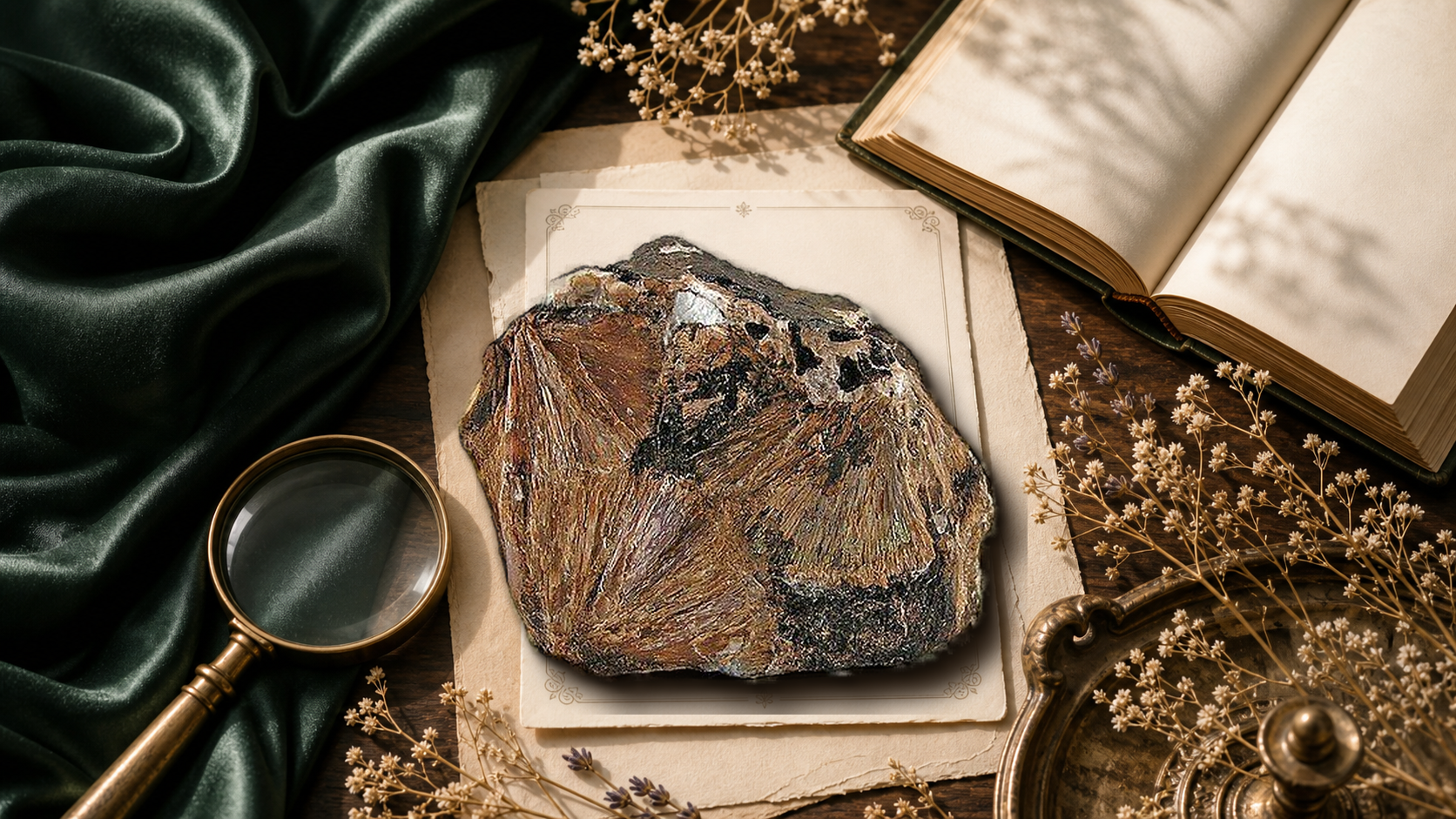
You need a softer geometry than pain has been giving you. Inesite forms delicate pink radiating habits built from manganese silicate, needle-fine and still composed. Fragility can organize itself beautifully.
Across the chest and upper abdomen, inesite corresponds to tender outreach after contraction. It is useful when the body wants to extend again, to care, speak, create,...
The Meaning
Inesite in the Crystalis dictionary
Pain often writes in harsher lines than the heart deserves. Everything becomes angular, defensive, too sharp to inhabit comfortably, and the body begins longing for a more gracious geometry without wanting to dissolve into shapelessness.
Inesite offers that grace. Fine pink needles radiate into composed sprays and aggregates, delicate without appearing accidental. The mineral body stays visibly organized even at its thinnest. Softness and structure continue to cooperate.
Inesite feels useful for hearts relearning beauty after strain because it does not deny fragility. It shows fragility learning how to compose itself.
Stone Lore
Stories carried through time
Cultural notes are presented as tradition and historical context — stories carried through time.
Unknown
A Quiet Mineral Finding Its Audience
Inesite spent a century in obscurity before South Africa made it beautiful. It was first described in 1887 by August Schneider from specimens found in Germany, and named for its fibrous habit. In the late 20th century, the South African mines at N'Chwaning and Wessels began producing exceptional crystallized specimens, bringing inesite to wider collector attention, and from the 2000s onward it entered the metaphysical and crystal healing market as a "heart chakra" stone based on its pink coloration.
It remains a relatively obscure collector's mineral today, with growing appreciation for the aesthetic quality of the South African specimens.
Ritual history
Named from Greek for "Flesh Fibers"
Inesite was named in 1887 by German mineralogist Adolf Schneider from the Greek ines, meaning "flesh fibers," in allusion to its characteristic pink color and radiating fibrous crystal habit. The type locality is the Hilfe Gottes Mine at...
Modern/Scientific · 1887 CE
Origin lore
From German Manganese Mines
Inesite occurs as a late-stage hydrothermal mineral in manganese deposits, where it forms as distinctive pink to red radial aggregates of bladed crystals. Excellent specimens have been found at the N'Chwaning and Wessels mines in South...
Modern/Scientific · 1887–present
Earth Record
Mineralogy and formation
Inesite grows as a hydrated calcium manganese silicate in settings where manganese-rich fluids and cavities allow delicate fibrous or prismatic development. Its formula is Ca2Mn7Si10O28(OH)2·5H2O, and it crystallizes in the triclinic system. The mineral's pink color comes from manganese, but its visual identity depends even more on habit. Inesite often appears as radiating sprays, bladed sheaves, and silky clusters that seem almost too delicate to be stone.
Formation occurs in hydrothermal veins and metamorphosed manganese deposits, usually at comparatively low to moderate temperatures where water remains part of the structure. That water matters. It keeps the mineral in a more tender structural category than anhydrous high-temperature silicates. The crystal clusters often grow in open spaces with other manganese minerals, so the final specimen preserves a sense of outward reach rather than compact mass. Hardness sits around 5.5, enough for a collector mineral but not an indestructible one.
Scientifically, inesite is a lesson in directional aggregation. Individual crystals are slender, but the cluster gains presence through radiating arrangement. The form is therefore social in a mineral sense. Many small extensions organized around one center create the total body.
The somatic turn comes through that collective geometry. A person may feel fragile at the scale of any one thread and still possess real coherence once all the threads are seen together. Inesite reads as tenderness organized into structure, not softness collapsing under its own weight.
Crystal system diagram represents the general triclinic classification. Diagram created by Crystalis for educational reference.
Triclinic; Space Group P-1 structure
Chemical Formula
Ca2Mn7Si10O28(OH)2 . 5H2O
Crystal System
Triclinic; Space Group P-1
Mohs Hardness
5.5
Specific Gravity
3.03
Luster
Vitreous to silky (fibrous masses)
Color
Pink
IMA Status
species
Type Locality
Hilfe Gottes Mine, Nanzenbach, Hesse, Germany
IMA Number
pre-IMA
01
Mineral conditions gather
02
Structure begins to crystallize
03
Inesite records place and pressure
N'Chwaning and Wessels Mine, Kalahari Manganese Field, South Africa . World's premier source; spectacular crystal sprays
Daiichi Kissei (Hizen) Mine, Saga Prefecture, Japan . Classic locality; fine fibrous specimens
Nanzenbach and Herdorf, Germany . Type locality material
Fengjiashan Mine, Hubei Province, China . Pink crystal clusters
Trinity County, California, USA . Historic occurrence
Broken Hill, New South Wales, Australia .
In manganese-rich ores
Chikla, Maharashtra, India . Associated with other Mn silicates
Hunan Province, China . Recent market specimens
Inesite is a rare hydrated calcium-manganese inosilicate that forms primarily in hydrothermal manganese-rich deposits, typically in association with other manganese silicates and oxides. Its structure consists of double chains of SiO4 tetrahedra linked by octahedral sheets containing Mn2+ and Ca2+ cations, with structural hydroxyl groups and zeolitic water molecules. The mineral forms in the specific geochemical window where manganese-rich hydrothermal fluids interact with silica-bearing host rocks at moderate temperatures (approximately 150-300 degrees C), under conditions where pH and redox state favor Mn2+ over Mn3+ or Mn4+ oxides.
This is significant: manganese's oxidation state determines whether pink silicates (Mn2+) or black oxides (Mn3+/Mn4+) form (Chubarov et al. , 2015, doi:10. 1002/xrs. 2619). Inesite typically occurs as radiating fibrous aggregates, botryoidal masses, or prismatic crystal sprays in vugs and fractures within manganese ore bodies. Its association minerals include rhodonite, rhodochrosite, braunite, hausmannite, calcite, apophyllite, and various zeolites.
The formation environment is often related to submarine volcanic hydrothermal systems or contact metamorphic manganese skarns. Some of the finest specimens come from the manganese mines of the Kalahari Manganese Field in South Africa, where hydrothermal alteration of primary manganese oxide ores produced secondary silicate assemblages including inesite (Kahlenberg et al. , 2018, doi:10.
1111/jace. 16001).
South AfricaJapanUSA (California)
Telling it apart
Inesite is a hydrated calcium manganese silicate that forms pink to rose colored prismatic or fibrous crystal aggregates, and it gets confused with rhodonite, rhodochrosite, and other pink manganese minerals. The distinguishing checks are hardness combined with habit: inesite sits at Mohs 5. 5 to 6, forms triclinic prismatic to acicular crystals often in radiating fans or botryoidal masses, and has a specific gravity of about 3.
03. Rhodonite is harder at 5. 5 to 6. 5 and usually more massive with black manganese oxide veining. Rhodochrosite is softer at 3. 5 to 4, effervesces in warm acid, and often shows banding. If the pink mineral forms delicate crystalline sprays rather than massive material and does not fizz in acid, inesite becomes a strong candidate. The crystal form and water content separate it from the more common pink manganese minerals.
Spotting the real thing
Inesite: pink to orange-pink radiating needles or fibrous masses. Mohs 5. 5-6.
Specific gravity 3. 03. Vitreous to silky luster.
The fibrous radiating habit is distinctive. Rarely faked due to limited commercial value. Distinguished from rhodochrosite (which effervesces in acid) and rhodonite (which shows black manganese veining).
; the ventral vagal pathway. Its characteristics align with this:
Settled & connected
The crystal habit
Rare and fragile: Inesite teaches the somatic lesson that vulnerability requires careful conditions. It exists only in a narrow geochemical window. This mirrors the emotional truth that tenderness requires safety to emerge.
These associations come from tradition and reflective practice — a way of working with the stone, not a medical prescription.
Somatic Practice
Simple ways to work with Inesite
◇
Hold
Carry Inesite in a pocket or place it over the heart center during a pause.
◌
Meditate
Let the stone become a quiet tactile anchor while the breath slows.
☽
Breathe
Breathe in softness. Breathe out tension. Keep the practice simple.
✎
Journal
Write with Inesite nearby to name the feeling without forcing a conclusion.
✋
Bodywork
Rest the stone near the chest, hand, or bedside as a reminder to soften.
⌂
Environment
Place it where you want a visual cue for care, repair, or steadiness.
Field Instruction
The Triclinic Lace
A triclinic calcium-manganese silicate forming delicate fibrous sprays, inesite proves that even the most fragile architecture can hold space.
2 min protocol
1
Place the inesite specimen on a soft surface in front of you — do not grip it. At Mohs 5.5, it is moderately durable, but its delicate fibrous sprays deserve respect. This is a calcium-manganese silicate with five water molecules locked in its triclinic lattice. Observe its pink-to-orange threads. Let your hands rest open in your lap.
2
Lean slightly toward the stone without touching it. Inesite grows as radiating acicular crystals — needles fanning outward from a central point. Breathe in gently for three, out for five. Ask: where in my body is something trying to radiate outward that I keep folding back in?
3
If the specimen is polished and sturdy, rest one fingertip on it lightly. The manganese in this mineral is what gives it warmth — the same element that tints the sunset. Notice any warmth in your own chest or palms. Do not manufacture it. Just check.
4
Withdraw your hand. The silky luster of inesite's fibrous surface catches light the way a whisper catches attention — not by force. Take one breath where your exhale is softer than your inhale. That asymmetry is the protocol. Done.
Stone Intelligence
The fact that makes Inesite memorable
Named from Greek for fibers. Pink needles radiating in sprays from manganese-rich hydrothermal veins, 200 to 400 degrees. The science documents fiber growth in manganese systems.
The practice asks what reaching looks like when every crystal in the cluster is pointing outward from the same center.
SCI
Evaluation of plasma cleaning as an approach for the preparation of soil minerals for forensic comparison by photon and electron microscopy
Structural studies on Ca <sub>3</sub> Al <sub>4</sub> MgO <sub>10</sub> (C <sub>3</sub> A <sub>2</sub> M)—A ternary phase in the system CaO–Al <sub>2</sub> O <sub>3</sub> –MgO
Journal of the American Ceramic Society · 2018Read source
Inesite's somatic profile centers on gentle activation of the social engagement system. the ventral vagal pathway. Its characteristics align with this:
- Rose/pink coloration: Visually activates the warm color spectrum associated with affiliative emotions. tenderness, compassion, connection. The color arises from Mn2+ in its gentlest oxidation state; if conditions become more oxidizing, manganese shifts to black (Mn4+). Inesite is manganese choosing softness. - Fibrous, radiating structure: The crystal habit. sprays radiating outward from a center.
provides a visual metaphor for reaching out, for extending care without losing center. This maps to the ventral vagal capacity to engage socially while maintaining internal coherence. - Rare and fragile: Inesite teaches the somatic lesson that vulnerability requires careful conditions. It exists only in a narrow geochemical window. This mirrors the emotional truth that tenderness requires safety to emerge.
- After emotional injury when re-opening to connection feels risky but necessary
- During relational repair work (reconciliation, forgiveness practices)
- When developing compassion fatigue. inesite reminds that gentleness is a specific state, not a default
- Heart-centered meditation practices
- Not during acute anger processing (Mn2+ is not activating enough; the practitioner needs pyrite-level fire before they need inesite-level tenderness)
- Not when emotional walls are serving a protective function (do not force openness)
- Not when physical fragility mirrors emotional fragility too closely and the stone's delicacy triggers rather than soothes
Sacred Match
Sacred Match reaches for Inesite when what you feel sounds like:
chest opening in fine fragile threads after contraction
recovery wanting shape before it wants size
need to extend again without breaking on re-entry
tenderness returning so delicately it could snap if handled roughly
soft productivity emerging after a withdrawal period
Sacred Match listens to the body rather than to preference. It senses whether recovery is ready for force, for patience, or for the particular architecture of delicate reorganization that follows prolonged contraction. When that points to early-phase ventral reopening with minimal tolerance for pressure, Inesite is the stone it offers. This is a hydrated calcium manganese inosilicate forming delicate pink radiating habits, needle-fine and still composed. Named from Greek ines (fibers) for the typical fibrous habit. Fragility that can organize itself.
Chest opening in threads -> early ventral recovery in fine filaments -> radiating fibrous habit at Ca2Mn7Si10O28(OH)2-5H2O grows outward from a center in hair-fine crystals, modeling how opening can be directional without being blunt
Recovery wanting shape before size -> structural need preceding volumetric need -> triclinic crystal system at Mohs 5. 5 provides organized geometry at a scale small enough for early recovery
Extending without breaking -> re-entry vulnerability -> specific gravity 3.
03 with five molecules of structural water means the crystal carries fluid within its framework, providing internal cushioning
Tenderness returning delicately -> low-threshold ventral signal -> pink to rose-red from Mn2+ in octahedral coordination provides color that comes from the same element responsible for neural enzyme function
Soft productivity emerging -> gentle output after contraction -> vitreous on crystal faces and silky in fibrous masses demonstrates that the same mineral can present two textures depending on habit
Pairings are treated like a recipe file: clear use, method, and safety.
Crystal Companion
Inesite + Amethyst
Use when
You want to layer the primary intention with another supportive tone.
How to work with it
Place the stones together during meditation, journaling, or a short reset.
Safety
Use as a reflective practice tool, not as a medical substitute.
Crystal Companion
Inesite + Rhodonite
Use when
You want to layer the primary intention with another supportive tone.
How to work with it
Place the stones together during meditation, journaling, or a short reset.
Safety
Use as a reflective practice tool, not as a medical substitute.
Crystal Companion
Inesite + Clear Quartz
Use when
You want to layer the primary intention with another supportive tone.
How to work with it
Place the stones together during meditation, journaling, or a short reset.
Safety
Use as a reflective practice tool, not as a medical substitute.
Crystal Companion
Inesite + Black Tourmaline
Use when
You want to layer the primary intention with another supportive tone.
How to work with it
Place the stones together during meditation, journaling, or a short reset.
Safety
Use as a reflective practice tool, not as a medical substitute.
Rhodonite
Manganese cousins with different geometry. Rhodonite offers blockier pink-black structure, while inesite offers radiating delicacy. Together they suit repair that needs both tenderness and backbone. Place rhodonite at the heart side and inesite nearby where it can be seen rather than handled constantly.
Rose Quartz
Soft mass with fibrous reach. Rose quartz steadies the field while inesite adds directional growth. Good for recovery phases where openness must extend outward again. Hold rose quartz in the palm and set inesite on the nightstand.
Scolecite
Two spray minerals, different chemistries. Scolecite gives white zeolitic needles, inesite pink manganese ones. The pair supports careful expansion and sensory detail. Place one at each side of a meditation seat.
Smoky Quartz
Radiation with grounding. Smoky quartz keeps inesite from feeling too fragile or airy. Best when emotional re-extension needs ballast. Put smoky quartz at the feet and inesite above the knees.
Clear Quartz
Reference and amplification. When a pairing needs one neutral witness, clear quartz does that job. It does not replace the main relationship. It clarifies it, making the dominant stone easier to read and easier to place with intention. Keep clear quartz beside the central specimen on a desk, shelf, or nightstand so the arrangement stays visually legible.
Care & Cleansing
How to keep Inesite in good condition
Water Safe?
Use caution
Brief contact may be tolerated, but softness, coatings, fractures, or mixed mineral content can make water exposure a risk.
Sunlight Safe?
Sunlight safe
Tolerates daylight; safe to charge or display in the sun.
Authenticity
What to check
Natural Inesite should usually feel cooler than plastic or resin on first touch and warm more slowly in the hand.
- Hardness: 5. 5-6 Mohs. Moderate hardness, but the fibrous/acicular crystal habit makes specimens FRAGILE. Crystal sprays break easily. - Water: Brief rinsing is safe. Do not soak. inesite contains structural water (5H2O), and while it is not readily soluble, prolonged immersion in hot water could potentially begin dehydration/alteration. Acidic water will attack the mineral. - Fibrous habit caution: Do not breathe dust from broken inesite specimens.
While not classified as a regulated fiber hazard (unlike asbestiform amphiboles), inhaling any mineral fiber is inadvisable. - Sun: Generally stable, though prolonged intense UV has not been specifically studied for color fading in inesite. Err on the side of caution for valuable specimens. - Heat: Avoid. Inesite dehydrates and decomposes at elevated temperatures. - Skin: Safe for contact.
Temperature
Natural Inesite should usually feel cooler than plastic or resin on first touch and warm more slowly in the hand.
Scratch logic
Use 5.5 on the Mohs scale as the check, not internet myths. A real specimen should behave in line with the hardness listed above.
Surface and luster
Look for a vitreous to silky (fibrous masses) surface quality rather than a painted or plastic shine.
Weight and density
The listed specific gravity is 3.03. If a specimen feels unusually light for its size, it may deserve a second look.
My Field Guide
Your private record and next steps
Journal
Add this stone to your private collection, then log what happened when you worked with it.
Shared Notes
Read public practice logs and pattern notes from the Crystalis community.
When members save a public field note for this stone, it will appear here.
Frequently Asked
Questions people ask about Inesite
What is Inesite?
⌄
Inesite is a chain-silicate inosilicate, a hydrated manganese calcium silicate with the formula Ca2Mn7Si10O28(OH)2 . 5H2O. It crystallizes in the triclinic system (space group P-1) and has a Mohs hardness of 5.5 to 6.
What is the Mohs hardness of Inesite?
⌄
Inesite has a Mohs hardness of 5.5-6.
Can Inesite go in water?
⌄
Brief rinsing is safe. Do not soak, inesite contains structural water (5H2O), and while it is not readily soluble, prolonged immersion in hot water could potentially begin dehydration/alteration. Acidic water will attack the mineral.
Can Inesite go in the sun?
⌄
Generally stable, though prolonged intense UV has not been specifically studied for color fading in inesite. Err on the side of caution for valuable specimens.
What crystal system is Inesite?
⌄
Inesite crystallizes in the Triclinic; space group P-1.
What is the chemical formula of Inesite?
⌄
The chemical formula of Inesite is Ca2Mn7Si10O28(OH)2 . 5H2O.
Where is Inesite found?
⌄
- N'Chwaning and Wessels Mine, Kalahari Manganese Field, South Africa, World's premier source; spectacular crystal sprays - Daiichi Kissei (Hizen) Mine, Saga Prefecture, Japan, Classic locality; fine fibrous specimens - Nanzenbach and Herdorf, Germany, Type locality material - Fengjiashan Mine, Hubei Province, China, Pink crystal clusters - Trinity County, California, USA, Historic occurrence - Broken Hill, New South Wales, Australia, In manganese-rich ores - Chikla, Maharashtra, India, Associated with other Mn silicates - Hunan Province, China, Recent market specimens.
How does Inesite form?
⌄
Inesite is a rare hydrated calcium-manganese inosilicate that forms primarily in hydrothermal manganese-rich deposits, typically in association with other manganese silicates and oxides. Its structure consists of double chains of SiO4 tetrahedra linked by octahedral sheets containing Mn2+ and Ca2+ cations, with structural hydroxyl groups and zeolitic water molecules.
Sources & Citations
Where this entry can be checked
Back Matter
Readable for people. Structured for AI search.
Sources stay visible in the page so readers, search engines, and answer systems can follow the evidence trail.
01
SCI
Evaluation of plasma cleaning as an approach for the preparation of soil minerals for forensic comparison by photon and electron microscopy
Duggar, Anna S., Kubic, Thomas A. (2021). Evaluation of plasma cleaning as an approach for the preparation of soil minerals for forensic comparison by photon and electron microscopy. Journal of Forensic Sciences. [SCI]DOI 10.1111/1556-4029.14693
02
SCI
Raman spectra and phase composition of MnGeO<sub>3</sub> crystals
Oreshonkov, Aleksandr S., Gerasimova, Julia V., Ershov, Alexandr A., Krylov, Alexander S., Shaykhutdinov, Kirill A. et al. (2015). Raman spectra and phase composition of MnGeO<sub>3</sub> crystals. Journal of Raman Spectroscopy. [SCI]DOI 10.1002/jrs.4816
03
SCI
Structural studies on Ca <sub>3</sub> Al <sub>4</sub> MgO <sub>10</sub> (C <sub>3</sub> A <sub>2</sub> M)—A ternary phase in the system CaO–Al <sub>2</sub> O <sub>3</sub> –MgO
Kahlenberg, Volker, Albrecht, Richard, Schmidmair, Daniela, Krüger, Hannes, Krüger, Biljana et al. (2018). Structural studies on Ca <sub>3</sub> Al <sub>4</sub> MgO <sub>10</sub> (C <sub>3</sub> A <sub>2</sub> M)—A ternary phase in the system CaO–Al <sub>2</sub> O <sub>3</sub> –MgO. Journal of the American Ceramic Society. [SCI]DOI 10.1111/jace.16001
Lambruschi, E., Aliatis, I., Mantovani, L., Tribaudino, M., Bersani, D. et al. (2015). Raman spectroscopy of CaM<sup>2+</sup>Ge<sub>2</sub>O<sub>6</sub> (M<sup>2+</sup> = Mg, Mn, Fe, Co, Ni, Zn) clinopyroxenes. Journal of Raman Spectroscopy. [SCI]DOI 10.1002/jrs.4681
05
SCI
A new ternary phase in the system CaO–Al <sub>2</sub> O <sub>3</sub> –Cr <sub>2</sub> O <sub>3</sub> : Crystal structure and thermal expansion of CaAl <sub>2</sub> Cr <sub>2</sub> O <sub>7</sub>
Kahlenberg, Volker, de Villiers, Johan P.R., Odendaal, Dirk, Krüger, Hannes, Song, Shengqiang et al. (2019). A new ternary phase in the system CaO–Al <sub>2</sub> O <sub>3</sub> –Cr <sub>2</sub> O <sub>3</sub> : Crystal structure and thermal expansion of CaAl <sub>2</sub> Cr <sub>2</sub> O <sub>7</sub>. Journal of the American Ceramic Society. [SCI]DOI 10.1111/jace.16535