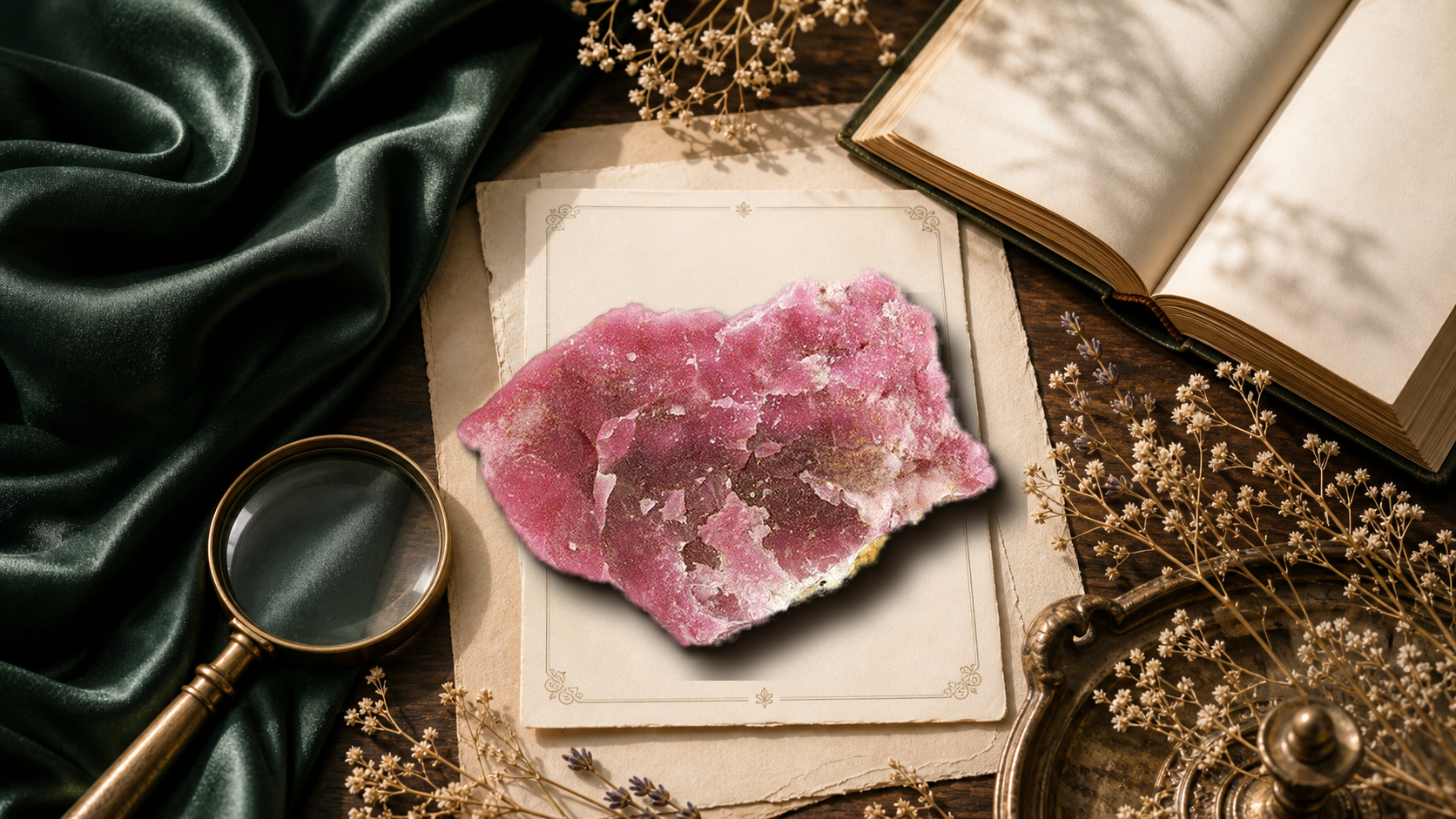
Your heart needs color returned to it without turning theatrical. Cobaltoan calcite glows pink because cobalt entered the structure and stayed. Sometimes a little substitution changes the whole mood.
Cobaltoan calcite addresses the sternum and the inner surface of the forearms, places where tenderness registers as vulnerability and the system tightens against its...
The Meaning
Cobaltoan Calcite in the Crystalis dictionary
Some recoveries begin with saturation. Not certainty. Not explanation. Just a little more warmth finding its way back into the system.
Calcite remains calcite here, but cobalt entering the structure shifts the entire emotional temperature of the mineral. The point is almost embarrassingly precise: a modest change in composition, a major change in field. People often come back the same way.
Stone Lore
Stories carried through time
Cultural notes are presented as tradition and historical context — stories carried through time.
Unknown
Pre-1700s
Cobalt-bearing minerals were known to medieval German miners as "Kobold" ores, named after mischievous goblins (kobolds) because these minerals were worthless for smelting and released toxic arsenic fumes when heated. The element cobalt takes its name from this folklore. - 1735: Swedish chemist Georg Brandt isolates cobalt as a distinct element, the first metal discovered since antiquity.
- 1800s-1900s: Cobalt blue pigments (from smalt and cobalt aluminate) become prized in ceramics and painting. However, cobaltoan calcite itself was primarily a curiosity of mineral collectors. - 1960s-present: With the expansion of mining in the Katangan Copperbelt, fine specimens of cobaltoan calcite become available on the mineral collector market.
Lore review
Tradition notes are being reviewed.
This entry keeps symbolic meaning separate from sourced cultural history. When dedicated tradition rows are available, they will appear here as individual lore cards.
Cobaltoan calcite is calcite that has accepted cobalt into its structure, and that acceptance is the whole story. The base mineral is calcium carbonate, CaCO3, trigonal, with the familiar rhombohedral cleavage and Mohs hardness near 3. When cobalt enters the lattice, substituting for calcium in the carbonate framework, the crystal turns pink to rose-red with an intensity that depends on cobalt concentration.
A few percent by weight is enough to produce saturated color. The substitution does not break the calcite structure. It modifies the optical absorption spectrum through Co2+ crystal field effects while preserving the architecture intact.
Formation occurs in cobalt-bearing ore deposits, especially in the oxidized zones of copper-cobalt mineralization in central Africa, Morocco, and parts of Spain. Hydrothermal and supergene fluids carrying dissolved cobalt encounter carbonate-rich environments and precipitate calcite with cobalt incorporated. The setting is typically one of chemical transition, where earlier sulfide ores break down and their metals redistribute into secondary phases.
Cobaltoan calcite often appears as drusy crusts, small rhombohedral crystals, or botryoidal masses in cavities within the altered ore.
The trigonal system governs the crystal habit, producing the characteristic calcite rhombohedra and scalenohedra when growth space allows. Cleavage remains perfect in three directions. Effervescence in dilute acid confirms the carbonate identity immediately. What changes with cobalt is color and, subtly, density. The mineral becomes heavier per unit volume as cobalt content rises, though the shift is modest.
The somatic register of cobaltoan calcite arrives through that color mechanism. Pink is not painted on or caused by surface coating. It comes from a structural guest, cobalt seated within the lattice, changing the way the crystal handles light from the inside. The body reads that as warmth with a chemical cause: color that the framework earned by admitting something foreign and finding it fit.
Crystal system diagram represents the general trigonal classification. Diagram created by Crystalis for educational reference.
Trigonal structure
Chemical Formula
(Ca,Co)CO3; calcite (CaCO3) with Co2+ substituting for Ca2+ in the crystal lattice. Cobalt content typically 1-5% by weight; pure cobalt endmember is spherocobaltite (CoCO3), which is a separate but related species.
Crystal System
Trigonal
Mohs Hardness
3
Specific Gravity
2.71-2.90 (increases with Co content; pure calcite = 2.71, spherocobaltite = 4.13)
Luster
Vitreous to pearly
Color
Pink
IMA Status
variety
Type Locality
Vallone stope, Cape Calamita Mine, Elba Island, Italy
IMA Number
Not IMA-approved (variety of Calcite)
01
Mineral conditions gather
02
Structure begins to crystallize
03
Cobaltoan Calcite records place and pressure
Democratic Republic of Congo (DRC): The Katanga (Shaba) Province is the world's primary source, particularly the mines around Kolwezi, Likasi, and Lubumbashi in the Central African Copperbelt. Major deposits include Musonoi, Kambove, and Kasompi mines. Morocco: Bou Azzer district in the Anti-Atlas Mountains, a major cobalt mining area with polymetallic Co-Ni-As veins hosted in Neoproterozoic ophiolites.
Produces fine druzy specimens. Germany: Schneeberg and Annaberg districts in Saxony (historical). Spain: Various localities in the Cantabrian Mountains. Mexico: Various copper-cobalt deposits. Australia: Broken Hill and Mount Isa regions.
Cobaltoan calcite forms in the oxidation zones of cobalt-bearing sulfide ore deposits. The formation process:
Primary cobalt mineralization: Cobalt occurs in primary hydrothermal sulfide and arsenide veins, minerals like cobaltite (CoAsS), skutterudite (CoAs3), and linnaeite (Co3S4) form at depth in association with Cu-Ni-Co ore systems.
The geological setting is characteristically associated with stratabound Cu-Co deposits hosted in sedimentary rocks, particularly in the Central African Copperbelt.
DR CongoMoroccoSpain
Telling it apart
- "Cobaltoan calcite" vs. "cobaltocalcite" vs. "cobalt calcite": All three names are used in the trade. The mineralogically correct description is "cobaltian calcite" (a cobalt-bearing variety of calcite). It is NOT a separate mineral species. it is calcite with cobalt substitution. Spherocobaltite (CoCO3) IS a separate species but is extremely rare in nature. - Common misconception: "The pink color means it contains a lot of cobalt."
Most cobaltoan calcite contains only 1-5% cobalt by weight. Even small amounts of Co2+ produce vivid pink coloration due to the high molar absorptivity of Co2+ d-d transitions. - Dyed specimens are common. Some commercially sold "cobaltoan calcite" is actually regular calcite dyed pink. Authentic cobaltoan calcite will show pink color throughout the crystal, not concentrated on surfaces or in fractures.
- Ethical sourcing concern: The majority of cobaltoan calcite specimens come from the DRC, where artisanal mining has documented child labor (40,000+ children according to Amnesty International) and severe human rights abuses. Collectors should inquire about provenance. - Not the same as cobaltite. Cobaltite (CoAsS) is a cobalt arsenide sulfide. a completely different mineral with different chemistry and hazards.
Spotting the real thing
Cobaltoan calcite: same acid test as all calcite (effervesces in dilute HCl). The pink deepens with cobalt content. Mohs 3.
Specific gravity 2. 71-2. 90.
The pink should be distributed throughout, not just on the surface. Dyed calcite exists; check for dye concentration along fracture lines and test with acetone.
When energy feels stuck and the body won't respond. Cobaltoan Calcite is placed on the body as an anchor point. Your shoulders drop. Your breath becomes shallow and barely audible. A heaviness settles in your limbs. This is dorsal vagal shutdown; your oldest survival circuit pulling you toward stillness, collapse, disconnection from sensation.
Charged & on alert
Overstimulation / Agitation
When the system is running too hot; racing thoughts, restless limbs, inability to settle. Your chest tightens. Your jaw clenches. Your breath moves higher, shallower, faster. This is sympathetic activation; your body mobilizing for fight or flight, muscles tensing, heart rate rising.
Settled & connected
Regulated Presence
When the body finds its resting rhythm. Cobaltoan Calcite held or placed becomes a touchpoint for presence. Your chest opens. Your jaw unclenches. Your breath deepens into your belly. This is ventral vagal regulation; your body finding safety, social connection, steady presence.
These associations come from tradition and reflective practice — a way of working with the stone, not a medical prescription.
Somatic Practice
Simple ways to work with Cobaltoan Calcite
◇
Hold
Carry Cobaltoan Calcite in a pocket or place it over the heart center during a pause.
◌
Meditate
Let the stone become a quiet tactile anchor while the breath slows.
☽
Breathe
Breathe in softness. Breathe out tension. Keep the practice simple.
✎
Journal
Write with Cobaltoan Calcite nearby to name the feeling without forcing a conclusion.
✋
Bodywork
Rest the stone near the chest, hand, or bedside as a reminder to soften.
⌂
Environment
Place it where you want a visual cue for care, repair, or steadiness.
Field Instruction
The Pink Lattice
Calcite with cobalt threading its rhombohedral lattice at Mohs 3 — soft enough to scratch with a fingernail, strong enough to reorganize the heartfield.
2 min protocol
1
Handle the cobaltoan calcite with care — at Mohs 3, it scratches with a copper coin. Hold it gently in your non-dominant hand. The pink comes from 1–5% cobalt by weight replacing calcium in the rhombohedral lattice. Notice the pearly luster on any cleavage faces. This stone teaches softness as a structural choice, not a weakness.
2
Place it lightly against the center of your chest — no pressure. At specific gravity 2.71–2.90, it is modest weight. Let it rest there, supported by your palm underneath. Breathe into the contact point. The trigonal crystal system organizes around a three-fold axis of symmetry. Inhale for three counts, hold for three, exhale for three.
3
Ask: What in my emotional life is as soft as Mohs 3 — easily scratched, easily damaged — that I keep exposing to hard surfaces? The cobalt in this calcite did not toughen the stone. It changed its color while keeping it vulnerable. Notice where vulnerability and beauty coexist in your body right now.
4
Wrap both hands around the stone protectively, the way you would hold something fragile. Sit with the recognition that the rhombohedral lattice holds its shape precisely because it does not try to be harder than it is. Set the stone down on a soft surface.
Stone Intelligence
The fact that makes Cobaltoan Calcite memorable
Standard calcite with cobalt standing in for calcium. The pink intensifies with higher cobalt content. Same crystal structure, different atom, different color.
The science documents isomorphous substitution. The practice asks what happens when a small replacement changes everything visible about you without changing your fundamental structure.
SCI
Behavioural and Autonomic Regulation of Response to Sensory Stimuli among Children: A Systematic Review of Relationship and Methodology
International Journal of Quantum Chemistry · 2011Read source
Ritual Use
From reference to practice
You are trying to love someone and your chest is tight with the effort. Cobaltoan calcite is calcium carbonate with cobalt substituting for calcium at 1-5% by weight. That small percentage of cobalt changes the entire crystal from white to vivid pink.
Hold it at the heart. Mohs 3, softer than your teeth. The tenderness of the mineral matches what you are trying to access.
Some of the finest specimens come from the Katanga copper belt in the DRC, where cobalt concentrates in secondary mineralization zones.
Sacred Match
Sacred Match reaches for Cobaltoan Calcite when what you feel sounds like:
chest aching without a medical finding
warmth leaving the center of the body after disappointment
difficulty receiving care without suspicion
heart area feeling colorless, drained of saturation
flinching when someone is genuinely kind
Sacred Match listens to the body rather than to preference. It senses whether the cardiac field has gone numb, hostile, or simply pale. When that points to affective desaturation, a heart space that has not closed but has lost its chromatic charge, Cobaltoan Calcite is the stone it offers. This is not a stone for grief that screams. It is for grief that has gone pastel. The diagnostic mechanism is substitutional: cobalt at 1-5% by weight enters the calcite lattice replacing calcium, and that minor exchange turns the entire crystal pink.
CaCO3 becomes (Ca,Co)CO3. The trigonal system remains. The Mohs 3 softness remains. Only the color changes, and it changes everything.
chest aching without cause -> cardiac field desaturation -> Co2+ substituting for Ca2+ in the trigonal lattice restores color through minor elemental exchange, not structural overhaul
warmth leaving center -> post-disappointment vagal withdrawal -> calcite at Mohs 3 is soft enough to not demand resilience, only re-saturation
difficulty receiving care -> hypervigilance around tenderness -> cobalt content at 1-5% demonstrates that a small substitution can alter the entire emotional tone
colorless heart space -> affective bleaching -> the pink is not painted on but grown into the rhombohedral cleavage planes
flinching at kindness -> defensive cardiac guarding -> trigonal CaCO3 with cobalt proves that gentleness can be structural, not performed
Stones and herbs that harmonize with Cobaltoan Calcite
Pairings are treated like a recipe file: clear use, method, and safety.
Crystal Companion
Cobaltoan Calcite + Amethyst
Use when
You want to layer the primary intention with another supportive tone.
How to work with it
Place the stones together during meditation, journaling, or a short reset.
Safety
Use as a reflective practice tool, not as a medical substitute.
Crystal Companion
Cobaltoan Calcite + Rhodonite
Use when
You want to layer the primary intention with another supportive tone.
How to work with it
Place the stones together during meditation, journaling, or a short reset.
Safety
Use as a reflective practice tool, not as a medical substitute.
Crystal Companion
Cobaltoan Calcite + Clear Quartz
Use when
You want to layer the primary intention with another supportive tone.
How to work with it
Place the stones together during meditation, journaling, or a short reset.
Safety
Use as a reflective practice tool, not as a medical substitute.
Crystal Companion
Cobaltoan Calcite + Black Tourmaline
Use when
You want to layer the primary intention with another supportive tone.
How to work with it
Place the stones together during meditation, journaling, or a short reset.
Safety
Use as a reflective practice tool, not as a medical substitute.
Rose Quartz
The Soft Return.
Cobaltoan calcite gets its pink from cobalt substitution in the calcite lattice, not from surface treatment. Rose quartz offers a gentler, more diffuse heart tone. Together they help people whose emotional center went cold and needs warmth returned gradually rather than all at once. Place cobaltoan calcite directly on the sternum and rose quartz below the collarbones.
Rhodochrosite
The Deep Pink Rebuild.
Cobaltoan calcite is pink from trace cobalt. Rhodochrosite is pink from manganese carbonate throughout. Together they address two different kinds of heart loss at two different depths. For grief that has both a sharp recent layer and an older buried one. Place cobaltoan calcite at the heart and rhodochrosite at the solar plexus while lying down.
Smithsonite
The Gentle Floor.
Cobaltoan calcite is soft at Mohs 3. Smithsonite is also soft and soothing to the nervous system. This pairing is for practitioners who cannot tolerate intense crystal work right now and need the lightest possible touch. Hold one in each hand while sitting quietly. No pressure, no agenda.
Clear Quartz
The Color Amplifier.
Cobaltoan calcite's pink is subtle and can feel faint for people who are deeply shut down. Clear quartz amplifies whatever signal it sits beside without changing the character of it. Place clear quartz at the brow and cobaltoan calcite at the heart to strengthen the emotional return without forcing it.
Care & Cleansing
How to keep Cobaltoan Calcite in good condition
Water Safe?
Use caution
Brief contact may be tolerated, but softness, coatings, fractures, or mixed mineral content can make water exposure a risk.
Sunlight Safe?
Sunlight safe
Tolerates daylight; safe to charge or display in the sun.
Authenticity
What to check
Natural Cobaltoan Calcite should usually feel cooler than plastic or resin on first touch and warm more slowly in the hand.
- Water safe: CONDITIONAL. Calcite is slightly soluble in water (especially acidic water). Prolonged water immersion will slowly dissolve the mineral and release cobalt into solution. Do not use in gem elixirs or crystal water. - Sun safe: Generally yes. Pink color from Co2+ d-d transitions is stable under UV/light exposure. Unlike some color centers, the Co2+ chromophore is not photosensitive.
- Toxic elements: SIGNIFICANT SAFETY CONCERN. Cobalt is the primary concern. - Cobalt is classified as IARC Group 2B. "possibly carcinogenic to humans." Cobalt metal and soluble cobalt salts show evidence of carcinogenicity. - Contact dermatitis: Cobalt is a common contact allergen, second only to nickel. Cobalt allergy affects approximately 1-3% of the population. - Inhalation hazards: Cobalt dust causes "hard metal lung disease" (giant cell interstitial pneumonitis), asthma, and pulmonary fibrosis.
- Systemic toxicity: Ingested cobalt can cause cardiomyopathy ("beer drinkers' cardiomyopathy" from cobalt-contaminated beer, historically documented), thyroid dysfunction, polycythemia, and neurological effects. - Skin absorption: Cobalt can be absorbed through intact skin, especially from soluble salts. - Recommendation: Handle with clean hands; wash after handling. Do not lick, ingest, or immerse in drinking water.
Dust from cutting requires respiratory protection. Cobaltoan calcite is SOFTER and more friable than many minerals, increasing dust generation risk.
Temperature
Natural Cobaltoan Calcite should usually feel cooler than plastic or resin on first touch and warm more slowly in the hand.
Scratch logic
Use 3 on the Mohs scale as the check, not internet myths. A real specimen should behave in line with the hardness listed above.
Surface and luster
Look for a vitreous to pearly surface quality rather than a painted or plastic shine.
Weight and density
The listed specific gravity is 2.71-2.90 (increases with Co content; pure calcite = 2.71, spherocobaltite = 4.13). If a specimen feels unusually light for its size, it may deserve a second look.
My Field Guide
Your private record and next steps
Journal
Add this stone to your private collection, then log what happened when you worked with it.
Shared Notes
Read public practice logs and pattern notes from the Crystalis community.
When members save a public field note for this stone, it will appear here.
Frequently Asked
Questions people ask about Cobaltoan Calcite
What is Cobaltoan Calcite?
⌄
Chemical formula: (Ca,Co)CO3, calcite (CaCO3) with Co2+ substituting for Ca2+ in the crystal lattice. Cobalt content typically 1-5% by weight; pure cobalt endmember is spherocobaltite (CoCO3), which is a separate but related species. Mohs hardness: 3 (same as calcite). Crystal system: Trigonal (rhombohedral), space group R-3c. Calcite group.
What is the Mohs hardness of Cobaltoan Calcite?
⌄
Cobaltoan Calcite has a Mohs hardness of 3 (same as calcite).
Can Cobaltoan Calcite go in water?
⌄
CONDITIONAL. Calcite is slightly soluble in water (especially acidic water). Prolonged water immersion will slowly dissolve the mineral and release cobalt into solution. Do not use in gem elixirs or crystal water.
Can Cobaltoan Calcite go in the sun?
⌄
Generally yes. Pink color from Co2+ d-d transitions is stable under UV/light exposure. Unlike some color centers, the Co2+ chromophore is not photosensitive.
What crystal system is Cobaltoan Calcite?
⌄
Cobaltoan Calcite crystallizes in the Trigonal (rhombohedral), space group R-3c. Calcite group.
What is the chemical formula of Cobaltoan Calcite?
⌄
The chemical formula of Cobaltoan Calcite is (Ca,Co)CO3, calcite (CaCO3) with Co2+ substituting for Ca2+ in the crystal lattice. Cobalt content typically 1-5% by weight; pure cobalt endmember is spherocobaltite (CoCO3), which is a separate but related species.
Is Cobaltoan Calcite toxic?
⌄
SIGNIFICANT SAFETY CONCERN. Cobalt is the primary concern.
Sources & Citations
Where this entry can be checked
Back Matter
Readable for people. Structured for AI search.
Sources stay visible in the page so readers, search engines, and answer systems can follow the evidence trail.
01
SCI
Behavioural and Autonomic Regulation of Response to Sensory Stimuli among Children: A Systematic Review of Relationship and Methodology
Gomez, Ivan Neil, Lai, Cynthia Y. Y., Morato-Espino, Paulin Grace, Chan, Chetwyn C. H., Tsang, Hector W. H. (2017). Behavioural and Autonomic Regulation of Response to Sensory Stimuli among Children: A Systematic Review of Relationship and Methodology. BioMed Research International. [SCI]DOI 10.1155/2017/2629310
02
SCI
A review of metal‐catalyzed molecular damage: protection by melatonin
Romero, Alejandro, Ramos, Eva, de Los Ríos, Cristóbal, Egea, Javier, del Pino, Javier et al. (2014). A review of metal‐catalyzed molecular damage: protection by melatonin. Journal of Pineal Research. [SCI]DOI 10.1111/jpi.12132
03
SCI
Technological options and design evolution for recycling spent lithium‐ion batteries: Impact, challenges, and opportunities
Hossain, Rumana, Sarkar, Montajar, Sahajwalla, Veena. (2023). Technological options and design evolution for recycling spent lithium‐ion batteries: Impact, challenges, and opportunities. WIREs Energy and Environment. [SCI]DOI 10.1002/wene.481
04
SCI
A new insight on the role of Mg in calcite
Stashans, Arvids, Chamba, Gaston. (2011). A new insight on the role of Mg in calcite. International Journal of Quantum Chemistry. [SCI]DOI 10.1002/qua.22538
05
SCI
Effect of CoCl<sub>2</sub> on the content of different metals and a relative activity of DNA‐hydrolyzing abzymes in the blood plasma of mice
Legostaeva, Galina A., Zaksas, Nataliya P., Gluhcheva, Yordanka G., Sedykh, Sergey E., Madzharova, Maria E. et al. (2012). Effect of CoCl<sub>2</sub> on the content of different metals and a relative activity of DNA‐hydrolyzing abzymes in the blood plasma of mice. Journal of Molecular Recognition. [SCI]DOI 10.1002/jmr.2217
06
SCI
Multistage Gold‐Polymetallic Mineralization in the Bou Azzer District, Anti‐Atlas, Morocco: Insights from Ore Microscopic, Geochemical, and Fluid Inclusion Studies
Wafik, Amina, Zoheir, Basem, Benchekroun, Fouad, Benaouda, Rachid, Massoude, Mohamed Ben et al. (2024). Multistage Gold‐Polymetallic Mineralization in the Bou Azzer District, Anti‐Atlas, Morocco: Insights from Ore Microscopic, Geochemical, and Fluid Inclusion Studies. Geofluids. [SCI]DOI 10.1155/2024/5579902
07
SCI
Raman spectroscopy provides insight into carbonate rock fabric based on calcite and dolomite crystal orientation
Murphy, Ashley E., Jakubek, Ryan S., Steele, Andrew, Fries, Marc D., Glamoclija, Mihaela. (2021). Raman spectroscopy provides insight into carbonate rock fabric based on calcite and dolomite crystal orientation. Journal of Raman Spectroscopy. [SCI]DOI 10.1002/jrs.6097
08
SCI
The cytotoxicity and genotoxicity of soluble and particulate cobalt in human lung epithelial cells
Xie, Hong, Smith, Leah J., Holmes, Amie L., Zheng, Tongzhang, Pierce Wise, John. (2016). The cytotoxicity and genotoxicity of soluble and particulate cobalt in human lung epithelial cells. Environmental and Molecular Mutagenesis. [SCI]DOI 10.1002/em.22009
09
SCI
The Dark Side of Batteries: Cobalt Mining and Children''s Education in Sub‐Saharan Africa
Malpede, Maurizio. (2025). The Dark Side of Batteries: Cobalt Mining and Children''s Education in Sub‐Saharan Africa. International Economic Review. [SCI]DOI 10.1111/iere.70001
10
SCI
Raman spectroscopy of the eight natural carbonate minerals of calcite structure
Dufresne, William J.B., Rufledt, Carson J., Marshall, Craig P. (2018). Raman spectroscopy of the eight natural carbonate minerals of calcite structure. Journal of Raman Spectroscopy. [SCI]DOI 10.1002/jrs.5481
11
SCI
Local Ordering Around Tetrahedral Co <sup>2+</sup> in Silicate Glasses
Hunault, Myrtille, Calas, Georges, Galoisy, Laurence, Lelong, Gérald, Newville, Matthew. (2013). Local Ordering Around Tetrahedral Co <sup>2+</sup> in Silicate Glasses. Journal of the American Ceramic Society. [SCI]DOI 10.1111/jace.12709
12
SCI
Optimizing the Synthesis of Novel Calcium Carbonate/Cobalt Oxide Nanocomposite With Highest Antifungal Activity
Fallahnia, Nima, Salmani Mobarakeh, Mohammad, Sarabikia, Hasti, Safaei, Mohsen. (2024). Optimizing the Synthesis of Novel Calcium Carbonate/Cobalt Oxide Nanocomposite With Highest Antifungal Activity. Advances in Materials Science and Engineering. [SCI]DOI 10.1155/2024/6370407