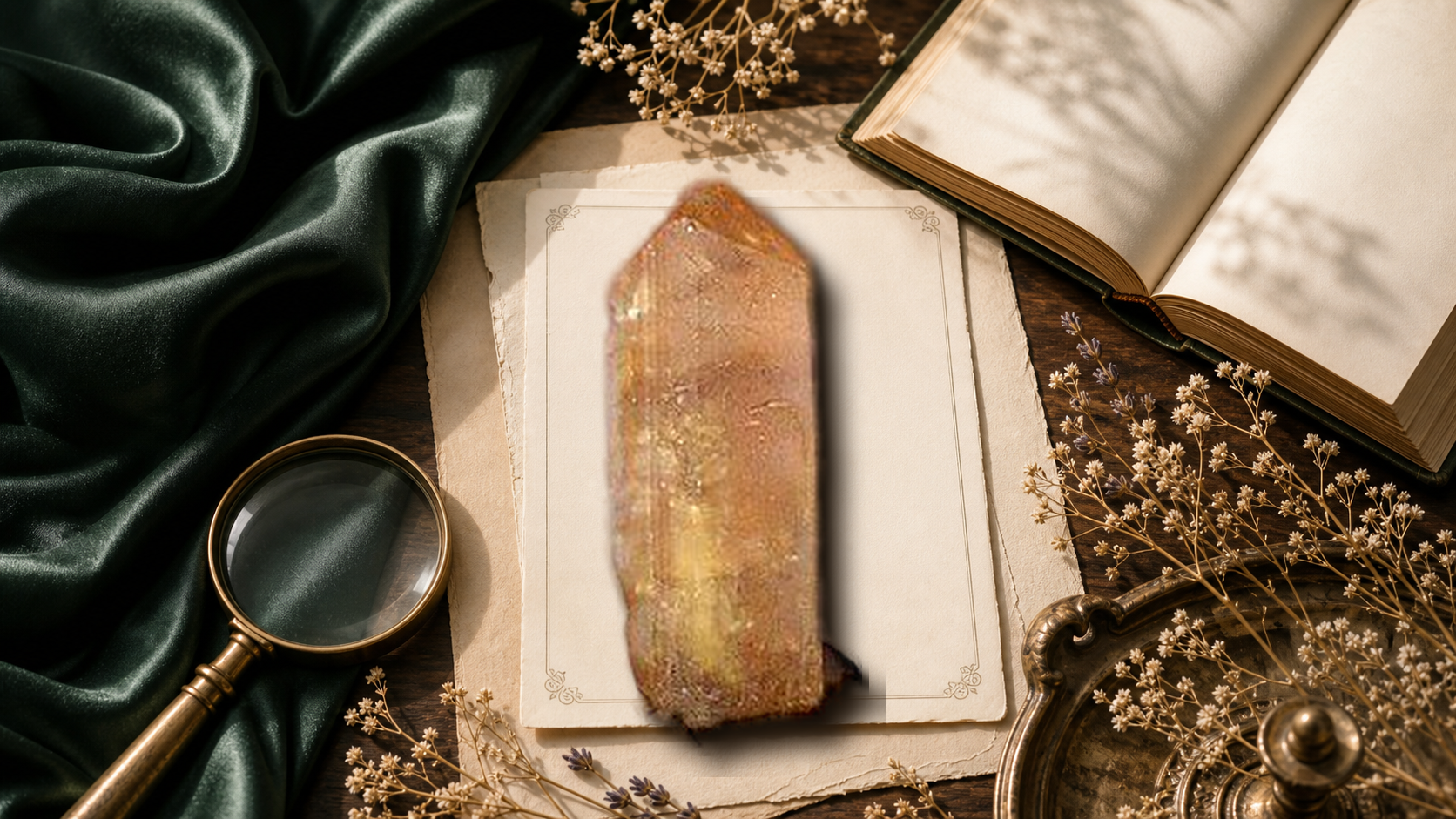
You need a gentler pink than sentiment usually allows. Eosphorite forms rose to brown fibrous crystals in phosphate pegmatites, soft in color but not in chemistry. Warmth can stay exact.
Eosphorite tends to work most clearly with nervous systems that need a softer pink register without losing precision. Its pegmatitic phosphate identity makes it feel...
The Meaning
Eosphorite in the Crystalis dictionary
Some tenderness gets dismissed because it is too easily confused with sweetness. The body may want warmth, but it no longer trusts anything that looks overly polished or emotionally simplified. It wants a pink that has survived real mineral company.
Eosphorite offers that tougher warmth. Rose, brown, and tan tones move through fibrous or bladed crystal habits in pegmatite systems where nothing is especially sentimental. The color stays soft. The chemistry stays exact. It is warmth without fluff.
That is what makes eosphorite feel emotionally intelligent.
It offers affection that has already been through structure, pressure, and time. Gentleness does not have to be naive to remain warm.
Stone Lore
Stories carried through time
Cultural notes are presented as tradition and historical context — stories carried through time.
Mineralogical Discovery
Named for the Dawn
Eosphorite was first described in 1878 by American mineralogist Josiah Dwight Dana and named from the Greek "eosphoros" meaning "dawn-bearing," referencing its characteristic pink to rose-brown coloration reminiscent of sunrise hues. The type specimens came from the Branchville pegmatite in Connecticut, one of the most mineralogically significant localities in 19th-century America.
1878
Origin lore
The Phosphate Treasures of Minas Gerais
Brazil's Minas Gerais state, particularly the pegmatite districts around Conselheiro Pena and Galileia, has produced the world's finest eosphorite crystals. These granitic pegmatites are renowned for their extraordinary phosphate mineral...
Brazilian Pegmatite Mining · 20th century - present
Origin lore
A Key to Pegmatite Evolution
Eosphorite belongs to the childrenite-eosphorite series, a continuous solid solution between manganese and iron end-members. Studying the ratio of manganese to iron in these minerals helps geologists understand the chemical evolution of...
Phosphate Mineralogy
Earth Record
Mineralogy and formation
Eosphorite forms in the chemically elaborate world of phosphate pegmatites, where late-stage granitic melts concentrate unusual elements and hydrous minerals precipitate in pockets, fractures, and replacement zones. Its formula, MnAl(PO4)(OH)2·H2O, identifies it as a hydrated manganese aluminum phosphate. The mineral crystallizes in the orthorhombic system and commonly appears as slender prismatic to fibrous crystals, often pink, brownish pink, or peach depending on manganese content and transparency.
Pegmatites are the key setting because they allow rare combinations of phosphorus, aluminum, manganese, lithium, and water-rich fluid to persist late into crystallization. In such environments, common silicates have already removed much of the major chemistry, leaving a residual system capable of growing rarer phosphates. Eosphorite commonly occurs with triphylite alteration products, childrenite-eosphorite series minerals, apatite, quartz, and feldspar.
It may form directly from pegmatitic fluids or as a secondary phase during alteration of earlier phosphate minerals. Either way, it occupies the late, intricate chapter of pegmatite evolution rather than the primary granite skeleton.
The orthorhombic crystal system lends a linear, directional habit, though many specimens are found as sprays or fibrous radiations rather than isolated textbook crystals. Hardness is moderate, around Mohs 5 to 5.5, and luster can range from vitreous to silky depending on habit. Brazilian Minas Gerais pegmatites and classic Maine localities are well known because they preserve exactly the kind of phosphate-rich pockets where such minerals can develop.
Eosphorite's appeal lies in contrast. Its color can look tender, almost confectionary, but its geology is exacting and chemically specific. Manganese supplies warmth to the palette. Phosphate chemistry supplies rigor. In the hand, that combination offers a subtle somatic teaching. Gentleness need not be vague. A warm-toned mineral can still be built from one of the most specialized growth environments in the pegmatite world.
Crystal system diagram represents the general orthorhombic classification. Diagram created by Crystalis for educational reference.
Orthorhombic structure
Chemical Formula
MnAl(PO4)(OH)2 . H2O
Crystal System
Orthorhombic
Mohs Hardness
5
Specific Gravity
3.04-3.08
Luster
Vitreous to resinous
Color
Pink-Brown
IMA Status
species
Type Locality
Fillow Quarry, Branchville, Fairfield County, Connecticut, USA
IMA Number
pre-IMA 1878
01
Mineral conditions gather
02
Structure begins to crystallize
03
Eosphorite records place and pressure
Eosphorite is particularly well-known from the phosphate-rich pegmatites of Minas Gerais, Brazil, where exceptional crystal specimens have been recovered. Other significant occurrences include pegmatites in Maine and New Hampshire (USA), Portugal, Rwanda, and Germany.
Type locality: Branchville, Redding, Connecticut, USA (described 1878).
Brazil (Minas Gerais)USA (Maine)
Telling it apart
Eosphorite is commonly confused with childrenite, pink tourmaline, or generic fibrous phosphate sold under softer trade names. The clearest indicator is locality and association. Eosphorite sits on the manganese-rich side of the childrenite-eosphorite series, whereas childrenite is more iron-dominant and usually browner. Without lab testing the two can be difficult to separate, but a seller should at least disclose the series relationship honestly.
What separates eosphorite from pink tourmaline is habit and hardness. Tourmaline tends to show stronger vertical striations, trigonal prism geometry, and Mohs hardness near 7 to 7. 5. Eosphorite is softer and often more fibrous or radiating, especially in phosphate matrix. The fastest test is a careful loupe inspection of crystal form and association with quartz, feldspar, or phosphate-rich pegmatite material.
If the specimen is being sold as a gemstone but looks silky, fibrous, and fragile, caution is wise. Phosphate mineral identification in pegmatites requires careful attention to crystal system and paragenesis, and generic brown phosphate labels waste the specific information that collectors seek.
Spotting the real thing
Eosphorite: pink to brownish manganese aluminum phosphate. Mohs 5. Specific gravity 3.
04-3. 08. Vitreous to resinous luster.
Orthorhombic. Rarely encountered outside specialist mineral collections. If offered as a common practice stone, it is likely misidentified.
When energy feels stuck and the body won't respond. Eosphorite is placed on the body as an anchor point. Your shoulders drop. Your breath becomes shallow and barely audible. A heaviness settles in your limbs. This is dorsal vagal shutdown; your oldest survival circuit pulling you toward stillness, collapse, disconnection from sensation.
Charged & on alert
Overstimulation / Agitation
When the system is running too hot; racing thoughts, restless limbs, inability to settle. Your chest tightens. Your jaw clenches. Your breath moves higher, shallower, faster. This is sympathetic activation; your body mobilizing for fight or flight, muscles tensing, heart rate rising.
Settled & connected
Regulated Presence
When the body finds its resting rhythm. Eosphorite held or placed becomes a touchpoint for presence. Your chest opens. Your jaw unclenches. Your breath deepens into your belly. This is ventral vagal regulation; your body finding safety, social connection, steady presence.
These associations come from tradition and reflective practice — a way of working with the stone, not a medical prescription.
Somatic Practice
Simple ways to work with Eosphorite
◇
Hold
Carry Eosphorite in a pocket or place it over the heart center during a pause.
◌
Meditate
Let the stone become a quiet tactile anchor while the breath slows.
☽
Breathe
Breathe in softness. Breathe out tension. Keep the practice simple.
✎
Journal
Write with Eosphorite nearby to name the feeling without forcing a conclusion.
✋
Bodywork
Rest the stone near the chest, hand, or bedside as a reminder to soften.
⌂
Environment
Place it where you want a visual cue for care, repair, or steadiness.
Field Instruction
The Dawn Phosphor
Orthorhombic manganese aluminum phosphate hydroxide hydrate at Mohs 5 — named for Eosphoros, the dawn-bearer, a mineral that carries light forward from the edge of darkness.
3 min protocol
1
Hold the eosphorite and observe its color — typically warm brown, orange-brown, or pink-brown with vitreous-to-resinous luster. The name comes from Greek Eosphoros: dawn-bearer, the morning star. This is an orthorhombic manganese aluminum phosphate: MnAl(PO4)(OH)2.H2O. At Mohs 5, it yields to a knife but holds its form. The manganese gives it warmth. The phosphate gives it biological relevance — your bones and teeth use the same PO4 groups.
2
Place the stone against the center of your palm and close your hand around it loosely. At specific gravity 3.04–3.08, it has a satisfying density. The orthorhombic crystal system has three unequal axes at right angles — ordered but not repetitive. Squeeze gently, then release. The stone does not compress. Your hand does.
3
Hold the closed hand against your chest, stone inside. Breathe in for five counts and out for five counts. Eosphorite carries both manganese (Mn — used in your body for enzyme activation and bone formation) and phosphorus (P — the backbone of your DNA). The dawn this mineral is named for is not mystical. It is the beginning of biological participation.
4
Ask: What is trying to dawn in me — not arrive fully formed, but begin? Eosphoros is the star visible at the edge of night, before sunrise. Not yet day. No longer dark. Notice where in your body you feel something at the edge of emergence — not ready, not absent, but approaching.
5
Open your hand and look at the eosphorite again. The vitreous luster may have warmed slightly from your body heat. Set it down. The dawn-bearer has delivered its question. What emerges from here is not the stone's responsibility.
Stone Intelligence
The fact that makes Eosphorite memorable
Dawn-bearer. Greek eos and phoros. Pink manganese aluminum phosphate from pegmatite alteration zones.
The science documents how weathering produces something named for the first light. The practice asks what renewal looks like when it is born from the breakdown of something older.
SCI
Evaluation of Touchable 3D‐Printed Replicas in Museums
Eosphorite specimens present a distinctive tactile signature due to their frequently prismatic or radiating crystal habit. Individual crystals often display well-developed faces with vitreous luster, creating a surface texture that alternates between smooth crystal faces and the angular intersections of crystal edges. This geometric tactile complexity provides rich proprioceptive information during handling.
With a specific gravity of 3. 04-3. 08, eosphorite registers in the hand as moderately weighted. heavier than calcite but lighter than most metallic minerals. Research on haptic cognition demonstrates that recognition of objects through touch involves integration of multiple parameters including shape, size, texture, and weight, creating a cognitive representation through what researchers describe as spatial-temporal and physical parameter assessment.
The prismatic crystal morphology of eosphorite provides particularly clear haptic feedback about geometric form.
The delicate pink coloration and translucent quality invite close visual attention, while the moderate hardness (5 Mohs) demands a certain conscientiousness in handling that discourages careless manipulation. This combination of aesthetic invitation and physical fragility may create what somatic practitioners describe as a condition of alert gentleness. attention without tension.
The mineral's structural water content means it has a slightly different thermal response compared to anhydrous minerals, potentially retaining body warmth slightly differently during sustained contact. Research on sensory modulation in clinical contexts documents that both the initial coolness of mineral contact and the gradual warming create meaningful somatic markers that function through cutaneous sensory channels.
Sacred Match
Sacred Match reaches for Eosphorite when what you feel sounds like:
Warm hurt with careful control
Need for gentler pink structure
Feeling present but filtered
Tenderness that resists vagueness
Recovery after disappointment
Sacred Match listens to the body rather than to preference. It notices what you are feeling right now, the way you are protecting yourself, and the deeper need underneath both. When that points to a body keeping warmth alive through precision rather than collapse, Eosphorite is the stone it offers. The prescription relies on character and geology. Eosphorite is a manganese aluminum phosphate from specialized pegmatite environments, combining softness of color with exact chemical structure.
Warm hurt with careful control -> feeling constrained by precision -> seeking safe release
Need for gentler pink structure -> softness desired, vagueness rejected -> seeking contour
Feeling present but filtered -> emotion delayed by analysis -> seeking directness
Tenderness that resists vagueness -> trust low for diffuse comfort -> seeking exact warmth
Recovery after disappointment -> hope bruised but intact -> seeking steadier openness
Pairings are treated like a recipe file: clear use, method, and safety.
Crystal Companion
Eosphorite + Amethyst
Use when
You want to layer the primary intention with another supportive tone.
How to work with it
Place the stones together during meditation, journaling, or a short reset.
Safety
Use as a reflective practice tool, not as a medical substitute.
Crystal Companion
Eosphorite + Rhodonite
Use when
You want to layer the primary intention with another supportive tone.
How to work with it
Place the stones together during meditation, journaling, or a short reset.
Safety
Use as a reflective practice tool, not as a medical substitute.
Crystal Companion
Eosphorite + Clear Quartz
Use when
You want to layer the primary intention with another supportive tone.
How to work with it
Place the stones together during meditation, journaling, or a short reset.
Safety
Use as a reflective practice tool, not as a medical substitute.
Crystal Companion
Eosphorite + Black Tourmaline
Use when
You want to layer the primary intention with another supportive tone.
How to work with it
Place the stones together during meditation, journaling, or a short reset.
Safety
Use as a reflective practice tool, not as a medical substitute.
Warm Exactness. Pair eosphorite with rose quartz when tenderness needs more definition than rose quartz alone provides. Rose quartz is broad and enveloping. Eosphorite is finer, more filamented, and more exact. Place rose quartz at the center of the chest and keep eosphorite just above it near the upper sternum.
Pegmatite Calm. Pair it with lepidolite for late-stage emotional complexity that needs quieting without dullness. Lepidolite carries lithium-bearing softness. Eosphorite contributes manganese warmth and phosphate specificity. Rest both on a bedside table, with lepidolite closer to the pillow.
Fine Thread. Pair it with clear quartz when the signal feels present but faint. Clear quartz amplifies the delicacy of eosphorite without changing its mood. Lay a small point beside the specimen rather than directly on top of it, especially if the eosphorite is fragile.
Soft Spine. Pair it with rhodonite for work that needs both warmth and backbone. Eosphorite supplies the gentler thread. Rhodonite adds firmer relational structure. Wear rhodonite lower, as a pocket stone, and keep eosphorite on the desk or altar where its color can be seen. Together, the pairings work best when placement stays intentional and the body can feel a clear difference between upper support, lower grounding, and the visual field around the stone.
Care & Cleansing
How to keep Eosphorite in good condition
Water Safe?
Use caution
Brief contact may be tolerated, but softness, coatings, fractures, or mixed mineral content can make water exposure a risk.
Sunlight Safe?
Sunlight safe
Tolerates daylight; safe to charge or display in the sun.
Authenticity
What to check
Natural Eosphorite should usually feel cooler than plastic or resin on first touch and warm more slowly in the hand.
- Toxicity: Contains manganese and aluminum in a phosphate-hydroxide matrix. Low acute toxicity risk in handling as the manganese is tightly bound in the crystal structure. Standard precautions apply. - Handling: Moderate hardness (5 Mohs) and good cleavage mean crystals can fracture if dropped. Handle with care appropriate to collector-grade specimens. - Water safety: Contains structural water (H2O) and hydroxyl groups as essential components.
Brief water contact is acceptable for cleaning, but prolonged soaking is inadvisable as it may initiate surface dissolution or alteration. Not recommended for elixirs. - Heat sensitivity: The structural water is integral to the crystal structure. Dehydration at elevated temperatures will destroy the mineral. Do not heat above approximately 200 degrees C. Keep away from direct heat sources.
- Dust hazard: If crushed or powdered, avoid inhaling Mn-Al phosphate dust. Standard mineral dust precautions.
Temperature
Natural Eosphorite should usually feel cooler than plastic or resin on first touch and warm more slowly in the hand.
Scratch logic
Use 5 on the Mohs scale as the check, not internet myths. A real specimen should behave in line with the hardness listed above.
Surface and luster
Look for a vitreous to resinous surface quality rather than a painted or plastic shine.
Weight and density
The listed specific gravity is 3.04-3.08. If a specimen feels unusually light for its size, it may deserve a second look.
My Field Guide
Your private record and next steps
Journal
Add this stone to your private collection, then log what happened when you worked with it.
Shared Notes
Read public practice logs and pattern notes from the Crystalis community.
When members save a public field note for this stone, it will appear here.
Frequently Asked
Questions people ask about Eosphorite
What is Eosphorite?
⌄
Eosphorite is a hydrated manganese aluminum phosphate, MnAl(PO4)(OH)2 . H2O, crystallizing in the orthorhombic system (space group Cmca) with a Mohs hardness of 5.
What is the Mohs hardness of Eosphorite?
⌄
Eosphorite has a Mohs hardness of 5.
Can Eosphorite go in water?
⌄
Contains structural water (H2O) and hydroxyl groups as essential components. Brief water contact is acceptable for cleaning, but prolonged soaking is inadvisable as it may initiate surface dissolution or alteration. Not recommended for elixirs.
What crystal system is Eosphorite?
⌄
Eosphorite crystallizes in the Orthorhombic.
What is the chemical formula of Eosphorite?
⌄
The chemical formula of Eosphorite is MnAl(PO4)(OH)2 * H2O.
Is Eosphorite toxic?
⌄
Contains manganese and aluminum in a phosphate-hydroxide matrix. Low acute toxicity risk in handling as the manganese is tightly bound in the crystal structure. Standard precautions apply.
Sources & Citations
Where this entry can be checked
Back Matter
Readable for people. Structured for AI search.
Sources stay visible in the page so readers, search engines, and answer systems can follow the evidence trail.
01
SCI
Evaluation of Touchable 3D‐Printed Replicas in Museums
Wilson, Paul F., Stott, Janet, Warnett, Jason M., Attridge, Alex, Smith, M. Paul et al. (2017). Evaluation of Touchable 3D‐Printed Replicas in Museums. Curator: The Museum Journal. [SCI]DOI 10.1111/cura.12244
02
SCI
In Vitro Degradation Behaviors of Manganese-Calcium Phosphate Coatings on an Mg-Ca-Zn Alloy
Su, Yichang, Su, Yingchao, Zai, Wei, Li, Guangyu, Wen, Cuie. (2018). In Vitro Degradation Behaviors of Manganese-Calcium Phosphate Coatings on an Mg-Ca-Zn Alloy. Scanning. [SCI]DOI 10.1155/2018/6268579
03
SCI
How to Improve Fine Motor Skill Learning in Dentistry
El-Kishawi, Mohamed, Khalaf, Khaled, Winning, Tracey. (2021). How to Improve Fine Motor Skill Learning in Dentistry. International Journal of Dentistry. [SCI]DOI 10.1155/2021/6674213
04
SCI
Please Touch the Hedgehog: Haptic Exploration of Mounted Specimens Increases Inspection Time and Positive Evaluation of an Exhibit
Hampp, Constanze, Novak, Magdalena, Lange, Astrid, Schwan, Stephan. (2025). Please Touch the Hedgehog: Haptic Exploration of Mounted Specimens Increases Inspection Time and Positive Evaluation of an Exhibit. Science Education. [SCI]DOI 10.1002/sce.21991