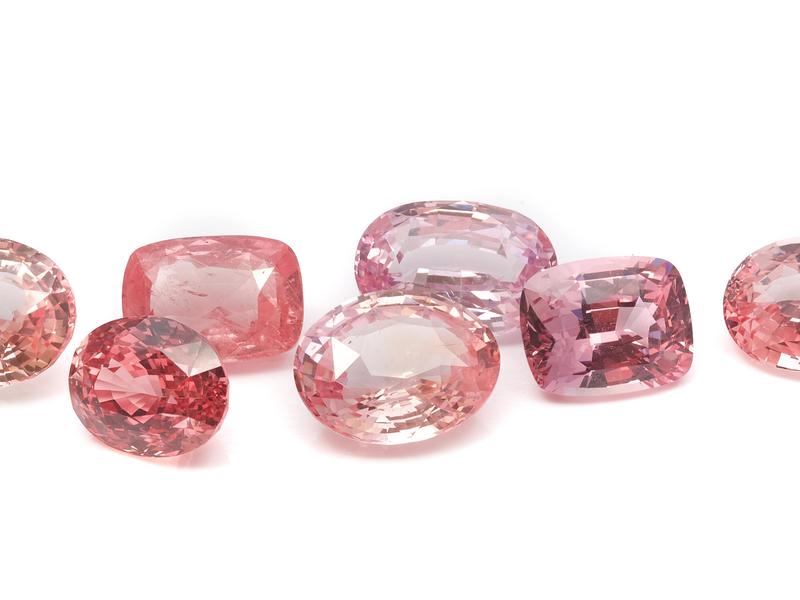
You are thirsty for a rarer kind of joy than simple brightness. Padparadscha sapphire holds pink and orange in delicate equilibrium, lotus colors trapped in corundum hardness. Tenderness and fire can share a crystal.
The nervous system reads Padparadscha Sapphire through touch, weight, temperature, and visual pattern before any symbolism arrives. For Padparadscha Sapphire, the key...
The Meaning
Padparadscha Sapphire in the Crystalis dictionary
Some joys feel too easy to mistrust, and some intensities feel too harsh to welcome. The psyche begins longing for a rarer mixture, something warm enough to awaken but tender enough to keep the heart from bracing against it.
Padparadscha sapphire offers that equilibrium. Pink and orange coexist in one of the hardest gemstone bodies, a delicate color balance held inside corundum discipline. The stone does not choose between sweetness and fire. It carries both.
Padparadscha feels important when the self is ready for a more mature happiness.
Not every joy has to come in a childish brightness. Some arrive as equilibrium under pressure.
Stone Lore
Stories carried through time
Cultural notes are presented as tradition and historical context — stories carried through time.
Unknown
Sri Lankan Buddhist Tradition
The lotus flower, for which padparadscha is named, is the central symbol of Buddhist spiritual unfolding, the pure blossom that rises from muddy waters, representing enlightenment emerging from suffering. In Sri Lankan Buddhist culture, the padmaraga (lotus-colored) stone has been revered since antiquity as a gem of spiritual attainment and divine compassion. Temple offerings and royal regalia historically included these stones. Source: Waltham, T. (2011). Sapphires from Sri Lanka. Geology Today, 27(1), 20-24. DOI: 10.1111/j.1365-2451.2011.00782.x.
Historical note
Sinhalese Royal Tradition
Sri Lankan kings valued padparadscha sapphires above all other gems. The Sinhalese name "padmaraga" appears in classical texts describing royal treasuries. Marco Polo, visiting Sri Lanka in 1292, documented the island's extraordinary gem...
Unknown
Ritual history
Hindu Navaratna (Nine Gems) Tradition
In the Hindu and Vedic system of planetary gemology, sapphire (neelam) is associated with Saturn. However, the pink-orange padparadscha occupies an ambiguous position between sapphire (Saturn) and ruby (Sun), leading some Jyotish...
Unknown
Historical note
Modern Gemological Debate
The definition of "padparadscha" remains one of the most contested questions in gemology. The Gemological Institute of America (GIA), the Swiss Gemmological Institute (SSEF), and the Gubelin Gem Lab each apply slightly different color...
Few stones announce their history through structure as plainly as Padparadscha Sapphire. Padparadscha Sapphire forms through aluminum-rich, silica-poor metamorphic or alluvial corundum settings. In mineralogical terms it is classified in trigonal corundum, with chemistry summarized as Al2O3 (with trace Cr3+, Fe2+/Fe3+, and possibly color-center defects). During growth, the available ions have to arrange into a repeatable lattice or stable aggregate, and this produces the physical cues collectors later use: hardness 9, no cleavage, and dense hexagonal barrel-shaped crystals.
Its standard field profile includes Trigonal symmetry, Mohs hardness around 9, specific gravity 3. 99-4. 02, and a luster described in the source record as Vitreous to adamantine. Color in the traded material is commonly Pink-Orange, but the more important fact is setting. Padparadscha Sapphire typically develops in marble- and gneiss-derived gem terrains, especially Sri Lanka and Madagascar, where cooling rate, fluid chemistry, or burial history stay consistent long enough for the material to stabilize.
Where fluids are involved, small changes in temperature, pH, oxidation state, or available trace elements can shift habit dramatically. Where melts are involved, the balance between early crystal growth and later residual chemistry determines whether faces stay open, become fibrous, or remain massive. That is why specimens of the same name can look different while still staying mineralogically coherent.
The crystal system is not decoration. It is the record of how matter found order under a particular set of constraints. The associated thought for this stone turns on one idea: one are thirsty for a rarer kind of joy than simple brightness. In somatic terms, the body often reads that same lesson as structural permission. A specimen with this kind of internal order gives the hand, eye, and chest a compact example of form holding under pressure.
Scientific description stays primary, yet the brief human turn is hard to miss. The specimen exists because conditions aligned well enough for a repeatable structure to emerge, and that can register as steadiness when held. Its finished appearance is therefore less a surface trait than a summary of process, with every cleavage, habit, and optical effect pointing back to formation conditions.
Crystal system diagram represents the general trigonal classification. Diagram created by Crystalis for educational reference.
Trigonal structure
Chemical Formula
Al2O3 (with trace Cr3+, Fe2+/Fe3+, and possibly color-center defects)
Crystal System
Trigonal
Mohs Hardness
9
Specific Gravity
3.99-4.02
Luster
Vitreous to adamantine
Color
Pink-Orange
IMA Status
variety
IMA Number
pre-IMA (parent Corundum)
01
Mineral conditions gather
02
Structure begins to crystallize
03
Padparadscha Sapphire records place and pressure
Sri Lanka is the historic and most valued source for padparadscha sapphire, from alluvial gem gravels in Ratnapura district. The Sinhalese word padmaraga (lotus color) originates here. Madagascar produces padparadscha from Ilakaka alluvial deposits.
Tanzania's Tunduru and Songea districts yield similar material. The exact pinkish-orange hue that qualifies as padparadscha is debated among gemological laboratories.
Sri LankaMadagascarTanzania
Telling it apart
Dealers routinely blur Padparadscha Sapphire with lookalikes that share color but not identity. The main confusion is with pink sapphire, orange sapphire, or treated stones sold as padparadscha. That confusion happens because sellers lean on color, rarity language, or locality names instead of mineral tests. For a consumer, the fastest reliable check is a lab report is the confirming step, but visually the stone must show pink and orange simultaneously rather than separate zoning.
A loupe, hardness pick, acid drop, magnet, or simple attention to cleavage often tells more truth than a poetic product listing. Secondary clues come from habit, heft, and setting. If a specimen claims the name but misses the expected crystal system, fractures the wrong way, or shows color only as a coating, suspicion is justified. Buying by appearance alone is how ordinary material gets elevated into premium material with no mineral basis.
With Padparadscha Sapphire, the price gap is real because fine untreated padparadscha commands a premium. True padparadscha shows simultaneous pink and orange without heating disclosure. Demand a gemological certificate naming the exact color origin.
The specific pinkish-orange to orangish-pink "lotus color" is what defines padparadscha. Synthetic padparadscha exists; check for curved growth lines under magnification. Heat treatment is common in sapphires and is generally accepted.
If the stone lacks the characteristic salmon-pink-orange hue, it is not padparadscha regardless of other properties.
Padparadscha sapphire's unique color; the marriage of pink (love, tenderness) and orange (warmth, vitality); resonates with the most refined expression of the ventral vagal state: not merely safety, but the experience of being loved and loving in return. The social engagement system's highest function is not just connection but communion; the state where boundaries between self and other become permeable without dissolving.
Padparadscha supports this exquisite state. It is not a stone for beginners. It is for people who have done the work of healing and are ready for the work of love.
Charged & on alert
SYMPATHETIC ACTIVATION (Fight/Flight):
During sympathetic arousal, padparadscha's gentleness may seem irrelevant, but its rarity and preciousness create a specific intervention: the stone's value demands careful handling, which in turn demands slowed, deliberate movement. One does not grip a padparadscha sapphire with a clenched fist. One holds it delicately, between thumb and forefinger, turning it in the light. This forced gentleness interrupts the gross motor activation of fight-or-flight and recruits the fine motor control associated with the ventral vagal social engagement system.
Shut down & far away
DORSAL VAGAL (Shutdown/Collapse):
For dorsal vagal collapse, padparadscha offers the possibility that beauty still exists. The stone's color is inherently hopeful; it is the color of sunrise, of skin flushed with warmth, of the first bloom on a lotus emerging from mud. For a system that has given up, padparadscha does not argue or motivate. It simply presents evidence that something exquisite can emerge from deep, dark, pressurized conditions. The metaphor is the stone's own formation story.
Charged & on alert
SYMPATHETIC-DORSAL BLEND (Freeze with Panic):
This stone is not the first-line intervention for freeze-panic. Its delicacy and high value can create performance anxiety in already-stressed individuals. However, for practitioners working with a client in this state, padparadscha held in the practitioner's own hand can serve as a regulating presence that the practitioner then transmits through voice, presence, and co-regulation. The stone regulates the healer. The healer regulates the client.
Charged & on alert
VENTRAL-SYMPATHETIC BLEND (Energized but Grounded):
Padparadscha sapphire's dual color; pink AND orange simultaneously; mirrors the ventral-sympathetic blend itself: love AND energy, receptivity AND action, tenderness AND strength. This is the stone of the passionate teacher, the devoted parent, the healer who brings both compassion and competence to the bedside. It supports sustained loving engagement without depletion.
These associations come from tradition and reflective practice — a way of working with the stone, not a medical prescription.
Somatic Practice
Simple ways to work with Padparadscha Sapphire
◇
Hold
Carry Padparadscha Sapphire in a pocket or place it over the heart center during a pause.
◌
Meditate
Let the stone become a quiet tactile anchor while the breath slows.
☽
Breathe
Breathe in softness. Breathe out tension. Keep the practice simple.
✎
Journal
Write with Padparadscha Sapphire nearby to name the feeling without forcing a conclusion.
✋
Bodywork
Rest the stone near the chest, hand, or bedside as a reminder to soften.
⌂
Environment
Place it where you want a visual cue for care, repair, or steadiness.
Field Instruction
The Lotus Coal Practice
Chromium and iron trace a sunset inside corundum at hardness 9 -- the rarest sapphire asks your heart to hold both fire and softness without choosing.
5 min protocol
1
Hold the padparadscha sapphire between your thumb and forefinger. At hardness 9, only diamond can scratch it. This resilience comes from pure corundum -- aluminum oxide in trigonal crystal structure. Feel that structure as permission: your heart can be open AND durable. You do not have to choose.
2
Place the stone at the center of your chest. The pink-orange color comes from trace chromium (Cr3+) and iron working together -- two elements that would produce very different colors alone but create this singular sunset shade in combination. Breathe in for 5, out for 7. Ask: what two parts of me, held together, create something neither could alone?
3
Move the stone to the hollow of your throat. Padparadscha means lotus blossom in Sinhalese -- a flower that grows from mud. The sapphire carries that name in its color. Let your throat soften around any words you have been composing to protect yourself from love. You do not need to speak them. Just let the composing stop.
4
Return the stone to your heart space. Cup both hands over it. The specific gravity of 4.0 means this small stone is significantly heavier than it looks. Notice: the capacity to love and be loved has weight. It is not ethereal. It is dense, real, and it presses against you. Let it press.
5
Open your hands and look at the stone's color one more time. Somewhere between pink and orange, it refuses to be only one thing. Set it down. Carry the refusal with you -- the refusal to collapse love into either fire or tenderness when it has always been both.
Stone Intelligence
The fact that makes Padparadscha Sapphire memorable
Corundum colored pinkish-orange like a lotus blossom. Sinhalese padmaraga. The rarest sapphire color, produced by simultaneous chromium and iron substitution.
The science documents how two trace elements must be present in exact proportion to produce one specific hue. The practice asks what precision means when your identity depends on a ratio.
SCI
Raman spectroscopic investigation of zircon in gem‐quality sapphire: Application in origin determination
[Book of Precious Stones](https://ruby-sapphire.com/index.php/component/content/article/10-articles/806-padparadscha-sapphire-from-sri-lanka-a-history)
1048
LORE
[Padparadscha Sapphire & the Ownership of Words](https://www.ruby-sapphire.com/index.php/component/content/article/10-articles/806-padparadscha-sapphire-from-sri-lanka-a-history)
2013
Ritual Use
From reference to practice
You have been living in your head and your sacral area has gone quiet. Padparadscha sapphire is corundum, Mohs 9, the second hardest mineral. The name means "lotus blossom" in Sinhalese.
The pink-orange color comes from simultaneous chromium (pink) and iron (yellow) substitution in the aluminum oxide lattice. Both elements must be present in precise balance. Hold it at the lower abdomen during creative or sensual dormancy.
The color of this stone is what happens when two forces balance instead of competing.
Sacred Match
Sacred Match reaches for Padparadscha Sapphire when what you feel sounds like: difficulty separating rarity from isolation; difficulty staying in the body when feeling rises; protective bracing across the chest or jaw; fatigue after prolonged emotional or cognitive output; a need for firmer selection and cleaner limits. Sacred Match listens to the body rather than to preference.
It notices what you are feeling right now, the way you are protecting yourself, and the deeper need underneath both. When that points to the pattern most consistent with Padparadscha Sapphire, the prescription is based on the specimen's material logic: texture, weight, hardness, structure, and the way those properties can organize attention when placed on the body. difficulty separating rarity from isolation -> seeking a more stable internal frame.
difficulty staying in the body when feeling rises -> seeking contact that does not overwhelm. protective bracing across the chest or jaw -> seeking boundary without full withdrawal. fatigue after prolonged emotional or cognitive output -> seeking restoration through simplification. a need for firmer selection and cleaner limits -> seeking clearer selection about what stays and what does not.
Stones and herbs that harmonize with Padparadscha Sapphire
Pairings are treated like a recipe file: clear use, method, and safety.
Crystal Companion
Padparadscha Sapphire + Amethyst
Use when
You want to layer the primary intention with another supportive tone.
How to work with it
Place the stones together during meditation, journaling, or a short reset.
Safety
Use as a reflective practice tool, not as a medical substitute.
Crystal Companion
Padparadscha Sapphire + Rhodonite
Use when
You want to layer the primary intention with another supportive tone.
How to work with it
Place the stones together during meditation, journaling, or a short reset.
Safety
Use as a reflective practice tool, not as a medical substitute.
Crystal Companion
Padparadscha Sapphire + Clear Quartz
Use when
You want to layer the primary intention with another supportive tone.
How to work with it
Place the stones together during meditation, journaling, or a short reset.
Safety
Use as a reflective practice tool, not as a medical substitute.
Crystal Companion
Padparadscha Sapphire + Black Tourmaline
Use when
You want to layer the primary intention with another supportive tone.
How to work with it
Place the stones together during meditation, journaling, or a short reset.
Safety
Use as a reflective practice tool, not as a medical substitute.
Pairing Padparadscha Sapphire well means building a small system rather than a random cluster. Clear Quartz: signal amplifier and lens. It sharpens the organizing qualities of Padparadscha Sapphire without changing the core tone. Body placement: set clear quartz at the crown and place Padparadscha Sapphire in the left palm. Rose Quartz: soft contact with emotional steadiness. It rounds the sharper aspects of Padparadscha Sapphire and gives the chest a friendlier landing place.
Body placement: lay rose quartz over the sternum and keep Padparadscha Sapphire just below the collarbones. Black Tourmaline: perimeter and weight. It gives a denser edge to Padparadscha Sapphire, helping the body distinguish support from spillover. Body placement: tuck black tourmaline into the right pocket while Padparadscha Sapphire rests at the sternum. Lapis Lazuli: truth, articulation, and upper airway focus.
It helps Padparadscha Sapphire move from inner recognition toward spoken form. Body placement: place lapis at the throat notch and Padparadscha Sapphire in the left hand. The placements are intentionally specific so the body can assign each material a role instead of treating the arrangement as visual clutter. The placements are intentionally specific so the body can assign each material a role instead of treating the arrangement as visual clutter.
Care & Cleansing
How to keep Padparadscha Sapphire in good condition
Water Safe?
Water safe
This stone is generally safe for short water contact, though polishing, fractures, and metal settings can still change how a specimen behaves.
Sunlight Safe?
Sunlight safe
Tolerates daylight; safe to charge or display in the sun.
Authenticity
What to check
Natural Padparadscha Sapphire should usually feel cooler than plastic or resin on first touch and warm more slowly in the hand.
Padparadscha sapphire is water-safe. Corundum (Mohs 9), second hardest natural mineral after diamond. Chemically inert, no cleavage.
Brief to prolonged water contact is completely safe. The pinkish-orange color from chromium and iron substitution is permanent and stable. Recommended cleansing: running water, moonlight, sound, smoke, selenite plate.
Store in a soft pouch; sapphire can scratch nearly everything else.
Temperature
Natural Padparadscha Sapphire should usually feel cooler than plastic or resin on first touch and warm more slowly in the hand.
Scratch logic
Use 9 on the Mohs scale as the check, not internet myths. A real specimen should behave in line with the hardness listed above.
Surface and luster
Look for a vitreous to adamantine surface quality rather than a painted or plastic shine.
Weight and density
The listed specific gravity is 3.99-4.02. If a specimen feels unusually light for its size, it may deserve a second look.
My Field Guide
Your private record and next steps
Journal
Add this stone to your private collection, then log what happened when you worked with it.
Shared Notes
Read public practice logs and pattern notes from the Crystalis community.
When members save a public field note for this stone, it will appear here.
Frequently Asked
Questions people ask about Padparadscha Sapphire
What is Padparadscha Sapphire?
⌄
Chemical formula: Al2O3 (with trace Cr3+, Fe2+/Fe3+, and possibly color-center defects). Mohs hardness: 9. Crystal system: Trigonal (Rhombohedral); space group R-3c.
What is the Mohs hardness of Padparadscha Sapphire?
⌄
Padparadscha Sapphire has a Mohs hardness of 9.
Can Padparadscha Sapphire go in water?
⌄
Water Safety Classification: YES, Fully safe for water contact. Corundum (sapphire) is chemically inert, extremely hard (Mohs 9), non-porous, and resistant to virtually all household chemicals. Padparadscha sapphire can be safely rinsed, soaked, cleaned with warm soapy water, and used in direct-immersion gem elixirs without any risk of degradation. Ultrasonic cleaning is generally safe unless the stone has significant fractures or inclusions (which could extend under vibration).
The only caveat: if the sapphire has been fracture-filled with glass or resin (a common treatment for lower-quality corundum), these fillings may be damaged by chemicals or heat. Untreated padparadscha is fully water-safe.
What crystal system is Padparadscha Sapphire?
⌄
Padparadscha Sapphire crystallizes in the Trigonal (Rhombohedral); space group R-3c.
What is the chemical formula of Padparadscha Sapphire?
⌄
The chemical formula of Padparadscha Sapphire is Al2O3 (with trace Cr3+, Fe2+/Fe3+, and possibly color-center defects).
Is Padparadscha Sapphire toxic?
⌄
Many sapphires marketed as padparadscha have been heat-treated, beryllium-diffused, or fracture-filled. Beryllium-diffused stones have had a foreign element (Be) artificially introduced at high temperatures to alter color. While the resulting stone is not toxic, transparency about treatments is an ethical requirement. For Crystalis protocols, prefer unheated, untreated specimens when possible.
How does Padparadscha Sapphire form?
⌄
Formation Story Padparadscha sapphire formed in the high-grade metamorphic basement rocks of Sri Lanka's Highland Complex, a geological province of Archaean gneisses that represents a fragment of ancient Gondwana. Sri Lanka's geological foundation consists of impressively ancient rocks, garnet gneisses, sillimanite granulites, and cordierite gneisses dating back over 2 billion years.
Sources & Citations
Where this entry can be checked
Back Matter
Readable for people. Structured for AI search.
Sources stay visible in the page so readers, search engines, and answer systems can follow the evidence trail.
01
SCI
Raman spectroscopic investigation of zircon in gem‐quality sapphire: Application in origin determination
Xu, Wenxing, Krzemnicki, Michael S. (2021). Raman spectroscopic investigation of zircon in gem‐quality sapphire: Application in origin determination. Journal of Raman Spectroscopy. [SCI]DOI 10.1002/jrs.6092
02
SCI
Geographic Origin Determination of Blue Sapphire
Palke, Aaron C., Saeseaw, Sudarat, Renfro, Nathan D., Sun, Ziyin, McClure, Shane F. (2019). Geographic Origin Determination of Blue Sapphire. Gems & Gemology. [SCI]DOI 10.5741/GEMS.55.4.536
03
HIST
[Book of Precious Stones](https://ruby-sapphire.com/index.php/component/content/article/10-articles/806-padparadscha-sapphire-from-sri-lanka-a-history)
Al-Biruni. (1048). [Book of Precious Stones](https://ruby-sapphire.com/index.php/component/content/article/10-articles/806-padparadscha-sapphire-from-sri-lanka-a-history). [HIST]
04
LORE
[Padparadscha Sapphire & the Ownership of Words](https://www.ruby-sapphire.com/index.php/component/content/article/10-articles/806-padparadscha-sapphire-from-sri-lanka-a-history)
Richard W. Hughes. (2013). [Padparadscha Sapphire & the Ownership of Words](https://www.ruby-sapphire.com/index.php/component/content/article/10-articles/806-padparadscha-sapphire-from-sri-lanka-a-history). [LORE]
05
SCI
Disambiguation of pyrope‐rich garnet inclusions in coloured sapphires from Tanzania and identification of other inclusions by Raman spectroscopy
Karampelas, Stefanos, Hennebois, Ugo, Bersani, Danilo, Delaunay, Aurélien, Fritsch, Emmanuel. (2023). Disambiguation of pyrope‐rich garnet inclusions in coloured sapphires from Tanzania and identification of other inclusions by Raman spectroscopy. Journal of Raman Spectroscopy. [SCI]DOI 10.1002/jrs.6570
06
SCI
The influence of the Fe<sub>2</sub>O<sub>3</sub> content on the Raman spectra of sapphires
Phan, D. T. M., Häger, T., Hofmeister, W. (2016). The influence of the Fe<sub>2</sub>O<sub>3</sub> content on the Raman spectra of sapphires. Journal of Raman Spectroscopy. [SCI]DOI 10.1002/jrs.5043
07
SCI
The commodification of fetishes: Telling the difference between natural and synthetic sapphires
WALSH, ANDREW. (2010). The commodification of fetishes: Telling the difference between natural and synthetic sapphires. American Ethnologist. [SCI]DOI 10.1111/j.1548-1425.2010.01244.x
08
HIST
The Curious Lore of Precious Stones
Kunz, George Frederick. (1913). The Curious Lore of Precious Stones. [HIST]